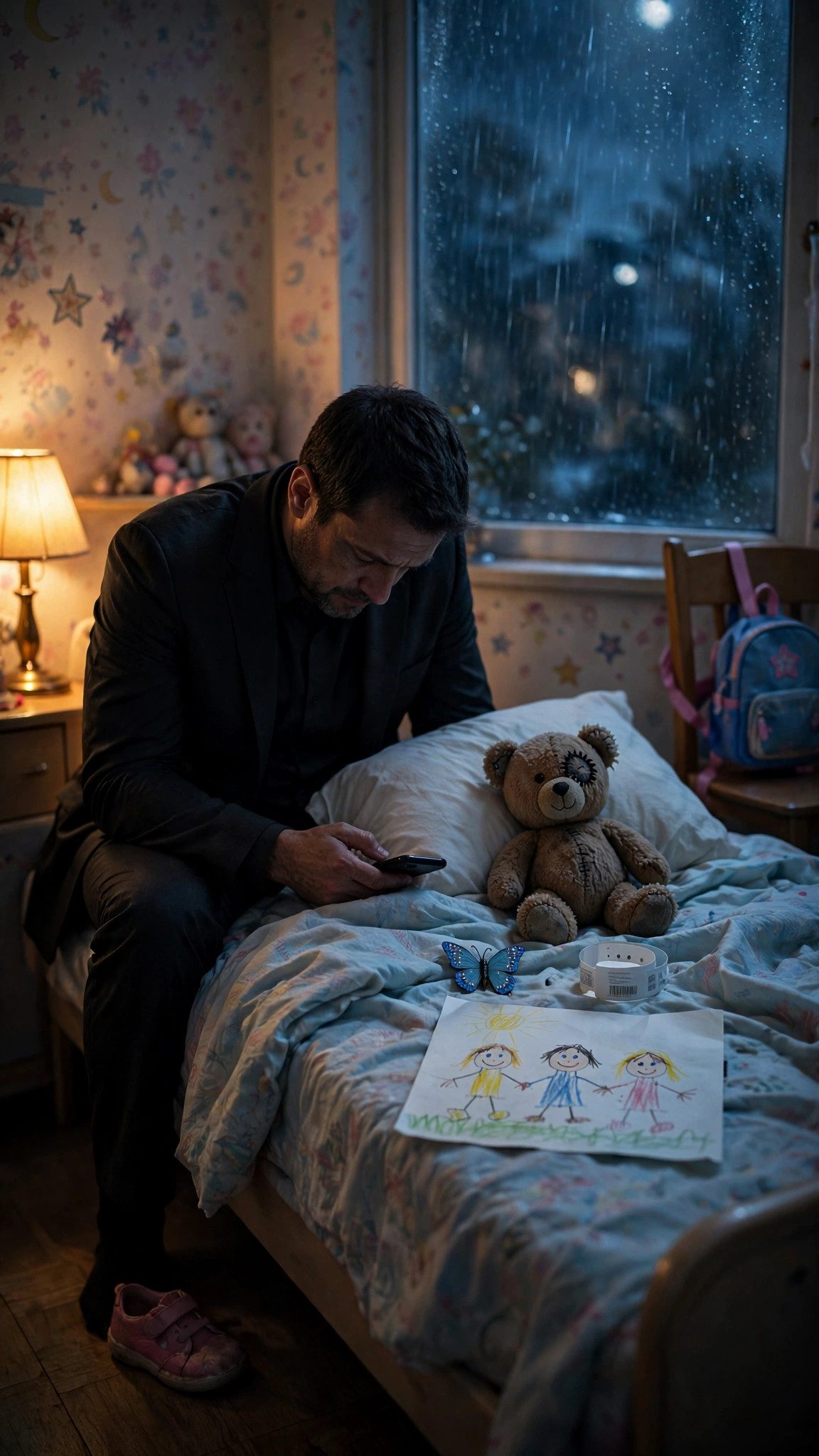
It took Damian Moreland three days to find his wife.
He did not use his men. He did not use his contacts, or his money, or the network of people who owed him favors across the city. He did it the way an ordinary man would do it: he called her mother, and he called her sister, and he asked, politely, if they had seen her, and he listened to the silence on the other end of the line, and he understood that they knew exactly where she was, and that they were deciding whether he deserved to know.
Sarah answered on the third call. Her voice was cold.
"She doesn't want to see you, Damian."
"I know," he said. "I just want to talk to her. Five minutes. That's all I'm asking."
"Five minutes," Sarah said. "That's how long it took you to answer her calls when your daughter was dying."
He flinched. He deserved it. "Please," he said. "Sarah, please."
There was a long silence. Then Sarah said, "Evanston. My house. Tomorrow, ten o'clock. You come alone. No drivers, no guards, no men. If anyone else comes with you, I will call the police."
He agreed. He drove himself to Evanston the next morning in his own car, a thing he had not done in years, and he sat outside Sarah's house for twenty minutes before he got out, because he did not know what he was going to say, and because he was afraid. Damian Moreland, the most feared man in Chicago, was afraid of a conversation with his wife in a small house in Evanston.
Claire opened the door herself. She was wearing a gray sweater and jeans, and her hair was pulled back, and her face was pale and thin, and she looked at him the way you look at a stranger on the street, with no recognition at all. Then she stepped aside and let him in, and she led him to the kitchen, and she put a kettle on the stove, and she did not offer him anything, and she did not sit down.
"Why are you here?" she said.
"To tell you the truth," he said. "All of it. And to hear the truth from you. All of it."
She laughed, a short, bitter sound. "The truth? The truth is that our daughter is dead, Damian. The truth is that she asked for you seven times while she was dying, and you were on a yacht in Monaco with your mistress. What more truth is there?"
"Seven times," he said quietly. "I heard the recording. I heard one of them. What were the other six?"
She stared at him. For a moment, he thought she was going to refuse. Then she pulled out a chair and sat down, and she looked at her hands, and she began to count.
"The first time was in the car, right after the truck hit us. She was bleeding, and she was frightened, and she said, 'Where's Daddy?'"
Damian closed his eyes.
"The second time was in the emergency room. 'Is Daddy coming?'"
He gripped the edge of the table.
"The third time was twenty minutes later. 'Where's Daddy, Mommy?'"
His knuckles went white.
"The fourth time was when they told me she needed surgery. 'Does Daddy know I'm hurt?'"
He could not breathe.
"The fifth time was right after that. 'Then why is he taking so long?'"
He put his head in his hands.
"The sixth time was just before they took her away. 'Daddy still loves me the most, right?'"
He made a sound then, a sound he did not recognize as his own, a sound like something tearing.
"And the seventh time," Claire said, and her voice broke, "the seventh time was after she died. Or maybe it was just before. I don't know. I leaned close to her ear, and I told her you were coming, and her lips moved, and I thought I heard her say, 'Tell Daddy I waited.'"
She stopped. The kettle whistled. Neither of them moved to take it off the stove.
"Seven times," Damian whispered. "She asked for me seven times, and I heard one."
"Yes," Claire said. "One. And you only heard that one because I left my phone on her bed for you. If I hadn't, you would have heard none of them. You would have gone on believing whatever story you told yourself about that day."
He looked up at her. His face was wet. He did not bother to wipe it.
"I didn't just miss the calls, Claire," he said. "Sabrina hid my phone. She saw your name on the screen, and she turned the phone face down, and she said nothing. She let me sleep while our daughter was dying."
Claire stared at him for a long moment. Then she said, very quietly, "Do you think that makes it better?"
"No," he said. "It makes it worse. Because I chose her. I chose a woman who would do that. I chose Monaco over my family. I chose the empire over my daughter. And I did it long before the accident. I did it the day I decided that my work mattered more than coming home for dinner. I did it the day I missed Lily's birthday. I did it every day for two years, and the accident only showed me what I had already done."
Claire stood up. She walked to the window and looked out at Sarah's small garden, where the first snow had settled on the bare branches of the maple tree.
"There is something else you should know," she said, without turning around. "About Sabrina."
"What about her?"
"She wasn't just your mistress, Damian. She was working for Castellano."
He went very still. Vincent Castellano was his oldest rival, the man who had wanted the docks and the shipping routes for twenty years, the man who had tried to kill him twice. "How do you know?"
"Because after you left for Monaco, she called someone from your office phone, and Rosa overheard her," Claire said. "Rosa didn't tell me until yesterday, because she was afraid. Sabrina told Castellano that you would be in Monaco for a week, that your guards would be thin, that the docks would be unprotected. Castellano was going to move on the freight routes while you were gone. She sold your schedule to him. She sold all of it. Your mistress was a spy, Damian. She was using you, and you were too blind to see it, because she told you what you wanted to hear."
Damian stood up slowly. He felt the old coldness settle over him, the coldness that had made him the most feared man in Chicago, the coldness he had tried to bury under lilies and birthday parties and promises. But this time, the coldness was not for revenge. It was for clarity.
"Did Rosa hear anything else?" he asked.
"She heard Sabrina say that Castellano had a man inside your organization," Claire said. "Someone close to you. Someone who has been feeding him information for months."
"Who?"
"She didn't hear a name. But she heard Sabrina say the words 'the docks' and 'Tuesday' and 'the vote.'"
Damian nodded. The zoning vote. The waterfront parcel. Castellano had wanted it for years, and Damian had blocked him, and now, with Damian in Monaco and his daughter dying, Castellano had been ready to move. He thought about the truck on Lake Shore Drive, skidding across the road in the rain. He thought about the timing. And then he stopped himself, because he knew where that thought led, and he knew it was a road he could not walk down without proof.
"The accident was an accident," Claire said, as if she had read his mind. "The police investigated. The driver fell asleep at the wheel. He was coming off a double shift. There was no one else involved. I know, because I asked. I needed to know. And it was an accident, Damian. A terrible, ordinary accident. Our daughter died because a tired man fell asleep, and because the rain was bad, and because the world is cruel sometimes for no reason at all. Not because of Castellano. Not because of the empire. Just because."
He nodded. He believed her. And in a strange way, it was worse. If Castellano had caused it, there would have been someone to blame, someone to punish, someone to destroy. But an accident has no one to blame. An accident just is. And the only thing he could blame was himself, for not being there.
"What do you want from me?" he asked her.
She turned around. Her eyes were dry now. She had cried all her tears, and what was left was something harder and quieter.
"I want you to listen to the recording again," she said. "All of it. Every day. Until you understand what it cost her. And I want you to do something with the rest of your life that would make her proud. Not the empire. Not the money. Something real. And I want you to leave me alone until you have done it. Because right now, Damian, when I look at you, I see the man who wasn't there. And I can't live with that man. Not yet. Maybe not ever."
He nodded. He understood. He had come to Evanston hoping for forgiveness, and he was leaving with something else: a task. A purpose. The first honest purpose he had had in years.
"I'll do it," he said. "I don't know how yet. But I'll do it."
He turned to go. At the door, he stopped.
"Claire," he said. "Thank you for counting. Thank you for telling me all seven."
She did not answer. She stood at the window, watching the snow fall on the maple tree, and she did not turn around. And Damian walked out of the house, and he drove back to Chicago alone, and he started to make a list in his head: the names of the men who had fed Castellano, the accounts that needed to be closed, the businesses that needed to be sold, the evidence that needed to be gathered. And at the top of the list, in his own mind, he wrote a single sentence, the sentence that would drive everything he did from that day forward:
Seven times. She asked for me seven times. And I will spend the rest of my life making sure that the next time a child asks for her father, her father is there.
The drive back to Chicago took an hour, and Damian spent it in silence, with the radio off and the heater on, watching the lake slide past on his left, gray and endless. He thought about the list he was making in his head, and he thought about the names on it, and he thought about the one name he had not yet found: the man inside his organization who had been feeding Castellano information for months.
He found him the next morning. It was not difficult, once he knew what to look for. He went to his office before dawn, and he pulled the phone records for the past six months, and he looked for the pattern: calls to numbers that did not belong to anyone in the family, calls made late at night, calls that lasted less than a minute. There were dozens of them, all from the same phone, all to a burner number that the FBI would later trace to a warehouse Castellano owned on the South Side.
The phone belonged to Marcus Hale, his head of security. Nine years loyal. The man who had stood outside his daughter's hospital room the night she was born, guarding the door. The man who had taught Lily to ride a bicycle. The man who had sold Damian's schedule, his routes, his dock plans, to Vincent Castellano for fifty thousand dollars a month.
Damian did not confront him in the office. He did not call his enforcers. He did something he had never done before in his life: he called the FBI.
Agent Daniel Reyes had been building a case against Castellano for three years, and he had been waiting for a witness on the inside, someone with access to the ledgers and the schedules and the money trail. Damian gave him everything. The phone records. The bank statements. The shipping manifests with the false entries. The names of the shell companies. The account numbers in the Caymans. He gave it all, and he asked for nothing in return except one thing: that the case be built properly, and that it be built to last, so that Castellano would never walk free again.
"Why are you doing this?" Reyes asked him, in the small conference room at the federal building, with a tape recorder on the table between them.
"Because my daughter asked for me seven times," Damian said, "and I wasn't there. And I am going to spend the rest of my life making sure that no other child has to ask for a father who is too busy counting his money to come home."
Reyes looked at him for a long moment. Then he nodded, and he turned off the tape recorder, and he said, "Mr. Moreland, I have been doing this job for fifteen years, and I have never heard a better reason."
Marcus Hale was arrested two weeks later, at dawn, in his own kitchen, with his wife screaming and his children crying in the hallway. He did not resist. He looked at the agents, and he looked at Damian, who was standing in the doorway, and he said, "I'm sorry, boss. They had my daughter. Castellano said if I didn't cooperate, something would happen to her."
Damian believed him. He also knew it did not matter. Marcus had sold the family for fifty thousand dollars a month, and he had put a little girl's father on a yacht in Monaco while his own daughter slept safely at home. There was no excuse that could make that right. Marcus testified, and he got eight years, and his daughter was placed in protective custody, and Damian paid for her schooling, quietly, through a trust, because whatever Marcus had done, his daughter was innocent, and Damian Moreland had learned, too late, what it meant to protect a child.
Sabrina was arrested a month later, in Paris, trying to board a flight to Dubai. She testified, too. She told the jury everything: the calls, the schedules, the money, the way Castellano had recruited her at a charity gala two years earlier, promising her a life of luxury if she would only keep Damian distracted. She got eight years for testifying. She cried on the stand, and Damian watched her, and he felt nothing. Not anger. Not pity. Nothing. She was a stranger to him now, a woman he had once believed he loved, and he could not remember why.
That was how the empire began to fall. Not with gunfire. Not with a war in the streets. With paper. With records. With a man who had lost his daughter and decided that the only thing left to do was to tell the truth, all of it, and let the law do what the law was made to do.