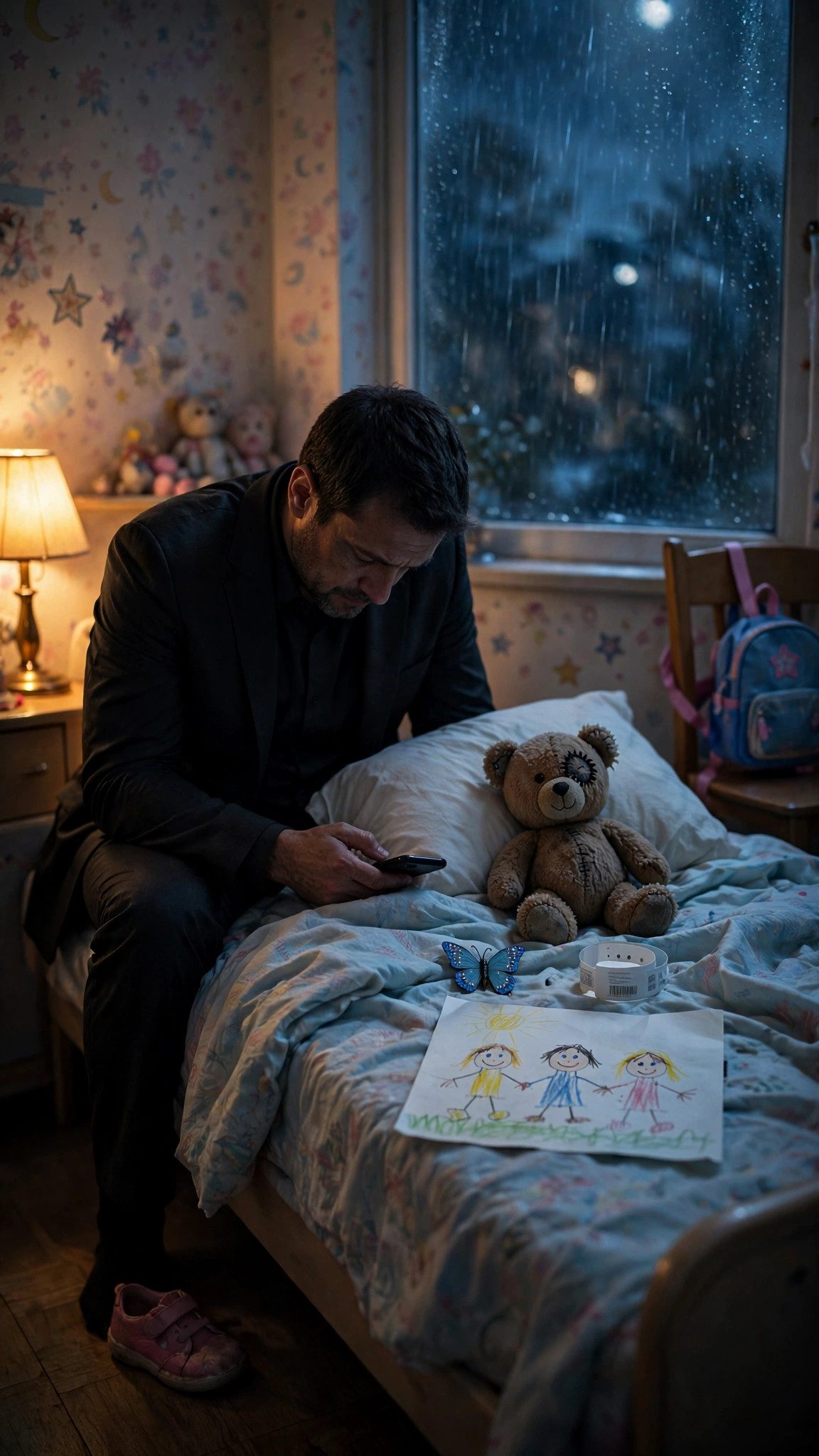
Claire said yes in June.
She came to the mansion on a warm afternoon, six months after Lily died, and she stood in the front hall where Damian had once stood with his suitcase, and she looked around at the house she had left, and she said, "I'll run the foundation. But I have conditions."
"Anything," Damian said.
"I work from Evanston, not from here. Not yet. The foundation's office will be at the hospital, not in your house. You don't attend the board meetings unless I invite you. And you don't call me, Damian. Not unless it's about Lily. Not unless it's about the work."
"All right," he said.
"And one more thing," she said. "You don't get to buy your way back. Not with money. Not with foundations. Not with hospital wings. If you want to be in my life again, you have to earn it. The way ordinary people earn it. By showing up. By being there. By staying."
"I understand," he said.
She nodded, and she turned to go, and at the door she stopped, and she said, without looking back, "She would have liked the foundation, you know. Lily. She always wanted to help people. When she was four, she tried to bandage her teddy bear's eye. She said the bear needed a doctor. She would have liked knowing that her name is on a hospital."
Then she was gone, and Damian stood in the front hall, and he felt something he had not felt in six months: hope. Not happiness. Not yet. But hope, thin and fragile as a seedling, pushing up through the dark.
The foundation opened in September. The office was a small suite on the third floor of St. Margaret's Hospital, with windows that looked out over the garden and a sign on the door that read LILY MORELAND FOUNDATION in plain black letters. Claire ran it the way she had once run a trauma bay: calmly, efficiently, with no patience for nonsense and infinite patience for people who were hurting. She hired nurses. She hired social workers. She built a program that put a family advocate beside every parent whose child came into the emergency room after a car accident, someone to sit with them, to explain what was happening, to hold their hand, so that no mother would ever have to sit alone in a hallway staring at a clock the way she had.
Damian kept his word. He did not attend the board meetings unless Claire invited him. He did not call her unless it was about the work. He sent the money, and he stayed away, and he waited, the way Lily had waited, patiently, trusting that the person he loved would come back when she was ready.
He spent his days differently now. He went to the office downtown, the small one he had kept, and he worked on the legitimate businesses, the ones he had not sold, and he went to therapy twice a week, and he volunteered at the hospital, carrying boxes and fixing shelves, the way he had once built a bookshelf for a children's ward because Claire had mentioned, in passing, that the old one was falling apart. The nurses did not know who he was at first. They just knew him as the quiet man in the work gloves who showed up on Tuesdays and never asked for anything. And that suited him. He had spent twenty years being the most feared man in Chicago. He was learning how to be an ordinary man, and it was the hardest thing he had ever done.
In October, on the first anniversary of the accident, Claire called him. It was the first time she had called him since the night in the hospital, and when he saw her name on the screen, his hands shook.
"Can you come to Evanston?" she said. "Sarah's house. Six o'clock. Don't bring anything. Just come."
He came. He drove himself, the way he had learned to do, and he knocked on Sarah's door, and Sarah opened it, and she looked at him, and for the first time, she smiled at him. Not a warm smile. But a smile.
"She's in the garden," Sarah said.
Claire was sitting on the bench under the maple tree, the same bench where she had sat with her sketchbook in the spring. The tree was bare now, its branches black against the gray sky, and the first snow of the season was starting to fall, thin white flakes drifting down through the dark. She had a mug of tea in her hands, and she was looking up at the sky, and when she heard him, she turned, and she said, "Sit down, Damian."
He sat down beside her. They did not touch. They watched the snow fall.
"I've been thinking," Claire said, "about the seven times. About how Lily asked for you seven times, and how I lied to her seven times, and how the last thing she said was, 'Tell Daddy I waited.'"
"I think about it every day," Damian said.
"I know," she said. "And I've been thinking about something else. About the eighth time."
"The eighth time?"
"She only asked seven times," Claire said. "But there is an eighth time. And it belongs to me."
She turned to look at him, and her eyes were clear, and her voice was steady.
"The eighth time," she said, "is me asking you to come home. Not to the mansion. Not to the empire. Home. To me. To us. To whatever is left of us. I'm asking you, Damian. I'm asking you to come home, and to stay, and to be the man Lily believed you were. The man who fixes things. The man who shows up. The man who is there."
He stared at her. He could not speak. The snow fell on his shoulders, and on her hair, and on the bench between them, and the world went quiet, the way it had gone quiet in the car after the accident, except this time the silence was not terrible. This time the silence was full.
"Yes," he said finally. "Yes. I will come home. I will stay. I will be there. I swear it, Claire. On Lily's name, I swear it."
She nodded. She set her mug down on the bench. And then, very slowly, she took his hand.
It was the first time they had touched in a year.
They sat like that for a long time, holding hands in the snow, under the bare maple tree, while the flakes came down and settled on their coats and their hair, and Sarah watched from the window, and she cried, quietly, because she had not believed this day would ever come.
That was how it began. Not with a grand gesture. Not with diamonds or promises or speeches. With a hand, held in the snow, under a bare tree, on the anniversary of the worst day of their lives.
The months that followed were not easy. There were days when Claire could not look at him without seeing the yacht, and days when Damian could not look at her without seeing the hospital corridor, and days when both of them woke up and reached for Lily in the dark, and found only empty sheets. Grief does not end. It changes shape. It becomes something you carry, instead of something that carries you. And they carried it together, the way they had once carried their daughter, one on each side, holding her up between them.
In the spring, Claire told him she was pregnant.
They were in the garden at the mansion, the garden Damian had built for her years ago, because she had once told him she missed having dirt under her nails. She was kneeling in the soil, planting lilies, white lilies, Lily's flowers, and he was beside her, holding the watering can, and she looked up at him, and she said, very quietly, "Damian. I'm pregnant."
He stared at her. The watering can slipped from his hands and fell into the dirt, and water spilled everywhere, and neither of them moved to pick it up.
"Are you sure?" he whispered.
"Yes," she said. "Twelve weeks. A girl, the doctor thinks. I wanted to wait until I was sure. I wanted to be sure it was real."
He knelt down beside her in the dirt, and he took her hands in his, mud and all, and he said, "Claire. I will be there. Every appointment. Every ultrasound. Every minute. I will be there. I swear it. This time, I will be there."
"I know," she said, and she smiled, and tears ran down her face, and she laughed, a small, shaky laugh. "I know you will. Because you are here now. And you have been here, every day, for a year. And that is how I know."
They named the baby before she was born. They named her Hope, because that was what she was: the hope that had pushed up through the dark, thin and fragile as a seedling, and grown into something that could hold them both. Hope Moreland. A sister for Lily. A second chance. Not a replacement. Never a replacement. Lily would always be their first daughter, their butterfly girl, the one who had loved the moon and the dolphins and the butterflies. Hope would be their second daughter, and she would grow up knowing about her sister, and she would know that her sister had asked for her father seven times, and that her father had learned, too late and just in time, what it meant to be there.
The foundation grew. The pediatric trauma wing at St. Margaret's opened its doors, and in the lobby, on the wall beside the entrance, hung Lily's family drawing, framed in plain wood, under glass. In the drawing, Lily and Claire stood together holding hands, and Damian stood farther away, near the gate. And beside it, Claire hung a second drawing, one she had drawn herself, in the months after she came home: the same three figures, in the same garden, but this time, Damian was standing close, holding Lily's other hand, and all three of them were smiling, and above them, in the sky, Claire had drawn a butterfly, blue and silver, with its wings spread wide.
On the day Hope was born, Damian was in the delivery room, holding Claire's hand, the way he had held it twenty-two hours when Lily was born. And when the nurse placed the baby in his arms, he looked down at her small, perfect face, and he whispered, "Hello, Hope. I'm your daddy. And I'm here. I'm right here. And I'm not going anywhere."
And in the quiet of the hospital room, with the sun coming through the window and Claire smiling from the bed, Damian Moreland thought about the seven times his first daughter had asked for him, and he thought about the eighth time, when his wife had asked him to come home, and he thought about this moment, this ninth time, this small girl in his arms, who had not yet learned to ask for anything, and who would never have to wonder where her daddy was.
Because this time, he was there. This time, he would always be there. And that, in the end, was the whole story: not the empire, not the money, not the yacht in Monaco. Just a father, holding his daughter, in a room full of light, finally, finally home.
One year after Hope was born, the pediatric trauma wing at St. Margaret's opened its doors. There was a small ceremony in the lobby, with white chairs in rows and a ribbon across the entrance, and Claire stood at the podium in a navy dress, with Hope on her hip, and she spoke to the families and the nurses and the doctors gathered there. She did not read from a script. She spoke the way she had once spoken to Lily in the back seat of a car, plainly, and from the heart.
"My daughter Lily was six years old when she died in a car accident," she said. "She asked for her father seven times while she was dying, and he was not there. This wing exists so that no other child has to wait alone, and no other mother has to sit alone in a hallway, wondering where the people who love her child have gone. Every family who comes through these doors will have someone beside them. Every child will have someone holding their hand. That is what Lily taught us. That is what her seven questions taught us. That being there is the only thing that matters. Everything else is just noise."
When she finished, there was silence, and then applause, and then a woman came up to her, a young mother with a little boy in a wheelchair, and she took Claire's hand, and she said, "Thank you. My son was here last month. Your advocate sat with us all night. She held my hand when I couldn't hold his. Thank you."
Claire nodded, and she cried, and she did not wipe the tears away, because she had learned that tears were not something to be ashamed of. They were the proof that love had been there, and that love was still there, in a different shape.
After the ceremony, Damian carried Hope through the wing, showing her the bright rooms and the murals on the walls, butterflies and dolphins and moons, painted by children from the hospital school, and in the lobby, beside Lily's drawing, Claire placed one more thing in the glass display case: the butterfly hair clip, blue and silver, the one Lily had worn on the last day of her life. It sat there on a small velvet cushion, catching the light from the windows, and the little girls who came through the lobby would press their faces to the glass and point at it, and their mothers would tell them that it had belonged to a brave little girl named Lily, who had loved butterflies, and who had asked for her daddy seven times, and who was still, in her own way, watching over every child who came through those doors.
Damian stood in front of the case for a long time, holding Hope, and he thought about the seven times, and the eighth time, and this time, this ninth time, this small girl in his arms, and he whispered, so quietly that only Hope could hear him, "Your sister is here, baby. She's in these walls. She's in every child we help. She's in the butterflies on the ceiling. And she's in me, every time I show up, every time I stay, every time I choose to be here instead of somewhere else."
Hope gurgled, and reached for the glass, and Damian lifted her hand, and together they touched the cool surface, father and daughter, looking at a butterfly clip that had once held back the curls of a little girl who had loved her daddy more than anything in the world.
And in the quiet of the lobby, with the sun coming through the windows and the sound of children laughing down the hall, Damian Moreland finally understood what his daughter had been trying to tell him, all those years ago, in a car in the rain, with blood on her forehead and her whole heart in her voice.
She had not been asking where he was. She had been asking him to come home. And he had come home. Late. Too late for her. But not too late for Hope. Not too late for Claire. Not too late for the hundreds of children whose names he would never know, whose hands he would never hold, but whose lives would be a little bit easier because a little girl named Lily had asked for her father seven times, and her father had finally, finally learned how to answer.
The End.
THE END