The trial of Vincent Castellano began on a cold morning in February, four months after Lily died, in a federal courtroom in Chicago with marble floors and high windows and a flag behind the judge's bench. Damian sat in the gallery every day, in the back row, wearing a dark suit, saying nothing, watching. He was not there as a defendant. He was there as a witness. And for a man who had spent twenty years avoiding courtrooms, it was the strangest thing in the world to walk into one voluntarily, to raise his right hand, to swear to tell the truth, and to mean it.
Agent Daniel Reyes had built the case the way you build a house: from the foundation up. The phone records. The bank statements. The shipping manifests. The testimony of Marcus Hale and Sabrina Voss. The ledger that Damian himself had handed over, a black leather book in which he had recorded, in his own handwriting, twenty years of payments, routes, and names. He had kept it as insurance, the way men in his world always kept insurance, never imagining that one day he would hand it to the FBI himself.
On the third day, Damian took the stand.
The prosecutor was a woman named Elena Vasquez, small and sharp-eyed, with a voice that could cut glass. She asked him about the docks. She asked him about the shipping routes. She asked him about the money. And then she asked him the question he had been waiting for.
"Mr. Moreland, why are you here? Why are you testifying against a man you have known for twenty years?"
Damian looked at the jury. Twelve ordinary people. Teachers and plumbers and nurses and shopkeepers. People like Claire. People like the parents of the children in Lily's class.
"Because my daughter died," he said, "and her father wasn't there. And I have spent four months asking myself why, and the answer is that I built a life that made it possible for me to be three thousand miles away when my six-year-old daughter needed me. I built an empire that required me to be everywhere except home. And Vincent Castellano was a part of that empire. He was the reason I had guards and guns and secrets. He was the reason my daughter grew up in a house with armed men at the door. And I am here to tell you that it was all a waste. All of it. The money, the power, the fear. None of it mattered. None of it saved my daughter. And none of it will bring her back."
The courtroom was silent. The prosecutor did not ask another question for a long moment. Then she said, "Thank you, Mr. Moreland. No further questions."
Castellano's lawyer tried to destroy him on cross-examination. He asked about Damian's own crimes, his own empire, his own hands, which were far from clean. And Damian did not deny any of it. He answered every question honestly, and he told the jury that he had done terrible things, and that he was not asking them to forgive him, and that he was not asking them to believe he was a good man. He was only asking them to believe the evidence.
"I am not a good man," he said. "But the evidence is good. And the evidence says that Vincent Castellano ordered the murder of two federal witnesses, that he smuggled weapons through my shipping lines, that he laundered forty million dollars through shell companies, and that he paid my head of security and my mistress to betray me. Believe the evidence. You don't have to believe me."
The jury deliberated for nine hours. They came back with a verdict of guilty on all counts: racketeering, smuggling, conspiracy, and the murder of two federal witnesses. The judge sentenced Castellano to life in prison without the possibility of parole. Castellano did not react. He sat at the defense table with his hands folded, staring straight ahead, the way a man stares when he has already accepted that his life is over.
Outside the courthouse, reporters shouted questions at Damian, and cameras flashed, and he walked through them without stopping, and he got into his car, and he drove home, and he sat in his office, and he looked at the walls covered with photographs of ships and buildings, and he began, methodically, to tear down his empire.
He sold the shipping company first. It took six months. He sold it to a legitimate firm from Rotterdam, and he insisted on a condition that made his lawyers stare at him: every employee would keep their job, at the same pay, for at least two years. No one would be thrown out on the street because the boss had decided to change his life. The buyers agreed, because the company was profitable, and because Damian Moreland's name, for all its darkness, still meant something in the world of freight.
He sold the luxury properties next. The hotels, the apartment buildings, the warehouses. He kept the mansion, because it was Lily's home, and he could not bear to sell it, and he kept one small office downtown, because a man needs somewhere to go in the morning. Everything else, he sold. The money went into a trust, and the trust went to work: children's hospitals, schools, scholarships for the children of the men who had worked for him, and for the children of the men who had worked against him.
He closed the illegal businesses himself. He called his capos together, one by one, in his office, and he told them, face to face, that it was over. Some of them argued. Some of them threatened him. One of them, an old man named Salvatore, who had known Damian's father, wept, and said, "Your father built this with his hands, Damian. You can't just walk away from it."
"My father built a shipping company," Damian said. "I turned it into something else. And my daughter paid for it. So yes, I can walk away from it. And I am."
Most of them left quietly. A few of them went to work for the legitimate company. One of them went to the FBI and asked if he could help, and Agent Reyes took his statement, and another case was built, and another man went to prison. The empire did not fall in a day. It fell the way a building falls when you take out the supports one by one: slowly, and then all at once, and then there was nothing left but an empty lot and a man standing in it, wondering what to build next.
In the spring, Damian went to see Claire again. He did not call first. He drove to Evanston, and he knocked on Sarah's door, and Sarah opened it, and she looked at him, and she said, "She's in the garden."
Claire was sitting on a bench under the maple tree, with a sketchbook in her lap. She had been a pediatric nurse before Lily was born, but before that, in college, she had studied art, and she had not drawn in years, and now she was drawing again. She was drawing Lily. Over and over. The same small face, the same brown curls, the same gap between her front teeth. Page after page of her daughter, as if she were trying to keep her alive with a pencil.
Damian stood at the edge of the garden for a long time before he spoke.
"Castellano got life," he said.
"I know," Claire said, without looking up. "I read about it."
"I sold the shipping company. I'm selling the rest. The illegal businesses are closed. I gave Reyes everything."
She looked up then. "Why are you telling me this?"
"Because you told me to do something that would make her proud," he said. "And I wanted you to know that I heard you. And because I want to do one more thing. I want to start a foundation, in Lily's name. For children who are hurt in car accidents. For the families who sit in hospital corridors waiting for news. For the nurses and the doctors who do everything they can. I want to call it the Lily Moreland Foundation, and I want you to run it. Not me. You. Because you were there. You were there for all seven times, and I wasn't there for any of them, and you are the only person who knows what those families need."
Claire stared at him. The sketchbook slid from her lap onto the grass. She did not pick it up.
"You want me to run a foundation," she said.
"Yes."
"With your money."
"Yes. The money from the empire. The money I made while I was away. I want it to do something good, for once. I want it to mean something."
She was quiet for a long time. The wind moved through the maple tree, and the first green buds of spring trembled on the branches, and somewhere down the street, a child was laughing.
"I'll think about it," she said finally.
It was not yes. But it was not no. And for Damian Moreland, a man who had spent four months learning how to live with the word no, it was enough. It was more than enough. It was the first door that had opened since the night his daughter died, and he was not going to force his way through it. He was going to wait, outside, in the cold, until she was ready to let him in.
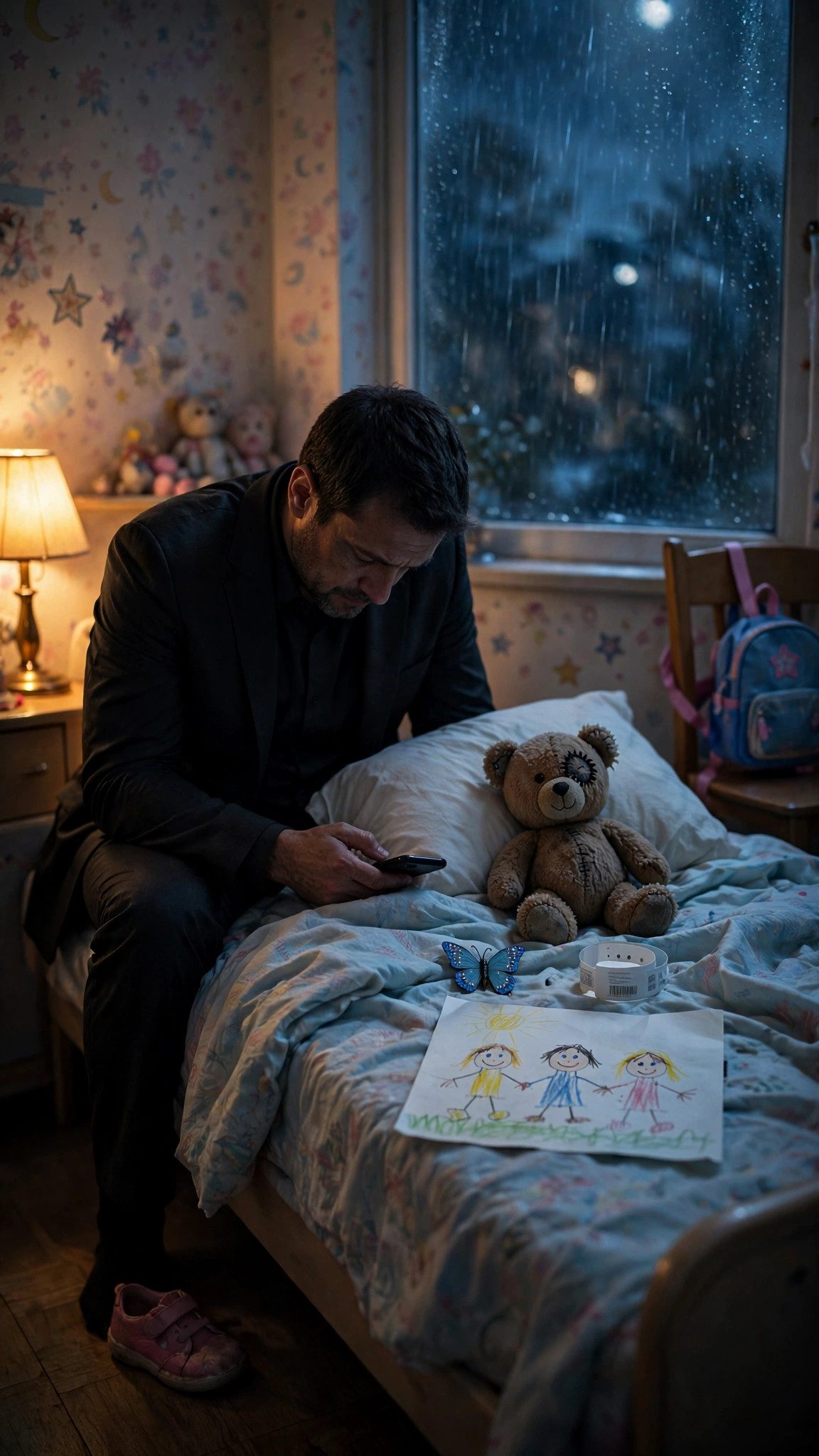
He went home that night, and he sat in Lily's room, and he picked up the teddy bear, and he thought about the foundation, and the hospitals, and the children, and he thought about Claire's sketchbook, full of Lily's face, and he thought about the seven times, and he thought about the eighth time.
The eighth time would be different. The eighth time, he would be there. He did not know how yet. He did not know what the eighth time would look like. But he knew it was coming, and he knew that this time, he would not be on a yacht in Monaco. This time, he would be where he belonged. Home.
There was one more thing Damian had to do before he could begin again, and he had been putting it off for months, because it was the hardest thing of all.
He went to see Ray Delgado.
Ray was the truck driver. The man who had fallen asleep at the wheel on Lake Shore Drive, coming off a double shift, hauling freight for a company that paid by the mile and did not ask how many hours a man had been awake. He was fifty-two years old, with a wife and three children and a mortgage, and he had pleaded guilty to negligent driving, and he was serving three years in a minimum-security facility outside Joliet.
Damian had his lawyer arrange the visit. He did not bring guards. He did not bring anyone. He sat across from Ray in a small room with a table between them and a guard by the door, and he looked at the man who had killed his daughter, and he saw a tired, frightened, ordinary man with gray in his hair and tears in his eyes.
"Mr. Moreland," Ray said, and his voice shook. "I am so sorry. I think about your little girl every day. I dream about her. I will never forgive myself."
"I know," Damian said. "I dream about her too."
They sat in silence for a while. The guard shifted his weight by the door. Somewhere down the hall, a door clanged shut.
"I came here to tell you something," Damian said. "I forgive you."
Ray stared at him. "What?"
"It was an accident," Damian said. "You fell asleep. You were tired. You were working too hard because the company paid you by the mile and your family needed the money. That is not evil. That is a system that chews people up. My daughter died because of that system, and because of the rain, and because the world is cruel sometimes for no reason. Not because you are a bad man. You are not a bad man. You are a tired man who made a terrible mistake, and you will carry it for the rest of your life, the way I will carry mine."
Ray wept then, openly, with his face in his hands, and Damian waited, and when the man had composed himself, Damian said, "I have arranged something. Your wife will have a job, at the foundation I am starting, with a real salary and real hours. Your children will have scholarships. And when you get out, there will be a job for you, driving for the foundation, delivering supplies to hospitals, with a schedule that lets you sleep. I am not doing this for you, Mr. Delgado. I am doing it for Lily. Because she would have wanted it. She was the kind of child who worried about other people's feelings, even when she was the one who was hurt. And I think she would want your children to be all right."
Ray could not speak. He just nodded, and he cried, and Damian stood up, and he left, and he drove home, and he felt, for the first time since the night his daughter died, something that was almost like peace. Not happiness. Not yet. But peace. The peace of a man who has finally stopped running from the truth and started walking toward it, one step at a time.
A week later, the Lily Moreland Foundation made its first gift: a new pediatric trauma wing at St. Margaret's Hospital, the hospital where Claire had once worked as a nurse, the hospital where Lily had died. Damian wrote the check himself, in the office that had once belonged to the most feared man in Chicago, and he wrote Lily's name on the memo line, in his own handwriting, and he thought about the seven times, and he thought about the eighth time, and he thought about the little girl with the butterfly clip, who had loved the moon and the dolphins and the butterflies, and who had waited for her father until there was nothing left to wait with.
He would not make her wait again. Not in the ways that mattered. Her name would be on a hospital wing. Her drawing would hang in the lobby. Her story would be told to every family that walked through those doors. And her father, who had failed her seven times, would spend the rest of his life making sure that no other child ever had to ask where her daddy was, and wait, and wait, and wait, for a man who was not coming.