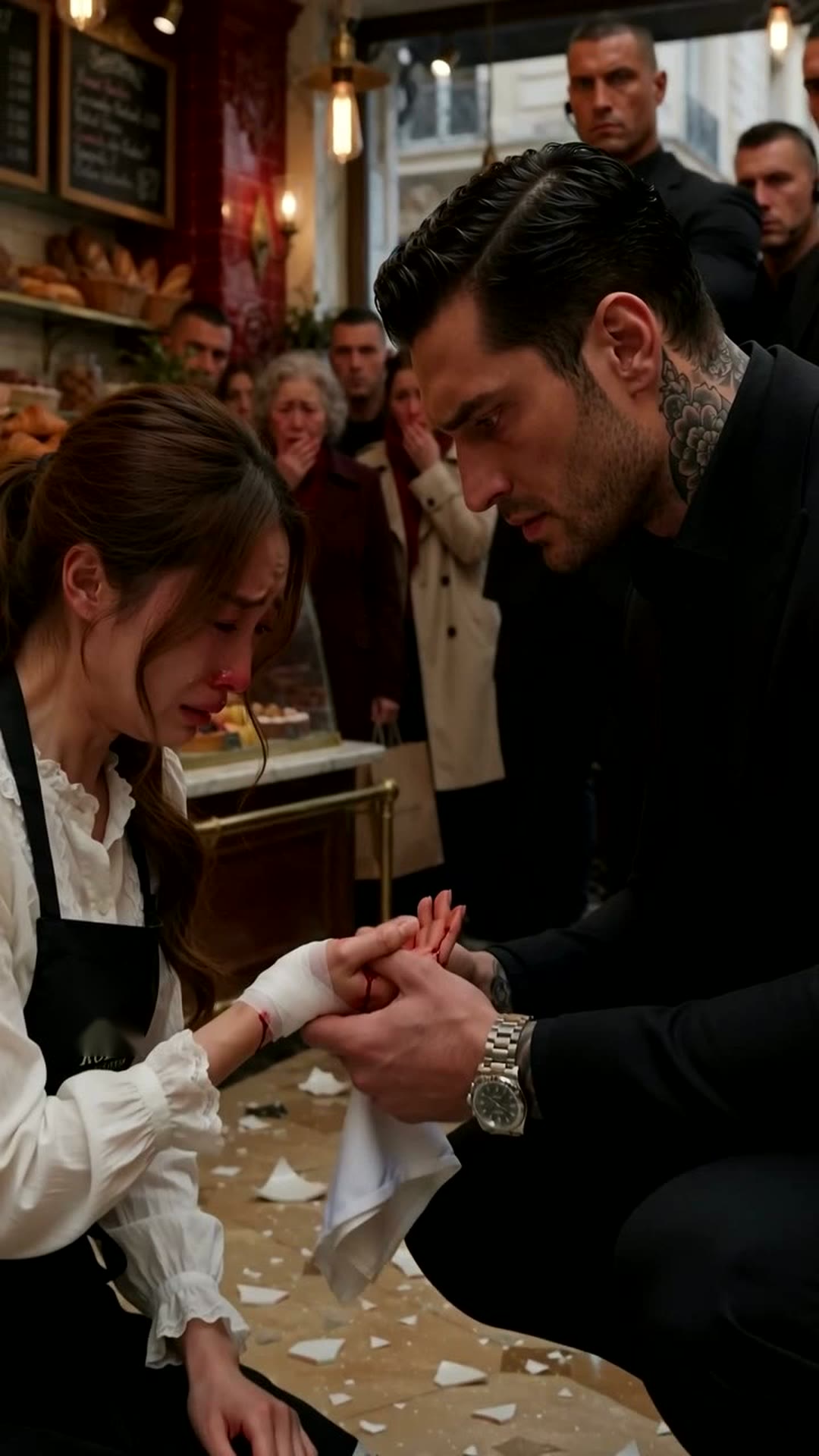
Dante presented the audit the next morning the way other men present weather reports — flat, factual, devastating.
We were in the study, where the wall of my disappearance still hung in its red thread, and he set three folders on the desk between Alessandro and me and did not sit down.
"Marie Chen's debts," he said, "total just under ninety-one thousand dollars. Cards, horses, two informal lenders here in Bellhaven." He opened the first folder. "But the debts are not the story. Who owns the debts is the story. In six years, every note she ever signed has been bought, quietly, at a discount, by one buyer: a collections firm called Harborlight Recovery." Second folder. "Harborlight is three shells deep. At the bottom of the shells is Lanza Maritime."
The name meant nothing to me. It clearly meant something to Alessandro, because the temperature of the room changed.
"Victor Lanza," he said.
"Your father's old partner," Dante said to me. "The friend who smiles at his table. Lanza Maritime absorbed most of your father's shipping routes in the eighteen months after his death — cheaply, because the estate was in confusion and the family wanted distance from the scandal of the crash. The crash." He let that sit. "Which the ledgers in your envelope speak to, but that's for the lawyers. Today's folder is Marie."
He opened the third.
"Eleven days after Marie took you out of this house, a payment of forty thousand dollars entered her account from Harborlight, described as debt restructuring. Every year since, smaller payments. On your birthdays, interestingly — as if someone wanted the arrangement to sting on schedule. In exchange, Harborlight has owned her compliance. Where you lived. Where you worked. When you moved. She reported all of it. She had to. It was the terms."
I was holding the edge of the desk. My bandaged hand throbbed in time with my pulse.
"And the men who came to my apartment," I said. "Thursdays."
"Harborlight collections. Including Rocco Fenn, who bruised your wrist. Rocco doesn't work Thursdays because he's collecting, Mrs. Caruso. He works Thursdays because Thursday was the check-in. He was confirming you were still where Marie said you were." Dante's face did something reluctant. "Eleven days ago Rocco's report said you were asking questions — you'd refused, for the first time, to hand over your whole envelope of wages. You'd kept back money. His handler flagged it: asset becoming unstable. That's the phrase in his notes. Asset."
"Show me," I said.
Dante slid the third folder across the desk to me, and I read my own erasure in bank statements. Forty thousand, the first year. Then nine thousand, then seven, then a long diminishing tail of payments as I became cheaper to keep — a woman working in bakeries, asking nothing, going nowhere. Someone at Harborlight had circled each payment date in red, year after year, and the dates were all the same date. March the eleventh. My birthday — except for the last one, which had been moved up, paid early, eleven days ago, the same week Rocco Fenn's handler flagged me as unstable. I put my bandaged hand flat on the page to stop it shaking.
"They paid her early because of me," I said. "Because I kept back money to — " I had to stop. What I had kept it back for, in a coffee tin over Marie's fridge, was so small and so enormous: a deposit. A room of my own, in my own name, that no one visited on Thursdays. Eight hundred and forty dollars toward a door with a lock I chose. That was the instability. That was what got a window shot out of a bakery: a girl saving for a door.
"He paid her early because assets that start saving start planning," Alessandro said. His voice was doing something I had never heard it do, and it took me a moment to name it, because it was an ordinary human sound and he was not an ordinary human man. He sounded ashamed. "And I read the report three hours after the money moved, through three shells, and I still walked into your bakery unprepared. I keep arriving, Sophia. I keep arriving exactly one disaster late."
"And yesterday morning?" Alessandro's voice was very quiet.
"My audit touched Harborlight's systems at seven-forty yesterday morning, boss. Their security saw the query. Names, amounts, every threat — I asked their computers exactly who held Marie Chen's leash, and their computers told their owners that the Carusos were finally pulling the thread. The shooting was at eight twenty-three. They didn't find her yesterday. They reacted. They'd rather lose her than lose the secret she was sitting on — and they nearly did it with her own location reports."
The study was silent except for the rain, which had come back in the night like it intended to stay.
"I need to see her," I said.
Alessandro looked up sharply. "No."
"I need to see her."
"Sophia—"
"She raised me." My voice was shaking, and I let it shake. "She taught me to read. She held my hand at my father's grave and told me a story about a car accident, and I need to stand in front of her and watch her face while I ask her which parts of my childhood were purchased. You can put a hundred men outside the door. You can put Dante inside it. But I am not learning about my own life from folders anymore. Not hers. Take me to my aunt, Alessandro."
He looked at me for a long moment. I watched him decide — not whether to refuse me, I understood later, but how to do a thing he'd sworn an oath against ever doing again, which was sending me toward pain on purpose.
"One condition," I said, and my voice surprised me by holding. "Whatever she's done — and I believe every word of these folders, that's the horror of it, I believe them — she walks out of that apartment alive, and unhurt, and breathing. She is the only family my father left me that still has a pulse. You don't touch her. Your men don't touch her. That's my price for letting you protect me today."
Something crossed his face — respect, I think, arriving in a place it hadn't expected to be needed. "Understood," he said. "She'll answer questions. She'll answer to the law, eventually, if the law wants her. But not to me. Not for this." He nodded at Dante.
"Bring the car around," he said to Dante. "Full detail. If Lanza so much as thinks about that street, I want to know before he does."
The apartment where I had lived with Marie for the last year was on the fourth floor of a building that smelled of other people's cooking. I had climbed those stairs a thousand times with groceries. I climbed them that afternoon between two men in dark coats, and Dante went in first, and came out and said, "She's alone, boss. She's — she's expecting something. There's a bag packed by the door."
Of course there was.
Marie stood in the middle of the little kitchen in her good cardigan, the one with the pearl buttons, and she looked at me, and at my bandaged hand, and at Alessandro behind me in the doorway like the wrath of God in a black coat, and she said, with terrible composure:
"You look thin, Sophie. Are they feeding you?"
Something in me — some last small stupid loyalty — wanted to laugh. Instead I said:
"Who paid you?"
The composure lasted perhaps four seconds. Then my aunt, who had survived loan sharks and landlords and six years of Thursdays, folded. Not gracefully. She sat down hard on the kitchen chair and put both hands over her face and wept like a person being emptied.
"At first it was threats," she said, eventually, into her hands. "You have to believe that, even if you believe nothing else after. After your father — after the crash that wasn't a crash, oh, God, Sophie, I knew within a month it wasn't a crash, everyone in the family knew except you — they came to me with my own debts itemized like a menu, and a photograph of you asleep in your room at the estate. Asleep. They could reach you even there. They said: the girl asks questions eventually, girls do, and when she does she'll go asking the Caruso boy, and the Caruso boy will go digging, and the digging ends with all of us dead, including her. They said the kindest thing was to take you away and keep you ordinary. Keep you small."
"You kept me starving."
"I kept you alive!" Her hands came down. Her face was ruined and furious and about twelve years old. "Do you think I don't know what I did? Every year they paid me on your birthday — your birthday, Sophie, they chose it — so I would remember exactly what the money was for. And I took it. I took it because the alternative was them taking you, and because—" She stopped. Honesty, dragged up from the bottom of her: "—and because by the third year I was gambling again, and the money was there, and I am not a good woman. I raised you and I sold you, and both of those things will be true at my funeral."
"The document," Alessandro said from the doorway. His voice was not loud. It was worse than loud. "The annulment. Who made it?"
"Lanza's lawyers. They brought it to me the week before. Names, stamps, everything." Marie's eyes went to him, and for the first time she looked genuinely afraid — not of his men. Of the arithmetic. "I never wanted— Mr. Caruso. Alessandro. I told myself you would find another wife. I told myself you were a hard man and it was a business marriage and you'd be relieved. I told myself so many things. And every year on her birthday I put their money in a drawer and I didn't spend that money, any of it, it's still— " She gestured, helpless, at the bedroom. "It's in a drawer. All of it. I don't know what I thought I was saving it for. Her wedding, maybe. A real one. As if I— " She couldn't finish.
I stood in my aunt's kitchen with my whole childhood rearranging itself around me, and I understood something Dante had said that I hadn't let land: the payments came on my birthday, chosen deliberately. These men didn't just buy my hiding. They salted it. They wanted the woman who hid me to be corroding the whole time she did it, so she could never walk into the light and confess. And it had nearly worked. It would have worked forever, if my fingers hadn't slipped on a wet cup.
"Aunt Marie," I said, very quietly, "there's something you need to tell me. Not about the money. About why me. Why it mattered so much that I stay hidden. It wasn't only the crash, was it?"
She wiped her face with the heel of her hand, and nodded at the packed bag by the door with a kind of exhausted relief.
"I packed when I heard about the bakery on the news. I thought it would be them coming, not you. If I'm going to be killed for talking, Sophie, I'd rather be killed for talking to you." She took a breath. "Your father didn't just die with secrets. He died with shares. The Bellhaven port consortium — your father, Caruso's father, and Victor Lanza built it together, three signatures, and your father's stake went into a trust for you on your eighteenth birthday. You own eleven percent of the port of Bellhaven, Sophie. You have since the day you married him. And there's a ratification due — the trustees, the lawyers, a signing — that has to happen before your twenty-fifth birthday, or the stake gets voted by the consortium board. And Victor Lanza has been buying the board for six years."
She looked at me with her ruined face, and for the first time in my life my aunt and I understood each other completely.
"If you sign, the stake is yours and he loses the port. If you never sign — if you're dead, or disappeared, or declared gone — he wins it by default." Her voice dropped to nearly nothing. "The signing is in two days, at the trust's offices downtown. And, Sophie — he knows about the envelope. He's always known. It's why you could never be allowed to reach it. Or him."