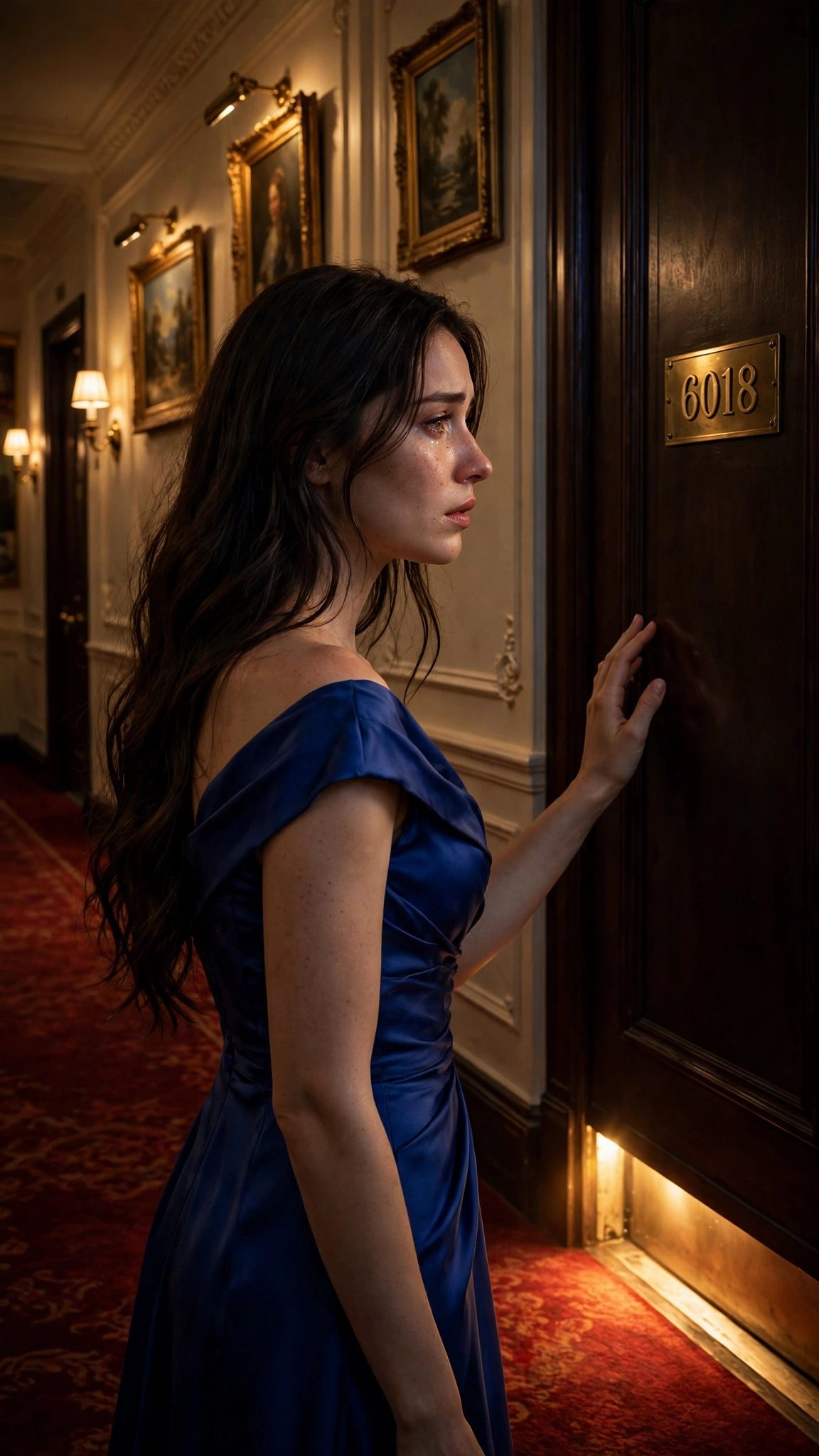
The night I stood outside Room 6018 and heard another woman laughing inside my husband's hotel room, I did not knock.
I stood in the hallway of the Drake Hotel in Chicago with my hand raised an inch from the door, and I listened to a young woman laugh — bright, bubbly, the laugh of a woman who is exactly where she wants to be — and something inside me went very quiet. Not broken. Quiet. The way a room goes quiet when someone has just switched off the lights and you realize you have been standing in the dark for a long time without noticing.
I had come to surprise him. It was the fourteenth month of our marriage, and I had spent the whole afternoon arranging white roses in our apartment, the way I used to arrange them for other people's weddings when I was still a florist and not a wife. I had cooked his favorite meal. I had put on the blue dress he once said made my eyes look like the lake in October. And then his text had come: Working late. Drake Hotel. Room 6018. Come if you want.
I had believed it was an invitation. I had believed, for one foolish afternoon, that the man who had married me in front of a priest, a judge, and fourteen witnesses might finally want me in the room with him for a reason that had nothing to do with his grandfather's will.
The woman laughed again behind the door, and I understood everything. Alexander Moretti had never needed a wife. He had needed a wife in name only. A temporary bride to satisfy the terms of his grandfather's will, granting him control of the Moretti empire. A woman he never once loved. A woman who would not ask questions. A woman who was convenient.
I lowered my hand. I did not knock. I did not scream. I did not demand an explanation, because there was nothing left to explain. I turned around and walked back down that long carpeted hallway, past the brass lamps and the oil paintings of dead men who had once owned this city, and I went home and packed one suitcase. No bodyguards. No drivers. No guards. Not even an apology waited for me at home, because Alexander was still at the hotel, still in Room 6018, still with her.
"This is war," I said to my phone, to no one, to the empty apartment. Then I sent him one final message. I am done. Do not look for me.
I checked out of my own life the way you check out of a hotel. I ordered a taxi in the middle of the night. I left the city. I did not ask him for a divorce. I did not cry. I did not beg him to stay. I did not even turn around.
That day, I thought my marriage was over.
Two years later, on a Tuesday in October, the bell over the door of Marta's flower shop in Galena, Illinois, rang at four in the afternoon, and Alexander Moretti walked in out of the rain.
I knew him before I looked up. I knew the weight of his footsteps. I knew the way the air in a room changes when he enters it, the way every conversation within twenty feet of him lowers its voice without anyone deciding to lower it. I had spent fourteen months learning the weather of that man, and two years trying to forget it, and my body remembered before my mind did. My hands stopped moving. The roses I was trimming stayed exactly where they were, half-wrapped in brown paper, and the scissors stayed open in my right hand.
"Gianna," he said.
He was thinner than I remembered. There were lines at the corners of his eyes that had not been there when I left, and his black suit was wet at the shoulders from the rain. He looked like a man who had not slept properly in a very long time. He looked like a man who had driven a very long way to say something he had rehearsed and already forgotten.
"You found me," I said. My voice sounded calm. I was proud of that, and then immediately ashamed of being proud of it, because calm was the only armor I had left and he could see straight through it. He always could.
"Two years," he said. "Two years, Gianna. Do you know how many cities I searched? Do you know how many men I sent looking for you?"
"Then you should have looked harder," I said, "or not at all."
He took one step toward the counter, and I took one step back, and the scissors were still open in my hand, and I realized I was holding them the way a person holds a weapon when she has already decided she will not use it but wants the other person to know she could.
"Why did you never confront me?" he asked. His voice was low and controlled, the voice he used in rooms where other men were deciding whether to live or die, and underneath the control there was something raw and unpracticed, something I had never heard from him in fourteen months of marriage. "That night. Room 6018. Why did you never knock on the door? Why did you never ask me what happened? You sent me one message and you vanished, and I have spent two years asking a question you could have answered in ten seconds."
"Because I heard her laughing," I said.
"What?"
"The woman in your room. I heard her laughing, Alexander. I stood outside your door and I heard another woman laughing inside your hotel room, and I understood. You did not need a wife. You needed a signature on a piece of paper so your grandfather's will would hand you an empire. You told me so yourself on our wedding day. 'This is what you want. A wife.' Like the ring on my finger was a business transaction."
His face changed. I had seen Alexander Moretti angry. I had seen him cold. I had seen him the night he came home with blood on his cuff and told me not to ask. I had never seen his face do what it did then — go completely blank, the way a man's face goes blank when the floor has just disappeared under him.
"Gianna," he said slowly, "I was never in Room 6018 that night."
"Liar."
"I was in the private dining room on the second floor until midnight," he said. "With the alderman and two of my captains. There were eleven people in that room, Gianna. Eleven witnesses. I never went up to 6018. I never sent you that text."
The scissors closed in my hand. I did not remember closing them.
"Then who sent it?" I asked, and my voice was not calm anymore. "Then who was laughing in your room?"
"I don't know," he said. "That is what I came here to find out. Because whoever did it took my wife from me, and I have spent two years tearing this city apart looking for them, and I only found you three days ago, and I drove here the moment I knew where you were, and I need you to tell me everything you heard that night, because I have been living with a version of that night that makes no sense, and you are the only person alive who was standing in that hallway."
Behind me, in the back room of the shop, behind the curtain of dried lavender Marta had hung there years ago, my daughter made a small sound in her sleep. A sigh. A shifting of blankets. The sound a child makes when she is dreaming and safe.
Alexander went still. His eyes moved past me, toward the curtain, and I saw him understand that there was someone else in this shop, someone small, someone who had not been in any of his reports, because I had made very sure of that.
"Gianna," he said, very quietly. "Who is behind that curtain?"
I should have lied. I had lied for two years, to everyone, about everything — my name on the lease, my past, the reason a twenty-six-year-old florist from Chicago was living above a flower shop in a town of three thousand people with no family and no husband. I was good at lying by then. But my daughter sighed again in her sleep, and Alexander took one step toward the curtain, and I stepped sideways, and he stopped, and we looked at each other across three feet of flower shop floor, and I knew that the lie would not survive the next ten seconds anyway.
"Her name is Ava," I said. "She is sixteen months old. And she is your daughter."
He did not move. He did not speak. For a long moment he simply stood there in his wet black suit, in the rain-smelling flower shop, staring at the curtain as if it were a door he was afraid to open, and I watched the most dangerous man in Chicago try to remember how to breathe.
Then he said, in a voice I had never heard from him, small and almost broken, "Show me."
I pushed the curtain aside.
Ava was asleep in the little wooden crib Marta had found at a yard sale and painted white, her cheek pressed against a blanket with yellow ducks on it, one fist curled tight against her chest the way she had slept since she was born. She had dark curls, too many of them, falling over her forehead. She had his eyes — I had known it since the day she opened them in the hospital in Galena, dark and serious, eyes that looked at the world like it owed them an explanation. She had the Moretti chin, the same stubborn line I had seen in the portrait of his grandfather that hung in the hallway of the house on Lake Shore Drive, the portrait I had dusted every Tuesday for fourteen months.
Alexander stood in the doorway of the back room and stared at my daughter, and I watched his hands. His hands were the hands of a man who had done terrible things with them, hands that had signed orders and held guns and once, gently, held my face on our wedding night. They were shaking. He put them behind his back, like a man who does not trust himself to touch something precious.
"Sixteen months," he said.
"Sixteen months," I said. "I found out I was pregnant three weeks after I left Chicago. I threw up in the bathroom of a diner outside Rockford and I thought it was the coffee, and then I counted, and I knew. She was born on a Tuesday in June, in the little hospital in Galena. Seven pounds, two ounces. She cried once, very loud, and then she looked at me like she was checking whether I was going to stay."
"And you stayed," he said.
"I stayed."
He turned to look at me, and his face was wet. I did not know if it was rain. I did not think it was rain.
"Gianna, I have a daughter," he said, like he was translating a sentence from a language he did not speak. "I have a daughter, and I missed sixteen months of her life, and someone stole them from me. Someone sent you a text I never wrote and put a woman in a room I never entered, and you walked out of my life believing I had thrown you away, and I have spent two years believing you left me because you never loved me."
"I did love you," I said, and the words came out before I could stop them, and once they were out I could not take them back, and I did not want to. "That was the problem, Alexander. I loved you, and I believed you had married me for a will, and I believed the woman laughing in your room was the proof, and I left because I could not stay in a marriage where I was a signature on a piece of paper. I left because I loved you and it was killing me."
The bell over the shop door rang, and Marta Kowalski came in with a bag of groceries and stopped dead in the doorway, staring at the tall man in the wet black suit standing in her back room looking at a sleeping baby.
"Gianna," Marta said slowly, in the voice of a woman who has run a flower shop in a small town for thirty years and has seen every kind of trouble walk through her door, "who is this?"
"This is my husband," I said.
Marta put the groceries down very carefully on the counter. "Your husband," she repeated. "The one from Chicago. The one who is a —" She stopped, because Marta knew exactly what Alexander was, and she had known for two years, and she had never once asked me to leave.
"The one from Chicago," I said.
Alexander turned around. He did what he always did when he met someone who mattered to the people he loved: he became polite, and formal, and suddenly very still, the way a dangerous animal becomes still when it wants you to know it is choosing not to be dangerous.
"Mrs. Kowalski," he said. "Thank you for taking care of my wife and my daughter when I could not find them. I owe you a debt I cannot repay."
Marta looked at him for a long moment. Then she looked at me. Then she looked at Ava, asleep in her crib, and her face softened in a way I had only ever seen when she talked about her own grandchildren.
"Well," Marta said, "you owe me two years of rent for the apartment upstairs, because Gianna would not let me charge her full price and I charged her anyway and she paid me in flowers. And you owe this girl an explanation." She pointed at me. "And you owe that baby a father. In that order."
"I know," Alexander said.
He took out his phone then, and for a moment I thought he was going to call one of his men, and I felt the old fear rise in my throat, the fear of what his world did to people. But he only looked at the phone for a second, and then he put it back in his pocket without making the call, and he looked at Ava again, and then at me.
"I am not leaving Galena tonight," he said. "I am not leaving without you. And I am not leaving without her. I will sleep in my car if I have to. I will sleep on the floor of this shop. But I am done losing the people I love to rooms I never entered and texts I never sent, and whoever did this to us is going to answer for it. Starting tomorrow."
Outside, the rain came down harder on the roof of the flower shop, and the wind moved through the dried lavender curtain, and my daughter slept on, one fist curled tight against her chest, unaware that the most dangerous man in Chicago was standing over her crib learning how to be a father.
"Tomorrow," I said.
"Tomorrow," he agreed.
And for the first time in two years, I believed him.