The first month of our marriage, I woke up every morning in the house on Lake Shore Drive and waited for someone to tell me I did not belong there.
No one ever did. The housekeeper, Rosa, showed me where the good plates were kept. The driver, Danny Cole, learned my schedule and never once asked where I was going. Alexander's captains nodded to me at family dinners like I had always been there. But belonging and being wanted are not the same thing, and I learned the difference slowly, the way you learn a house — room by room, until you know every corner of it and still cannot call it home.
I tried. God, how I tried. I arranged white roses in every room, because flowers were the only thing I knew how to do, and because a house full of flowers felt less like a museum. I cooked Sunday dinners the way my mother had taught me, pasta with sauce that took six hours, and Alexander's men ate at my table and told me it was the best meal they had eaten in years, and Alexander watched me from the head of the table with an expression I could not read. I went to charity events on his arm and smiled at cameras and learned to say "the Moretti family" like it was my family too.
And Alexander — Alexander was kind to me. That is the part that makes the story hard to tell, because kind is not the same as loving, and I did not know the difference until it was too late. He was never cruel. He never raised his voice. He never made me feel small. He brought me coffee in the morning. He asked me about my day, and he listened to the answer. He bought me a small greenhouse for the back garden, so I could grow my own roses in the winter, and he built the shelves himself one weekend, in an old shirt, with sawdust on his hands, cursing quietly in Italian when the wood split.
But he never said the words. He never said "my wife." He never said "I love you." And when the family gathered for Sunday dinner and his aunt asked him, in front of everyone, how married life was treating him, he said, "The will is satisfied. The empire is secure." And everyone laughed, and I laughed too, because that is what you do when you are a wife in name only and the joke is about you.
The will was everywhere in that house. Enzo Moretti had died six weeks after our wedding, and his will had been read in the library while I sat upstairs arranging flowers and pretending not to listen. The terms were simple, and everyone in Chicago knew them within a week: Alexander would take full control of the Moretti empire — the shipping, the warehouses, the docks, everything — but only if he remained married. If the marriage ended, by divorce or by abandonment, control would pass to a board of trustees, and the board was full of men who owed Vincent Castellano favors.
Castellano. I learned that name the way you learn the name of a storm that is coming. Vincent Castellano, head of the Castellano family, sixty years old, patient as a spider, the man who had wanted the Moretti docks for twenty years. He sent flowers to our wedding — white lilies, funeral flowers — with a card that said only Congratulations. Alexander threw the card in the fire without reading it twice.
Rosa, the housekeeper, found me in the kitchen the morning the lilies arrived, staring at the card in the trash. She was sixty years old, with grey hair in a knot and hands red from years of hot water, and she had worked for the Moretti family since before Alexander was born. She took the lilies out of the vase and carried them to the back door herself.
"Funeral flowers at a wedding," she said, shaking her head. "That man has no shame. Listen to me, girl. I have watched this family for forty years, and I will tell you the one thing you need to know about Vincent Castellano. He does not fight with guns. Guns are for men who are in a hurry. Castellano is never in a hurry. He fights with stories. He will tell a story about your husband to the right person at the right time, and the story will do the work for him. And the story does not have to be true. It only has to be believed for one night."
"What kind of story?" I asked.
"The kind that makes a wife walk out of her own house," Rosa said. She looked at me for a long moment, and then she went back to her work, and I stood in the kitchen holding a dish towel, and I thought about what she had said, and I told myself I would remember it.
I forgot that, too. Rosa warned me, and Enzo warned me, and Alexander warned me, and I forgot all three of them in the hallway outside Room 6018, because a woman's laugh behind a door is louder than three warnings, and I was twenty-six years old, and I believed what I heard over what I had been told. That is the part of the story I am least proud of. But it is the truth, and the truth is the only thing I have left to offer.
"He will try to break the marriage," Alexander told me one night, months into our marriage, standing at the window of our bedroom looking out at the lake. It was the closest he ever came to explaining his world to me. "That is how he wins. Not with guns. With doubt. He will put doubt between us, Gianna, and doubt is quieter than a bullet and twice as deadly. If you ever hear something about me that makes you doubt me — come to me. Ask me. Do not walk away from me without asking."
I promised him I would. I promised, with my whole heart, and I meant it. I did not know then that a promise is easy to make in a bedroom at midnight and very hard to keep in a hallway outside Room 6018.
There was one night, a month before Room 6018, when Alexander came home at two in the morning and I was still awake, sitting at the kitchen table with a cup of tea gone cold, and I asked him where he had been. He stood in the doorway for a long time, his tie undone, his jacket over his arm, and I could see him deciding how much to tell me.
"The docks," he said finally. "Castellano's men tried to take a shipment. Nobody was hurt. Danny handled it."
"And you?" I asked. "Were you there?"
"I was there," he said. "I am always there, Gianna. That is the job. I go where the danger is, so it does not come here."
"To me," I said.
"To you," he said, and he came to the table, and he sat down across from me, and he took my cold hands in his, and he said, "I know what this life costs you. I know you did not sign up for midnight phone calls and men at the door. If you ever want to leave — if this is ever too much — you tell me. I will not stop you. But I will ask you to remember one thing first."
"What?" I asked.
"That I come home to you," he said. "Every night. No matter what happens out there, I come home to you. That is the only promise I can make you, and I have never broken it."
I believed him that night. I believed him with my whole heart, sitting at the kitchen table with my cold tea and his warm hands. And then, a month later, I stood outside Room 6018 and heard a woman laughing, and I forgot that, too. I forgot that he came home to me every night. I forgot that he had never once broken his promise. I forgot everything except the laugh.
That is what doubt does. Rosa was right. Doubt is quieter than a bullet and twice as deadly, and it does its work in seconds, in a hallway, while you are standing with your hand raised an inch from a door.
The fourteenth month of our marriage was the hardest. Alexander was gone more. The board was fighting him. Castellano had filed a challenge to the will in court, claiming the marriage was a sham, a piece of paper bought to satisfy a dead man's condition. His lawyers were asking questions about me — where I came from, who my family was, whether I had been paid. I sat in a lawyer's office in downtown Chicago and answered questions about my own wedding like a woman on trial, and I thought: this is what it means to be a wife in name only. Your marriage is evidence. Your love is a legal argument.
And then came the night of Room 6018.
It was a Friday. Alexander had been at the Drake Hotel all day, in meetings about the docks. I had spent the afternoon arranging white roses in our apartment — not the house, the apartment we kept in the city — and cooking his favorite meal, osso buco the way my mother made it, slow and rich. I put on the blue dress he had once said made my eyes look like the lake in October. I was going to surprise him. I was going to walk into that hotel and remind him that his wife was a person, not a signature, and that fourteen months was long enough to be a transaction and it was time to be a marriage.
The text came at seven in the evening. Working late. Drake Hotel. Room 6018. Come if you want.
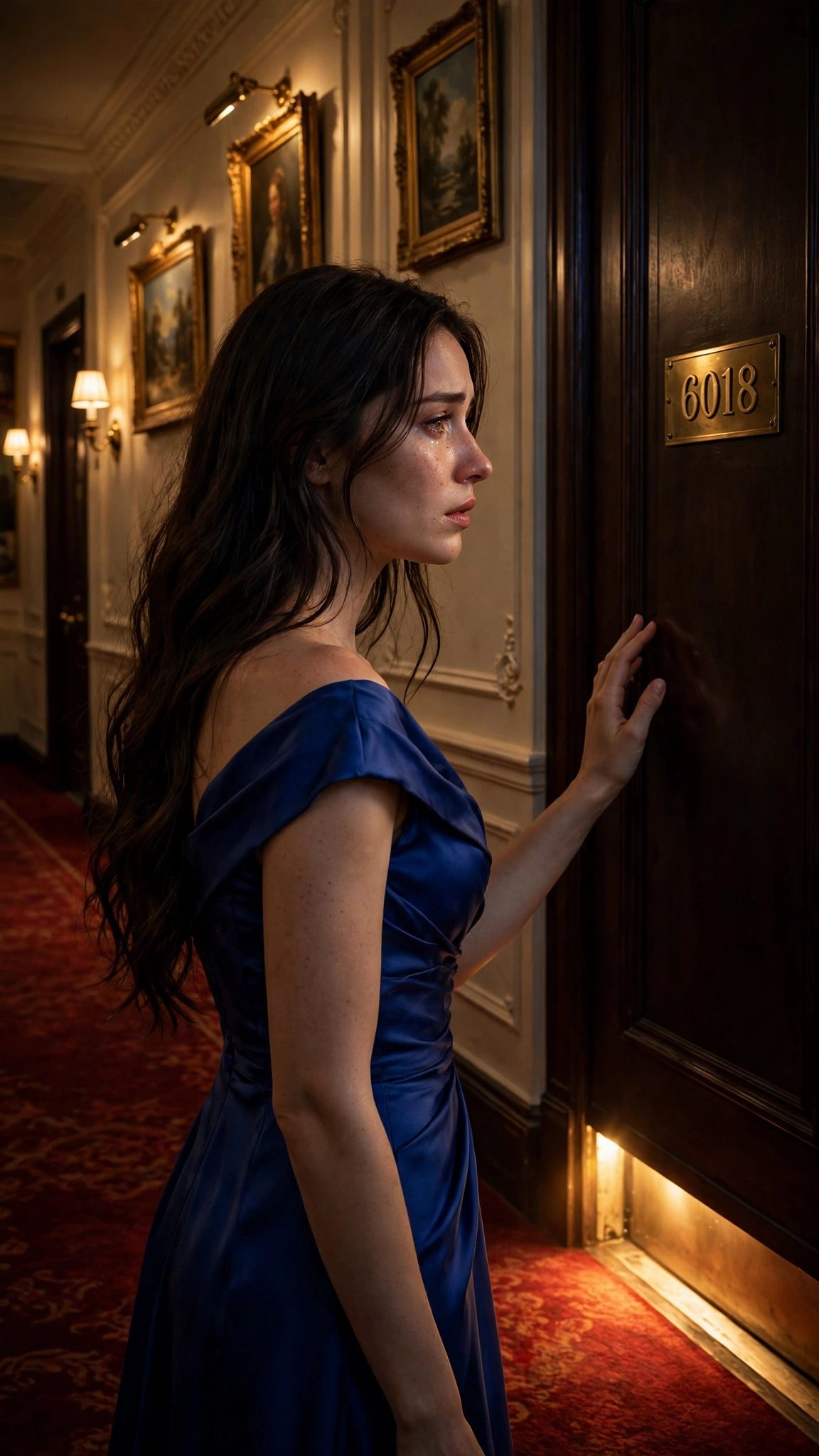
I believed it. I believed it was an invitation, and I was happy, and I took a taxi to the Drake with my heart beating too fast, and I rode the elevator to the sixth floor with a smile on my face, and I walked down the long carpeted hallway past the brass lamps, and I stopped outside Room 6018, and I raised my hand to knock.
And I heard her laughing.
She was young. I could tell that from her laugh — bright, bubbly, the laugh of a woman who is exactly where she wants to be. She laughed, and then a man's voice said something too low for me to hear, and she laughed again, and I stood there in the hallway with my hand raised an inch from the door, and I understood.
I understood that Alexander Moretti had never needed a wife. He had needed a wife in name only. A temporary bride to satisfy the terms of his grandfather's will, granting him control of the Moretti empire. A woman he never once loved. A woman who would not ask questions. A woman who was convenient. And when a rumor began to spread that he had been unfaithful, the Moretti family said nothing, because a perfect marriage would make a perfect empire.
I lowered my hand. I did not knock. I did not scream. I did not demand an explanation. I thought of his words — If you ever hear something about me that makes you doubt me, come to me — and I thought of the woman laughing behind the door, and I thought: there is nothing to ask. The laugh was the answer.
I went home. I packed one suitcase. I took the blue dress off and folded it neatly on the bed, because even then, even in that moment, I could not bear to be cruel to beautiful things. I took my mother's gold earrings, the only treasure I owned. I left the ring on the dresser, because the ring had never been mine. The ring had belonged to the will.
"This is war," I said to my phone, to the empty apartment, to the portrait of Enzo Moretti staring down from the hallway. Then I sent Alexander one final message. I am done. Do not look for me.
No bodyguards stopped me. No drivers. No guards. Not even an apology waited for me, because Alexander was still at the hotel, still in Room 6018, still with her. I ordered a taxi in the middle of the night. I left the city. I did not ask him for a divorce. I did not cry. I did not beg him to stay. I did not even turn around and head back to the room. I simply checked out of the hotel of my own life, and I left.
The taxi driver asked me where I wanted to go. I said, "The train station." He asked me which train. I said, "The first one that leaves Chicago." It was the train to Galena, Illinois, a town I had never heard of, a town of three thousand people and one flower shop and a river that ran slow and brown past the old brick buildings. I got off the train at dawn, and I stood on the platform with one suitcase and my mother's earrings, and I thought: this is where my marriage ends. In a town I cannot pronounce, in a state I never planned to live in, with nothing but a suitcase and a lie I told myself — that I was free.
I was not free. I was pregnant. I did not know it yet. Three weeks later, in the bathroom of a diner outside Rockford, I threw up my coffee and counted the days, and I understood that the night I walked away from my husband, I had already been carrying his child.
That day, I thought my marriage was over. I was wrong about that, too. My marriage was not over. It was waiting — in a flower shop in Galena, behind a curtain of dried lavender, in a white crib with a blanket covered in yellow ducks — for the man who had spent two years tearing a city apart to find us.