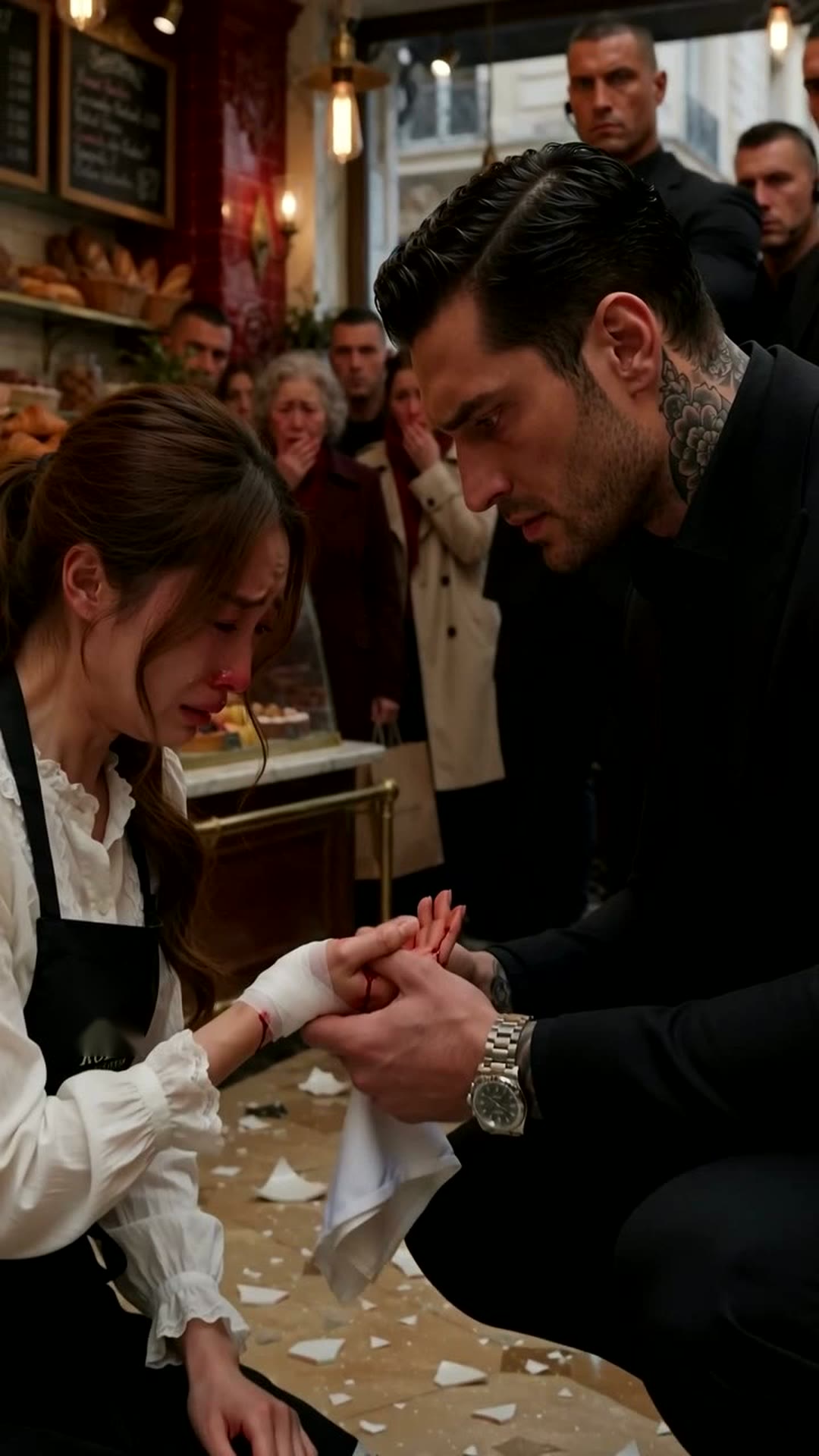
The bullet missed everything that kills you quickly. That is the sentence the surgeon used, standing in a corridor at four in the morning with his cap in his hands, while I sat in a plastic chair wearing a dead man's — no. Wearing a living man's blood, dried, on a borrowed shirt. Shoulder. Muscle and mess and a great deal of luck, the surgeon said, and I hated him briefly and completely for the word luck, as if luck had been standing in that garage with its hand on the gun.
Alessandro slept for a day behind a door with two guards on it. I slept in the chair beside his bed, in shifts, against orders, and every time I woke up my hand was bandaged and his was not, and I checked his breathing the way you check a child's, with my palm hovering, not daring to touch.
The first night he woke twice, briefly and badly. The first time he didn't know the room, and Dante — who had materialized in the doorway with a bag of my clothes and the particular stillness of a man standing guard over the only thing his world is for — stepped in and said, "St. Aurelia's, boss. You're whole. She's here," and I watched Alessandro's eyes find me the way a dropped compass finds north, all at once, and then he was under again before the fear had even finished arriving.
The second time, near dawn, he woke clearer and asked me if the audit had been my idea. I told him no, the audit had been his, and the bakery had been mine, and the shooting had been Victor Lanza's, and he should keep the accounting straight if he wanted to brood accurately. Something in his face — the drugs, maybe, or the hour — let go of the control entirely, and he said, "You were right to leave the tray. I was a coward at the far end of a table. Tell her—" and fell asleep mid-sentence, apologizing to a girl six years gone who had once left him broth outside a door and fled the house at two in the morning while he stood in a corridor doing nothing, perfectly, in the family style.
I told the sleeping man a few things that night that I have not yet said to the waking one. The nurses pretended not to hear. Dante, at the door, pretended with great dedication, facing outward, like a man guarding a country.
On the second day, Ms. Hale came to the hospital. She brought a slim file and the particular calm of a woman whose machinery is working exactly as designed, and she sat down in the visitor's chair and told me what my father had left me.
The sealed packet contained ledgers. Not metaphors — ledgers. Freight invoices from Lanza Maritime, six years old and older, with a second set of books beneath them, in my father's hand: payments routed through dummy cargo contracts, each one flagged, dated, initialed by the man who had quietly kept copies for four years before his death because he had begun to suspect what his partners were becoming. Payments to a salvage crew that specialized, Ms. Hale said carefully, in vehicle recovery. Payments dated the week of my father's crash, to the owner of the tow company that had taken the wreck away before the police finished photographing it. A mechanic's signed statement, notarized, describing a brake line cut with a file and paid for in cash by a man whose description had aged, over six years, into a perfect description of Victor Lanza's operations chief. And at the back — the thing that made Ms. Hale's voice finally change — my father's own memorandum, dated nine days before he died, naming the friend who smiles at my table, and writing: If I am wrong about him, burn this. I am not wrong about him.
"He kept proof for years," I said. "Why didn't he just — go to the police? Run?"
"Because proof isn't protection," Ms. Hale said. "Proof is a weapon that fires after you're dead. Your father knew that. The living weapon he built was you — your stake, your signature, your marriage. The packet was designed to be un-fireable until you were of age, in public, and out of reach." She closed the file. "It's firing now. The district attorney has it. The founding families have it. The Harborlight shells collapsed this morning — someone at Lanza Maritime has been shredding since dawn, which is, legally speaking, a confession with confetti. Victor Lanza was arrested at his own docks at noon. I thought you would want to know that he asked, twice, whether you had actually signed."
"Tell him yes," I said. "Tell him I signed in my own hand, in a nice office, and the pen worked fine."
"I'll have it conveyed," she said, and I believed she would, word for word.
Lanza's empire did not fall in a day. Empires don't. But a port runs on trust the way a body runs on blood, and by the end of the week the consortium had suspended him, the families had frozen him out of rooms he'd built, his collections men were being arrested in twos and threes by men with warrants instead of envelopes, and Rocco Fenn — Rocco, of the Thursday visits and the smiled threats and the fingers around my wrist — was in custody, talking, Dante reported, at the speed of a man who has realized the ship he's on is the one going down. Leave the particulars to the lawyers. What mattered, in the hospital room, was simpler: for the first time since I was eighteen, nobody was coming for me. The men who had killed my father were named, and broken, and finished — not shot in a garage, not vanished into the underground the way Alessandro's world handles things, but dismantled in daylight, on paper, by the machine my father had built out of ledgers and patience and a daughter he believed in.
It was better than revenge. It was arithmetic.
Before I left the hospital that day, Ms. Hale's office sent over copies — not the originals, which had gone into evidence, but clean, certified copies of everything: the ledgers, the memorandum, the letter. I sat in the corridor with the folder on my knees and read my father's memo once more, and then I did the thing I'd been circling for days. In the packet, behind the ledgers, there had been one more item I hadn't told anyone about — because some things you carry alone until you can carry them standing. It was a deed. A small one. A bakery-sized one, you might almost say — no: it was the deed to a narrow commercial building in Bellhaven, bought quietly in my name a month before my father died and held by the trust ever since. The building my bakery stood in. Mrs. Moretti's landlord, for six years — the faceless holding company nobody on the street could ever reach — had been me.
My father hadn't just left me proof and a port. He'd left me the street I would end up starving on — as if he'd known that whatever happened, I would wash up in Bellhaven eventually, and wanted one square of it to be mine under my feet when I did.
I laughed in that hospital corridor, alone, until a nurse came to check on me. He had excellent judgment in everything except friends. In daughters, apparently, he'd had a prophet's.
Marie's reckoning came four days later, and it came because I asked for it.
Dante drove me — Alessandro, propped in bed and furious at the entire concept of other people driving me anywhere, exacted a route, a detail, and a phone check-in every twenty minutes as the price of his blessing. The apartment building was the same. The stairwell was the same. But the little kitchen at the top of it was not: there were no locks of muscle by the door this time, only my aunt, and a police liaison officer in the corner with a recorder, and a pot of tea nobody drank.
Marie had asked for protection, and given a statement. Nine hours of it, Ms. Hale said, everything: the blackmail, the photograph of me asleep, the payments, the forged annulment she'd carried into my room like a midwife of grief. In exchange she would be somewhere far away soon, with a new name and no niece. She looked older. She looked, for the first time in my life, exactly her age.
"I won't ask you to forgive me," she said.
"Good." My voice was steadier than I felt. "Because I can't. Not today. Maybe not — I don't know about ever, Aunt Marie. I want to say the words eventually for my own sake, not yours. That's the truest thing I have."
"Then I'll say the other thing." She folded her hands around nothing. "You were never a burden. When your mother died, and your father worked those hours — you were the happiest part of that house, Sophie. I did love you. That's the part I can't make sense of, and I've had six years. I loved you and I did it anyway. If there's a hell arranged for people like me, that's the exhibit."
"Then live long enough to make it complicated," I said, and stood up, and — because my father raised me and his ghost was standing in that kitchen with his careful upright handwriting all over my life — I bent and kissed her forehead, once, the way you close a book you will not open again. "Goodbye, Aunt Marie."
She was crying when I left. So was I. The difference was that I got to cry in the open air.
Alessandro was sitting up when I got back, against orders, with a sling and a book he wasn't reading. He took one look at my face and set the book aside and opened his good arm, and I went — across six years and one hospital room — and I put my face against the unhurt side of his neck and cried there too, differently. For my father. For the girl in the white dress. For the woman on the Thursdays. He held me with the arm that worked and didn't say anything at all, which was the most eloquent he had ever been.
When I could breathe again, he reached — awkwardly, one-handed — into the drawer of the bedside table, and took out a small box I recognized before he opened it.
The silver ring. My wedding ring, which I had left on a dresser in a house I fled at two in the morning. The cold had never left it; it caught the hospital light the same way it had caught the chapel's.
"I carried it in my jacket," he said. "Not every day. Most days. It was in the pocket over — " He stopped, and for a moment the great controlled Alessandro Caruso was simply a man embarrassed by the size of his own heart. "The pocket over my heart, which is a sentence I would shoot another man for enjoying. The envelope was in the other one. I suppose I've been walking around for years with my whole life in my coat."
He didn't offer it to me. I want to record that, because it matters more than anything else he ever did: he held the open box on his palm, between us, and he left it there, and he said:
"I'm not asking anything. Not today. You have a port, a bakery that's offered you your job back three times, a signature that works, and a name that's yours. What I need to know — the only thing I need to know, Sophia — is what you want. Not what your father arranged. Not what Marie sold. Not what I protected. What do you want, now that wanting is finally free?"
I looked at the ring. I looked at the man. And I did not answer — not because I didn't know, but because for the first time in my life the answer was mine to keep for one more night, and I wanted to say it standing up, in daylight, in a place I had chosen.
"Ask me tomorrow," I said. "At home."