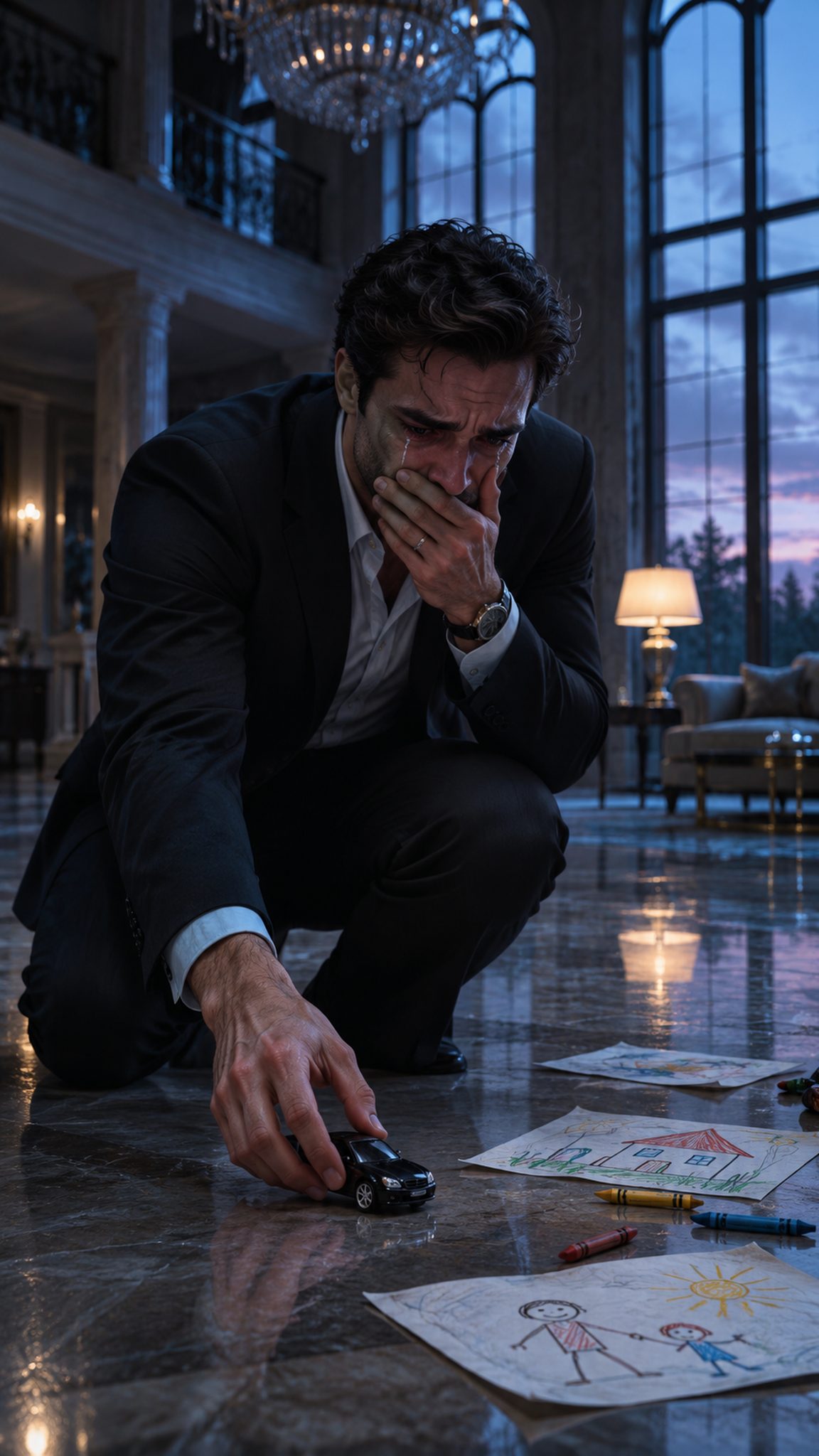
For a little while, we had been allowed to believe the worst was behind us. The operation had succeeded. Lucas had been moved to intensive care. His small chest rose beneath the blanket, and the monitor beside his bed kept its steady rhythm. Elena sat on one side of him. I sat on the other, afraid to move far enough that he might wake and find neither of us there.
Then the fever came.
A nurse noticed it before either of us understood what was happening. She checked the reading, checked it again, and called the doctor. More people entered the room. Someone adjusted the monitor. Someone else asked Elena when Lucas had last eaten and whether he had complained of pain. I stood up so quickly that my chair scraped against the floor.
“What is it?” I asked.
The nurse kept her voice calm. “His temperature is elevated. We're checking for a possible infection.”
Possible.
The word had become a door through which every terrible thought could enter.
Elena reached for Lucas's hand. I watched the nurse draw blood and watched the doctor examine the incision. They explained that fever could happen after a major procedure, but they would not dismiss it. They needed tests, observation, and time.
Time was the one thing I had never learned to respect until it became something I could not command.
The results did not give us an immediate answer. The team began treatment while they investigated the cause. The doctor explained the precautions and told us what changes they were watching for. I listened to every sentence. I asked questions when I did not understand. I did not pretend I knew more than the people caring for my son.
Elena looked at me once while the doctor spoke. There was exhaustion in her face, but also a small, guarded recognition that I was listening.
I wanted to tell her I would do anything. I wanted to promise that Lucas would be fine, that no more frightening news would come, that I could somehow take the fear from her and carry it myself.
I said none of those things.
I had made too many promises that depended on a future I could not control.
Instead, I moved my chair closer to hers.
“I'm here,” I said.
She did not answer, but she did not ask me to leave.
The fever settled for a time, then returned. The next complication came before dawn, when the monitor sounded an alert and the rhythm on the screen changed. A nurse entered, followed by a doctor. Lucas's heartbeat had become irregular.
Elena stood with one hand over her mouth.
I felt the room narrow around the bed. The doctor and nurses moved with practiced urgency. They checked Lucas, adjusted his monitoring, and reviewed the readings. One of them asked us to step back. I wanted to refuse. I wanted to put myself between my son and every frightening instrument in the room.
But there was nothing I could do by standing in their way.
I took Elena's hand and moved with her to the wall.
“Is he—” she began.
“I don't know,” I said.
It was the truth, and it was the hardest truth I had ever spoken.
The team worked until the rhythm settled. The doctor explained that irregular beats could occur during recovery after heart surgery, but the episode required close observation. They would continue monitoring him and respond if it happened again.
Lucas remained alive. His condition was fragile. Those two facts had to exist together.
When the room quieted, Elena lowered herself into the chair. I knelt beside her.
“I thought we had passed the worst of it,” she whispered.
“So did I.”
“I can't do this again.”
I had no answer that could make the fear smaller. I rested my forehead against her hand and stayed there until she drew a breath that was not quite steady.
Near morning, Lucas's condition worsened again. His temperature climbed, his heart rhythm became unstable, and the doctors ordered further tests. They spoke to us plainly. There was concern about infection and the strain his body was under after surgery. They were treating what they could treat and watching him closely, but the next stretch would matter.
Elena turned toward me.
For one terrible moment, neither of us spoke. We had both heard the same warning. We had both imagined the same empty room.
I took her hand. “We're staying with him.”
She nodded, but her eyes were fixed on our son.
The doctors did not promise us an easy recovery. They made adjustments to his care, monitored his response, and explained what they would do if his condition changed again. I listened. I wrote down the names of the medications and the questions we needed answered. When Elena was too exhausted to speak, I asked for her. When I did not understand an answer, I asked the doctor to explain it again.
I could not command Lucas's heart to heal. I could make sure I was present for every decision that concerned him.
By afternoon, the fever began to ease. The irregular rhythm became less frequent. The doctors remained cautious, and no one used the word safe as if it were a guarantee. But the numbers were moving in a better direction.
Elena leaned back and closed her eyes for the first time in hours.
I watched her face. The woman I had once treated as a permanent part of my life looked as though she had been carrying the weight of the world without help. I had made her do that. I had left her alone with medical appointments, frightening explanations, and a child who wanted his father. Now I could not undo those months. I could only refuse to leave her alone again.
When Lucas finally opened his eyes for a few seconds, his gaze moved slowly across the room. It found Elena first.
“Mom?” he whispered.
“I'm here, sweetheart.”
His eyes shifted toward me. He seemed to take a moment to recognize me.
“Dad?”
I moved close enough for him to see my face. “I'm here, Lucas.”
“Did you stay?”
The question entered me more deeply than any accusation could have.
“Yes,” I said. “I stayed.”
He looked at me for another moment, then let his eyes close. His fingers remained curled around Elena's hand.
I did not ask him to say anything else.
Recovery did not arrive as one great improvement. It came in small permissions. A little less fever. A longer stretch of steady rhythm. A few spoonfuls of food. A short conversation before Lucas grew tired. The doctors explained each step and reminded us that he needed rest. We learned not to treat a good hour as proof that the difficult hours were finished.
“Just a few more,” I told him one morning.
He frowned at the little breathing device. “It's boring.”
“I agree.”
“Then why do I have to do it?”
“Because it helps your lungs while your body gets stronger.”
He considered that. “Can you do it too?”
I picked up the spare practice device the nurse had shown us and followed his lead. My effort was clumsy enough to make him laugh.
“You're doing it wrong,” he said.
“Then you'll have to teach me.”
He showed me how to breathe slowly and steadily. I followed his instructions as seriously as if he were explaining a matter of state. When he finished, he looked pleased with himself.
“Better,” he decided.
“Much better, teacher.”
Elena watched from the window. The hint of a smile touched her mouth before she looked away.
The first steps came later, after the doctors were satisfied that he could try. A nurse helped him stand. Elena walked on one side, I on the other. Lucas held our hands, his small fingers tight around mine. We moved slowly down the corridor, stopping when he became tired.
He made it only a short distance.
But when he turned back toward his room, he looked at us with a quiet pride that made my throat ache.
“I walked,” he said.
“You did,” I answered.
“Both of you came.”
“We're both here,” Elena said.
I began to understand that atonement was not a speech delivered at the right moment. It was a pattern that had to hold when no one was watching.
I also had to end the life I had kept separate from my family, as if the damage could be contained by keeping its pieces in different rooms.
Serena called while Lucas was sleeping one afternoon. Her name appeared on the screen, and for a moment I stared at it without answering. There had been a time when I would have stepped away from my family to take that call. Now I looked at Lucas's resting face, then at Elena, who was reviewing the next appointment with a nurse.
I declined the call.
Then I knew that declining was not enough.
I asked Victor to arrange a brief meeting with Serena in a public place near the hospital, away from Lucas's room and away from Elena. I did not want a scene, and I did not want to use my men to intimidate her. I needed to say what I should have said long before.
I told Elena before I went.
“Serena called,” I said. “I declined it. But I need to end this clearly, in person. I won't leave the hospital for long. Victor can bring her to the café across the street, and I'll be back immediately.”
Elena's face tightened. “Why does she need to see you?”
“She doesn't need anything from me. I need to make sure there is no ambiguity. I won't leave a door open.”
She looked at me for a long moment. “Do what you think is right. But don't ask me to make you feel better about it.”
“I won't.”
Victor arranged the meeting. I went alone.
Serena was already seated when I arrived. She looked at me with a familiar expression, one that assumed she could read the room before I spoke.
“You finally answered,” she said.
“I came to end this.”
Her expression changed. “Adrian—”
“There is no relationship between us anymore. There won't be one again.”
She looked toward the window, then back at me. “Is this because Elena came back?”
“Elena did not make this decision for me.”
“Then what changed?”
“I stopped pretending I could keep two lives without destroying the people in one of them. I chose to betray my wife. I chose to miss my son's life. Those were my decisions.”
Serena folded her arms. “You can't blame all of that on me.”
“I'm not. I am not blaming you for my choices. I am telling you that I am ending this. Completely.”
She searched my face, perhaps expecting anger or some softer explanation that would leave room for another call.
There was none.
“Will you call me when things settle down?” she asked.
“No.”
“Never?”
“Never.”
I stood. “Do not contact Elena. Do not contact Lucas. Do not come to the hospital or our home. If there is anything practical to resolve, my attorney can handle it.”
“You're throwing everything away for them.”
I looked at her. “They were never something I should have risked losing.”
I left without waiting for an answer.
When I returned to the hospital, Elena was beside Lucas's bed. She looked up as I entered.
“It's over,” I said. “Completely. I told her there would be no calls, no visits, no return. I made it clear that my choices were mine, and I did not blame you or Lucas.”
Elena studied me. “And what did she say?”
“It doesn't matter. I won't reopen it.”
She looked toward Lucas, then back at me. “Thank you for telling me.”
It was not forgiveness. It was a small opening through which honesty might begin to pass.
“I am stepping back,” I said.
Victor did not pretend to misunderstand. “From what?”
“Daily control. The organisation. The decisions. All of it.”
Marco lowered his phone. “You mean temporarily?”
“No.”
Victor looked at me for a long moment. “Adrian, the timing could not be worse. The rivals who arranged the ambush will read this as weakness. Some of our people will challenge the transition. Others will try to take advantage.”
“I know.”
“You built the structure,” Marco said. “If you leave the centre, it won't simply keep running.”
“I am not asking it to keep running as it did. I am handing over daily control and beginning a formal separation from the operations. The legal businesses can be reviewed and handled lawfully. Anything criminal ends. I won't direct it from another room, and I won't put someone in charge as a mask for me.”
Victor's jaw tightened. “There are men who will not accept that.”
“Then they will have to accept the consequences through the proper channels. I won't start another war to preserve a title.”
“You could lose everything,” Marco said.
“I already nearly lost what mattered.”
The words silenced them.
Victor looked at the folder in his hands. “You understand that stepping away won't erase what you've done.”
“Yes.”
“And it won't guarantee your family is safe.”
“I know. We will use lawful protection where needed. We will cooperate with the authorities. But I won't keep the old machine alive and tell myself it is protecting them.”
Marco's expression softened slightly. “What do you want us to do if someone comes after you?”
“Document it. Report it. Protect people without escalating. No one touches Elena or Lucas. No one uses them to send me a message. If there is a credible threat, the authorities are informed.”
Victor closed the folder. “This is going to cost you.”
“It should.”
He held my gaze. “You may not be able to come back.”
“I am not planning to.”
For years, men had waited for me to speak because my decisions shaped their fortunes. That night, I spoke to them as a man who had finally understood the cost of being obeyed.
When they left, I returned to Lucas's room.
He was awake, looking at the doorway.
“Where did you go?”
“To speak with Victor and Marco.”
“Work?”
“Something I needed to finish.”
“Are you going back?”
I sat beside him. “Not tonight.”
“Tomorrow?”
“No. I'm changing the way I work. I won't be doing the things that kept me away from you.”
He looked at me carefully. “Does that mean you'll be here?”
“Yes.”
He seemed to weigh the answer. “Even when I'm better?”
“Especially then.”
He turned his head toward Elena. “Can Dad read the next chapter?”
“If you want him to,” she said.
“I do.”
So I read.
Later, when Lucas was awake and occupied with his drawing pad, Elena and I spoke about the divorce papers.
They had followed us into the hospital in everything but paper. The decision she had made months earlier was still there, and neither of us could pretend that my return had erased it.
“I don't want to leave this unresolved,” she said quietly.
“Neither do I.”
“I filed because I needed to protect Lucas. I needed a life where I wasn't waiting for you to decide whether we mattered.”
“I understand.”
“I need you to understand something else. Your being here now matters. But it doesn't erase the years before this week.”
“I know.”
“And if we rebuild, it can't be because we're frightened. It can't be because Lucas is ill and we want the picture of a family around him. He needs parents who are honest, whether we're married or not.”
I looked at her. “I want to be your husband. But I don't want you to stay because you feel you owe me another chance.”
“I don't.”
“Then what do you want?”
She looked at Lucas, who was coloring a house with a blue roof. “I want to see whether the man sitting beside him now is the man who will still be here when we go home. I want to see whether you can be present when there isn't a crisis forcing you to pay attention.”
“I can only show you.”
“Yes.”
“I won't ask you to withdraw the divorce papers today. But if you're willing, I'd like us to set the process aside while we work out what comes next. Not as a promise that everything is repaired. As a choice to give the truth a chance.”
She was silent for a long time.
Then she said, “I can agree to that. The papers can stay put for now. We don't have to make a final decision in this room. We can rebuild slowly, and Lucas comes first.”
“Lucas comes first,” I repeated.
“And honesty comes with it.”
“Yes.”
She reached across the narrow space between our chairs and touched my hand. It was not a declaration that everything was forgiven. It was not a return to the marriage we had before. It was a small, deliberate choice to see what we might become if I kept doing what I had begun.
I held her hand gently and did not ask for more.
Lucas looked up from his drawing. “Are you talking about me?”
“We're talking about all of us,” Elena said.
He studied us. “Are we going home together?”
The question made my chest tighten.
“If the doctors say you're ready,” I answered. “And if your mother agrees.”
Elena glanced at me, then at him. “We're working on it, sweetheart.”
Lucas nodded. He returned to his picture, apparently satisfied that the answer had not been no.
That evening, I helped him choose a story. He picked the one with the bear and the rabbit again. I read slowly, giving each character the voice he liked. When I finished, he asked whether I would read it tomorrow.
“If you want me to.”
“I will.”
“I'll be here.”
He looked at me. “You said that before.”
“I did.”
“And then you weren't.”
I felt Elena go still beside the window.
“You're right,” I said. “I said it before, and I didn't keep my promise. I can't change that. I can keep showing you what I mean now.”
Lucas looked down at the blanket. “How many times?”
“As many times as it takes.”
He seemed to consider that answer longer than a child should have to consider his father's reliability.
“Okay,” he said at last.
It was not complete trust. It was a beginning, and I treated it as something precious.
His doctor reviewed the latest results with us. The recovery was progressing, but they would continue to monitor his heart and watch for any return of fever or rhythm problems. There was still care to complete and instructions we would need to follow after discharge. The doctor did not promise a particular date. He said Lucas was moving in the right direction.
I thanked him and wrote down the guidance.
Elena asked about activity at home, medication schedules, follow-up appointments, and signs that should prompt us to call. I added the answers to the notes. We divided the responsibilities between us, not because either of us needed to prove something, but because this was how parents were supposed to work.
Later, Victor sent a message confirming that the transfer process had begun. The legal and business reviews would take time. Some men had objected. Others had accepted the change. There were risks, and there would be consequences. I read the message once and put the phone away.
Elena noticed.
“You don't have to ignore every call,” she said.
“I know. But nothing in that message needs me more than Lucas does.”
She looked at me for a moment. “That's new.”
“It should have been normal.”
She did not disagree.
As evening approached, Lucas grew tired. We helped him settle into bed. Elena checked his blanket. I placed his water within reach and set the book on the bedside table.
“Will you be here when I wake up?” he asked.
“Yes.”
“Not downstairs?”
“Right here, or just outside if the nurses need room. You'll know where I am.”
He nodded. “Okay.”
Elena kissed his forehead. I did the same, careful not to disturb him.
The doctor came by later with an update. Lucas was stable. His temperature had remained down, the infection concern was being managed, and his heart rhythm had been steady through the latest monitoring period. They would continue to observe him overnight. If he remained well and the next checks were reassuring, he might be able to go home the following day with a clear care plan and follow-up appointments.
“Tomorrow?” Lucas asked sleepily when the doctor had finished.
“Possibly,” the doctor said. “If everything continues as it is, we can talk about discharge tomorrow.”
Lucas looked at Elena, then at me. “Home?”
“Maybe tomorrow,” Elena said, smoothing his hair.
He smiled faintly and closed his eyes.
After the doctor left, Elena and I sat on either side of the bed. The hospital room was dim, lit by the monitor and the small lamp near the door. Lucas's breathing was even. His hand rested outside the blanket, close enough that I could touch it without waking him.
Elena leaned back in her chair.
“You look exhausted,” she said.
“I am.”
“You should sleep.”
“I will. In a minute.”
She studied me. “You don't have to stay awake to prove you're here.”
“I know. I just want to see him settled.”
“He is settled.”
I looked at Lucas. “I spent so long thinking that being needed meant being powerful. I don't want to confuse those things again.”
Elena's eyes softened, though the caution remained. “Then remember this room.”
“I will.”
“Remember the ordinary parts too. The appointments. The meals. The days when he's impatient and tired. The mornings when nothing dramatic happens. That's where you have to keep choosing.”
“I understand.”
She rested her hand on mine. This time, she did not pull away when I turned my palm upward and held it.
I knew we were not finished healing. Lucas still had a heart condition that required care. Elena still had every reason to be cautious. I still had consequences to face for the life I had led. Tomorrow would bring instructions, follow-up appointments, and the first steps of a different routine. None of it would be solved by a single night in a hospital room.
But Lucas was alive. He was stable. He was sleeping between us.
For the first time in longer than I could bear to measure, I was not thinking about the next meeting, the next threat, or the next demand from the world outside. I was thinking about breakfast at home, the book Lucas might ask me to read, the small things we would need to pack, and the promise I could make without pretending it was enough on its own.
I leaned close to his bed.
“Tomorrow, if the doctor says we're ready, we'll go home,” I whispered. “And we'll be home before dark.”
Lucas did not wake, but his fingers shifted lightly against mine.
I stayed beside him as the evening settled around the hospital room, listening to the steady monitor and the quiet breathing of my son.
Tomorrow, we would begin again.