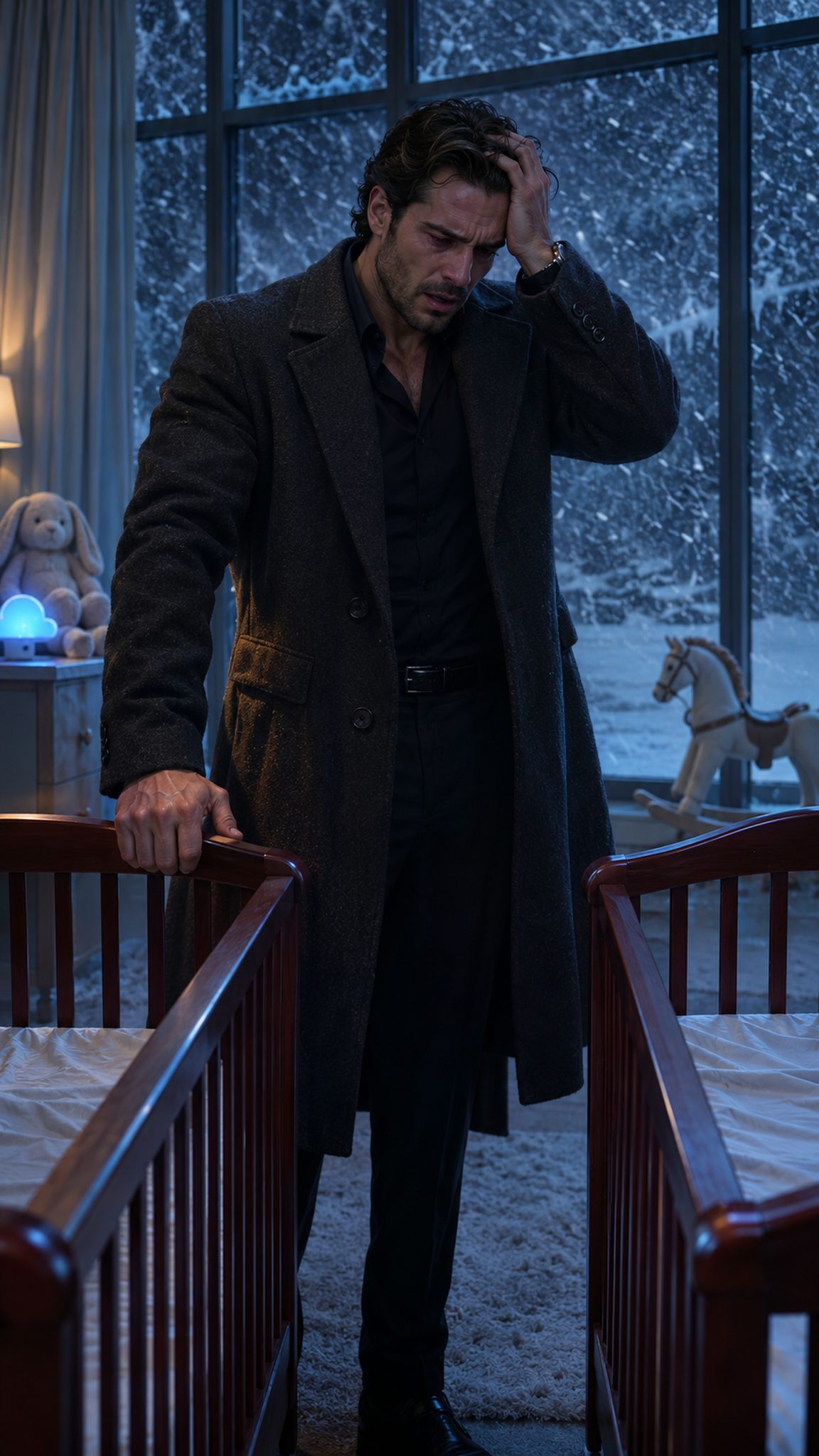
At 5:03 in the morning, I stood between two empty cribs while the worst snowstorm Chicago had seen in years battered the windows of my penthouse.
The blue nightlight painted the nursery walls in a color too soft for what I was seeing. Leo's mahogany crib stood to my left. Mia's stood to my right. Both were empty. Both fitted sheets were smooth except for the shallow indentation near the center of Leo's mattress, where his small body had rested hours earlier. Mia's white stuffed rabbit was gone.
I looked at the empty spaces as if staring hard enough could make my children appear.
“Nora?”
My voice sounded wrong in that room. Too loud, then too small. The snow slapped the floor-to-ceiling glass. Somewhere beyond it, Chicago was disappearing beneath white, but I barely heard the storm. I could hear only the silence where my son should have been fussing and my daughter should have been breathing in her sleep.
I checked the clock again. 5:03 A.M.
I had come home expecting the ordinary disorder of a young family: a bottle warming on the kitchen counter, a blanket thrown over the nursery chair, Nora asleep upright because Leo had been colicky again. Maybe Mia crying before I had both shoes off. I had expected to complain about the hour, kiss my wife without really waking her, and tell myself I would make up for another late night tomorrow.
Instead, both cribs were empty.
I stood there in my black wool coat, the collar still carrying cigar smoke and the faint sweetness of cherry-blossom lotion. The scent had followed me from the car, from the private elevator, from the woman whose name I had no right to bring home.
Sylvia.
I did not let myself think about her. Not yet. I stepped backward into the hallway and called again.
“Nora!”
No answer.
The nursery door remained open behind me. The soft blue light fell across the floorboards, catching the polished curve of the two mahogany cribs. I moved through the penthouse as if I had entered a house after a disaster and had not yet found the damage.
The front door stood open four inches.
I stopped in the marble foyer. The narrow gap showed only darkness and a slice of the private corridor. No broken lock. No splintered frame. No overturned console table. There was no sign that anyone had forced entry. I checked the biometric panel anyway, pressing my thumb against it and watching the green light confirm that the door had been opened by someone authorized to enter.
Nora had opened it.
The living room looked staged. The cushions were aligned. The glass coffee table was clear. The throw folded over the back of the sofa had been smoothed into a perfect rectangle. Nothing was overturned. Nothing had been dropped in a hurry. The room was clean in a way that made my skin tighten, because Nora had never cared about making the penthouse look untouched. She cared about keeping the babies fed, warm, and breathing. She cared about the next bottle and the next dose of medicine and whether Leo's breathing sounded different from the night before.
I crossed into the kitchen.
The refrigerator hummed. A glass sat upside down beside the sink. The counter was wiped clean. The bottle sterilizer was gone.
I stared at the empty patch of counter where it belonged. Its absence was so domestic, so deliberate, that it unsettled me more than a broken window would have. Nora had not simply carried the babies out. She had thought about what she would need when she got wherever she was going. She had taken the equipment that made feeding two premature infants safer and easier.
I opened the refrigerator. The formula was gone. The insulated medicine pouch that had been kept in the small nursery refrigerator was gone too. I looked at the shelves as if I might find a note tucked behind a carton, a clue that would tell me where she had taken them.
There was nothing.
“Nora, answer me.”
My phone was in my hand before I remembered taking it from my pocket. I called her. The call rang once, then went to voicemail. I called again. The same result. I sent a message asking where she was, then another telling her to answer immediately.
The words on the screen looked like orders.
I deleted the second message before I could send it.
I went to the master bedroom.
The bed was made. Nora's side was untouched, the pale coverlet smooth from pillow to edge. Her winter coats were gone from the wardrobe. So were her practical boots, the nursing sweaters she wore around the apartment, and two overnight bags she usually kept on the upper shelf. The drawers had not been emptied. Her jewelry box remained. A pair of earrings lay beside the lamp. She had taken what she needed, not everything she owned.
I opened the wardrobe again, although I had already seen the empty hangers. Her clothes had been arranged by season and weight. The gaps were unmistakable. Thick coats. Boots made for ice. Sweaters soft enough to wear while holding a baby against her chest. The things a woman would choose if she expected to be outside in a Chicago winter.
The storm had been building all evening. Every forecast had warned that the roads would become dangerous before dawn. The city had urged people to stay indoors. Nora had taken our premature twins into it anyway.
A cold pressure gathered beneath my ribs.
I went to the biometric drawer beneath my nightstand. My thumb opened it. The small interior light came on, illuminating the cash bundles and document sleeves exactly where I had left them.
Fifty thousand dollars in emergency cash remained untouched.
My backup passports were still there.
I checked the cash once, then again, as if a different number might appear if I counted carefully. The money was not missing. Nora had not taken it. She had left it in the drawer with the passports I kept for myself, the ones that could get me across a border if a business arrangement turned into a threat.
Her passport was gone.
The new passports issued for Leo and Mia after their early delivery were gone too.
I held the empty document sleeve in my hand. The difference was plain. She had taken the papers she needed for herself and the babies. She had left the money I believed could solve almost any emergency and the documents that could protect me.
That was when the truth settled.
No one had taken them.
Kidnappers did not pack infant medicine. They did not choose weather-appropriate clothes. They did not remove a bottle sterilizer, formula, diapers, and the insulated medicine pouch from a nursery refrigerator. They did not leave fifty thousand dollars behind when it was sitting in an unlocked path to a better life.
My wife had left me.
For several seconds I could not move. I had faced men who wanted me dead without giving them the satisfaction of seeing fear on my face. I had sat across from judges, rivals, and men who mistook my silence for hesitation. I had built an organization that could find a person in another country before the person knew anyone was looking.
But I did not know where my wife had gone.
I did not know where my children were.
I looked down at my coat. The cherry-blossom scent rose from the wool when I moved. It was faint, but it was there. Sylvia. She wore it on her wrists and at the base of her throat. I had noticed it in the elevator on the way down from her apartment. I had noticed it when she leaned close to speak. I had noticed it when I told myself the night had been a mistake that could be contained.
Now it was on the coat I had worn through my own front door.
Nora would have smelled it.
The thought struck harder than the discovery of the empty cribs. She would have known. Perhaps she had known for longer than I wanted to imagine.
Memory came in pieces, each one small enough to excuse on its own and ugly when placed beside the next.
Nora had stopped asking when I would be home.
At first I had taken it as a blessing. I had told myself she understood the demands of my life. She no longer called at midnight to ask whether I was coming upstairs. She no longer sent messages asking me to be quiet when I entered because Leo had finally fallen asleep. When I came in after two, she would glance up from the nursery chair, check the clock, and return her attention to the baby in her arms.
I had mistaken her silence for acceptance.
I remembered one night when Leo cried for nearly an hour. I had stood in the doorway with my tie loosened, exhausted and irritated by a sound I could not command to stop. Nora was barefoot, her hair twisted into a loose knot, Mia tucked against her chest while she rocked Leo's crib with one hand.
“Can you take him for a minute?” she had asked.
“I have an urgent meeting.”
“You just got home.”
“It can't wait.”
She had looked at me then. Not angrily. That would have been easier. Her eyes had moved over my face as if she were trying to recognize the man standing in front of her.
“All right,” she had said.
I had left the room.
The meeting had been Sylvia.
I pressed my palm against the edge of the dresser. The memory was so clear I could see the warm light from the nursery lamp and the tiny crease between Nora's brows. I had told myself the meeting was necessary. I had told myself I was allowed one private corner of a life that demanded everything from me. I had told myself Nora and the babies were safe, comfortable, protected.
Protected by what? By the money in the drawer? By the guards downstairs? By the locks and cameras and men who answered my calls?
None of those things had kept my wife from deciding that the safest place for our children was somewhere I could not reach.
I called the head of building security.
“Mr. Rinaldi,” he answered immediately.
“Tell me when my wife left.”
There was a pause. “Sir?”
“The front door is open. The children are gone. Check every camera and every access log. I want the time, the elevator, the garage, all of it.”
“Yes, sir.”
“And do not send anyone after her yet.”
Another pause. “Understood.”
I ended the call and looked again toward the nursery. The order had come out of me before I had fully understood it. I wanted to find her. I wanted to put every available person on every road, every station, every hospital. But I also knew what the sight of my men would mean to Nora if she was already frightened enough to leave in a blizzard.
She might run again.
I could not let myself picture her carrying two premature infants through snow deep enough to swallow the curb. I imagined the practical boots I had seen missing from the wardrobe, the heavy coat wrapped around her, one baby secured against her chest and the other in a carrier. I imagined the wind pushing at her, the cold finding every gap in her clothes. I imagined her stopping somewhere to check a bottle or adjust a blanket while the storm thickened around her.
I did not know if that was what had happened. I knew only that she had prepared for it.
The nursery offered more evidence. The diapers were gone. The formula was gone. The medicine pouch was gone. Mia's white rabbit was gone. Nora had not taken the expensive things. She had taken the things that mattered to two small children who had arrived before the world was ready for them.
Leo's fitted sheet still held the faint impression of his body. I touched it with two fingers. The fabric was cool. The indentation was already fading.
I remembered the hospital room where the twins had first been placed in our arms. They had been so small that every movement seemed enormous. The nurses had explained feeding schedules, temperature checks, warning signs, and the medicines we had to keep close. Nora had listened to every word. She wrote everything down. She asked questions until she understood. I had signed forms, made calls, and arranged security. I had thought my part was to make sure no one could get near them.
Nora had learned how to care for them.
I had learned how to leave.
The phone vibrated. Security was calling back. I answered.
“We're reviewing the internal cameras now,” the guard said. “The storm is affecting the exterior feeds. We have a gap near the service entrance.”
“Did she leave through the private elevator?”
“We're checking.”
“Check the garage too. Every vehicle that exited after midnight.”
“Yes, sir.”
“Do not use the word kidnapping on the radio. No police alert, no public notice, no one approaches a woman carrying two infants unless I authorize it.”
“Understood.”
I ended the call. I could hear the command in my voice, the familiar certainty that made people move quickly. It had worked in every room I had ever entered. It did not make the empty cribs less empty.
I walked to the floor-to-ceiling windows. Snow pressed against the glass in thick, shifting sheets. Far below, the city lights were blurred and distant. The streets I knew by heart had become pale corridors, and the lake wind drove the storm between buildings with a force that made the towers seem to shudder.
Somewhere in that weather, Nora was trying to keep Leo and Mia warm.
I looked at my reflection. The man in the glass wore an expensive coat and a face trained not to reveal anything. He looked like the man Chicago feared. He did not look like a father who had come home too late.
The cherry-blossom scent was still on me.
I pulled off the coat and dropped it over the back of a chair. The movement did not remove the smell from the room. It did not remove the memory of Sylvia's hand resting on my sleeve or the way I had let her believe that she could have a place in my life without consequence.
I had treated betrayal as something that happened in private, separate from the rest of my responsibilities. I had imagined I could keep it away from the nursery, away from Nora's hands and the babies' blankets. I had believed that if I never said the truth aloud, it could not become part of our home.
But the scent had come through the front door with me.
Nora had not needed a confession.
I returned to the bedroom and opened the drawer again. The cash sat in neat bundles. Fifty thousand dollars. A sum that could buy transportation, shelter, food, medical care, and a dozen false explanations. It could pay people to search every road out of Chicago. It could purchase information from men who sold secrets for less than the cost of a watch.
It could not tell me whether Mia had enough formula.
It could not tell me whether Leo's medicine was still at the right temperature.
It could not tell me if Nora had found somewhere warm before the storm became impassable.
I had spent years believing that every problem had a price. If a man refused to cooperate, I found the price that would change his mind. If a door was closed, I found someone who could open it. If a threat appeared, I removed it before it reached my family.
Now the money remained untouched, and the people I wanted most were beyond my reach.
I sat on the edge of the bed. Nora's pillow was in its usual place. The coverlet on her side was smooth. I could not remember the last time she had slept there beside me for an entire night. I could remember her falling asleep in the nursery chair, her head tipped against the cushion, one hand resting near a baby's blanket. I could remember waking her once to tell her she should go to bed.
She had answered, “I'm fine.”
I had accepted that answer because it allowed me to leave again.
I tried to remember whether she had looked at me when she said it. I could not.
My phone lit up with a message from security. They had found no sign of forced entry. The private elevator records were being retrieved. The garage cameras were still under review. There was no confirmed route.
No confirmed route.
I read the words twice. The man who could find almost anyone had no direction to follow.
I opened Nora's contact and stared at her photograph. It had been taken in the hospital after the twins came home. She was holding Mia, with Leo asleep in the crook of her other arm. Her hair was loose. Her face was tired, but she was smiling down at them. I stood beside her in the photograph, one hand on her shoulder, looking toward the camera as if the photographer had interrupted something important.
I had saved that picture because I thought it proved I was happy.
Now I wondered what Nora had seen when she looked at it.
I called once more. Voicemail.
I did not leave a message. What could I say that would not sound like another demand? Come home. Tell me where you are. Let me fix this. I could hear the words before I spoke them, and every one of them placed my need ahead of hers.
I had no right to ask her to make me feel better.
Still, fear kept pushing the same question through my mind: what if the storm caught them before I could find them? What if one of the babies became ill? What if Nora had nowhere to go? What if she had made this decision because she believed staying with me was more dangerous than walking into a blizzard?
That last possibility stopped me.
I looked at the open nursery door. I looked at the empty cribs. I thought of all the ways I had made the penthouse secure and all the ways I had made it unbearable for the woman living inside it.
The front door remained open four inches. Cold air from the corridor moved faintly through the foyer. I crossed the room and closed it, then stood with my hand on the brass handle.
I had always thought a locked door meant safety.
For Nora, perhaps it had meant there was nowhere left to go.
At 5:03 in the morning, I had come home smelling like another woman and found both cribs empty. I had lost no money, no territory, no influence. My backup passports were still in their drawer. My men were waiting for instructions. Every instrument of power I had built remained within reach.
Only my family was gone.
I rested my hand on the empty crib rail again, careful not to disturb the fading indentation in Leo's sheet. For the first time in my adult life, I faced a question money could not answer.
What if the people I loved weren't missing?
What if they were hiding from me?