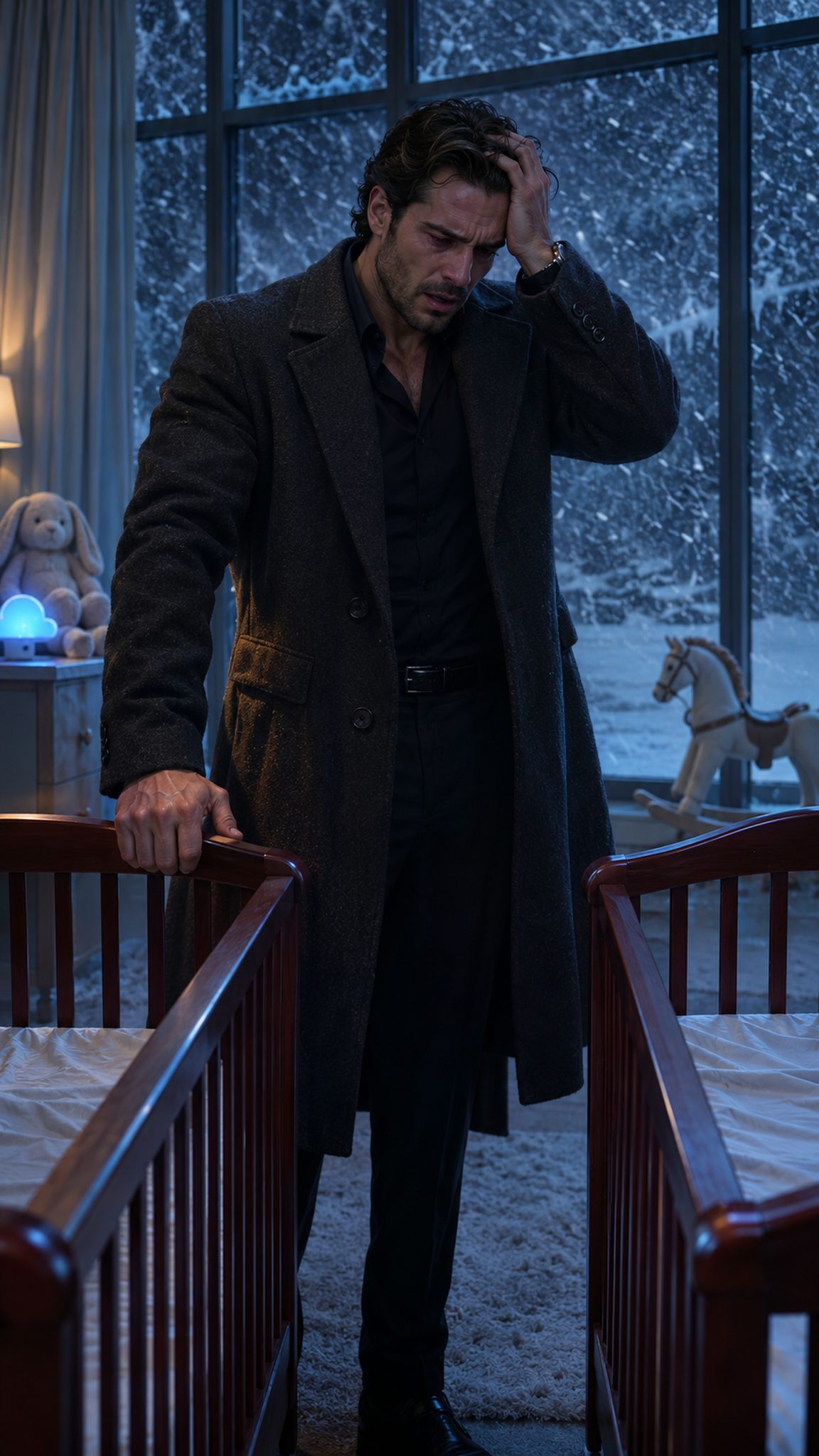
The question remained in the nursery with me.
What if the people I loved weren't missing? What if they were hiding from me?
I stood between the two mahogany cribs, listening to the storm strike the windows. The blue nightlight made a small pool of color on the carpet. Beyond it, the room was familiar down to the smallest detail, and yet nothing in it seemed to belong to the life I had believed I was living.
I looked at the cribs again.
I had built a reputation on finding people. Men who thought a new name would protect them learned that names could be traced. Men who crossed state lines discovered that distance was only a delay. Men who disappeared into the noise of Chicago eventually learned that someone had remembered the car they drove, the bar they visited, the cousin they trusted, or the debt they had forgotten to pay.
I had found men in hotel rooms under borrowed identities. I had found a bookkeeper who had crossed three states with a suitcase full of cash. I had found a witness who believed a different haircut and a rented apartment made him invisible. I had found people who had spent months planning their disappearances, and I had found them because I understood how people moved when they were afraid.
But I had never considered that the person I was looking for might be my wife.
My gaze shifted to the empty space beside Leo's crib. I could still picture Nora standing there, one hand on the rail, her hair loose around her shoulders. She used to lean over him and speak so softly that I could barely hear her from the doorway. Sometimes she sang. Sometimes she told him what the weather was doing beyond the windows, as if he could understand the snow gathering on the glass.
I had heard those quiet conversations and thought they were sweet. I had not understood how much of her day was made of moments like that: small, repeated acts of attention that held a fragile life together.
I knew how to recognize a threat. I knew how to read a room when a man entered with a concealed weapon or a lie he had practiced too carefully. I could hear the change in a voice when someone was preparing to betray me. I could notice a driver taking a different route or a guard looking toward the wrong door.
I had not noticed my wife growing lonely.
The distinction was difficult to bear. I had spent years teaching myself to see what other people missed. I had made a profession out of details. Yet the most important changes in my own home had happened in plain sight.
My father had taught me that information was power. He taught me to remember names, faces, habits, and debts. He taught me that a man who waited for trouble to announce itself had already lost. When I was young, I thought those lessons made him invincible. Later, I understood that they had made him feared, and that fear was the closest thing to loyalty he knew how to demand.
I had inherited his world before I was old enough to understand what it would cost.
At eighteen, I learned that a promise could be more dangerous than a threat. At twenty, I learned that men would smile while calculating how much they could take from you. By the time I was thirty, the Rinaldi name had become a warning in rooms where people lowered their voices when I entered.
I did not become Chicago's most feared man in one dramatic night. There was no single moment when the city decided I was dangerous. It happened through years of decisions, each one teaching someone that I would remember an insult, a betrayal, or an unpaid debt. I learned to keep my expression still. I learned to let silence do the work of anger. I learned that a man who never had to repeat an order could make other men nervous simply by looking at them.
My organization grew because I was patient when patience served me and relentless when it did not. I knew which businesses were legitimate and which ones were only respectable from the street. I knew which officials wanted favors, which partners wanted protection, and which rivals would wait until a weakness appeared. I had people who could tell me when a warehouse door opened after midnight or when a familiar car appeared outside a building where it did not belong.
I had become the man people called when someone could not be found.
The irony was so sharp that I almost laughed.
There were men who would have given anything to have my resources. I had money in accounts across several institutions, properties under different companies, drivers, security teams, lawyers, and people who owed me favors. I could make a call and have a dozen people moving before the conversation ended.
But I had not made a call.
I was still standing in the nursery, because the first thing I needed to understand was what Nora had chosen to leave behind.
The money in the biometric drawer had been a decision. Fifty thousand dollars, untouched. I could see the neat stacks in my mind, exactly where I had placed them. Emergency cash, enough to pay for a safe room, transportation, medical help, or anything a sudden crisis might require. I had put it there because I believed I could anticipate every emergency.
Nora had known it was there. She had left it.
That was not forgetfulness. She knew where the drawer was. She knew the code. She knew what the cash was for. She had chosen not to take it, and I could not decide whether the choice meant she had other resources or whether she simply refused to use money that came from me.
My backup passports were still there too. Their sleeves sat beside the empty space where her passport had been. The new passports for Leo and Mia, issued after their early delivery, were gone. She had taken the documents that belonged to herself and the children. She had left mine.
A man could build a life around the belief that every problem had a price. He could keep cash ready, maintain several identities, arrange transport, and make sure every door opened when he wanted it to. I had done all of that. Nora had looked at the same resources and decided they were not what she needed.
I looked at the medicine pouch's empty place in the nursery refrigerator. That absence frightened me more than the missing money. The twins had been born too early. Their care required attention, not improvisation. Nora knew the instructions. She knew what needed to stay with them and what could not be left behind. She had taken the insulated pouch because the medicine mattered.
She had taken the diapers and formula. She had taken warm clothes. She had taken two overnight bags. The practical details formed a picture I could not escape: Nora had considered the children first, then herself. She had packed for the weather. She had planned for feeding, changing, and medicine. She had not left them to chance.
I should have been relieved by that.
Instead, I felt the terrible weight of knowing that she had prepared to do it without me.
My eyes returned to the fitted sheet in Leo's crib. The faint indentation remained near the center. It was barely visible, but I could not look away. A small body had rested there. A small body I had held, though not often enough. I remembered the first time Leo's fingers closed around mine. His hand had seemed impossibly small, his grip more reflex than choice. I had told Nora he was strong.
She had smiled and said he had to be.
Mia had arrived with a different kind of quiet. She watched faces longer. She settled when Nora spoke close to her ear. Her white stuffed rabbit had become part of the routine, and Nora had kept it within reach. The rabbit was gone now. That detail told me she had remembered the comfort Mia needed even while preparing to leave everything familiar.
I pressed my fingers against the crib rail.
The wood was smooth beneath my palm. I had approved the cribs because they were solid, beautiful, and made to last. I had considered the room's design, the security of the windows, the temperature controls, and the distance between the cribs. I had paid for every detail.
Nora had made the room a nursery.
I had made it a project.
The difference seemed obvious now. It had not seemed obvious when the twins came home.
Their early weeks had been a blur of hospital corridors, quiet instructions, and the strange machinery of keeping two tiny lives stable. I remembered the monitors and the soft light in the neonatal unit. I remembered standing beside the beds while nurses explained feeding schedules and warning signs. I remembered Nora listening with a concentration that made the rest of the room disappear.
She asked questions. She wrote things down. She repeated instructions until she was certain she understood them. When a nurse showed her how to hold Leo, Nora adjusted her hands carefully and watched his face. When Mia needed attention, Nora was already leaning toward her.
I had listened too. I had asked about their progress and signed forms. I had made sure the bills were handled and the private room was available when it was appropriate. I had arranged additional security for the family and told the hospital administrator that the twins would receive whatever care they needed.
I had mistaken those things for being equally involved.
The truth was that I had been present for important moments and absent from the ordinary ones that followed. I had come and gone. Nora had remained.
At home, the days became a pattern of feeding, medicine, laundry, appointments, and attempts to sleep between cries. The twins did not understand that their father had responsibilities beyond the penthouse. They did not understand meetings or contracts. They knew hunger, discomfort, warmth, a familiar voice, and the arms that lifted them.
Nora learned their rhythms. She could tell when Leo's crying meant he was hungry and when he needed to be held longer. She knew how Mia settled when the room was quiet. She could prepare a bottle while checking the time and listening for the other baby. She moved through the nursery at night with a tired confidence that came from repetition.
I loved them. I did.
But love had become something I felt when I was in the room rather than something I practiced when the room needed me.
I remembered the first night I complained about the crying. It was after two. I had returned from a long evening of meetings and had fallen asleep only to be woken by Leo. The crying seemed endless. Nora was in the nursery, moving slowly with him against her shoulder. Mia had begun to fuss in the other crib.
I stood in the doorway and asked whether someone could take care of it.
Nora looked at me. “I am taking care of it.”
“I have an early meeting.”
“So do I,” she said.
I had been irritated by the answer. I told myself I had spent the day handling problems that affected the family's future. I told myself that she was better at the babies' routine and that my presence would only make the night more difficult.
I did not ask what she needed.
I went back to bed.
The memory was so clear that I could almost hear the nursery door closing. I had treated her exhaustion as an inconvenience because I had decided my own exhaustion mattered more.
Another night, I had found her sitting in the chair with Mia against her chest and Leo finally quiet in his crib. The room was dim. Nora's head had tipped back against the cushion. She looked as if she had fallen asleep sitting up.
I stood there for a few seconds. I could have taken Mia. I could have asked Nora to lie down. I could have sat beside her and watched the babies while she slept.
Instead, I checked my phone.
There had been a message from the office. A contract needed approval. I stepped into the hall to answer it, telling myself I would return in a moment.
I did not return until much later.
The nursery held every version of that failure. The chair where she had slept upright. The refrigerator where she kept the medicine. The cabinet where the diapers had been. The empty place where Mia's rabbit belonged. I could see the life she had lived in the room more clearly now that she was no longer there to move through it.
I had believed my absence was temporary. One meeting, one night, one emergency at a time. I had not understood that a marriage could be emptied by a thousand small departures.
My phone lay in my coat pocket. I could feel its weight, and I knew how easy it would be to use it. One call could summon my chief of security. Another could put the building's camera feeds on a screen. Another could begin the quiet process of checking hospitals and transit records.
I did not take it out.
Chapter 4 would begin with the search. Not yet. These minutes still belonged to the moment before I moved, when the facts had arrived but my mind had not accepted what they meant.
I looked toward the bedroom. The bed was made. Nora's side was untouched. I remembered how she used to leave a glass of water on my nightstand when she knew I would come home late. She stopped doing that. I had noticed the missing glass once and asked the housekeeper whether the tray had been moved.
I had not asked Nora.
I remembered her winter coats hanging in the wardrobe. She had chosen them for warmth, not appearance. She wore practical boots when the sidewalks iced over and nursing sweaters that made it easier to feed the twins. I used to tease her about wearing the same two sweaters. She would smile and say they were comfortable.
Now the hangers were empty.
I had thought of those clothes as ordinary. I had never considered that they were the things she would need if she had to leave in bad weather with two infants.
The storm outside intensified. Snow swept past the windows in thick, slanting sheets. The glass trembled faintly under the wind. I pictured Nora moving through that weather with one carrier in each hand or one against her body and another close beside her. I could not know the exact way she had managed it. The uncertainty made my mind fill with possibilities, each worse than the last.
Were the babies warm? Had she found shelter? Was there someone with her? Had she planned the route before the snow became this heavy? Had she waited until I was gone because she believed she could not leave if I was home?
That last question held me still.
Had she been afraid I would stop her?
I wanted to say no. I wanted to believe she knew I would never keep her against her will. But I had spent years making people obey me. I had built a home surrounded by guards and controlled entrances. I had treated my decisions as final. Even when I had not raised my voice, the people around me understood that refusal came with consequences.
Nora had lived inside that world.
Perhaps she had not feared that I would hurt her. Perhaps she had feared that I would simply decide she was not allowed to go. That I would call it protection. That I would tell her she was exhausted and upset and did not know what she was doing. That I would take the children into my arms and make the decision for her.
I could imagine myself saying those things. I could imagine the certainty in my own voice.
The thought made me look down at my hand on the crib rail.
I had never struck Nora. I had never needed to. Power did not always announce itself through violence. Sometimes it was the knowledge that one person could make a hundred calls and the other person would have to live with the consequences.
I had mistaken the absence of physical harm for proof that I was a safe husband.
It was not proof.
The clock on the nursery wall moved forward. The minute hand seemed louder than it should have been. I counted the seconds without meaning to, then stopped when I realized I was doing it.
Five minutes had passed since I understood.
Five minutes in which I had not moved beyond the nursery door.
I thought of the first time I met Nora. I remembered the way she had looked directly at me, not at the men behind me or the car waiting outside. She had not seemed impressed by the name. She had asked me a question and waited for a real answer. I had liked that she did not rush to fill silence. I had liked that she could disagree without trying to win.
She had made me feel that I could be a man before I was a reputation.
I had promised her a life where she would not have to be afraid. I had promised that my work would never come before our family. At the time, I believed those promises. I had meant them.
But meaning a promise was not the same as keeping it.
The first years of our marriage had been easier. I came home more often. We ate late dinners in the kitchen. Nora would tell me about the clinic, about a family she had helped, or about something she had read. I would tell her about the parts of my day I could safely share. Sometimes she would sit beside me while I reviewed papers, her feet tucked beneath her, and I would reach for her hand without thinking.
Then the organization grew. More people depended on my decisions. More rivals tested the boundaries. I began to treat every problem as urgent and every evening as available time. I missed dinners, then weekends, then small plans that Nora stopped making because she had learned not to count on me.
I told myself she understood.
She had never agreed to that arrangement.
I looked at the empty cribs again. The babies had changed everything, as children do. They had made time more precious and sleep more fragile. They had made Nora's need for me impossible to mistake. Yet I had found ways to mistake it anyway.
I had complained about the crying. I had complained about being woken. I had complained that the nursery lights were on when I came home. I had asked whether the staff could take a shift, as though the question were about staffing rather than being a father.
Nora had listened. Sometimes she answered. More often she became quiet.
I had taken her quiet as agreement.
Now I wondered how many times she had wanted to tell me that she was reaching the end of what she could carry. How many times she had looked at me and decided there was no point asking again. How many times she had stood in this room, with one baby in her arms and another crying, and understood that the man who could make an entire city respond to his voice could not be counted on to answer hers.
The thought was almost unbearable.
I moved from Leo's crib to Mia's. The white rabbit was gone, leaving the mattress bare. I lowered my hand to the rail but did not touch the sheet. I could not bear to disturb the faint evidence that she had been there.
I remembered the day the twins came home from the hospital. Nora had been careful at every step. She checked the carriers, the blankets, the temperature in the car. She asked the nurse one more question before we left. I had stood beside her and told her everything was ready.
She had looked at me and said, “We have to keep being careful.”
I had answered, “We will.”
She had meant every feeding, every medicine dose, every night. I had meant that I had paid for the right equipment and arranged the right people.
We had used the same word and meant different things.
I returned to the center of the nursery. The blue light touched the front of my coat. Somewhere beneath the wool, the faint scent of cherry blossom seemed to rise again. Sylvia's lotion. A trace that had followed me home more than once.
Nora had known.
I could no longer pretend she had discovered the affair only when she left. She had seen the pattern before I had admitted there was one. She had watched me return late. She had heard the excuse of urgent meetings. She had noticed the smell. She had watched me complain when the twins cried and then leave her alone with them.
She had stood barefoot in the kitchen with Mia against her chest while I told her I had an urgent meeting. She had not asked me to stay. I had read that silence as permission to go.
Now I understood that she had already known where I was going.
I looked at the clock again.
The minute hand had moved, but it had not reached the hour I feared. It was still only a little after five. Five minutes had passed since I understood what the empty room meant, and I was still standing where the truth had found me.
My hand remained on the polished rail between the two cribs. The blue nightlight washed over my fingers. Beyond the windows, snow kept striking the glass, covering the city in a white silence that made every distance seem greater.
I thought about what I would do when I finally moved. I would need to keep the search quiet. No police broadcast, no public alert, no announcement that might expose Nora or frighten her away from the help she had chosen. I would have to remember that she had taken the twins deliberately, and that finding them did not give me the right to decide what happened next.
But those were decisions for the next few minutes.
For now, I could not make myself leave the nursery. I could only look at the empty mahogany cribs and imagine Nora carrying our children through the storm, prepared in ways I had never bothered to understand.
The clock showed 5:08.
I stood between the cribs, my hand still resting on the rail, and let the silence tell me what my pride had refused to hear: the people I loved had not simply disappeared. They had chosen to get away from me.
And I had to face the possibility that they had good reason.