The next call came on a Thursday morning, three days after Nora had spoken to me.
I was in the nursery, checking the feeding notes I had rewritten in my own hand, when my phone rang. Margaret's name appeared on the screen.
“Victor,” she said, “Nora is willing to meet you.”
I stopped turning the page.
“Where?”
“She suggested the clinic. The small courtyard behind it. Tomorrow, at eleven.”
“I'll be there.”
“There are conditions.”
“Tell me.”
“You come alone. No driver waiting outside, no security detail across the street, no one following her afterward. You don't ask where she's staying. You don't ask her to come home. If she wants to leave after five minutes, you let her.”
“I agree.”
Margaret was quiet for a moment. “Then perhaps this meeting can happen.”
After the call, I stood in the nursery longer than I needed to. Tomorrow I would see Nora. I might see Leo and Mia. The thought filled me with a hope so sharp that I was afraid to move in case I frightened it away.
I did not tell my men. I did not ask anyone to check the clinic or the roads around it. I did not arrange a car to wait nearby. I took the appointment as it had been offered: a place, a time, and a boundary.
The next morning, I drove myself. The city was still recovering from the storm. Snow remained in dirty banks along the sidewalks, but the main roads were clear. The sky was pale and bright, and sunlight flashed on the wet pavement. I parked several blocks from the clinic and walked the rest of the way.
The courtyard was small, enclosed by brick walls and sheltered from the wind. A bare tree stood beside a bench. Someone had swept the path, though a thin line of snow remained along the edges.
Nora was already there.
She stood near the bench wearing a dark winter coat and practical boots. Her hair was pulled back, and her face looked thinner than I remembered. She held Mia against her chest in a warm carrier. A second carrier rested beside her, with Leo inside. Both babies were bundled carefully. Mia's white stuffed rabbit was tucked beside her, one soft ear visible above the blanket.
For a moment, I could not speak.
Nora looked at me. “Hello, Victor.”
“Hello, Nora.”
I stayed where I was. I did not rush toward her. I did not reach for the babies. I waited until she gave a small nod toward the bench.
“You can sit,” she said.
I sat at the other end, leaving space between us.
Leo made a small sound inside his carrier. I turned toward him, then stopped myself from leaning closer.
“Are they well?” I asked.
“They're doing better. They're growing.”
I swallowed. “I'm glad.”
“Mia still likes her rabbit.”
I looked at the white ear showing above the blanket. “I remember.”
Nora adjusted the carrier strap. Her movements were practiced and careful. I watched the way she checked Mia's blanket, then glanced at Leo. She had done this countless times without me. The sight hurt, but I did not let the hurt become an accusation.
“I want to thank you for meeting me,” I said.
“Margaret thought it might help.”
“I know.”
“That doesn't mean I've decided anything.”
“I understand.”
She looked at me for a long moment. “You said that on the phone.”
“I meant it then. I mean it now.”
The courtyard was quiet. A delivery truck passed on the street beyond the wall. Somewhere inside the clinic, a child laughed.
Nora looked down at her hands. “I didn't leave because I wanted you to chase me.”
“I know.”
“I left because I couldn't keep living that way. I couldn't keep waiting for you to come home. I couldn't keep wondering whether the next urgent meeting was real or whether you were with her.”
I held her gaze. “Sylvia.”
“Yes.”
“I ended it.”
“I know you told Margaret.”
“I ended the affair before I spoke to you about it. I told Sylvia the truth. I told her I had chosen to betray my marriage, and I wasn't going to blame her for choices I made. I ended the personal relationship completely. I also arranged for her work to be separated from mine so there would be no private contact.”
Nora's face remained still. “Did you tell her you loved her?”
“No. I told her I had wanted the attention and the escape. I told her I had let her believe something that made it easier for me to keep lying. I didn't pretend the affair was meaningless, but I didn't call it love to excuse it.”
“Why should I believe that?”
“You shouldn't have to believe it because I say it. You can judge what I do from here.”
She looked toward the babies. “You always had an explanation.”
“I know.”
“You said the meetings were urgent. You said you were doing everything for us. You said you were tired because you worked all day. I was tired too, Victor. I was frightened all the time those first weeks. They were so small. Every feeding mattered. Every medicine instruction mattered. I needed you to be there.”
“I should have been.”
“You weren't.”
“No.”
The word sat between us. I did not soften it with a reason.
Nora's eyes shone, but she did not cry. “Do you know what it was like to stand in the kitchen with Mia and ask you to hold her for five minutes? You looked at your phone and told me to ask the staff.”
I remembered the moment exactly. The bottle warming beside the sink. Leo crying in the nursery. Nora barefoot on the marble with Mia against her chest. My keys in my hand.
“I remember,” I said.
“I wondered if you even saw me.”
“I saw you. I chose to leave anyway.”
She looked away. “That was worse.”
“I know.”
For a while, neither of us spoke. I could hear Mia breathing softly against Nora's coat. Leo shifted in his carrier, then settled.
“I've been learning their care,” I said at last. “Not because I expect you to bring them back. I went through the instructions with the nurse. I practiced preparing bottles, learned the medicine records, and went over the signs that mean I need to call the doctor. I learned the routine for when Leo is unsettled.”
Nora looked at me. “You practiced with a doll?”
I nodded, almost embarrassed. “Yes.”
A small, unwilling smile touched her mouth. “You used to say you didn't need instructions.”
“I did need them. I was too proud to admit it.”
“Leo never cared about your pride.”
“No. He only needed me to hold him properly.”
She looked down at the carrier. “He likes being walked slowly. Not too much movement. And he needs a little time after feeding.”
“I remember the nurse explaining that.”
“Remembering isn't the same as doing.”
“I know.”
She studied me, perhaps searching for the old impatience. I kept my hands folded and waited.
“What about your business?” she asked.
“I stepped back from the violent operations. The legitimate companies are being managed through professionals. Disputes go to lawyers. Threats go to the authorities. I won't send men to collect debts or punish people.”
“And Varga?”
“He tried to take the western contracts. We lost one lease. The rest are being handled legally.”
“You let him take it?”
“I let the lawyers contest it. I didn't send men after him.”
“Because of me?”
“Because of what I finally understood. I don't want our children growing up believing that fear is how a man solves every problem. I don't want you to have to wonder whether a disagreement will become another reason for violence.”
Nora looked toward the courtyard gate. “You could have changed before I left.”
“Yes.”
“Why didn't you?”
I could have offered the familiar answers: pressure, responsibility, inheritance, the demands of the organization. None of them would have changed the truth.
“Because I believed I could keep everything and make you live with the cost,” I said. “I thought providing money and security meant I was doing my part. I thought you would always be there. I was selfish, and I used my work as an excuse.”
She looked at me again. “I didn't need a bigger house. I needed my husband.”
“I know that now.”
“I needed you at two in the morning when Leo cried. I needed you to take Mia so I could sleep. I needed you to sit beside me after the hospital appointments and ask how I was doing. I needed you to stop making me feel guilty for being tired.”
“I should have done all of it.”
“Yes.”
“I can't give you those nights back.”
“No.”
“But I can stop making the same choices.”
She was quiet. Then she reached down and adjusted Leo's blanket. “He has been asking for you without knowing who you are.”
The words struck me harder than anger.
“I know he doesn't remember me,” I said.
“He knows voices. He knows being held. He'll have to learn you.”
“I would like the chance.”
“Not today.”
I nodded. “Not today.”
Nora studied me for another moment, then looked at Mia. “Would you like to say hello to them?”
“Yes,” I said, keeping my voice low. “If you're comfortable.”
She shifted the carrier slightly so I could see Mia's face. Our daughter was awake, her eyes open beneath the edge of her blanket. She looked at me without recognition. I felt the years of my life narrow to that small face.
“Hello, Mia,” I whispered.
Her fingers moved near the rabbit's ear.
I did not touch her.
Nora turned the second carrier toward me. Leo was sleeping. His cheeks were fuller than I remembered, and his mouth rested in a small, relaxed line. I watched his chest rise and fall.
“Hello, Leo.”
I wanted to hold them both. I wanted to take the carriers and walk the courtyard until they slept. I wanted to be the father who knew their cries and could settle them without asking Nora what to do.
Instead, I stayed seated.
Nora noticed. “You can touch his hand.”
I moved slowly, giving her time to change her mind. I rested one finger against Leo's tiny hand. His fingers curled around it in a reflexive grip.
My throat tightened.
“Hi, son,” I whispered.
He did not wake. His hand remained around my finger for a few seconds, then relaxed.
I withdrew carefully.
Nora watched me. “You didn't ask to take him.”
“You said I could touch his hand.”
She looked down at Leo. “Thank you.”
It was a small exchange, but it mattered more than the meetings I had once commanded.
We stayed in the courtyard for nearly twenty minutes. Nora told me the twins were gaining weight and that their doctors were pleased with their progress. She described their different habits. Mia settled more easily when she had her rabbit. Leo sometimes became unsettled in the evenings, especially when he was tired. Nora had found a routine that helped.
I listened without interrupting. When I had a question, I asked it gently. When she answered, I did not turn the information into a reason to request more time.
At the end, she checked the time.
“I need to go.”
“Of course.”
She stood and secured the carriers. I stood too, but remained a few steps away.
“Can I see you again?” I asked.
Nora looked at me. “I don't know.”
“Then I won't ask you to decide now.”
“Margaret can contact you if I'm ready.”
“I'll wait.”
She adjusted the strap over her shoulder. “You have to understand something. One meeting doesn't repair this.”
“I understand.”
“And I won't move back into the penthouse because you have made changes for a few weeks.”
“I wouldn't ask you to.”
“You might want to.”
“I do want you home,” I said. “But wanting it doesn't give me the right to demand it.”
She held my gaze. For the first time that morning, I saw a little of the woman who had stood in the clinic courtyard years ago and told me that responsibility and power were not the same thing.
“Goodbye, Victor.”
“Goodbye, Nora.”
I watched her walk toward the gate. I did not follow. I did not ask one of my men to trail her. I stayed in the courtyard until she had gone, then returned to my car alone.
For the rest of that day, I could still feel Leo's fingers around mine.
The next weeks were not a smooth return to marriage. Nora did not call every day. Sometimes several days passed without a message. When Margaret arranged another short meeting, Nora chose the time and place. I arrived alone. I did not bring flowers. I did not bring expensive gifts or promises. I brought myself, and I listened.
At the second meeting, Nora allowed me to hold Mia for five minutes while she sat beside me. I supported Mia's head and kept her close, following the nurse's instructions. When Mia began to fuss, I did not hand her back in frustration. I asked Nora whether she wanted me to try walking slowly.
“Just a little,” she said.
I stood and walked along the path. Mia's small body rested against my chest. Her crying softened, then stopped. I kept moving until Nora told me she was ready to take her.
At the third meeting, Leo was awake. Nora let me hold him while she prepared his bottle. I checked his position and waited for her to confirm that I had him correctly. When he began to cry, I remembered the routine and stayed calm. Nora watched me without offering praise.
I did not need praise.
I needed to learn.
At home, the nursery remained ready. I continued the medical education sessions and kept the care notebook current. I attended every appointment I could attend without asking the clinic to reveal Nora's schedule. When Nora chose to tell me about an appointment, I offered to meet her there. If she declined, I accepted it.
The business changes continued too. Varga's pressure did not disappear, but the legal team handled the disputes. I sold my controlling interest in one operation that could not be separated from the old methods. The sale cost me money and influence. I used part of the proceeds to establish a trust for Leo and Mia, with independent oversight and no requirement that Nora ask me for funds.
I told her about it only when she asked how the children's expenses would be handled.
“I don't want to be dependent on you,” she said.
“You won't have to be. The trust is for them. An independent administrator handles it. You can review every document.”
She considered that. “I'll have my own lawyer look at it.”
“Of course.”
She did. Her lawyer approved the arrangement after changes were made to protect her control over the children's daily needs. I signed every revision.
The first time Nora came to the penthouse again, it was not to move back. She wanted to see the nursery and collect a few personal things she had left behind. She arrived with Margaret and the twins.
I opened the door and stepped aside.
The foyer looked the same, but I had removed the decorative table that narrowed the entrance. The living room was clean without being staged. The kitchen counter held the bottle sterilizer and feeding supplies. The nursery door was open.
Nora stood at the threshold and looked inside.
“You kept the cribs.”
“Yes.”
“And the nightlight.”
“Yes.”
She walked in slowly. Mia's eyes followed the blue glow. Leo moved in his carrier.
I showed her the repaired refrigerator, the clean storage shelves, and the folded sheets. I did not point out every change as if presenting evidence in a trial. I let her look.
She noticed the empty space where Mia's rabbit belonged.
“You didn't replace it,” she said.
“No. It was hers.”
Nora looked at me. Something in her expression eased.
She sat in the nursery chair and held Mia while Leo slept. I remained near the doorway until she asked me to bring the feeding notebook. I handed it to her.
The pages were organized by date. I had written down the instructions, the questions I had asked the nurse, and the answers. Nora turned through them slowly.
“You really did learn it,” she said.
“I am still learning.”
She closed the notebook. “That's the right answer.”
That afternoon, she stayed for lunch. We ate at the kitchen table while the twins slept nearby. It was not the old life. There was no assumption that she would remain, no promise that she would sleep in our bedroom, no declaration that everything was repaired.
But she stayed.
When she left, I walked her to the door and waited while she secured the carriers. She looked up at me.
“I don't know when I'll be ready to come back,” she said.
“I won't set a deadline.”
“I need to know the changes are real when I'm not here.”
“They will be.”
She gave me a tired smile. “Then keep doing them.”
“I will.”
Over the following month, the visits became less formal. Nora sometimes came with the twins for an hour. Sometimes we met at the clinic. Once, she asked me to accompany her and the babies to a follow-up appointment. I sat beside her in the waiting room and listened while the doctor reviewed their progress. I asked questions, took notes, and made sure I understood the next steps.
When the appointment ended, Nora looked at me.
“You remembered the medicine instructions.”
“I wrote them down.”
“You used to hate writing things down.”
“I used to think remembering was enough.”
She nodded.
The day she first let me put Leo down in his crib, I stood beside the mahogany rail for several minutes after he fell asleep. I checked the blanket, followed the safe-sleep guidance, and stepped away when Nora said it was all right. I did not linger because I wanted her to see how much I had changed. I lingered because I was grateful to have been trusted with something so ordinary.
The first night Nora agreed to stay for dinner, she did not promise to stay overnight. We ate at the kitchen table. Mia sat in her carrier. Leo slept in the nursery. The conversation was awkward at first, then easier. We spoke about the babies, the clinic, the doctors, and the practical arrangements for the coming weeks.
After dinner, Nora stood near the living room window.
“It's strange being here,” she said.
“I know.”
“I remember leaving.”
“I remember finding the door open.”
She looked at me. “I didn't leave the door open to make a point. I was carrying too much.”
“I know.”
“I didn't want you to wake up and stop me.”
The admission settled between us.
“I wish I had been someone you could wake,” I said.
“So do I.”
I did not ask her to forgive me. I did not reach for her hand. I stood beside her and looked out at the city.
After a while, she placed her hand on the windowsill, close to mine. Our fingers did not touch, but the space between them felt different from the distance that had filled the penthouse before she left.
When she finally said she was ready to go, I helped carry the bags to the elevator. I did not ask whether she would return the next day.
She kissed Mia's forehead, checked Leo's blanket, and looked at me.
“Tomorrow?” she asked.
I felt my chest tighten.
“If you want.”
“I do.”
That was how it began again. Not with a grand declaration, but with another visit. Then another. Then an afternoon when Nora stayed long enough to nap in the nursery chair while I watched the twins. She trusted me with the feeding routine, then with the evening routine, then with a full night when she chose to rest in the guest room.
I did not treat any of those steps as proof that she owed me the next one.
The night Nora finally returned to our bedroom, she stood in the doorway for a long time. The bed was made. Her side was untouched. I had never changed the sheets or moved her pillow.
“Do you still want me here?” she asked.
I looked at her. “I want you here because you choose to be here. Not because this room belongs to you.”
She crossed the threshold.
“I am not ready to pretend nothing happened,” she said.
“I don't want us to pretend.”
“I may still be angry.”
“You have every right.”
“And I will not live with another Sylvia.”
“There won't be another Sylvia. But I know saying that isn't enough.”
She sat on the edge of the bed. “Then keep showing me.”
I sat beside her, leaving a little space. After a moment, she placed her hand in mine.
I held it gently.
The twins were asleep in their nursery. The blue nightlight glowed beneath the door. I could hear the faint hum of the refrigerator and the quiet rhythm of the apartment. For the first time in months, the silence did not feel like absence.
It felt like rest.
Later, when Leo woke and began to fuss, I got up before Nora could move. I checked the time, followed the feeding notes, and went to the nursery. I lifted him carefully, supporting his head, and held him close while he settled. Nora appeared in the doorway, watching.
“You can go back to bed,” I whispered.
She shook her head. “I'll sit with you.”
We sat together in the nursery chair. Leo rested against my chest. Mia slept in the other crib, her white rabbit tucked beside her. Nora leaned her head against my shoulder.
I did not tell her I would never fail again. I did not promise that every night would be easy or that my past could be erased. I simply stayed awake with her until our son was calm and the room was quiet.
At dawn, the light entered through the floor-to-ceiling windows. Nora was asleep against my shoulder. Leo was asleep in my arms. Mia stirred beneath her blanket, then settled again.
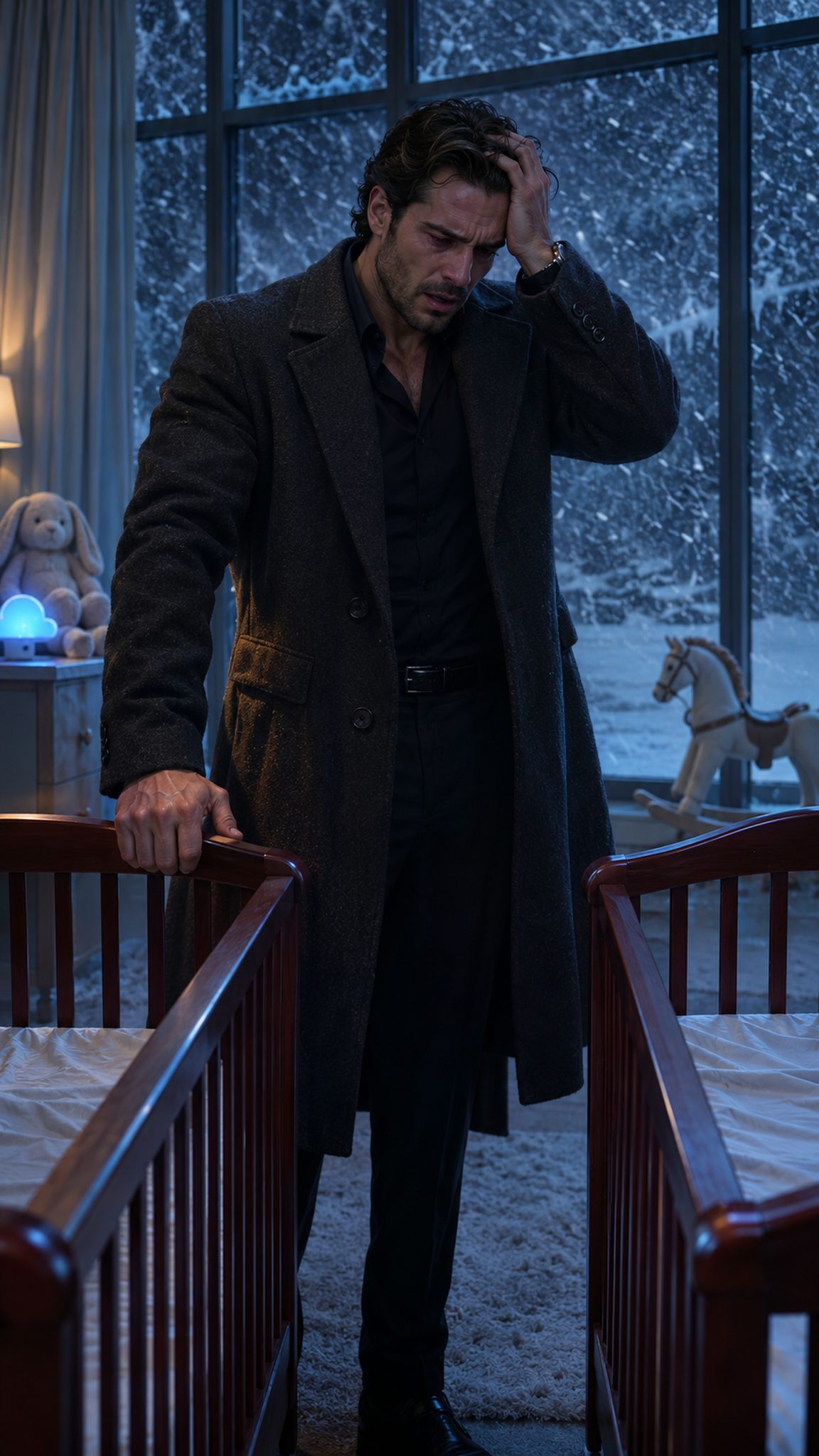
I looked at the two mahogany cribs and remembered the morning I had found them empty at 5:03. I remembered the storm, the open front door, the untouched fifty thousand dollars, the passports gone, and the cherry-blossom scent on my coat. I remembered believing that I could find anyone because I had enough men, enough money, and enough power.
I had been wrong about what finding someone meant.
Nora had never needed to be found by force. She needed to be heard. She needed a husband who would come home, share the work, tell the truth, and stay when the night was difficult.
I had not earned her trust in one morning or one apology. I had earned the chance to begin earning it through hundreds of small choices. There would be more difficult conversations. There would be days when she remembered the affair and wondered whether she could trust me. I would have to answer honestly, even when the answer hurt. I would have to keep choosing our family when no one was watching.
Nora woke and looked at the baby in my arms.
“Did he settle?”
“Yes.”
She smiled faintly. “You stayed.”
“I did.”
She reached over and touched Leo's cheek, then rested her hand on mine.
Outside, Chicago was bright beneath the morning sun. The storm had passed. The roads were open. The city continued without asking whether I was still feared or whether Varga had taken another contract. For once, none of that mattered as much as the warmth of Nora's hand and the steady breathing of our children.
I had come home at 5:03 in the morning and found two empty cribs.
Now, at dawn, both cribs were occupied.
And the woman I loved was beside me because she had chosen to be.
THE END