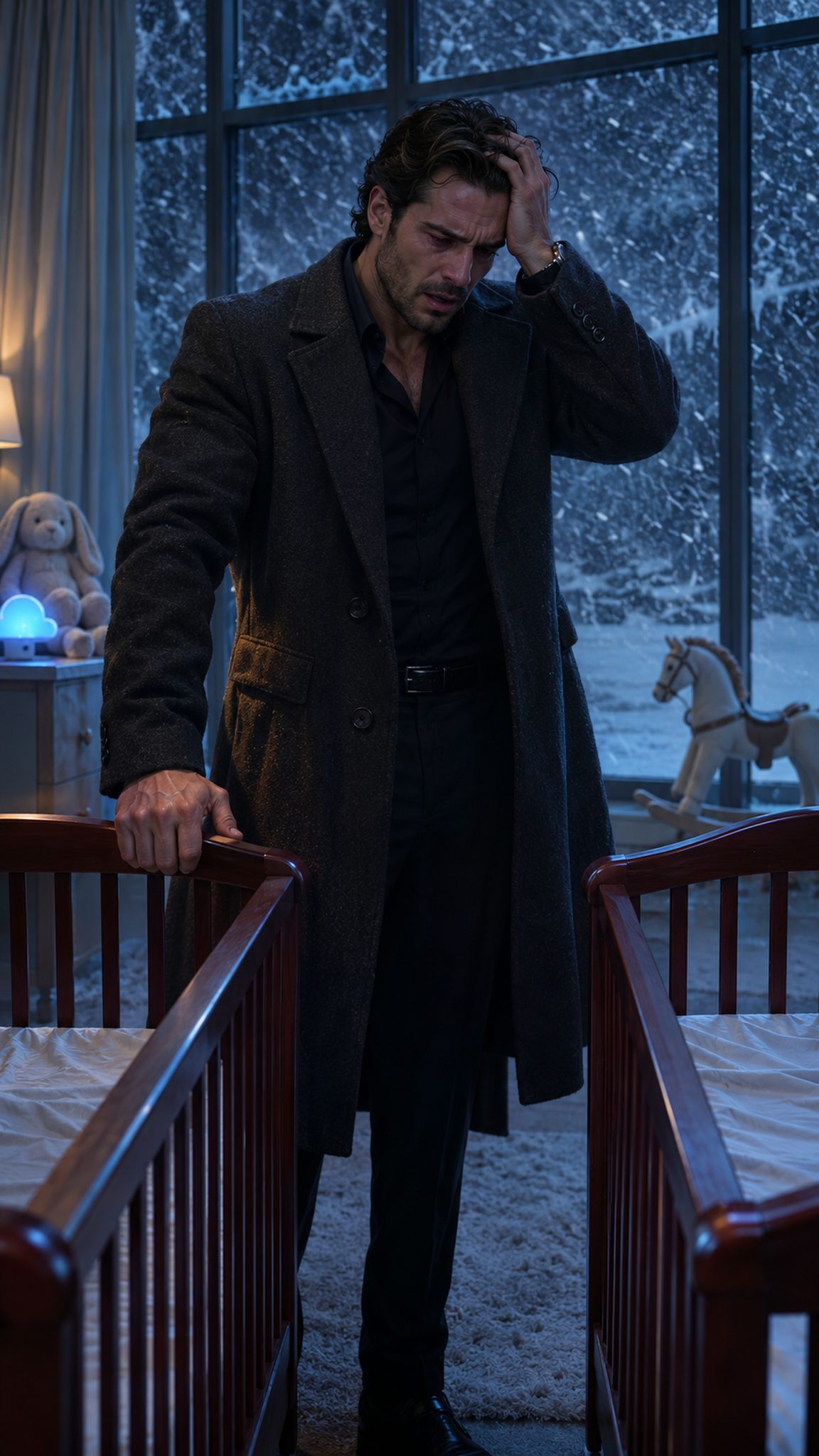
The first thing I changed was the way I entered the nursery.
For years, I had walked through that doorway as if it were another room in a house I owned. I checked the temperature, glanced at the cribs, asked whether the babies had settled, and left when my phone rang. After Nora disappeared, I began entering as if the room belonged to someone whose trust I had to earn.
The two mahogany cribs were still empty. The soft blue nightlight still glowed against the wall. Leo's fitted sheet had been changed, and Mia's side no longer held the faint outline of the rabbit she had taken with her. I had asked the housekeeper not to replace it with another toy. I did not want the room dressed up to pretend nothing had happened.
I wanted to learn what I had failed to learn when the children were here.
The hospital had given us written instructions when the twins came home. Nora had kept them in a folder near the kitchen, along with feeding notes, medicine schedules, and follow-up appointments. I found the folder exactly where she had left it. The pages were softened at the corners from being handled so often.
I read every page.
Then I called the pediatrician's office and asked for a meeting. I did not ask them to tell me where Nora was or whether she had contacted them. I explained that I was the father of Leo and Mia, that they had been born prematurely, and that I needed to understand their care without relying on my wife's notes.
The nurse who answered recognized my name.
“Are the babies with you now?” she asked.
“No.”
“Are they safe?”
“I believe they are. I don't know where they are, and I won't ask you to tell me.”
There was a pause.
“I need to learn their feeding routine, their medicine, and what to watch for if they become unwell,” I said. “I should have learned it properly before.”
The nurse's voice softened. “We can arrange an education appointment. Bring the discharge instructions.”
“I will.”
I arrived the next morning with the folder, a notebook, and no security detail inside the clinic. The nurse walked me through the instructions again. She explained how to prepare formula safely, how to check the temperature, how to keep feeding equipment clean, and how to record amounts and times. She reviewed the medicine instructions and showed me how to keep a clear written record so that no dose was repeated or missed.
I wrote everything down.
“Don't rely on memory,” she told me. “Especially when you're tired.”
“I won't.”
She showed me how to recognize signs that required medical advice and when an infant needed urgent attention. She explained that premature babies could need extra care with temperature, feeding, and follow-up visits. I asked questions until I understood the answers, then repeated the instructions back to her.
At the end, she looked at my notebook.
“You're taking this seriously.”
“I should have done it months ago.”
“Yes,” she said. “You should have.”
I accepted the answer.
Back at the penthouse, I cleared a section of the kitchen counter and set up a clean place for feeding supplies. I did not ask the staff to do it for me. I checked the sterilizer's instructions, cleaned the parts, and practiced assembling it until I could do it without looking at the diagram. I learned where the formula was stored and how the feeding notes should be organized.
The first bottle I prepared was wrong. I had measured carefully but forgotten one step in the instructions. I threw it away and started again. The second time, I followed every line. I checked the temperature and recorded the practice run in the notebook.
There were no babies to feed. The exercise felt foolish and painful. I did it anyway.
The next day, I asked the nurse whether I could observe a demonstration with a training doll. She agreed. I practiced supporting the head and neck, holding the bottle at the correct angle, and recognizing when a baby needed a pause. I practiced burping the doll and changing its position. I learned how to keep the routine calm rather than rushing because I wanted the task finished.
I had once believed that fatherhood would come naturally because I loved my children. Love had come naturally. The skills had not, and I had treated that as Nora's responsibility.
I would not make that mistake again.
The colic instructions were harder. Leo's crying had always unsettled me. At two in the morning, when the sound continued and sleep had become impossible, I had complained. I had said I needed rest. I had acted as though the crying were something Nora could control if she tried harder.
The nurse explained that colic was not a failure of parenting. She reviewed the soothing methods the hospital had discussed with us: checking the baby's basic needs, holding him safely, using gentle movement, keeping the environment calm, and seeking medical advice if the crying was unusual or accompanied by concerning symptoms.
I wrote down the sequence.
At home, I practiced the movements with the training doll. I learned to slow my breathing, support the head, and walk without bouncing too sharply. I learned that soothing a baby was not a contest in which the adult won by making the crying stop immediately. Sometimes the task was simply to stay calm and provide comfort while the baby struggled.
That lesson reached further than the nursery.
I began changing the way I handled the organization too.
The first meeting was with my senior advisers. I told them that I was stepping back from direct operational decisions. The legitimate businesses would continue under professional management. Contracts, disputes, and labor matters would go through lawyers and the appropriate authorities. Any threat of violence would be reported and handled through lawful channels. No one would collect debts through intimidation. No one would retaliate against Varga or his people on my behalf.
One of the older men stared at me across the table.
“You're handing over control?”
“I'm changing how control is exercised.”
“Varga is still testing us.”
“Then document what he does and let counsel respond.”
“He'll read this as weakness.”
“He can read it however he likes.”
Another adviser leaned forward. “Your father would never have accepted this.”
“My father isn't the one who has to live with my decisions.”
The room fell silent.
I assigned oversight of day-to-day operations to a management group and made it clear that I would not approve violent work. The men who had been waiting for my instructions were given lawful responsibilities or told to leave. Some resigned. Others complained that the organization was losing its edge. I did not try to persuade them to stay.
Carlo remained. He had served me for years and understood the difference between a dangerous order and a difficult one.
“You know this will cost you,” he said after the meeting.
“I know.”
“Money, territory, influence.”
“I know.”
“And if someone comes after you?”
“We protect people. We call the police. We let the lawyers do their jobs.”
He looked at me for a long moment. “You're serious.”
“I should have been serious before.”
The changes were not clean or immediate. Varga continued pressing the western contracts. One partner suspended a deal. Another demanded new guarantees. My lawyers filed the necessary responses and documented the threats. We lost one warehouse lease and spent several weeks negotiating to keep the workers employed. I signed the agreements that reduced my personal control and accepted the financial cost.
There were men who called me foolish. There were men who said I was surrendering the city because my wife had walked away. I did not answer them.
I had spent years making my name larger than my life. Now I was trying to make my life worth returning to.
I also changed the penthouse.
The nursery had been designed for the twins, but it had become a monument to their absence. I considered removing the cribs, then stopped. They belonged there. I had no right to erase the room because I could not bear to look at it.
Instead, I repaired what needed repairing. I checked the nightlight and replaced a faulty switch. I had the nursery refrigerator serviced and cleaned. I restocked the shelves with the supplies the pediatrician recommended, but kept the medicine pouch empty until a doctor could confirm what was appropriate for the twins' current needs. I bought fresh fitted sheets and kept them folded in the cabinet. I left space for Mia's white rabbit rather than choosing another toy for her.
I removed the expensive decorative objects that had crowded the shelves and replaced them with practical storage. The room needed to be safe and easy to care for, not impressive.
I moved the chair closer to the cribs. I tested its support and made sure the floor around it was clear. I put a small lamp beside it so that someone could read feeding notes without turning on the overhead lights. I added a clock that showed the time clearly from the chair.
Then I sat there.
I imagined Nora in that chair at two in the morning, one baby against her chest and the other crying. I imagined her trying to keep her eyes open while checking the next feeding time. I imagined myself walking past the doorway and complaining about the noise.
I sat until the room grew dark.
Margaret's conditions remained clear. She would pass along a message if she believed it was appropriate. She would not give me Nora's location. She would not arrange a meeting without Nora's consent. I would not contact the clinic staff to ask questions about Nora's movements, and I would not send anyone to watch the building.
I kept those conditions.
When I wanted to call Margaret, I waited until I had a reason that did not involve asking where Nora was. I sent the clinic a donation for supplies, with no conditions and no request for information. Margaret returned the first transfer because it had been made through one of my companies.
“Don't make this a transaction,” she told me over the phone.
“I wasn't asking for anything.”
“You may not have meant to. But people here know your name. They will think accepting your money means they owe you something.”
I understood. I asked the clinic what supplies it needed and arranged for the items to be purchased directly by an independent charity account, without my name attached. Margaret confirmed that the supplies had arrived. She did not tell me whether Nora knew.
I did not ask.
A week later, Margaret called.
“Nora received your message,” she said.
I stood in the study, holding the phone so tightly my fingers hurt.
“Did she say anything?”
“She said she read it.”
“Was she—”
“Victor, I won't interpret her feelings for you.”
“Of course.”
“She asked me to tell you that the babies are safe.”
My eyes closed.
“Both of them?”
“Both.”
“Are they getting their medicine?”
“She said their care is being managed.”
I let out a breath I had been holding for days. “Thank you.”
“She also said she isn't ready to come home.”
“I understand.”
“Do you?”
“Yes.”
“She doesn't want you sending people to look for her.”
“I won't.”
“She doesn't want gifts delivered to wherever she is.”
“I won't send any.”
“And she doesn't want you using the children to make her answer.”
I looked toward the nursery. “I would never do that.”
Margaret was quiet.
I corrected myself. “I won't do that.”
“Good. I'll tell her you agreed.”
The call ended. I sat at my desk for a long time, repeating the words in my mind. The babies are safe. Both of them. Their care is being managed.
It was not the answer I wanted. I wanted to know where they were, whether Leo was still colicky, whether Mia had begun sleeping longer, whether Nora had found a place where she could rest. I wanted to hear their voices. I wanted to hold them.
But the message had come from Nora, through someone she trusted. It was a boundary and a gift. I would not turn it into a demand for more.
I wrote down the date and the information she had allowed me to know. Then I put the notebook away.
The next days became a routine. I woke early, reviewed the twins' care instructions, and practiced preparing bottles. I went to the pediatric education sessions when they were available. I learned the signs that required a call to the doctor and the questions I should ask at follow-up appointments. I learned how to organize medicine records without relying on memory. I learned that the right answer to uncertainty was to call a qualified professional, not to guess.
At night, I sat in the nursery chair and read the feeding notes Nora had left behind. I no longer saw them as reminders of tasks she had managed. I saw the record of a mother paying attention.
I began to understand the difference between being present and being useful. I had been in the hospital room. I had stood beside the cribs. I had carried Leo. I had held Mia. But Nora had been the one who knew when a sound was different, when a feeding had taken too long, when a medicine pouch needed checking, and when the next appointment was due.
I had mistaken occasional participation for shared responsibility.
One evening, Carlo came to the penthouse with a folder. He found me in the nursery, reviewing the pediatric instructions.
“Am I interrupting?”
“Yes,” I said, closing the folder. “What is it?”
“Varga's lawyers have responded. They want a settlement on the warehouse leases.”
“Send it to our counsel.”
“They're asking for a meeting with you.”
“Then counsel can meet them.”
“They say they won't accept anyone else.”
“Then they won't get a meeting.”
Carlo glanced at the cribs. “You really are done.”
“I am done with doing business through fear.”
“What if they take more?”
“Then we challenge it legally. If we lose, we lose.”
He looked at the notebook in my hand. “You used to say there was no price too high for control.”
“I was wrong.”
He nodded slowly. “I hope you know what you're giving up.”
“I do.”
After he left, I returned to the notes. The page described a calm night routine: prepare supplies, keep the room comfortable, follow the feeding schedule, record what happened, and respond to each baby individually. I read it twice.
The simplicity was almost unbearable. The children had never needed a feared man. They had needed a father who could stay awake, pay attention, and help their mother.
I began to write a letter to Nora.
The first version was three pages long. I explained the changes at the company, the meetings with the doctors, the nursery repairs, and the way I had started to understand what she had carried. I wrote that I missed her. I wrote that I missed the twins. I wrote that I wanted another chance.
Then I read it again and saw how much of it was about me.
I tore it up.
The second version was shorter.
Nora,
Margaret told me the twins are safe. Thank you for letting me know. I have begun learning the care routines properly, including feeding, medicine records, and how to respond when Leo is unsettled. I have also changed the way the business is managed. I will not use threats or send anyone to find you.
I am not asking you to come home. I am not asking you to forgive me. I wanted you to know that I understand these changes are my responsibility, whether you ever see them or not.
I am sorry for leaving you alone when you needed me.
Victor
I gave the letter to Margaret. She read it before accepting it.
“This is all?” she asked.
“Yes.”
“No promises?”
“No.”
“No request for a reply?”
“No.”
She folded the letter and placed it in her bag. “I'll give it to her if she wants it.”
I nodded.
Two days passed before Margaret called again. Nora had read the letter. She had not written back, but she had asked whether I would be willing to speak for a few minutes by phone if she arranged it.
I sat down.
“Yes,” I said. “Whenever she's comfortable.”
“Not whenever you are comfortable. Whenever she is.”
“Understood.”
“And if she ends the call, you let her.”
“Yes.”
“You don't ask where she is.”
“I won't.”
“You don't ask her to come back.”
“I won't.”
Margaret paused. “I'll speak with her.”
The call did not come that day. It did not come the next. I continued the routine, kept the appointments, and did not ask Margaret to hurry her. I had to learn that waiting was not something I did while preparing to get what I wanted. It was part of respecting the answer she had already given.
On the third evening, my phone rang at 8:17.
The number was unfamiliar. I answered without speaking.
“Victor?”
Nora.
For a moment, the room seemed to lose its air. I gripped the edge of the desk and closed my eyes.
“Yes.”
“Margaret said you wanted to talk.”
“I do. Thank you for calling.”
There was a pause. I could hear faint movement on her end, then a quiet breath.
“How are the babies?” I asked, then stopped myself. She had already told me they were safe. “I'm sorry. You don't have to give me details.”
“They're all right.”
I lowered my head. “I'm glad.”
“Leo still has difficult evenings.”
I listened. She did not sound angry. She sounded cautious, as if each sentence had to be tested before she allowed it into the conversation.
“I'm sorry you've had to manage that alone,” I said.
“I haven't been alone.”
I understood the correction. Someone had helped her. Someone had been there when I had not.
“I'm glad you have support.”
She was quiet.
I wanted to ask where they were. I wanted to ask whether she had enough formula, whether Mia still needed the rabbit to settle, whether the storm had frightened them. I wanted to ask whether she had slept. I wanted to tell her that I had learned the feeding routine and could prepare a bottle without help.
I did not make the call about my progress.
“Are you getting the medical care you need?” I asked.
“Yes.”
“Good.”
“Margaret told me you went to the clinic.”
“I did. I wanted to learn the instructions properly.”
“You could have done that before.”
“I should have.”
Another pause.
“I don't know what you expect from this,” Nora said.
“Nothing tonight.”
“Then why are we talking?”
“Because you offered a few minutes, and I wanted to hear your voice. I don't want to turn that into a request.”
She breathed out slowly. “You always know what to say when you want something.”
The words hurt because they were true.
“I don't know what to say now,” I admitted. “I know I hurt you. I know I made you carry too much. I know I lied. I can't undo any of it by saying I'm sorry.”
“No.”
“I won't ask you to come back.”
“Good.”
“I won't send anyone to look for you.”
“You said that before.”
“I know. This time, I will prove it by what I don't do.”
She was silent again. I heard a soft sound in the background, perhaps a baby stirring. My heart tightened.
“Is that Leo?” I asked.
“It's Mia.”
I smiled despite myself. “Is she all right?”
“She was sleeping.”
“I'm sorry.”
“It's fine.”
I wanted to hear more. I wanted to ask what she was wearing, whether she had found a comfortable chair, whether the twins were growing. I wanted to step into the ordinary life of the family I had lost.
But Nora had offered a few minutes, not an open door.
“Thank you for letting me know they're safe,” I said.
“Margaret thought you should know.”
“I'm grateful to her. And to you.”
“I have to go.”
“Of course.”
“Good night, Victor.”
“Good night, Nora.”
The call ended.
I kept the phone against my ear for several seconds after the line went silent. Then I lowered it and sat in the dark study.
I had spoken to my wife. She had not forgiven me. She had not told me where she was. She had not promised another call. But she had chosen to speak, and I had not used the opportunity to demand more.
It was a small thing.
For the first time, I understood that small things were where trust began.
I went to the nursery and turned on the blue nightlight. The two cribs stood ready. The sheets were clean. The medicine pouch was not there, because Nora had it with the twins. Mia's rabbit was not there, because it belonged with Mia. I did not fill the empty spaces.
I sat in the chair and opened the notebook. I reviewed the feeding routine, the medicine record, and the signs that required medical advice. I practiced the sequence once more, not because I expected the babies to return that night, but because I wanted to be ready if they ever did.
Then I turned off the lamp and stayed.
I did not call Margaret to report that Nora had spoken to me. I did not ask her to arrange another conversation. I did not send flowers or gifts. I did not ask my men to watch the clinic or search the shelters again. I let the call remain what Nora had offered: a few minutes.
Outside, Chicago moved through another cold night. Somewhere in the city, my children were sleeping under a roof I could not see. Their mother was keeping them safe. I was learning to be a father without demanding that she bring them back to prove I had changed.
The nursery was still empty.
But for the first time since 5:03 in the morning, I did not mistake an empty room for permission to take something from the people who had left it.
I turned the page in my notebook and wrote one sentence.
Stay when staying is difficult.
Then I closed the book, left the nightlight on, and remained in the chair until morning.