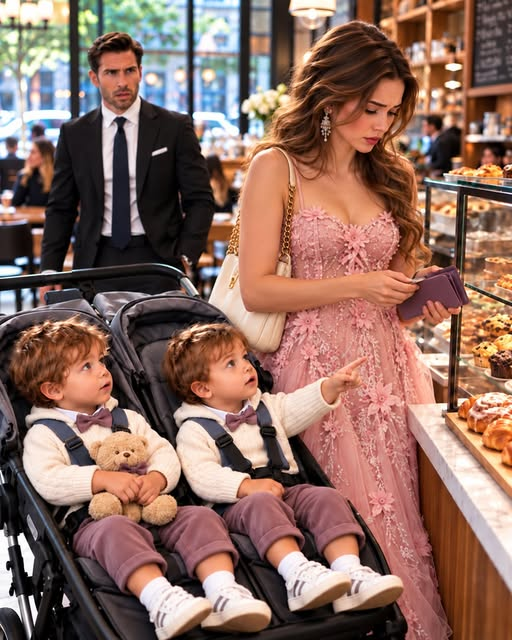
By Saturday morning, Nathan Harrison knew the square footage of his ex-wife's apartment.
Six hundred and forty square feet. Second floor of a brick walk-up on the South Side, one bedroom, a kitchen with a stove that had to be lit with a match, a bathroom with a window that didn't close all the way and a curtain Emma had sewn herself — the investigator had noted the curtain, in passing, as evidence of what he called *pride of occupancy*, and Nathan had read that phrase eleven times.
He read the whole weekend like that. The full dossier lived on his kitchen island in his penthouse, forty-one floors above a city that was having a bright, ordinary October weekend, and Nathan moved around it the way you move around something unexploded. He would read a page standing up. Sit down. Stand up again. Read the page again, as if repetition might file it under a different name.
The debt schedule was the worst of it, worse even than the number itself. Emma owed, as of the first of the month, $118,340. She paid $310 a month, on the ninth, never late — the hospital's collection notes used the phrase *religiously punctual*, which Nathan found he could not read without putting the page down for a while. At $310 a month, with interest eating a third of it, the debt would outlive the boys' childhood. It would be standing there, patient as furniture, when they started high school.
There was a payment plan document. There was a letter from the hospital's financial office, courteous and implacable. There was a summary of the birth: labor at thirty-two weeks, an emergency, two boys under three pounds each, twenty-six days in the neonatal intensive care unit. Noah's lungs. Noah's asthma, mild, managed with an inhaler that cost $46 a month after the pharmacy discount card Emma had applied for twice.
Nathan read the birth summary with his coffee going cold, and did the only math that mattered. Thirty-two weeks. Seven months after the divorce. She had labored early and alone — no, not alone, her sister had flown in, the file said, for the first week — and she had sat in a hospital for twenty-six days watching two boys the size of her two hands learn to breathe, and the entire Harrison empire, with its jets and its lawyers and its forty-one floors, had been eleven miles away and entirely unaware.
The file said she had listed no father on the intake forms. The file said, in the flat voice of forms, *father: not involved.* Nathan read that until the words stopped making sense, which took a long time.
Marcus called at noon, as if summoned by the reading.
"You're going to ask me how I got the preschool records," Marcus said. "Don't. You asked for everything. This is everything."
"She pays the hospital three hundred and ten dollars a month," Nathan said. "She has never once been late."
"I know."
"There was a payment in March — two payments. She paid double in March. Do you know why a person pays double in March, Marcus? Tax refund. She gets a refund from the government of the United States and she sends it to a hospital. For my sons."
The line was quiet a moment. "What are you going to do?" Marcus asked.
"Nothing she can see."
"Then do it properly," Marcus said, in the tone of a man who had stage-managed a decade of Nathan's weather. "Foundations. Lawyers. Paper between you and it, thick enough to stand on. If there's a thread back to you, she'll find it. You know she will. She found a way to have your children for four years without you, Nathan. Hiding things is the one sport she's better at than you."
Nathan looked at the preschool summary again — *no complaints* — and at the two bus routes printed in the appendix, the 6:10 and the 6:47, the long dark haul across the city she made twice a day with a tote of ungraded quizzes.
"I know," he said. "That's why it has to be perfect."
He spent the afternoon with the appendix the way other men spend it with scripture. The boys' preschool: a church basement with a waiting list Emma had joined while still in the hospital, because even then, broke and stitched and terrified, she had been planning four years ahead. Noah's inhaler technique, initialed by three different teachers. A photograph, taken from across a playground fence by a man Nathan was paying, of two small boys on a climbing frame and a woman on a bench below them with her face tipped up to the sun, laughing at something, entirely unguarded — the only photograph in the file in which Emma Parker looked her age.
He kept that one out when he closed the folder. He did not put it with the others. He told himself it was because it was the clearest image of the boys, and his hands believed him about as much as Emma would have.
—
On Saturday morning, in a second-floor walk-up on the South Side, Emma Parker made pancakes from a box mix that was mostly flour and optimism, and Ethan informed her, standing on a chair in his pajamas, that he was going to be an astronaut *and* a baker, both, and Noah said he would be the one who drew the maps for Ethan's rockets, because somebody had to know where the planets were.
"Statistically," Emma said, flipping a pancake shaped like a failing continent, "most astronauts do not also run bakeries."
"Mr. Russo does both," Ethan said.
"Mr. Russo does not go to space, baby."
"He *could*," Ethan said, with the absolute confidence of a man who has never been wrong about anything important. "He has the special bread."
Emma laughed and put the failing continent on his plate anyway, because in her house you ate the mistakes first and saved the good ones for company that never came. The rent was paid. The light bill was paid. The hospital got its $310 on the ninth, religiously, a word her mother would have used and which Emma preferred to think of as *the deal she had made with the universe*: you can have the money, but you cannot have my panic. The boys ate. Noah ate slowly, saving his cinnamon — a pinch from the little jar, Friday's treasure carried home like communion — for last, with the ceremony of a priest.
After breakfast there was the library, because the library was free and warm and had a rug shaped like the solar system, and Noah Parker's entire soul lived on that rug. Ethan endured the rug for Noah's sake and then dragged everyone to the window to watch a crane on a construction site two blocks over, narrating its operations like a sportscaster. Emma let him. She sat with her tote in her lap and a stack of ungraded quizzes inside it and graded exactly four of them before Ethan required arbitration in a dispute with a stuffed bear over who was captain of the rug.
She did not think about money that morning, which was the point of Saturday mornings. Saturday morning was the one shift the universe worked for her. The money thoughts were scheduled for Sunday night, at the kitchen table, where they belonged.
Sunday was groceries, and groceries was arithmetic with a live audience.
"Can we get the cheese with the holes?" Ethan asked, in the tone of a diplomat opening negotiations.
"The cheese with the holes costs more because of the holes," Emma said. "We are not paying extra for missing cheese."
This was, Noah explained to his brother on the bus home, actually fair, because the holes were where the cheese wasn't, and Mom said you shouldn't pay for things that weren't there. Ethan considered this and announced that when he was an astronaut-baker he would sell the holes separately, to rich people, and buy Mom a school. Emma carried the bags up the stairs with her sons orbiting her like small, argumentative moons, and did not let either of them see her face until she had arranged it back into its daytime expression.
In the afternoon she mended the knee of Noah's trousers at the kitchen table while the boys built a space station out of every cushion she owned, and Ethan, from inside the station, asked the question that arrived about once a season, always from Ethan, always in a voice of pure scientific inquiry.
"How come Marcus's dad picks Marcus up, and Lily's dad, and our dad is a star?"
"Because some dads live far away," Emma said, keeping her needle steady, "and yours lives the farthest. But he gave you your good hair and your arguing, so you carry him around all day anyway."
"I'm the best at arguing," Ethan said, satisfied, and the station required his attention, and the moment passed the way she had built her whole life to let it pass: quickly, and at cost only to her.
That night, when the boys were asleep in the bedroom — Noah's notebook on the pillow, the inhaler on the nightstand, Ethan starfished across three-quarters of the mattress — Emma sat at the kitchen table in the quiet with the bills in their order. Rent: covered. Light: covered. Hospital: the ninth, $310, religiously. Groceries for the week: $84 and change, if she was careful, and she was always careful. Preschool snacks for Friday. One bus pass, renewed. She did the arithmetic twice, out of respect, and then she opened her lesson plans and began, with a red pen and total absorption, to design a volcano that would erupt on Tuesday for twenty-six South Side eighth-graders, in a science lab where half the faucets didn't run and the periodic table on the wall was missing the noble gases.
She had given up many things in five years. She had not given up the volcano.
—
Nathan drove out at two o'clock, telling himself nothing, because there was no version of the sentence that survived being said aloud.
He drove past Russo's bakery first. It was busy — Saturday, families, a line — and he sat across the street in a car that cost more than the building and watched the door. He did not know what he was waiting for. She didn't come. Of course she didn't come; Friday was bread day, the file said so, the file knew her week's whole skeleton, and he sat there anyway like a man standing in the rain of his own surveillance.
Then he drove south, eleven miles that took him through four different Chicagos, and parked half a block from a brick walk-up with a curtain in the bathroom window that a woman had sewn herself.
He knew the windows. Second floor, left. The file had photographs — discreet, professional, obscene in their discretion — and he had memorized them the way he memorized load tolerances. A light was on in the kitchen. Somewhere in there, a boy was drawing a planet. Somewhere in there, a boy was explaining space travel to a woman flipping a pancake.
Nathan put both hands on the steering wheel and did not get out of the car.
He had a speech. He had had a speech since Friday, several drafts of it, all of them beginning with her name and all of them ending, if he was honest, with him writing a check — because a check was the only fluency he had left. And the check was an obscenity too, he understood that now, sitting in the darkening street. She had counted coins in a bakery rather than call him in four years. She had paid $310 a month for four years rather than call him. Emma Parker would experience his money arriving uninvited exactly the way she experienced everything from him: as weather. As something to endure with her chin up.
What she could not endure — what no one could take from her — was not knowing. If he did it right, she would never know.
He drove home through the lit city. On Sunday he read the file twice more, and the preschool summary undid him worst of all: *Ethan: leader, shares eventually. Noah: gentle, advanced vocabulary, carries notebook everywhere, uses inhaler with assistance, no complaints.* No complaints. The investigator had underlined nothing. Nathan underlined it himself, with a pen that shook, and then sat in his glass tower with his sons described to him in the third person and understood that he was going to do this, and that he was going to do it the only way it could be done.
Money, given openly, would be a claim. Money, given as Nathan Harrison, would be a door kicked in.
Money given by nobody — by a foundation, by a stranger who did not exist — could simply be a fact. A lab could be built. A debt could quietly stop existing someday, when he figured out how. A woman could stand in a room built by a miracle and never have to thank the man who'd failed her for it.
On Sunday night, while Emma Parker sat at her kitchen table eleven miles away with the bills arranged in their weekly order and her chin up, Nathan opened his laptop and began, very carefully, to design a miracle with no name on it.