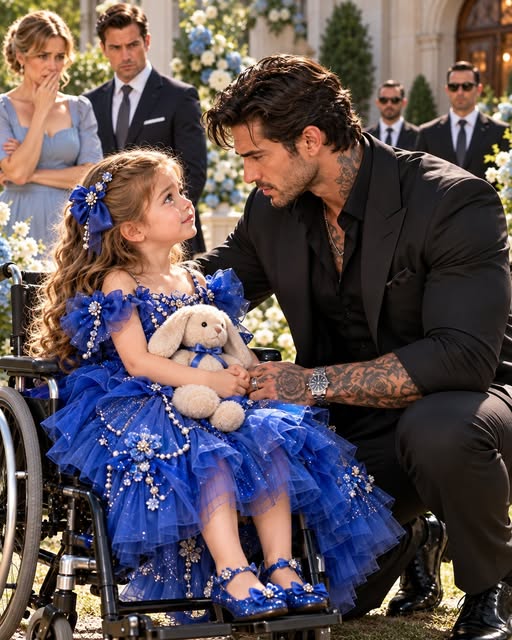
The social worker did not stay long that first day, but her visit changed the air in the orphanage. She walked through the dining room and the bedrooms and the courtyard, she wrote in her notebook, she asked Mrs. Bell questions in a low voice, and she smiled at me in the way grown-ups smile when they are trying not to look like they are judging you. I smiled back, because Mrs. Bell had told me to be myself, and being myself included being polite to visitors, even when my stomach felt wobbly.
"She will write a report," Mrs. Bell told Dominic after the woman left. "The report will go to a judge, and the judge will decide whether you can be a temporary guardian while a longer decision is made. It will not be a simple yes. There will be a hearing, Mr. Moretti, and people will be allowed to speak against you."
Dominic nodded, as if he had expected this. "Let them speak," he said. "I would rather be judged in a courtroom than in a newspaper."
That was a brave thing to say, and it turned out to be a little bit too brave, because the newspaper came anyway.
Two days later, a man with a camera and a notebook was waiting outside the orphanage gate. He was not a social worker. He was a reporter, and he had a question that was not really a question. He wanted a photograph of the feared mafia boss and the little girl in the wheelchair, and he wanted a story that would make people gasp.
"Is it true," he called out, when Dominic arrived with Marco and Enzo, "that you are using this child to clean up your image?"
Dominic stopped. I could see his jaw tighten, and I could see Marco step forward, the way a bodyguard steps forward when he thinks someone might be a threat. But Dominic put a hand up, just a small movement, and Marco stopped.
"I am not going to answer questions about a child to a man with a camera," Dominic said, in a voice that was quiet and very firm. "If you want to write about me, write about me. Leave Lily out of it."
The reporter did not leave Lily out of it. The next morning, there was a story, and Mrs. Bell tried to hide the paper from me, but I saw the headline anyway, because I was good at seeing things grown-ups tried to hide. It said something about a mafia boss and an orphan, and it made it sound as if I were a prize, or a trick, or a sad story someone could sell. I did not like being a headline. Headlines do not have feelings, and I had a lot of feelings.
But the headline was not the only problem. Dominic's own world had a problem with me too. His consigliere, the older man who advised him on business and who had known him for many years, came to the orphanage one afternoon and asked to speak to Dominic alone. I listened from the hallway again, because listening was my special skill, and because this was about me.
"A child will slow you down," the consigliere said. He did not sound cruel. He sounded worried, in the way of a man who thinks worry is the same as wisdom. "Your rivals will see a soft spot. Your business partners will ask questions. A girl in a wheelchair needs doctors, and school, and time, and you do not have time, Dominic. You have enemies, and you have deals, and you cannot be in two places at once."
"I have been in two places at once for years," Dominic said. "I have been in my office and in my grief, and neither one made me a better man. Lily is not a soft spot. She is a reason to be careful, and I have not had a good reason to be careful in a very long time."
"And if the court says no?" the consigliere asked. "What then? You will have made a public promise and failed a child in public. That will hurt her more than if you had never come."
Dominic was quiet, and I held my breath, because this was the question I had been afraid to ask out loud. What if he tried and failed? What if the court said no, and he went away, and I was left with another goodbye?
"I would rather try and fail in the open," Dominic said at last, "than never try and wonder for the rest of my life whether I could have been a father again. And if the court says no, I will still come to visit, if Lily wants me to, and I will still be someone she can count on. A court can decide where a child lives. It cannot decide whether a man keeps his word."
I wheeled back to my room very quietly after that, and I thought about his words for a long time. They were not perfect words. They did not promise that everything would work out. They promised that he would stay, even if it did not work out the way we wanted. That felt more honest than a perfect promise.
The hearing was set for the following week, in a courtroom that was smaller than I expected. It did not look like the courtrooms on television. There was no big crowd, and no dramatic music. There was a judge in a plain robe, a long table, chairs that squeaked, and a window that let in pale morning light. Mrs. Bell sat beside me, holding my hand, and Dominic sat on my other side, straight-backed and nervous in a way he tried very hard to hide. Marco and Enzo waited outside, because the judge said only people directly involved should be inside, and they were not happy about it, but they waited anyway.
The social worker spoke first. She was fair, I thought, even though I was scared of her notebook. She talked about my life at the orphanage, about Mrs. Bell's care, about my schoolwork and my health and my wheelchair, and she said I was a bright, funny, brave child who needed a stable home. Then she talked about Dominic, and her voice became careful.
"Mr. Moretti has wealth and a home," she said. "He also has a public reputation that raises questions. The court must ask whether a child would be safe, not only from harm, but from attention, from headlines, from the pressures of his work. We are not here to punish Mr. Moretti for his past. We are here to protect Lily's future."
Then the consigliere spoke, not unkindly, but firmly. He talked about Dominic's work, about rivals, about the risk of a child being seen as a weakness. He did not say Dominic was a bad man. He said Dominic was a busy man, and that a child needed more than money. I wanted to be angry at him, but I also understood, in a small way, why he was worried. Grown-ups worry in strange ways, and sometimes worry sounds like saying no.
Then Mrs. Bell spoke, and her voice did not shake at all. "I have known Lily since she was a very small girl," she said. "I have watched three families turn away from her, and I have watched her keep hoping anyway. I have also watched Mr. Moretti come back, day after day, without being asked. He has eaten our soup. He has sat under our oak tree. He has listened to Lily's questions and answered them honestly, even when the honest answer made him look foolish. He has not tried to buy her love. He has tried to earn her trust, one small promise at a time. That is not nothing. In my experience, that is everything."
I squeezed her hand, and she squeezed mine back.
Then the judge looked at me. "Lily," she said, gently, "would you like to speak? You do not have to. But if you want to, the court would like to hear your words, in your own voice."
My heart was beating so loudly I was sure everyone could hear it. I had practiced what I might say, in my room, to Mr. Bear, but practicing to a teddy bear is very different from speaking to a judge. I took a deep breath, and I remembered what Mrs. Bell had told me: tell the truth, even when it is not pretty.
"I am Lily," I said. "I am six. I use a wheelchair, and I like my blue dress, and I like my teddy bear, Mr. Bear. Three families did not choose me. The third family said I was a burden, and they wanted a normal child. That hurt, but it also taught me something. I do not want a family that wants a normal child. I want a family that wants me."
I looked at Dominic, and he was looking at me, and his eyes were wet, but he did not look away.
"Mr. Moretti knelt down so he could see my face," I said. "He did not look over my head. He asked me why I was alone, and I asked him if he would leave me too. He did not answer right away, because he was thinking, and I liked that. He did not promise me a perfect life. He promised me small things, and he kept them. He came back. He ate soup. He listened to Mr. Oak. He said a house should fit the person, not the other way around. That is how I know he is not pretending. Pretending people say big, shiny things. He says small, true things."
The judge nodded, and wrote something down, and I felt a little bit braver.
"I am not asking the court to make him perfect," I said. "I am asking the court to let him try. If he fails, I will still have Mrs. Bell, and I will still have Mr. Bear, and I will still be me. But if he is not allowed to try, I will always wonder what would have happened if someone had finally chosen me back."
There was a long silence after that, the kind of silence that feels full instead of empty. Dominic reached over, very slowly, and I put my hand in his, because I wanted to, not because anyone told me to. His hand was big and warm, and it had a tattoo on it, and it did not shake.
Then Dominic spoke, and his voice was low and steady. "Your Honor," he said, "I have made many deals in my life, and I have always known what I would gain from them. This is not a deal. I stand to gain nothing except a chance to be a father again, and to lose a great deal, including my privacy and my pride, if I fail. I have already turned down a business meeting this week because it would have taken me away on a day I promised Lily I would be here. I will do it again, as many times as I need to. A child is not a distraction from my life. She is the reason I want a better life."
He paused, and then he said something I did not expect. "If the court grants me temporary guardianship, I will accept every condition. I will accept visits, and reports, and checks, and I will not complain about them, because they protect Lily. I would rather be watched and trusted slowly than be trusted quickly and fail her."
The judge listened to everyone, and then she took a long time to think. The clock on the wall ticked, and Mrs. Bell's hand was warm in mine, and I tried not to fidget, because fidgeting is what I do when I am nervous, and I was very nervous.
At last, the judge spoke. "This court has heard a great deal about Mr. Moretti's reputation," she said. "It has also heard a great deal about his conduct in recent weeks, and about Lily's own wishes, which the court takes seriously. A child is not property, and a guardian is not a reward. A guardian is a responsibility."
She looked at Dominic, and then at me. "Temporary guardianship is granted, with conditions. There will be regular visits from a social worker. There will be a trial period. Lily will continue her schooling, and her care will be reviewed. Mr. Moretti, you will report any significant change in your circumstances. Mrs. Bell, you will remain a trusted contact for Lily. If any condition is broken, this order can be changed. Do you both understand?"
"I understand," Dominic said.
"I understand," I said, and my voice came out a little squeaky, but it was clear.
Outside the courtroom, the reporter was waiting again, with his camera, but this time Marco and Enzo stood in front of us, not in a scary way, just in a steady way, like a wall that moves, and Dominic did not stop to answer questions. He wheeled me, slowly and carefully, to the black SUV, and he helped me in, and Mrs. Bell kissed my forehead and whispered, "You did beautifully, my brave girl. Now the real work begins, and you will not do it alone."
As the car pulled away, I looked back at the courthouse, and I thought about what the judge had said: a trial period. That meant we had a chance, but we also had a test. We would have to learn how to live together, not just visit together, and I was not sure what that would look like. I was excited, and I was scared, and I was holding Mr. Bear very tightly, and Dominic, sitting beside me, reached over and gently fixed Mr. Bear's blue ribbon, which had slipped again.
"You did beautifully too," I told him.
He smiled, and it was not his public smile. It was a small, tired, happy smile, the kind you wear when you have just been given something precious and you are afraid to drop it.
"We have a trial," he said. "Let us make it a home."
And as we drove toward his house, with the city passing by the window, I realized the hearing was over, but the story was only just beginning, and the next chapter would not be decided in a courtroom at all. It would be decided in a kitchen, and a bedroom, and a garden, where a little girl and a feared man would have to learn, day by day, how to be a family.
TITLE: A Feared Mafia Boss Knelt Before My Wheelchair, But My Five-Word Question Broke His Heart