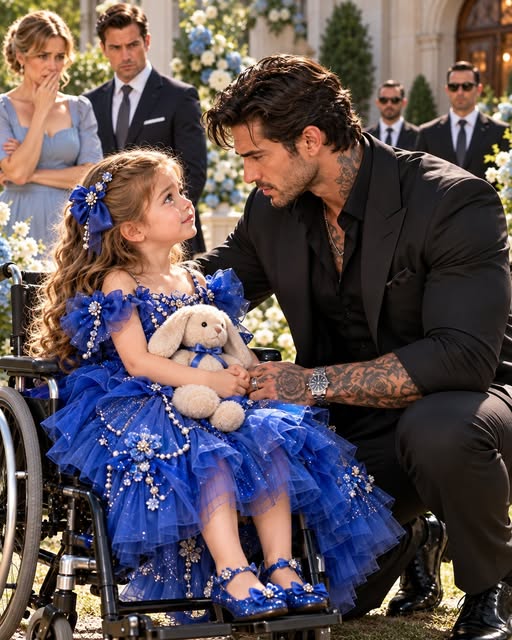
Dominic's house was not what I expected. I had imagined something dark and grand, with long hallways and men whispering in corners, because that was how houses of feared men looked in stories. His house was grand, yes, with high ceilings and a garden full of flowers, but it was also warm in a way I had not expected. Someone had already changed it for me before I arrived. There was a ramp at the front door, smooth and wide, and the kitchen table had a space where my wheelchair fit without anyone having to move a chair. The bathroom had bars I could hold, and my bedroom had a low bed, a bookshelf, and a window that looked out over the garden.
"It is not perfect yet," Dominic said, standing in the doorway of my room, looking nervous in a way that made him seem younger. "If something does not work, tell me, and we will change it. A house should fit the person, remember?"
"I remember," I said. "You said that under Mr. Oak."
He smiled, and I could tell he was pleased that I remembered. Grown-ups like it when you remember their good sentences.
The first week was a week of learning. I learned where the light switches were, and which floorboard creaked, and that Marco snored if he fell asleep on the couch, which he denied completely. Dominic learned how I liked my toast, which was not too brown, and that I needed help reaching the top shelf but not the middle shelf, and that Mr. Bear had to sit on my pillow at night, facing the door, because Mr. Bear was on guard duty.
Marco and Enzo changed, too, in the trial weeks. At first they were bodyguards, standing by doors and speaking in low voices. Then, slowly, they became something softer. Marco learned to make my favorite soup, after asking Mrs. Bell for the recipe three times and writing it down very carefully, as if it were a secret code. Enzo learned to read stories in funny voices, and he was terrible at it in the best way, making the dragon sound like a grumpy old man and the princess sound like a mouse. I started calling them Uncle Marco and Uncle Enzo in my head, and then, one day, out loud, by accident.
"Uncle Marco, can you pass the bread?" I said at dinner, and then I froze, because I had not meant to say Uncle, and I did not know if bodyguards were allowed to be uncles.
Marco did not freeze. He passed the bread, and he said, "Of course, little one," and his ears went a little bit pink. Enzo looked at his plate and smiled. Dominic looked at me, and then at Marco, and he did not correct me. He just said, "Bread is important. Uncles should always pass the bread."
After that, they were Uncle Marco and Uncle Enzo, and no one argued about it. It felt right, like a name that had been waiting to be used.
School was a new part of the trial, too. Dominic drove me himself some mornings, or Marco drove us, and I went to a school with a ramp and a teacher who knew my name on the first day. I liked school, mostly, except for math, which I liked less, and for the days when other children stared at my wheelchair. On those days, I would sit a little straighter and pretend I did not notice, and then I would tell Dominic about it at dinner, and he would listen without trying to fix it right away.
"Do you want me to talk to the school?" he asked once.
"No," I said. "I want you to listen first. Listening is fixing, sometimes."
He nodded, and he listened, and that was enough. Later, he did talk to the school, quietly, about ramps and about kindness, but he did it in a way that did not make me feel like a problem. He did it the way a father would, I thought, although I did not say that word out loud yet. The word father was still a big word, and I was still getting used to it.
We cooked together, too, which was messy and wonderful. Dominic was a terrible cook at first. He burned the toast, and he put too much salt in the soup, and he looked at a recipe as if it were a map to a country he had never visited. I was a better cook, because Mrs. Bell had taught me to stir slowly and to taste before adding more. So I became the teacher, and Dominic became the student, and he was a very serious student, which made it even funnier.
"Stir slowly, Dominic," I would say, in my best teacher voice. "Slowly. You are not in a race with the soup."
"I am not in a race," he would say, stirring very, very slowly, with his tongue sticking out a little in concentration. "I am winning the race by going slowly."
We laughed a lot in that kitchen, and laughter made the house feel less grand and more like a home. Even Mr. Bear got a small apron, which Enzo made out of a napkin, and Mr. Bear supervised from the counter, which was a very important job.
Therapy was part of the trial weeks as well, but not in a scary way. A kind therapist came to the house and helped me with exercises to keep me strong and comfortable, and she talked to me about feelings, too, in a gentle way. She asked me what worried me, and I told her the truth, which was that I worried about being too much. Too much work, too much noise, too much sadness on bad days. She said that was a normal worry for a child who had been told she was a burden, and that a family was not a place where you had to be easy to be loved. A family was a place where you could be difficult and still be loved.
I thought about that for a long time, and then I had a bad day to test it on.
It started with rain. Rain made the garden gray, and it made my wheelchair wheels squeak, and it made my legs ache in a dull way that I did not like to talk about. At school, a boy had asked me why I was in a wheelchair, in a loud voice, and I had answered politely, but inside I had felt small. At home, I spilled my juice, and Dominic tried to help, and I snapped at him, "I can do it myself," in a voice that was sharper than I meant it to be.
Dominic stepped back, and he did not look hurt, but I could tell he was surprised. I went to my room, and I closed the door, and I cried, not because of the juice, but because I was afraid I had been too much. Too grumpy, too loud, too difficult. The third family's words came back, like a cold wind: burden, burden, burden. I hugged Mr. Bear and whispered, "I am sorry I am too much," and Mr. Bear, being a very good bear, did not answer, but he also did not leave.
After a while, there was a soft knock on my door. It was Dominic, and he did not come in right away. He waited, the way Mrs. Bell had taught him, I think, by example.
"Lily," he said through the door, "may I come in? I brought tea, and I am not going to fix anything unless you ask me to."
I wiped my face with my sleeve. "You may come in," I said.
He came in, carrying two cups, one for me and one for himself, and he sat on the floor beside my bed, because the chair was too far away and the floor was closer to me. He did not say "do not cry" or "it is fine" or any of the quick sentences grown-ups say when they want crying to stop. He said, "Bad days are allowed here. You are allowed to spill juice and to be grumpy and to need help and to not need help, all in the same afternoon. That does not make you a burden. That makes you six."
I stared at him. "Are you sure?" I asked. "Because the third family said—"
"The third family was wrong," Dominic said, firmly but gently. "They wanted a child who was easy. I want a child who is you. You are not easy all the time. Neither am I. I burn toast. I am grumpy in the morning. I worry too much. If being difficult meant being unlovable, neither of us would have anyone, and we have each other, so that cannot be true."
That made me laugh through my tears, which is a strange feeling, like sunshine and rain at the same time. Dominic handed me the tea, and I drank it, and he told me about a bad day he had once, when he was young, when he had broken something important and thought his father would never forgive him. His father had forgiven him, he said, and that was how he learned that love was not about being perfect. It was about staying after the mess.
"Staying after the mess," I repeated. "That is a good sentence. You should write it in pen."
"I will," he said. "In the letter, maybe. The letter is getting longer."
After the bad day, something shifted. I stopped testing Dominic quite so hard, not because I trusted him completely all at once, but because trust was growing like a plant, a little bit every day, with water and light and patience. He stopped trying to be perfect, too, and he let me see him tired, and confused, and funny, and that made him easier to love.
Later that week, my blue dress tore. It was my favorite dress, the sparkling royal-blue one with pearl buttons, and I had worn it so many times that the seam at the side gave way. I was upset, because the dress was part of my story, part of who I was when Dominic first knelt before me. I thought it might be ruined, and that made me feel as if a piece of my beginning was breaking.
Dominic did not buy me a new dress right away, which is what I expected a rich man to do. Instead, he sat with me at the kitchen table, with a needle and thread, and he mended it, slowly and carefully, with big, clumsy stitches that were not perfect but were strong. Marco held the fabric, Enzo found the right blue thread, and I watched, holding Mr. Bear, whose blue ribbon was fraying at the edges.
"When the dress is done," Dominic said, "we will fix Mr. Bear's ribbon too. We do not throw away things we love because they are worn. We mend them. That is what family does."
He mended the dress, and then he replaced Mr. Bear's ribbon with a new blue one, tying it in a neat bow, and Mr. Bear looked very smart indeed. I put the dress on, and I twirled, as much as I could twirl in a wheelchair, which is a special kind of twirl, and everyone clapped, and I felt like a princess and a regular girl at the same time, which is the best way to feel.
That evening, at dinner, with the soup steaming and the bread warm, Dominic asked me about my day, and I started to answer, and the word slipped out before I could catch it.
"Today was good, Papa," I said.
The table went quiet. Marco stopped chewing. Enzo stared at his soup. Dominic stared at me, his spoon halfway to his mouth, and his eyes went shiny. I felt my face go hot, because I had not meant to say Papa. Papa was a big word, bigger than Dominic, bigger than Mr. Moretti, bigger than guardian. Papa meant father, and father meant forever, and I was not sure I was ready for forever, even though I wanted it very much.
"I am sorry," I said quickly. "I did not mean— I mean, I did mean, but I did not plan—"
Dominic put his spoon down, very gently. "Lily," he said, "you do not have to be sorry for a true word. You can call me whatever feels right, whenever it feels right. Dominic, Mr. Moretti, Papa, all of them are me, and I will answer to all of them, because I am here."
I took a deep breath, and I looked at him, really looked at him, at the tired eyes and the gentle smile and the hands that had mended my dress, and I said it again, this time on purpose, slowly, so there would be no mistake.
"Thank you, Papa," I said. "Today was good."
He reached across the table, and he took my hand, and he did not say anything for a moment, because sometimes words are too small. Then he said, in a voice that was rough with feeling, "Today was good, my girl. And tomorrow, we will try again."
Marco wiped his eyes with his napkin and pretended it was the steam from the soup. Enzo cleared his throat very loudly. Mr. Bear sat on the table, in his new blue ribbon, supervising, as always.
That night, as I lay in my low bed, with Mr. Bear on my pillow facing the door, I thought about the trial period, and the judge, and the headlines, and the third family, and all the small promises that had led to this one big word. I was still Lily, still in my wheelchair, still in my blue dress, still holding Mr. Bear. But I was also, now, a daughter in a house that fit me, with uncles who passed the bread, and a father who mended dresses and stayed after the mess.
I fell asleep thinking about tomorrow, and about the garden, and about what we would cook next, and I was not afraid of the next chapter. I was ready for it, because for the first time, I knew that home was not a place you waited to be chosen for. Home was a place where someone chose you, day after day, and you chose them back.
TITLE: A Feared Mafia Boss Knelt Before My Wheelchair, But My Five-Word Question Broke His Heart