The conference room had always obeyed me. That was the point of it. The long table was polished until it reflected the chandelier, the curtains were heavy enough to keep the afternoon out, and the men who sat around that table knew better than to speak out of turn. I had built my life on that kind of order. At thirty-nine, I controlled an empire built on fear, loyalty, and blood, and I did not allow surprises inside my own house.
That afternoon, the surprise walked in wearing pink slippers.
We were in the middle of a conversation that could have started a war. Twelve dangerous men sat around my conference table, and the air was thick with cigar smoke, coffee, and the kind of tension that makes even experienced men choose their words carefully. Carmine Falcone was across from me, his hands flat on the table, his voice low and reasonable in the way that dangerous men use when they are trying not to threaten you outright. We were discussing betrayal, missing shipments, and whether the Falcone family had finally pushed us too far. My adviser, Salvatore, sat to my right with a file open in front of him, his pen hovering over a page he had already read three times. The other men watched Falcone, watched me, and waited to see which of us would blink first.
I had one absolute rule, and everyone in that room knew it. No children inside my estate. Not since my younger brother, Matteo, was murdered three years earlier. I had made the rule the week after his funeral, when the house still felt full of his laughter in the hallways and empty in all the wrong places. Children made you soft, I told myself. Children made you hesitate. Children reminded you of what you had lost, and I could not afford to be reminded in front of men like Falcone. So the staff knew. The guards knew. The doors to the conference wing were kept closed during meetings, and no one, for any reason, was supposed to open them.
That was why, when the door opened, every man at the table turned at once.
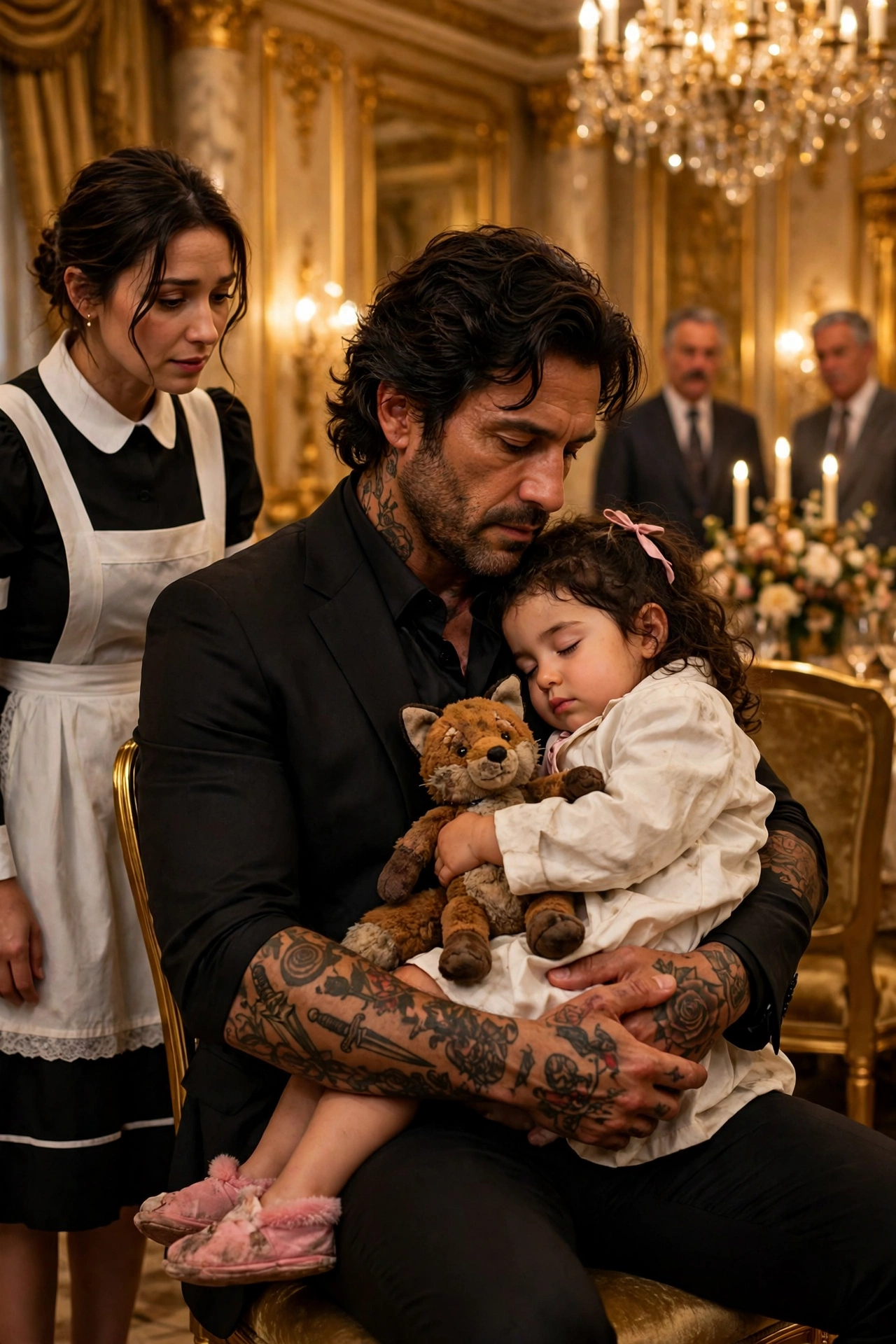
She was very small. That was the first thing I noticed, because the doorway was tall and she barely reached the handle she had somehow managed to pull. She wore a crooked white coat that was too big for her, pink slippers that made almost no sound on the polished floor, and a ribbon that was barely holding back her dark curls. A battered stuffed fox dangled from her hand, its ears flopped forward, its fur worn thin in the places where small fingers had held it for a long time. Her brown eyes were wide and trusting, and she did not look frightened at all, which was strange, because twelve dangerous men were staring at her as if she had appeared out of nowhere.
My guards stood frozen behind her. I could see them in the hallway, their hands half-raised, their faces caught between duty and disbelief. They had not let her in. She had slipped past them, the way only a very small, very determined child can slip past people who are looking for threats and not for pink slippers.
"Can I sleep on you, mister?"
The tiny voice interrupted a conversation that could have started a war, and for a moment, no one seemed to know what to do with it. Falcone's mouth opened and then closed. Salvatore's pen stopped in midair. One of the younger men at the far end of the table actually leaned back in his chair, as if distance might make the situation make more sense.
I should have called security. That was the rule. That was what a man in my position was supposed to do. I should have stood up, pointed at the door, and told the guards to take her back to wherever she belonged, quietly, before this became a story that men would repeat in bars and back rooms for years. A mafia boss does not hold children in the middle of a meeting about missing shipments and betrayal. A mafia boss does not kneel in front of a stranger's daughter and ask if she is sleepy.
Instead, something about her trusting brown eyes made me kneel.
She walked straight toward me. She did not hesitate at the table, she did not look at Falcone, she did not seem to notice the guns that some of the men wore under their jackets or the way the room had gone completely still. She walked around the corner of the table, her stuffed fox bumping against her leg with each step, and she stopped in front of my chair.
"Up, please," she whispered, lifting her tiny arms.
Nobody moved. I could feel the whole room holding its breath. Salvatore made a small sound in his throat, like a man who wanted to speak and had forgotten how. Falcone watched me with an expression I had never seen on his face before, something between disbelief and curiosity, as if he were witnessing a different kind of negotiation entirely.
I looked down at her. She was three years old, perhaps. Her coat was crooked, one button undone, and her ribbon was coming loose. Her cheeks were round, her eyelids were already heavy, and she looked at me the way a child looks at someone she has already decided to trust. It was not the look people gave me in business. People in business looked at me and calculated. This child looked at me and simply waited to be picked up.
The moment I picked her up, she wrapped her arms around my neck. It was not tentative. It was complete, as though she had been waiting for me, as though my arms were a place she already knew. Her weight was light and warm, her hair smelled faintly of soap and something sweet, and her stuffed fox pressed against my chest between us.
"Are you sleepy, sweetheart?" I asked, and my voice sounded strange to my own ears, softer than it had been all afternoon, softer than it had been in years.
She nodded and pressed her cheek against my chest. Within seconds, her breathing softened. Her little body grew heavier against me, the way sleeping children do, and her fingers, which had been tight around my collar, loosened just a little. I sat back down very slowly, careful not to jolt her, and I realized that I was holding her the way you hold something fragile and important at the same time, one arm under her legs, one hand steady against her back.
I looked around the room. Carmine Falcone stared in disbelief. My adviser Salvatore looked ready to faint, his file forgotten, his pen now lying on the table where he had dropped it. The other men exchanged glances they did not bother to hide. One man cleared his throat. Another looked down at his hands. No one dared to laugh, and no one dared to speak first, because no one knew what the rules were anymore.
But my uncle Vittorio was watching the child with an expression I could not understand. He was an older man, silver-haired, his suit immaculate as always, his hands usually steady around a glass. Now his hands were not steady. His eyes were fixed on the little girl in my arms, not with the surprise the other men showed, but with something sharper, something that looked a great deal like fear. He did not look at me. He did not look at Falcone. He looked only at her, as if she were a problem he had not expected to walk into this room.
I filed that look away. In my business, you learn to notice the one man who does not react the way the others do.
Then the little girl stirred. Her breathing changed, her tiny fingers tightened around my collar again, and she made a small, sleepy sound against my chest. I thought she was waking up, and I was about to ask Salvatore to find out quietly who she was and where she belonged, when she murmured a single word.
"Renzo."
My blood turned cold.
That name had not been spoken in years. My mother used it when I was little, in the kitchen, when she called me in from the garden. My father whispered it during our rare moments together, when business was put aside and we were simply father and son for an hour. And Matteo? Matteo called me Renzo every single day. Especially when he wanted something, especially when he was grinning and already knew I would say yes. After his funeral, I made certain nobody used it again. Not my men, not my family, not even in stories about the old days. Lorenzo was the name of the boss. Renzo belonged to a boy who no longer existed, and to a brother who was gone.
I stared at the child. She was still mostly asleep, her cheek against my chest, her fox tucked under her chin, but her lips had formed that name as naturally as breathing.
"Who taught you that name?" I whispered, and I did not care that Falcone could hear me, or that Salvatore was staring, or that the meeting had completely fallen apart. "Who taught you to call me that?"
She rubbed her sleepy eyes with one small fist, not quite waking, not quite asleep, and she answered in the same tiny, trusting voice she had used at the door.
"Matty."
My heart slammed against my ribs.
Matty. That was what Matteo had called himself when we were children. Not Matteo, the name on his birth certificate and, later, on his grave. Matty, the boy who climbed trees he was not supposed to climb, who stole sweets from the kitchen and blamed me with a straight face, who whispered plans to me at night when we were supposed to be asleep. No one outside our family had ever called him that. No one in this room, except me and Vittorio, should have known it at all.
"Who is Matty?" I whispered, because I needed to hear her say it again, because I needed to be sure I had not imagined it in a room full of smoke and tension and grief.
She hugged her stuffed fox tighter and pressed her face a little closer to my chest, as if the answer were simple and the question were strange.
"The man who tells Mommy not to cry."
Across the room, glass shattered.
Uncle Vittorio had dropped his drink. The glass hit the polished floor and broke into pieces that scattered under the table, and the sound was shockingly loud in a room that had gone silent. Wine, or whiskey, I did not notice which, spread in a dark stain across the floor. Vittorio was trembling. His face, usually ruddy and confident, had gone white. He stared at the child, then at me, then down at the broken glass at his feet, as if he could not decide which of those things frightened him more.
I looked up sharply. My guards moved at last, stepping forward, but I held up one hand, and they stopped. I did not want noise. I did not want a scene that would turn this into gossip before I understood it. I wanted to watch Vittorio, and I wanted to remember exactly how he looked in that moment, because men like Vittorio do not tremble without a reason.
And suddenly, I remembered something Matteo had told me the night before he died. We had been alone, late, in a room not unlike this one, and he had been serious in a way he rarely was. He had looked at me, not as a younger brother looking up to an older brother, but as a man who knew something he could not yet prove.
"Renzo, if anything happens to me, don't trust the people who call themselves family."
I had dismissed it at the time. Matteo worried too much, I had thought. Matteo saw enemies everywhere. I had told him to be careful, to come to me if he needed help, and then I had gone back to business, because business was always waiting. Three years later, I was holding a three-year-old girl who had just spoken his childhood name, and my uncle was trembling over a broken glass, and Matteo's warning was no longer something I could dismiss.
I held the little girl closer. Her breathing had softened again. Her fox was warm against my chest. The meeting was over, even if no one had said so out loud. Falcone was watching me now with a different expression, less like a rival and more like a man who understood that something private and important had just happened in front of him. Salvatore was quietly closing his file, as if he already knew that the shipments and the betrayal would have to wait.
Because for the first time in three years, I wondered whether my brother's death had been a lie. Not the fact of it, which I had mourned and buried and carried like a weight, but the story of it, the neat explanation I had been given, the people who had told me to accept it and move on. I wondered whether someone had arranged it, whether someone had wanted Matteo silent, and whether that someone was sitting right in front of me, trying very hard not to look at a sleeping child.
I did not know her name yet. I did not know her mother's name, or how she had gotten into my house, or why she knew the names that only my dead brother should have known. But I knew one thing, with a clarity that cut through three years of grief and discipline and rules.
I was not going to hand her back to the hallway and pretend this had not happened. I was going to find out who Matty was to her, who her mother was, and why my uncle looked afraid of a three-year-old girl in pink slippers.
And I was going to do it before anyone in that room had a chance to decide, for me, what this meant.
TITLE: A three-year-old maid's daughter walked into my private mafia meeting, climbed into my arms, and called me by a name nobody had dared speak since my brother's murder