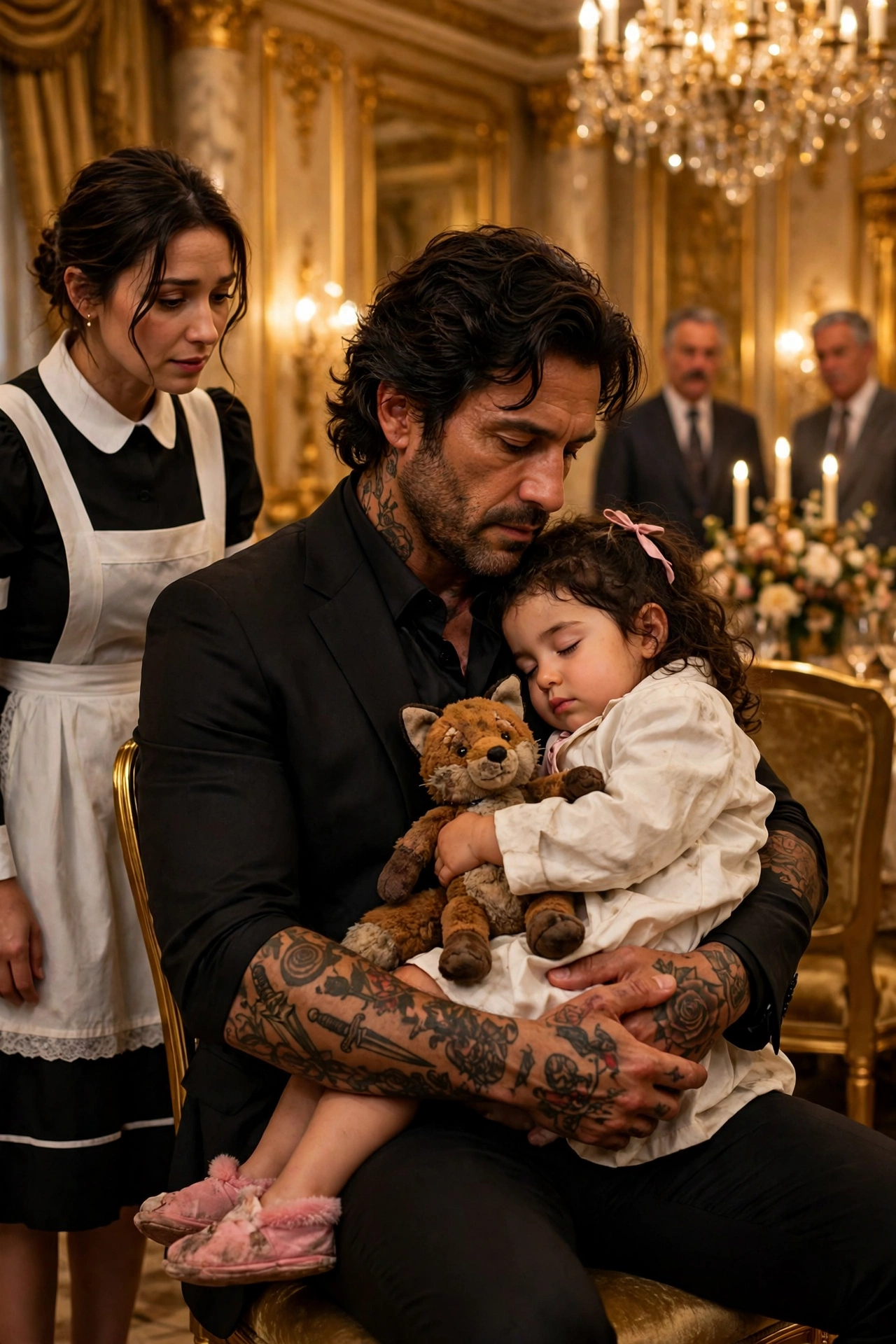
I did not end the meeting with a speech. Men like the ones around my table do not need speeches to understand when something has changed. I stood up slowly, the little girl still asleep against my chest, her stuffed fox tucked between us, and I looked at Falcone.
"We will continue this tomorrow," I said. My voice was calm. It was the voice I used when a decision had already been made and there was no point in arguing about it. "Salvatore will contact you."
Falcone nodded. He did not protest, which told me more than any argument would have. A rival who has just watched you hold a sleeping child in the middle of a negotiation does not know whether he has seen weakness or strength, and Falcone was wise enough not to guess out loud. He stood, buttoned his jacket, and left with his men, glancing back once at the doorway where the girl had appeared, as if he expected her to still be standing there.
The other men followed, quietly, one by one, until only Salvatore and Vittorio remained. Salvatore was gathering his files with hands that were not quite steady. Vittorio was still standing near his chair, staring at the broken glass on the floor as if it might explain itself. A member of staff came in with a cloth and began to clean it up, carefully, without looking at anyone.
"Uncle," I said, "you look unwell. Perhaps you should rest."
Vittorio looked up at me, and for a moment his face was almost normal again, the familiar, confident uncle who had taught me to play chess and who had sat beside my father at family dinners for as long as I could remember. Then his eyes flicked to the child in my arms, and the fear was back, quick and unguarded, before he smoothed it away.
"It was only a glass, Lorenzo," he said, too lightly. "And a long meeting. I am tired."
He left without another word. Salvatore watched him go, then looked at me, and I saw the question in his eyes that he was too loyal to ask out loud: what had just happened, and what were we going to do about it?
"Find out who she is," I said quietly, so as not to wake her. "Quietly. No one outside this house. Start with the staff. Someone must know which maid has a three-year-old daughter."
Salvatore nodded and slipped out. I was left alone in the conference room with a sleeping child, a broken glass already cleaned away, and a name echoing in my head.
Matty.
I carried her out of the conference wing and into the quieter part of the house, where the afternoon light came through tall windows and the air smelled of polish and fresh flowers instead of smoke. I did not hand her to a guard. I did not call for a nanny, because there was no nanny in this house, not since I had made my rule. I carried her myself, down the hallway, past portraits of my father and my grandfather, men who had also believed that a house like this was no place for softness, and I found myself wondering what they would have thought of a boss who could not put down a child who had fallen asleep on his chest.
Her mother found us before I found her.
She was standing in the doorway of the staff corridor, in a black and white maid's uniform, her hands clasped tightly in front of her, her dark hair pulled back, her face pale. She was young, younger than I had expected, and she looked the way a mother looks when she has lost sight of her child in a crowd and has just found her again in the arms of a stranger. Relief and terror were fighting each other on her face, and terror was winning, because the stranger holding her daughter was me.
"Mr. Moretti," she whispered. "I am so sorry. She slipped away while I was working. I turned around for one moment, and she was gone. Please, I did not mean for her to disturb you. I will take her now, and it will never happen again."
She reached out, very carefully, as if she were afraid that any sudden movement might make me angry, or make the child wake up crying. I looked down at the girl, still asleep, her ribbon now completely loose, her curls falling over her forehead, her fox still clutched in one small hand. I looked back at her mother, and I saw the same brown eyes, the same dark curls, the same gentle shape of a face. There was no doubt that this was her daughter.
"What is her name?" I asked.
The maid hesitated. It was a simple question, but she answered it as if it were a test she was afraid of failing.
"Sofia," she said softly. "Her name is Sofia."
Sofia. I repeated it silently, and it felt right in a way I had not expected. A small, ordinary, beautiful name for a child who had just walked into the most dangerous room in my house and asked to sleep on a mafia boss.
"And you?" I asked.
"Elena," she said. "Elena Rossi. I have worked here for four years, sir. In the kitchens and the guest rooms. Sofia stays with me in the staff quarters when I am on duty, but today she was supposed to be with the other children, and she must have followed me when I came to clean the hallway near the conference wing."
I nodded, but I was not really listening to the explanation about hallways and schedules. I was listening for something else, for the part of the story that would explain the names.
"Elena," I said, keeping my voice low and steady, "your daughter called me Renzo. She said a man named Matty taught her that name. She said Matty is the man who tells you not to cry."
Elena went very still. Her hands, which had been clasped in front of her, tightened until her knuckles were white. Her eyes filled with tears, but she did not look away, and that took courage, because she must have known who I was and what I was capable of.
"Please," she whispered. "Please do not be angry with her. She is only three. She does not understand. She heard the name once, and children remember the strangest things."
"Where did she hear it?" I asked. "From you?"
Elena shook her head, slowly, and then she did something I did not expect. She looked down the hallway, as if to make sure no one was listening, and then she looked back at me and spoke in a voice so quiet I had to lean in to hear her.
"From him," she said. "From Matteo."
The name hung between us in the hallway, and for a moment I could not breathe. Matteo. Not Matty, the childhood nickname, but Matteo, the full name, spoken by a maid in my own house as if he were a person she had known, not a story she had heard.
"My brother has been dead for three years," I said, and my voice was harder than I intended. "Sofia is three years old. She cannot have known him."
"I know how it sounds," Elena said quickly. "I know you will think I am lying, or confused, or trying to gain something. But I am not. Matteo was kind to us before Sofia was born. He found me when I had nowhere to go, and he helped me find work here. He would visit the staff quarters sometimes, not as a boss, but as a friend. He would sit on the floor and talk to Sofia when she was a baby, and he would tell her stories, and he would tell me not to cry when I was afraid."
She stopped, and tears slipped down her cheeks, but she did not wipe them away, as if she had cried so many times before that it no longer embarrassed her.
"He called you Renzo," she said. "He talked about you all the time. He said his big brother Renzo would protect us if anything ever happened to him. He said Renzo was the only person he trusted completely. Sofia must have heard him say it, over and over, when she was very small. Children remember voices, Mr. Moretti, even when they do not remember faces."
I stared at her, and grief hit me in a way it had not hit me in a long time. Not the clean, controlled grief of a funeral, where you stand straight and accept condolences and make decisions about flowers and burial plots. This was messier, more personal. Matteo had a life I had not known about. Matteo had friends I had not met. Matteo had sat on the floor of the staff quarters and talked to a baby and promised a frightened young mother that his brother would protect her, and I had not known any of it, because I had been too busy running an empire to notice that my brother was building a quieter, kinder life on the edges of it.
"Why did you never tell me?" I asked. "After he died, why did you stay silent?"
Elena's answer was simple, and it broke my heart a little, because it was the answer of someone who had learned to be afraid.
"Because I was told not to," she said. "After Matteo died, a man came to me and said that if I ever spoke about Matteo and Sofia, if I ever told you, Sofia would not be safe. He said it would be better for everyone if I kept working quietly and forgot that Matteo had ever known us. I believed him, because I had a baby and nowhere else to go."
"Who was the man?" I asked, though I already feared the answer.
Elena shook her head. "I do not know his name for certain. He was older, well-dressed, and he spoke like family. He said he was looking out for the family name. I was too frightened to ask questions."
Older. Well-dressed. Speaking like family. Vittorio's face, white with fear over a broken glass, rose in my mind uninvited, and I pushed it aside for the moment, because I did not want to accuse my uncle on the word of a frightened maid and a sleeping child. But I could not unhear it either.
"Elena," I said, "I need you to listen to me very carefully. No one is going to hurt you or Sofia while you are in this house. Not a stranger, not a member of staff, and not a member of my family. Do you understand me?"
She nodded, but she did not look convinced, and I understood why. Promises are easy. Safety is harder, especially in a house where a man could be threatened into silence and a child could wander into a meeting about war.
"Then why did Sofia come to me today?" I asked, more gently. "Why did she walk into that room, of all rooms?"
Elena looked at her daughter, asleep in my arms, and her expression softened, even through her tears.
"Because she has been asking about you," she said. "Not about Mr. Moretti the boss. About Renzo. She asks when Renzo is coming to visit, the way other children ask about a favorite uncle. She saw a picture once, in an old album Matteo left behind, of you and Matteo together when you were boys. She pointed at you and said, 'Renzo.' I told her you were very busy and very important, and that she must not disturb you. But today she must have heard the meeting, or seen the door open, and she simply went to find you."
I looked down at Sofia again. Her breathing was slow and even. Her fox was still in her hand. In the late afternoon light, her blue dress, which she must have changed into after the meeting, or which I had only just noticed in the soft light of the hallway, caught the light and shimmered. She looked peaceful, and for the first time since the meeting, I felt something other than anger or suspicion. I felt protective, in a way that had nothing to do with business or territory or reputation. I felt like a man who had been given a second chance to keep a promise his brother had made, and who did not intend to waste it.
"Matteo told me something the night before he died," I said, almost to myself. "He said, 'Renzo, if anything happens to me, don't trust the people who call themselves family.' I thought he was being dramatic. I thought he was tired. Now I am beginning to think he was trying to warn me, and I was too busy to listen."
Elena did not answer. She did not need to. The warning and her story fit together too well to be a coincidence.
Salvatore returned then, quietly, from the end of the hallway. He looked at Elena, at Sofia asleep in my arms, and at me, and he understood, in the way loyal men do, that the afternoon had changed everything and that we would not be discussing shipments again today.
"Sir," he said softly, "I have found what you asked for. Elena Rossi, maid, four years. Sofia, three years old. No record of any complaint, no record of any trouble. And sir, there is one more thing. The staff rota for the day Matteo died shows that Vittorio was the last member of the family to see him alone. No one has ever asked about that rota since."
I nodded slowly. I did not want to jump to conclusions. I wanted evidence, and I wanted the truth, not revenge dressed up as justice. But I also wanted Elena and Sofia safe, and I wanted answers about Matteo, and I knew, with the same clarity I had felt in the conference room, that those two things were now connected.
"Elena," I said, "from tonight, you and Sofia will not stay in the staff quarters alone. You will have rooms in the main house, near mine, where my own guards can watch the doors. Sofia will have proper clothes, and food, and a safe place to sleep, and no one will threaten you again. I am not asking you to trust me all at once. I am asking you to let me keep the promise Matteo made to you."
Elena stared at me, and then she began to cry in earnest, quietly, her hands over her mouth, as if she had been holding those tears back for three years and they had finally found a way out.
"Thank you," she whispered. "Thank you, Renzo."
She said my name the way Matteo must have said it, not as a title, not as a warning, but as a name belonging to a person, and for the first time since my brother's funeral, I did not flinch when I heard it.
I held Sofia a little closer, and I thought about the man who tells Mommy not to cry. I did not know yet whether Matty was alive, or whether Matteo had simply left behind a story that a child had carried for him. But I knew that Sofia had brought him back into my house, in the only way a three-year-old could, by walking into the wrong room and asking to sleep on a stranger.
And I knew that, whatever the truth was about Matteo's death, I would not find it by ignoring a child who called me Renzo. I would find it by protecting her, by listening to her mother, and by asking the questions I should have asked three years ago, starting with the man who had dropped his glass when he heard a dead brother's name spoken aloud.
TITLE: A three-year-old maid's daughter walked into my private mafia meeting, climbed into my arms, and called me by a name nobody had dared speak since my brother's murder