The wooden box was smaller than I expected.
Elena brought it to my study the next morning, wrapped in a plain cloth, her hands steady now that she had decided to trust me. Sofia was in the next room with Salvatore, building a tower out of wooden blocks and knocking it down with great seriousness. I could hear her laughing through the wall, and that sound made it easier to open something I was afraid to read.
Inside the box was a letter, folded twice, in Matteo's handwriting. I recognized it at once. He had always written quickly, his letters leaning to the right, as if they were in a hurry to get somewhere.
The letter was short. It did not name a killer. It did not accuse Vittorio directly. It said, in Matteo's plain way, that shipments had been going missing for months, but the shipments were not really missing. They were being rerouted, sold quietly, and the money was being moved through a company that did not exist on any of our books. He had followed the paper trail to a warehouse outside the city, and he had found his own signature forged on a delivery sheet for a shipment he had never approved.
He wrote, "Renzo, if you are reading this, it means I could not finish this myself. Start with the shipments. Follow the money, not the men. Men lie. Money leaves a trail."
At the bottom, in smaller writing, he had added, "Tell Elena and Sofia I am sorry I could not stay. I promised Sofia a fox that would never get lost. I hope she still has it."
I folded the letter again, very carefully, and put it back in the box. My hands were shaking, but my mind was clear. Matteo had not died because of a rival family. He had died because he had found a theft inside our own house, and someone had needed him to stop looking.
"Salvatore," I said, when Elena had gone back to Sofia, "I want every record for the shipments from the six months before Matteo died. Not the summaries. The originals. Delivery sheets, driver logs, warehouse receipts. Everything."
Salvatore did not ask why. He just nodded and left. He knew, as I did, that this was no longer about grief. It was about evidence.
We spent the next two days in the study, going through boxes of old paper. It was slow work, and it was boring in the way that real investigations are boring. Most of the sheets matched. Most of the drivers had done their jobs. Most of the warehouses had signed for what they received.
But on the third box, Salvatore found it. A shipment of olive oil, of all things, ordinary and unremarkable, that had been listed as lost on the road between the port and the city. The driver had reported a breakdown. The company had written it off. And yet, three weeks later, the same shipment number appeared again, on a delivery sheet for a different warehouse, signed in Matteo's name, in handwriting that was close to his, but not quite his.
"The signature is wrong," Salvatore said, holding the two sheets side by side. "Look at the M. Matteo always made his M with a sharp point in the middle. This one is rounded. Someone copied it, but they did not copy it well."
"Who had access to these sheets?" I asked.
"Only a few people," Salvatore said. "You. Me. Matteo. And Vittorio, because he was in charge of the warehouse accounts at that time."
Vittorio again. Not proof, but another crack, in the same wall.
That afternoon, I did something I had not done in three years. I went to the warehouse myself, with Salvatore and two men I trusted completely, and I asked to see the old logs. The manager, an older man who had worked for my father, looked nervous when he saw me, but he brought out the books without arguing.
In the back of one ledger, in a different ink, someone had written a series of numbers. They were account numbers, for a company I had never heard of. Salvatore copied them down. When we checked them later, they led to a small office in the city, rented under a false name, paid for in cash, month after month, even after Matteo died.
"Who paid the rent after Matteo died?" I asked Salvatore that night.
He looked at the paper in his hand. "The payments continued for six months after his death, and then they stopped, suddenly, as if someone had decided the risk was no longer worth it. The last payment was made by a man who gave the name of Vittorio's driver."
The driver's name was the same as the driver from the Naples trip, the one who had died in a car accident two years ago. A dead man cannot pay rent, but a living man can use a dead man's name.
I sat back. I was not angry in the way people expect a mafia boss to be angry. I was cold, and clear, and very tired. For three years, I had believed a simple story because it was easier than asking who in my family had benefited from my brother's death. Now the money was telling me a different story, and money, as Matteo had written, does not lie the way men do.
While Salvatore followed the account numbers, I turned my attention to the other half of the problem: protecting Elena and Sofia. Vittorio had seen Sofia in the meeting. He knew she existed now. He knew she had said Renzo. He would be wondering what else she might say, and what her mother might know.
I moved Elena and Sofia to a larger room on the second floor, near my own study, where the guards could see the hallway from both ends. I told the staff, plainly, that Elena and Sofia were under my personal protection, and that anyone who tried to move them, question them, or take them anywhere without my word would answer to me directly.
Elena was grateful, but she was also frightened. "Will Vittorio be angry?" she asked me one evening, while Sofia was playing with her fox on the rug.
"Probably," I said honestly. "But he will be more afraid than angry, if he knows I am watching him. Fear makes men careful, and careful men make mistakes."
Sofia looked up from her fox. "Is Uncle Vitty a bad man?" she asked, using the name she had heard the adults say.
I knelt down beside her, so I was at her level. "Uncle Vittorio is a grown-up who has made some very bad choices," I said, choosing my words carefully. "You do not need to worry about him. That is my job. Your job is to play, and to eat your dinner, and to sleep well."
She thought about that, and then she nodded, as if that was a fair division of work. "Okay, Renzo," she said. "I will play."
That night, Falcone sent another message, more urgent this time. He wanted a meeting, and he wanted it now, because the missing shipments were affecting his family too, and he was tired of waiting. I almost refused again, but Salvatore stopped me.
"Let him come," Salvatore said. "Not to the house. To a neutral place. If Falcone is also losing money from these rerouted shipments, then he is not the thief. He is another victim. And a victim who is angry can be useful, if you point him in the right direction."
I thought about that. For three years, I had blamed Falcone for Matteo's death, because that was the story Vittorio had given me. If Falcone was innocent of that, then I owed him an apology I would never fully be able to give. But I also owed Matteo the truth, and the truth was more important than my pride.
"Set the meeting for tomorrow," I said. "Neutral ground. No weapons in the room, except for the guards outside. And tell Falcone I want to talk about shipments, not about war."
The next day, before the meeting, I sat with Elena and Sofia for breakfast. It was a small, ordinary thing: toast, eggs, juice in a plastic cup with a lid, because Sofia liked to spill things. Elena watched me as if she was still trying to decide if I was the Renzo from Matteo's stories.
"Matteo used to eat breakfast like this," she said quietly. "Not fancy. Just toast, and talking about ordinary things. He said that was when he felt most like himself."
"I remember," I said. "He always burned the toast, and then he pretended he liked it that way."
Sofia giggled. "Burnt toast is yucky," she said.
"Yes, it is," I said, and I laughed, for the first time in what felt like a very long time.
After breakfast, Salvatore came in with one more piece of paper. It was a bank statement, for the false company, showing a large payment made the week before Matteo died, to an account in Vittorio's name. Not a driver. Not a false name. Vittorio himself, in his own name, as if he had stopped being careful at the very end.
"This is it," Salvatore said softly. "This is not a crack anymore. This is a door."
I looked at the statement, and then at Sofia, who was drawing a picture of a fox with a crayon, her tongue stuck out in concentration. I thought about what Matteo had written: follow the money, not the men.
"Keep this safe," I said to Salvatore. "Make three copies. Put one in the safe in my study, one with a lawyer we trust outside the family, and one where only you and I know it is. Do not show it to Vittorio yet. Do not show it to Falcone yet. I want to be ready, with everything, before I confront anyone."
Salvatore nodded and left. I stayed with Sofia and Elena for a little while longer, watching a child draw, listening to ordinary talk about toast and foxes and bedtime stories. It was the most peaceful hour I had spent in my house in three years, and it was also the hour when I finally understood what Matteo had been trying to protect.
He had not just been trying to protect money, or shipments, or the family name. He had been trying to protect a mother and a little girl who had no one else, and a brother who was too busy being feared to notice what was happening in his own house.
I was not going to make that mistake again. Vittorio would face what he had done, with evidence, not with violence, and in a way that did not put Sofia or Elena in danger. Falcone would learn the truth about the shipments, and the war he had been expecting would not happen, because there was no war to fight. There was only a theft, and a lie, and a brother who had tried to stop both.
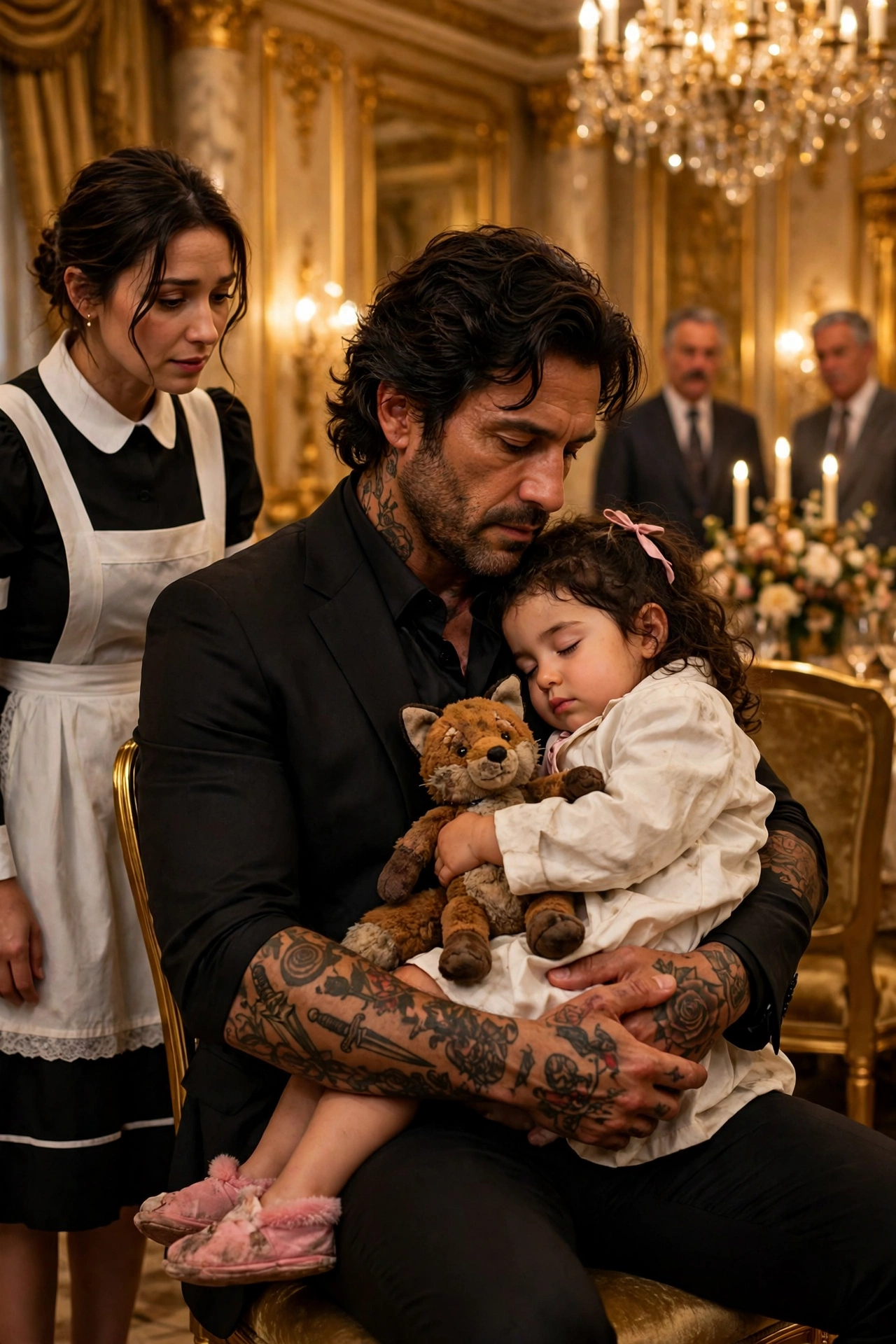
That evening, as Sofia was getting ready for bed, she climbed into my lap, just as she had climbed into my arms in the conference room. She was heavier than she looked, and warm, and sleepy. She pressed her fox against my chest and whispered, "Renzo, will you stay?"
"Yes," I said. "I will stay. I am not going anywhere."
She fell asleep like that, trusting me completely, and I sat there, holding her, thinking about shipments and signatures and bank statements, and about how a three-year-old girl had walked into my meeting and changed everything, not with a weapon, or with a threat, but with a name, and with trust.
Before I went to Sofia's room that night, Salvatore came back with news about the copies. He had done exactly what I asked, and he looked relieved to have the papers out of his hands and into safe places.
"The lawyer outside the family has one copy," he said. "He does not know what it is yet, only that it is to be opened if something happens to you or to me. The safe in your study has the second. The third is where only you and I know, and I will not write that place down anywhere."
"Good," I said. "That means Vittorio cannot make this disappear by taking one paper from one room. He would have to find all three, and he does not know where all three are."
Salvatore hesitated, and then he said something I had not expected. "Lorenzo, I have worked for your father, and then for you, for twenty years. I have seen men do terrible things for money, and I have seen men lie to their own brothers. I have never seen a man change the way you have changed in the last few days. Sofia did that. Not the shipments. Not the papers. A child who trusted you."
I did not know what to say to that, so I just nodded. Salvatore was right, in a way I had not wanted to admit. Before Sofia walked into my meeting, I had been content to live with a simple, sad story about my brother, because asking questions would have meant admitting that someone I trusted might have betrayed us. After Sofia, I could not live with that story anymore, because she had given me a reason to look again, and because Matteo had clearly wanted me to look again, through Elena, through the letter, through the fox.
Elena found me in the hallway a little later, while Sofia was brushing her teeth with great concentration and a great deal of toothpaste on her chin. Elena looked calmer than she had the day before, but still careful, the way a person looks when they are learning to trust a new room.
"Will it be dangerous tomorrow?" she asked. "When you speak to Vittorio?"
"I will not let it be dangerous for you or for Sofia," I said. "You will stay in this part of the house, with guards I trust, and you will not be in the room when I speak to him. You will not have to hear it, and Sofia will not have to hear it. That is my promise, and it is separate from everything else."
She nodded, and for the first time, she smiled without looking away. "Matteo would be glad," she said. "Not about Vittorio. About you. About the way you are with Sofia."
I thought about that as I walked to Sofia's room. Matteo would be glad. That was a strange thought, and a comforting one, after three years of thinking only about how Matteo had died. Perhaps, in the end, the best way to honor him was not to find a perfect punishment for the man who had hurt him, but to become the kind of man Matteo had believed I could be, the kind of man who keeps a promise even when it costs him something.
Tomorrow, I would confront Vittorio. Tonight, I would just sit here, and keep a promise I had made to a brother who was gone, and to a little girl who was still here.
TITLE: A three-year-old maid's daughter walked into my private mafia meeting, climbed into my arms, and called me by a name nobody had dared speak since my brother's murder