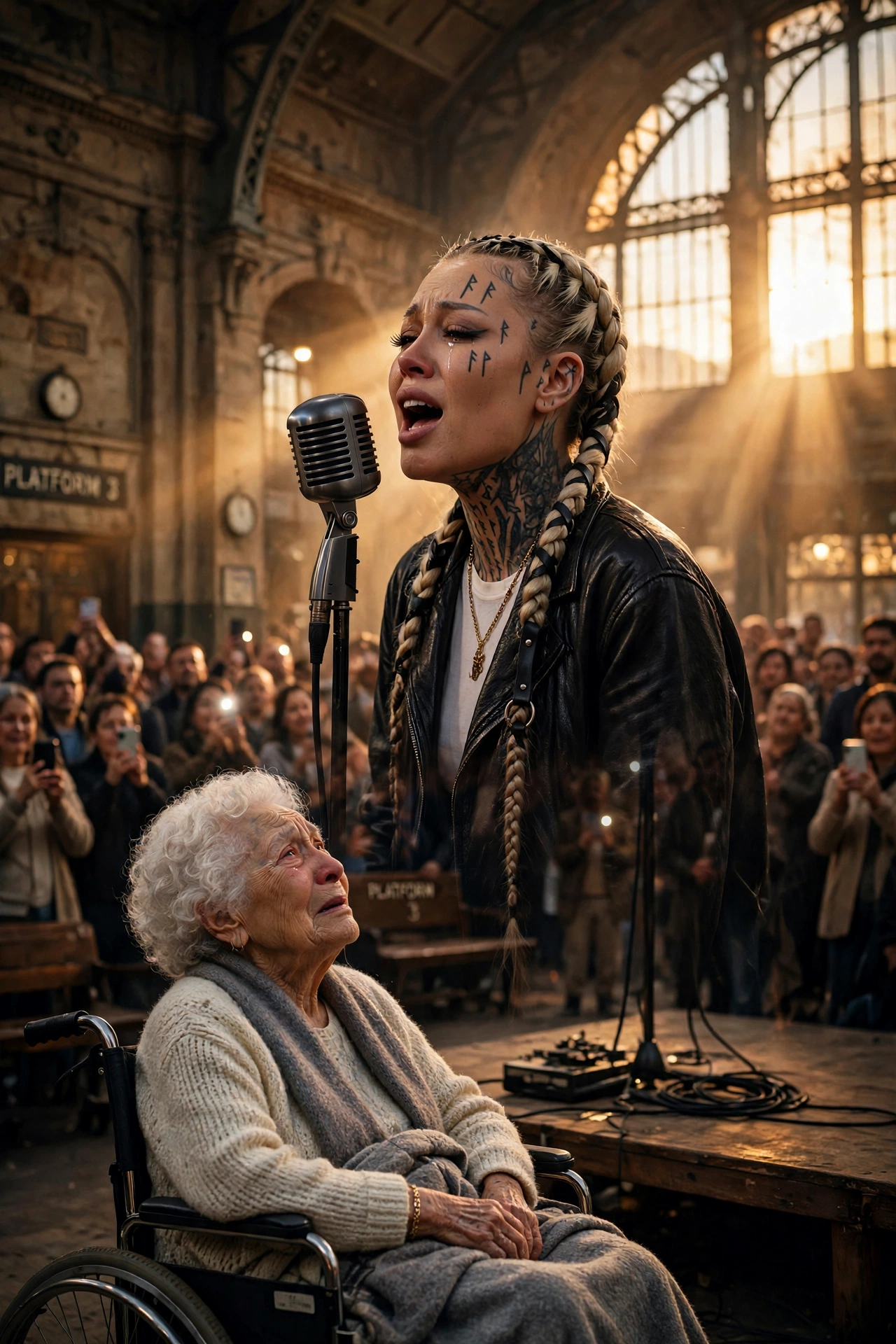
Mara came home at three in the morning, and the apartment was too quiet.
Usually, even at that hour, there was some sign Anna had waited up: a lamp burning low, a pot on the stove, a folded blanket on the sofa. Tonight the kitchen was dark. Mara stood in the doorway with her guitar case in one hand and her coat still damp from the rain, and told herself she was imagining things. Anna was seventy-one. She went to bed early sometimes.
But Mara had learned, over twenty years of coming home late from bars and small stages, to read the silence of this apartment. She set her guitar case down and walked to Anna's bedroom door. It was open a few inches. In the faint hallway light, she could see her mother lying on her side, facing the wall, one hand curled near her face. Her breathing was shallow and uneven, as if sleep itself had become work.
"Mom?" Mara whispered.
Anna did not answer at first. Then her eyes opened, slow and heavy, and she tried to smile. It was a thin smile, the kind she used when she did not want Mara to worry.
"You are home late," Anna said, her voice hoarse. "Did it go well?"
Mara knelt beside the bed. Up close, she could see what the dim light had hidden: Anna's face was pale in a way that had nothing to do with the hour, and there was sweat on her forehead despite the cool room. Her hands, when Mara took one, felt too light, the bones too close to the skin.
"Mom, you are burning up," Mara said. "How long have you felt like this?"
Anna looked toward the small window where rain tapped the glass. "A few days," she said, as if it were nothing. "It is just a cold. I did not want to bother you. You had the show at The Lantern."
The show at The Lantern had not gone well. Mara had sung to a room of twenty people, half of them talking over her, and the manager had paid her less than promised because the crowd had been thin. She had not told Anna that part. She never told Anna the worst parts. But standing there, holding her mother's feverish hand, she understood suddenly that Anna had been keeping her own worst parts hidden too, in the same careful, loving way.
"You should have called me," Mara said.
"I did not want to worry you," Anna repeated, and she squeezed Mara's hand. "You worry enough for both of us."
Mara did not sleep that night. She sat beside Anna's bed, a damp cloth in her hand, changing it every half hour, listening to her mother drift in and out of restless sleep. Around five, Anna began to cough, a deep cough that shook her whole frame and left her gasping. When Mara helped her sit up to drink water, Anna winced and pressed a hand to her side.
"It hurts here," Anna admitted, very quietly. "It has hurt for a while. I thought it would pass."
By morning, Mara had made up her mind. She called the clinic as soon as it opened, explaining the fever, the cough, the pain, and the weight Anna had lost that Mara had not allowed herself to see until now. The nurse told her to bring Anna in that morning. Mara helped her mother dress, slowly, button by button, because Anna's hands trembled too much to manage the small buttons herself. Anna apologized for the trouble three times on the way to the taxi, and each time Mara said, "Stop apologizing, Mom," a little more fiercely than she meant to.
The clinic smelled of disinfectant and old coffee. They waited two hours in plastic chairs, Anna leaning against Mara's shoulder. When a doctor finally called Anna's name, Mara stood up so fast the chair scraped against the floor. She followed them into the examination room and stood in the corner, arms crossed tight, while the doctor asked questions and Anna answered calmly: yes, the pain had been there for weeks, maybe months; yes, she had lost her appetite; no, she had not wanted to make a fuss.
They sent Anna for blood tests and a scan. The waiting stretched into the afternoon. Mara walked the corridor again and again, thinking about all the nights she had come home to hot soup waiting on the stove, and all the flyers from her failed auditions that Anna had kept in a drawer, smoothed flat and treasured as if they were certificates. Mara had spent twenty years chasing a stage that never wanted her, and she had never once asked her mother what she needed, what hurt, what she was afraid of.
When the doctor returned, his face told Mara the news before his words did. He was a kind man, middle-aged, with tired eyes, and he did not rush. He spoke to Anna first, and then to Mara, and he used plain words, which Mara was grateful for, even as each word landed like a blow.
There was a tumor, he said. Malignant. It had grown in silence, which was why Anna had felt only vague pain and tiredness for so long. He used the word cancer only once, gently, and then went back to the medical terms, as if softening it might make it easier to carry home. He explained what the scans showed, what the blood tests suggested, and what the next steps would be: a specialist, a fuller set of tests, and then treatment. Treatment was possible, he said, and he said it firmly, looking at both of them in turn. This was not a hopeless case. The disease had been caught in time for treatment to work, if they moved quickly.
Mara clung to that sentence while the doctor went on, because she needed something solid to hold.
Then he talked about the cost.
He laid it out in numbers that grew larger with every line: the specialist consultations, the surgery that would likely be needed, the rounds of treatment after surgery, the medication, the hospital stay, the follow-up scans. He wrote the estimate on a piece of paper and slid it across the desk. Mara stared at the total and felt the room tilt slightly, as if the floor had shifted under her chair.
She did the math in her head before she could stop herself. Twenty years of singing in bars. Twenty years of auditions that ended with a polite no, of managers who promised to call and never did, of nights when she was paid in tips instead of money. She had a savings account with less than two months' rent in it. She had a guitar that was worth something, and a car that barely ran, and a drawer full of flyers. She did not have this number. She did not have a tenth of this number.
"Is there a cheaper way?" she heard herself ask. Her voice sounded far away. "A program, or a payment plan?"
The doctor nodded, not unkindly. There were programs, he said, and the hospital had a financial office that could explain them. Some costs could be spread out. Some charities helped in cases like this. But he was honest with her: the treatment could not wait for a perfect solution. The sooner Anna started, the better her chances. Waiting months to gather money would cost them the very thing the money was meant to buy.
Anna, sitting beside Mara, had said almost nothing through all of this. When the doctor finished, she reached over and covered Mara's hand with her own. Her hand was cool now, the fever broken for the moment, and her grip was steady.
"Do not be afraid," Anna said softly. "We will manage. We always have."
Mara looked at her mother and felt guilt so sharp it made her eyes sting. Anna was the one who was sick. Anna was the one who had just been told she had a malignant disease. And Anna was the one doing the comforting.
That night, after Anna had fallen into an exhausted sleep, Mara sat at the kitchen table with the doctor's estimate in front of her and a blank piece of paper beside it. She made lists and crossed things out. She called the bar where she sang on Fridays and asked the owner if there was any extra work. He said business was slow; he could give her one more night a week and that was all. She called an old friend who now worked at a music school and asked if they needed a teacher. They did not. She searched online for charities and patient funds until her eyes burned and filled out two application forms.
By two in the morning, the paper in front of her was full of numbers that did not add up. The total she could realistically gather in the next few weeks, even if she sang every night and sold everything anyone would buy, was a fraction of what the hospital needed to begin. Mara put her head down on the table and cried, quietly, so she would not wake Anna — for her mother, for the years she had wasted, and for a world where belief and love were not currency, where twenty years of a mother's silent pride could not be traded for a single round of treatment.
She must have fallen asleep at the table, because she woke to the smell of soup.
Anna was standing at the stove in her nightdress and robe, moving slowly, one hand braced on the counter, stirring a pot with the other. She had gotten up despite the fever and the pain, despite everything the doctor had said that day, to make soup for her daughter. When she saw Mara watching her, she smiled, a little embarrassed.
"You did not eat yesterday," Anna said. "Sit down. It is almost ready."
Mara went to her and took the spoon gently from her hand. "Mom, you should be in bed."
"I will go back to bed," Anna said. "After you eat. A singer cannot sing on an empty stomach, and a daughter cannot fight on one either."
Mara sat down. Anna ladled the soup into a bowl and set it in front of her, then sat across the table and watched Mara eat, as she had a thousand times before. Anna looked frail, and her face was still too pale, but her eyes were clear and calm. There was no panic in them, no blame — only the same quiet, steady love Mara had lived inside her whole life without ever fully naming it.
"Tell me honestly," Mara said, after a while. "Are you scared?"
Anna considered the question slowly and without fuss. "A little," she said. "But I have been scared before, and I am still here. And I have you. That is more than many people have."
"You deserve better than this," Mara said. "You deserve a daughter who can pay for your treatment without having to beg."
Anna reached across the table and took Mara's hand. Her fingers were thin, but her grip was firm. "Listen to me," she said. "I have never once been ashamed of you. Not when you came home with no money. Not when people laughed at your tattoos, or said a woman your age should stop dreaming. I watched your videos every night, Mara. Every single night. Do you know why? Because when you sing, you are the person you were meant to be. That is worth more to me than any amount of money."
Mara could not speak. She had never guessed that her mother stayed up, alone, watching her daughter sing on a small phone screen, keeping every flyer, believing without ever saying the words aloud. The knowledge broke something open in her chest — grief, and gratitude, and a fierce, protective love.
Later that day, Mara walked to the hospital's financial office. There were forms, and waiting lists, and partial assistance that might cover a small part of the cost, but not the surgery, and not soon enough. On her way home she thought about giving up the dream, about finding any steady job, about selling the guitar. But a steady job would take months to pay what the hospital needed, and selling the guitar would buy a week, not a cure. Every practical road led to the same wall: not enough, not in time.
And yet, something in her hardened into resolve. She would not accept that wall as the end of the story. If the money would not come from singing in bars, it would have to come from somewhere else, from some chance she had not yet found. She did not know what that chance was, or where to look, or what she could offer that the world had not already refused for twenty years. But she knew one thing: she would find a way to pay for her mother's treatment, whatever it took, because Anna had spent a lifetime carrying her, quietly, without ever asking for thanks.
When Mara got home, Anna was asleep in her chair by the window, a blanket over her knees, her face peaceful in the gray afternoon light. Mara watched her for a moment, then went to the kitchen and began to wash the soup pot, her hands steady now. She had no solution, no plan, no miracle waiting around the corner. What she had was a mother who still believed in her, a bill she could not yet pay, and a determination that felt, for the first time in twenty years, larger than her fear. It would have to be enough to start with.