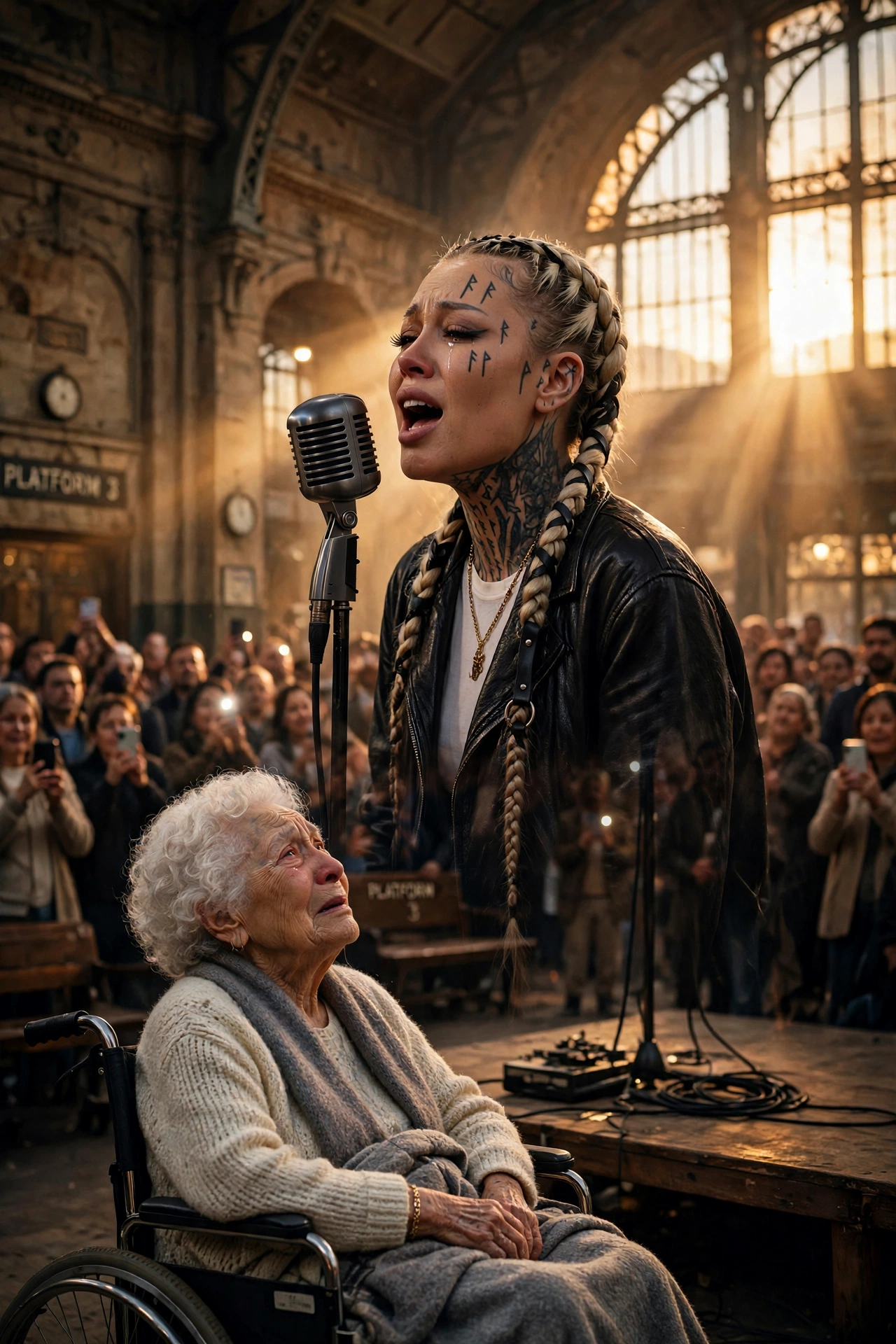
The old train station had not been a station for a long time, not really. The trains still passed through on the far tracks, late and loud, but the grand hall in the middle belonged now to other things: a farmers' market on Saturdays, a wedding now and then, and on nights like this, a small stage put together from borrowed planks and black curtains, lit by strings of warm bulbs that swayed whenever a door opened. Mara had sung in worse places. She had sung in bars where the beer taps hissed louder than the applause, in rooms where people talked straight through her choruses, in a diner where the owner paid her in pie. But she had never sung here, under this high vaulted roof, where every note seemed to rise and then come back to her, changed, as if the building itself were listening.
She arrived early, carrying her guitar case in one hand and a small bag in the other. The air inside smelled of old iron and rain. Outside, October had turned cold, and the wind pushed dead leaves along the platform. Inside, the bulbs glowed amber against the dark steel ribs of the ceiling, and the polished concrete floor reflected them in long, trembling lines. Someone had set out rows of folding chairs, more than Mara had expected. A few people were already there, unwinding scarves, holding paper cups of coffee, talking in low voices.
She set her case down behind the curtain and took out the guitar. It was the same guitar she had owned since she was seventeen, its wood worn smooth where her forearm rested, a thin crack near the neck that she had learned to play around. She tuned it slowly, letting each string settle. Her hands were steady, which surprised her. All day her hands had shaken. All day she had told herself she would not do this song. She had told herself it was too private, too old, too unfinished. She had written it at eighteen, in a bedroom with posters peeling off the walls, on a night when her mother had come home late from a double shift and fallen asleep at the kitchen table with her coat still on. Mara had watched her sleep and written the words in a notebook, not because she thought anyone would ever hear them, but because she did not know what else to do with the feeling in her chest.
Twenty years had passed since then. Twenty years of auditions in rooms with fluorescent lights and tired judges who looked at her tattoos before they listened to her voice. Twenty years of being told she was too much, too loud, too rough around the edges, or simply not what they were looking for. Twenty years of singing at night in bars while people she had gone to school with built steadier lives, and of hearing, in the spaces between songs, the quiet judgment that followed her home. What she had not learned was how to stop wanting it: the big stage, the lights, the moment when a room full of strangers went quiet because of something she had made.
Her mother had never once told her to stop. Anna had never criticized the late nights, the bars, the tattoos that curled like dark vines along Mara's jaw and down her neck. Anna had never said the words other people said so easily, that singing was not a real life, that Mara should have chosen something safer. Instead, Anna had done quieter things. She kept the old flyers from Mara's earliest shows, folded carefully into a drawer. She watched Mara's performance videos every night on her phone, the volume low, long after Mara had gone to bed. When Mara came home exhausted, her throat raw and her feet aching, there was always hot soup waiting on the stove, covered with a lid, still warm. Mara ate it standing up in the kitchen, half asleep, and rarely thought to ask why her mother was still awake. She did not know, not fully, how proud Anna was. She knew her mother loved her. She did not know that Anna carried that pride like a lamp, every day, even on the days when the world gave Mara nothing back.
Now Anna was sick. The word the doctors used was malignant, and it sat in Mara's mind like a stone. Treatment existed, but it cost more money than Mara had ever held in her hands at one time. Still, the gap between what she had and what her mother needed felt like a distance she could not cross. That was why tonight mattered, though no one in the room knew it. Tonight was not an audition. There was no judge, no contract waiting in the wings. There was only a small stage, a crowd, and a song Mara had carried for twenty years without ever singing it for the person it was written for.
Anna arrived just before the show began. Mara saw her from behind the curtain, and her breath caught. Her mother was in a wheelchair, pushed gently by a nurse from the care center, a blanket folded over her knees. Anna looked smaller than Mara remembered, her hair thinner, her face pale under the warm lights, but her eyes were bright and alert, moving across the hall as if she were memorizing it. She wore a soft blue scarf that Mara had given her years ago, and she held a small tissue in one hand, already crumpled. The nurse settled the wheelchair in the front row, right in the center, where Anna could see the stage without anything in the way. Anna looked up, found Mara behind the curtain, and smiled. It was a small smile, tired and full of something Mara could not name, and it undid her more completely than any rejection ever had.
The lights dimmed, or as close to dimmed as the string bulbs allowed. Mara stepped onto the stage, and the wooden planks creaked under her boots. She looked out at the crowd and saw what she had not expected to see: not just the regulars, not just a handful of friends, but a real audience, phones raised, faces turned toward the stage. The vaulted roof arched above them all, and the bulbs swayed almost imperceptibly, casting moving light across faces. Mara's heart beat so hard she was sure the microphone would pick it up.
She did not introduce the song the way she usually introduced songs, with a joke or a story to loosen the room. She simply sat on the stool, settled the guitar against her body, and looked at her mother in the front row. Anna was watching her, hands folded in her lap, the blanket neat over her knees, tears already shining in her eyes though Mara had not sung a single note. Then she remembered the kitchen, the sleeping woman in the coat, the notebook open on the table, and she let her fingers find the first chords.
The song began quietly, almost like a confession. It was about a girl who watched her mother work until her hands shook, who learned to be brave by watching someone else be tired and keep going anyway. It was about coming home late and finding the light still on, about soup on the stove and a voice that never once said give up. Mara had written it in the plain language of an eighteen-year-old, and she had been almost embarrassed by its plainness for years. Tonight, under the high roof, the plain words sounded different. They sounded true. Her voice, rough from years of smoky rooms, carried the melody gently at first, then stronger, as if the song itself were remembering why it had been written.
Halfway through the first verse, her voice broke. It was not a performance break, not a trick she had practiced. It was the real thing, a crack that ran through a word and left her breathless for a second. She felt heat rise in her face, and for an instant the old fear returned, the fear of being laughed at, of being judged for showing too much feeling. But no one laughed. The room stayed still. A woman in the second row pressed her hand to her mouth. A young man lowered his phone, then raised it again, his eyes wet. In the front row, Anna was crying openly now, the tissue pressed to her cheek, her shoulders shaking quietly under the blue scarf. She did not look away. She looked at Mara as if Mara were the only person in the hall, as if she had been waiting twenty years to hear this song and had known, somehow, that it was hers.
Mara kept singing. The chorus came, and her voice steadied, growing fuller, filling the vaulted space. The words were about gratitude, about a debt that could never be repaid with money or fame, only with love returned in kind. She sang about the nights her mother stayed awake, about the flyers kept in a drawer, about the small, stubborn faith of a woman who believed in her daughter when no one else did. The guitar rang clear beneath her voice, and somewhere far off a train passed and faded.
By the final verse, Mara was crying too, though she kept her voice on the melody, kept her fingers moving. The last lines were the simplest in the song, and the hardest to sing: a promise to stay, to sing, to come home, no matter what the world said. She sang them looking straight at Anna, and Anna nodded through her tears, her lips moving silently, as if she were answering. When the last chord faded, Mara did not move. Her hands rested on the guitar. The hall held its breath. The silence that followed was not empty. It was full, thick with feeling, the kind of silence that comes after something true has been said aloud. Mara could hear her own breathing, and the faint hum of the bulbs, and somewhere in the back, a small, choked sob.
Then she did something she had not planned. She set the guitar down carefully on the stool, stepped to the edge of the stage, and climbed down. The crowd parted slightly, surprised, but no one spoke. She walked the short distance to the front row, her boots quiet on the concrete, and knelt before the wheelchair. The floor was cold through her jeans. She took Anna's hands in hers, both of them, and held them the way she had held them as a child, when her mother's hands had seemed large enough to hold the whole world. Anna's hands were thinner now, the skin soft and cool, the fingers trembling, but her grip was steady. Mara pressed her forehead to her mother's forehead, gently, and closed her eyes.
For a long moment, neither of them said anything. Mara could feel Anna's breath, warm and uneven, against her face. She could feel the tears on both their cheeks. She could feel, through the press of their foreheads, a closeness she had not felt since she was small, before auditions and bars and tattoos and all the years of trying to prove herself to strangers. She thought of the soup on the stove and the light left on, and let the fear fall away for this one moment.
The crowd fell silent first, and then, slowly, it broke into applause. It started with one person, then a few, then the whole hall, a wave of sound that rose toward the vaulted roof and rolled back down again. People stood. Phones were raised higher, screens glowing in the dim light. Mara heard the applause as if from far away, and then, gradually, as if from close by. She did not lift her head right away. Anna whispered something so quiet only Mara could hear it, and Mara whispered back.
When Mara finally lifted her head, Anna was smiling through her tears, her eyes shining with a pride so clear and so complete that Mara felt it land in her chest like light. For the first time, she understood: her mother had always been proud of her, not for a stage or fame, but for who she already was. The applause went on, warm and unhurried, and people in the crowd were wiping their eyes, holding each other, holding their phones steady. Someone near the front, a young woman Mara did not know, had been filming the whole time, her phone held up through the song, through the kneeling, through the forehead pressed to forehead. Now she kept filming, her hand trembling slightly, as Mara helped straighten the blanket over Anna's knees and stayed kneeling beside the wheelchair, still holding one of her mother's hands.
She did not know that the video was already being shared, passed from one phone to another in the rows behind her, or that by morning it would travel far beyond this old station. She knew only this: she had sung the song, her mother had heard it, and for one night, under the vaulted roof, that was enough. The young woman in the crowd lowered her phone for a moment, looked at the screen, and pressed a button, sending the moment out into the night.