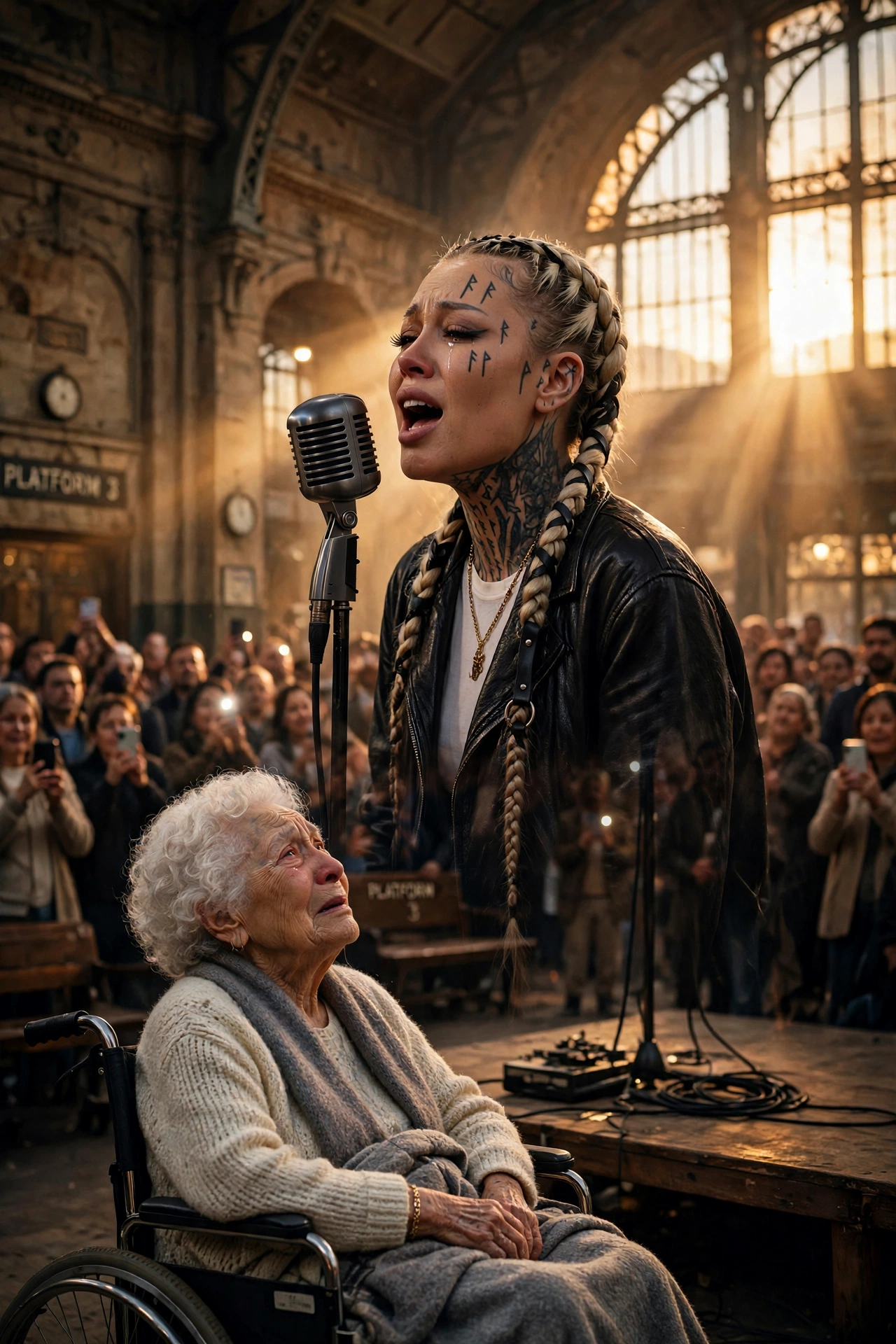
The money arrived the way Mara had always imagined money would arrive in other people's lives: quietly, and all at once, in numbers that did not look real on a screen.
She sat at the kitchen table in the apartment above the laundromat, the contract spread out beside her laptop, and read the figure three times. It was the advance from the producer, the first payment for the big stage, for the recordings, for the tour that still felt like a story about someone else. Her hands were shaking. Not from excitement. From the sudden, terrifying realization that for the first time in twenty years, the thing standing between her mother and treatment was gone.
Anna was asleep in the next room, in the hospital bed they had rented months ago, the one with the crank handle and the thin mattress that Mara had covered with three blankets to make it softer. The apartment smelled faintly of soup and medicine. Outside, a bus hissed past on the wet street. Mara put her hand over her mouth and cried without making a sound, because she did not want to wake her mother, and because she had spent so many years learning how to cry quietly in rooms where no one was listening.
In the morning, she told Anna first, before she told anyone else. She sat on the edge of the bed and took her mother's hand, the hand that had always been warm and steady and was now thinner than Mara remembered, the skin papery over the bones.
"Mama," she said, "we can do it. The surgery. The treatment. All of it. We can pay."
Anna looked at her for a long time. Her eyes filled, but she did not ask how much it would cost, or whether Mara was sure, or whether the money was really theirs to spend. She only squeezed Mara's fingers and whispered, "My girl."
That was all. That was everything.
The hospital was not the small county clinic where they had first heard the diagnosis, the place with the flickering fluorescent lights and the doctor who had spoken gently and then handed them a pamphlet about payment plans. This was the hospital the specialist had named in the same breath as the word "if." If they could get her in. If they could afford the surgery. If they could keep her there for the months of treatment that followed.
Now they could.
Mara signed the papers with a pen that kept slipping in her damp palm. She read every line twice, the way Anna had taught her to read anything important, slowly, out loud in her head. Surgery. Anesthesia. A team of specialists. Weeks in the hospital after, then months of medicine and therapy. She did not flinch at the numbers anymore. She had spent too many nights doing the arithmetic of what they could not afford. Now the arithmetic was different. Now the numbers meant something else: a chance.
The night before the surgery, Mara did not go to rehearsal. The producer's assistant called twice, polite and then less polite, and Mara let both calls go to voicemail. She sat beside Anna's hospital bed in the quiet room on the fourth floor, where the city lights came in through the blinds in thin gold stripes, and she sang very softly, the way she used to sing when she was a girl and Anna would sit on the edge of her bed listening.
It was not a performance. Her voice was low and a little rough from the day. She sang the song she had written at eighteen, the one from the train station, the one the whole world now knew, but she sang it slower, like a lullaby, and when she reached the chorus Anna's eyes closed and her breathing eased, and Mara kept singing until her mother's hand relaxed in hers.
"Mama," Mara whispered, when the song was done, "tomorrow is going to be hard. But I will be right here when you wake up. I promise."
Anna opened her eyes. "I know," she said. "You always are."
The surgery took seven hours. Mara counted every one of them in the waiting room, in a chair that was too hard and too low, with a paper cup of coffee gone cold in her hands. She counted the minutes on the clock above the nurses' station and the tiles on the floor, and tried not to read anything into the faces of the people hurrying past in scrubs.
At noon, a nurse came out and said the surgery was going well, and Mara nodded and thanked her and then sat back down and cried into her hands for exactly thirty seconds, because she had promised herself she would not fall apart in the waiting room, and then she wiped her face and waited some more.
At three o'clock, the surgeon came out. He was a tall man with tired eyes and a calm voice, and he pulled a chair close and sat down so that he was looking at Mara at eye level, not down at her, and he said the words she had been holding her breath for all day.
"The surgery was successful. We removed the tumor. The margins are clear."
Mara did not understand all the medical words that followed. She understood enough. The thing that had been growing inside her mother, the thing that had made Anna tired and thin and afraid in a way she never said out loud, was gone. Taken out. The disease had not won that round.
"And now?" Mara asked.
"Now she rests," the surgeon said. "Then the medicine. Then time. It will be slow. But today went as well as it could have gone."
Mara went into the recovery room and stood beside Anna's bed, the monitors beeping softly, and thought of all the nights Anna had sat up waiting for her to come home from the bars, all the nights Anna had left soup on the stove and pretended she had not been worried, all the years of silent support Mara had only fully understood when the train-station video went around the world.
"Mama," she whispered, "you did it. You're still here."
Anna did not wake up until evening. When she did, her eyes fluttered open, unfocused at first, and then found Mara's face, and the smallest smile moved across her lips.
"Hey," Mara said, and her voice broke on the word. "Hey, Mama. I'm here."
Anna's fingers moved, weak, against the blanket. Mara took her hand and held it, gently, the way you hold something precious and breakable, and Anna squeezed back, so faintly that Mara almost missed it, and Mara laughed through her tears, because that faint squeeze was the most important thing that had happened all day.
The days after the surgery were measured not in hours but in small victories. The first time Anna sat up in bed without help, her face going white with the effort and then pink again with pride. The first time she kept down a full bowl of broth. The first time she asked for her own clothes instead of the hospital gown, because she was tired of feeling like a patient and wanted, for an hour, to feel like herself.
Mara was there for all of it, between rehearsals. In one world, she stood on a stage in a rehearsal hall downtown, under bright lights, learning where to stand and when to breathe. In the other, she sat beside a hospital bed, holding a cup of water with a straw to her mother's lips. She sang so that she could pay for this room, for these nurses, for this medicine. And she came back to this room so that she would remember why she was singing at all.
The medicine was hard. Mara had not expected that part to be so hard, after the surgery had gone well. But Anna fought it the way she had fought everything in her life: without complaint, with a stubbornness that made the nurses smile. There were days when Anna was too sick to sit up and could only lie still with a cool cloth on her forehead while Mara read to her in a low voice. There were nights when Mara slept in the chair beside the bed, waking every hour to check that her mother was still breathing easily.
And then, slowly, there were better days. The doctors began to use a word Mara had been afraid to hope for. Receding. The scans showed it, visit after visit, the shadows shrinking. The surgeon showed Mara the latest scan and pointed to the places where the darkness had been, and where it was no longer.
"She is responding beautifully," he said. "Better than we dared to expect."
Mara cried in the corridor, not caring who saw. A nurse passing by squeezed her shoulder and kept walking.
Recovery is not a single moment. It is a staircase, and every step counts.
The first step was sitting up on the edge of the bed, legs dangling, with a nurse on one side and Mara on the other, Anna gripping both their hands until her knuckles went white, her breath coming short and fast, and then the grin that broke across her face when she stayed upright for a full minute.
"Look at me," Anna said, breathless and laughing. "Look at me, Mara. I'm sitting."
"I see you, Mama," Mara said. "I see you."
The next step was standing. That took a week of trying. The physical therapist was a woman named Rosa with strong hands and an encouraging voice, and she taught Anna to plant her feet, to hold the walker, to trust her legs again after months in a wheelchair and weeks in a bed. The first time Anna stood, she swayed, and Mara was there, an arm around her waist, steadying her, and Anna leaned into her daughter and whispered, "Don't let go."
"I won't," Mara said. "I've got you. I've always got you."
They stood there for a long time in the afternoon light, and Mara thought about how many times Anna had been the one holding her up, and how strange and how right it felt to be the one doing the holding now.
After standing came walking. Three steps to the door, then back. Five steps to the window. Ten steps down the corridor, with Rosa walking backward in front of her, calling out encouragement, and Mara beside her, ready to catch her, and Anna laughing at the whole slow wonderful business of learning to walk again.
"Slow down, Mama," Mara teased one afternoon, when Anna insisted on one more length of the corridor. "You're showing off."
"I've got a concert to get to," Anna said, and winked, and Mara's heart nearly stopped, because Anna had said it lightly, as a joke, but Mara knew it was not only a joke. It was a promise Anna was making to herself, and Mara would hold her to it.
The weeks turned into months. The hospital room gave way to a small apartment near the rehearsal hall, where Anna could recover in a place that smelled like home instead of disinfectant. Mara cooked the soups now, the way Anna had cooked them for her, and left them on the stove for Anna to find, and Anna pretended not to notice.
Anna's hair grew back soft and short. Color came back to her cheeks. She began to walk without the walker, first around the apartment, holding on to furniture, then down the hallway, then, one bright morning, all the way to the corner shop and back, with Mara beside her, not holding her, just walking, like two people out for an ordinary morning, which was the most extraordinary thing in the world.
"I did it," Anna said at the front door, a little out of breath, a little triumphant. "I walked to the shop, Mara. By myself."
"You did," Mara said, and hugged her mother so hard that Anna laughed and told her to stop, she was squashing her, and Mara laughed too, and they stood there in the doorway, mother and daughter, both of them crying and laughing at the same time.
The day the doctor said Anna was strong enough to attend a concert, Mara was in the middle of a rehearsal, standing on a taped mark on the stage floor, when her phone lit up. She stepped off the mark, ignoring the producer's frown, and read the message twice.
She called Anna from the wings, her heart hammering. "Mama? Did you hear? The doctor said yes."
"I heard," Anna said, and her voice was full of tears and laughter at once. "He said I'm strong enough. He said I can come."
Mara closed her eyes. She pictured the stage, the lights, the thousands of faces she had not yet sung for. And she pictured one face below them, in the front, where it belonged. Not in a wheelchair. Standing. Smiling. Proud.
"Then you will come," Mara said. "You will be there, Mama. I want you there more than anything."
That night, Mara went home and found Anna standing at the window, looking out at the city lights, her back straight. She did not turn around. She just said, very quietly, "I never doubted you, Mara. Not once. Not in twenty years. I just waited for the world to catch up."
Mara stood beside her at the window and took her mother's hand, and they stood there together, both of them whole, both of them still here, and the future looked less like something to survive and more like something to step into, together, on two steady pairs of feet.