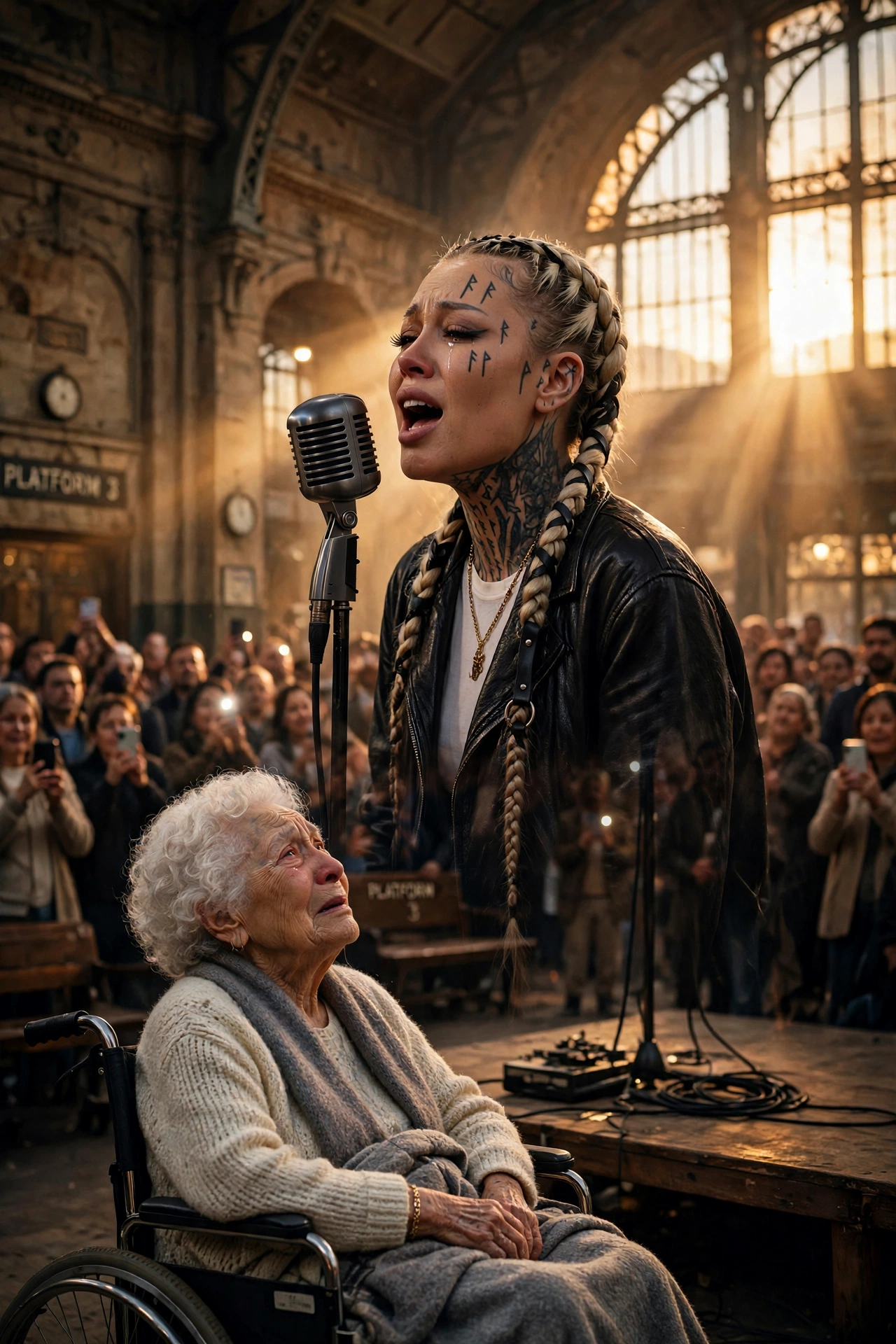
Mara woke to a sound she did not recognize at first. It was her phone, buzzing against the nightstand, again and again, like something small and frantic trying to get out of a box. She reached for it with her eyes still closed, expecting the usual: a bar owner cancelling a shift, a bill reminder, a message from one of the few friends who still checked on her. Instead the screen was full of numbers she could not make sense of before coffee, notifications stacked on top of notifications, names she had never seen, and a video thumbnail showing her own face in the lamplight of the old train station.
For a long moment she simply stared at it. The night before came back to her in pieces, warm and unreal: the cold air in the station, the smell of rain and old iron, her mother in the front row in her wheelchair, wrapped in the blue coat Mara had bought on sale three winters ago. Mara had sung the song she wrote when she was eighteen, the one she had never dared to sing for anyone except her mother. She remembered stepping down from the low platform at the end, kneeling in front of the wheelchair, taking her mother's hands, and pressing her forehead to her mother's forehead while the last note faded. She remembered Anna crying, quietly, the way she always cried when she was proud, as if she were trying not to make a sound and failing.
Someone had filmed it. Someone had posted it. And while Mara slept, the world had found it.
She sat up slowly, her heart beating too hard, and opened the first notification. The video had been watched more than a million times. She blinked, scrolled, and the number changed while she watched, climbing as if it were alive. Comments poured in faster than she could read them: people saying they had cried on a train, in a kitchen, in a car parked outside a hospital. People tagging their mothers, and writing that they had just picked up the phone after years of silence.
Mara put the phone face down on the blanket and pressed both hands over her face. After twenty years, this was the feeling she had stopped allowing herself to imagine. Not the applause, exactly. The being heard. She had auditioned in rooms where judges looked at their phones while she sang. She had been told she was too old, too rough, too tattooed, too much of a night person to be trusted on a respectable stage. She had sung in bars where men talked over her and women laughed at the ink on her cheekbone, a small blackbird she had gotten at nineteen because she wanted something beautiful that could not be taken away. She had learned to smile through it, to pack up her guitar, to walk home in the dark and tell herself that tomorrow was another night, another room, another chance to be ignored a little more politely.
Now her phone would not stop buzzing, and she did not know whether to laugh or cry, so she did a little of both, sitting on the edge of her narrow bed in her mother's small apartment, in the gray morning light.
"Mara?" Anna's voice came from the kitchen, thin but steady. "Are you awake, love?"
Mara wiped her face with her sleeve, pulled on a sweater, and went to find her. Anna was at the table by the window, a bowl of soup steaming in front of her, although it was barely morning. She always made soup when Mara came home late, and she always left it covered on the stove, as if pretending she had not stayed up waiting. This morning she had made it early, and she was watching Mara with eyes that already knew something had changed.
"You saw it," Mara said.
Anna nodded, and her smile trembled. "A neighbor showed me on her phone. She knocked on the door an hour ago, very excited. She said, 'Anna, your daughter is on everyone's phone.' I did not understand at first. Then I watched it. I watched you sing my song."
"It was always your song," Mara said, and her voice broke. She sat down across from her mother and took her hands, careful of the thinness of them, careful of the illness that had been quietly taking pieces of her mother away for months. "I wrote it for you when I was eighteen. I just never knew how to give it to you properly."
"You gave it to me last night," Anna said. "In front of everyone. That was proper enough."
They ate the soup in silence for a while, the way they always did when words felt too big. Mara's phone buzzed on the table between them, and Anna glanced at it, then back at Mara, with a look that was almost mischievous.
"Answer it, love. It might be important."
It was not important. It was a local radio host asking for an interview. Then a music blogger. Then a television producer from a morning show, asking if Mara could come in and sing the song live. Then a woman from a charity who wanted Mara to sing at a fundraiser for families facing illness. Mara answered each call with the same stunned politeness, the same sentence repeated until it started to sound like someone else's voice: "Thank you. I don't quite believe this yet. Yes, my mother is the reason I sang it."
By noon, the numbers had passed five million views. A newspaper ran a short piece online with a photograph taken from the station, Mara kneeling before the wheelchair, both lit by a single hanging lamp. The headline called her "the voice from the station." A famous singer Mara had admired since she was a girl shared the video with three words: "This is real." Mara read that one three times and had to sit down.
That evening, when the light went amber over the rooftops and the phone finally quieted for a few minutes, a call came from a number Mara did not recognize, with a city code she associated with big offices and bigger stages. She almost let it go to voicemail. Something, perhaps the steadiness in her mother's eyes from across the room, made her answer.
"Is this Mara?" a woman's voice asked, warm and professional, unhurried. "My name is Elena Vasquez. I produce live concerts. I saw the video from the station last night, and I have watched it more times than I will admit. I would like to talk to you about singing on a big stage. A real one. With a real audience, a real band, and a real contract."
Mara's first instinct was to laugh, because after twenty years of closed doors, an open one felt like a trick. Her second instinct was to look at her mother. Anna was watching her, and in her face there was no surprise at all, only a quiet certainty, as if she had been waiting twenty years for someone else to finally hear what she had always heard in her daughter's voice.
"I'm listening," Mara said, and her hand was shaking so badly she had to hold the phone with both hands.
Elena did not rush her. She talked about a concert hall in the city, a stage Mara had walked past a hundred times and never dared to enter except as a cleaner, years ago, when she took any work she could find between bar shifts. She talked about an evening dedicated to songs about family, about a full band, about proper sound and lighting, about an audience of thousands. She talked about money, plainly and without embarrassment: a fee for the performance, a recording agreement, and the possibility of more concerts after that, if Mara wanted them. She did not promise fame. She promised work, respect, and a stage that would not talk over her.
"I need to think," Mara said, although her heart was already racing ahead of her. "And I need to read anything before I sign it. I've learned that much."
"Of course," Elena said, and Mara liked her instantly for not arguing. "I will send you the contract tonight. Take your time. Have someone you trust look at it with you. And Mara, one more thing. We saw the whole video, not just the singing. We saw you kneel down for your mother. That is the kind of artist we want to work with."
After the call, Mara sat very still. Anna wheeled herself closer and put a hand on her daughter's arm.
"Well?" she asked.
"She wants me to sing on a big stage," Mara said, and the words sounded impossible even as she said them. "A real contract. Real money."
Anna's eyes filled, but she smiled. "Then you will sing, love. And you will sing beautifully, the way you always have."
"But what about you?" Mara said, and this was the part she could not get past, the part that had been sitting underneath every happy thought all day. "The treatment, Mama. The doctors said it costs so much. I have been saving coins in a jar, and it is not enough, not even close. If I do this, the first thing I want, the only thing I want, is to pay for your treatment. Not a dress. Not a car. Your treatment."
Anna shook her head gently. "Mara, do not put that weight on a song. Sing because you love to sing."
"I am putting it on the song because the song is mine," Mara said, fiercely, the way she had not spoken to her mother in years. "You have watched my videos every night. You have kept every flyer, even the ones from bars that closed. You have left soup for me when I came home exhausted and too proud to say I was hungry. You never once told me to stop dreaming, even when everyone else did. Let me do this one thing for you. Let the money go to the doctors, so you can get better."
Anna did not argue further. She simply took Mara's hand and held it, and they stayed like that until the soup went cold and the evening light went out of the window.
The contract arrived that night by email, long and formal. She printed it at a copy shop the next morning and sat at the kitchen table with a pen, reading every page slowly, twice. She checked the fee, the number of performances, the rights to her song, and the recording terms. A legal aid lawyer a friend recommended explained the difficult paragraphs in plain language and told her, honestly, that the contract was fair and the producer reputable. He advised only that the payment schedule be clear, so she would not wait months for money she needed now. Elena agreed without hesitation to a clear schedule and an advance payment. That was the moment Mara allowed herself to believe it: a powerful producer saying yes to a small, reasonable request from a woman who had spent twenty years being told no.
She signed the contract at the kitchen table, with her mother beside her, on a rainy afternoon two days after the station video. Her hand shook on the signature line, and she had to steady it with her other hand, but the letters came out clear: Mara. Anna watched every stroke, and when it was done, she clapped once, softly, as if she were in the front row of a concert hall already.
Then the preparations began, all at once. Elena sent a schedule, a rehearsal plan, and a list of musicians who wanted to play with her. A vocal coach called and talked about breathing, about saving her voice for the big room, about singing the station song the same way she had sung it in the cold air, without polishing the feeling out of it. A stylist asked, gently, whether Mara wanted to cover the tattoos on her face for the stage, and Mara said no, without apology, because the blackbird on her cheekbone had sung with her through every rejection, and it was going to sing on the big stage too.
Mara practiced in the apartment, in the mornings, while Anna listened from the next room, the way she had listened to Mara's videos every night for years. Only now she did not have to watch a screen. She could hear the real voice through the wall, growing stronger, surer, ready. In the evenings, Mara sat with her mother and talked about practical things: the hospital, the doctors, the treatment plan they would finally be able to afford, the future that had seemed closed a week ago and now stood open like a door. She did not yet know how the treatment would go, and she did not pretend to. She knew only that the contract was signed, the stage was waiting, and for the first time in twenty years, her dream and her mother's life were moving in the same direction.
That night, before bed, Mara opened her phone one last time. The video had passed ten million views. She looked at the thumbnail, at herself kneeling before the wheelchair, at her mother's face lit by lamplight, and she whispered, "Thank you," to no one in particular, to everyone, to the stranger who had filmed it, to the mother who had believed in her before anyone else did. Then she put the phone down, and went to sleep, and dreamed, for the first time in years, not of audition rooms and closed doors, but of a big stage, bright and waiting, with her mother standing below it, smiling through tears.