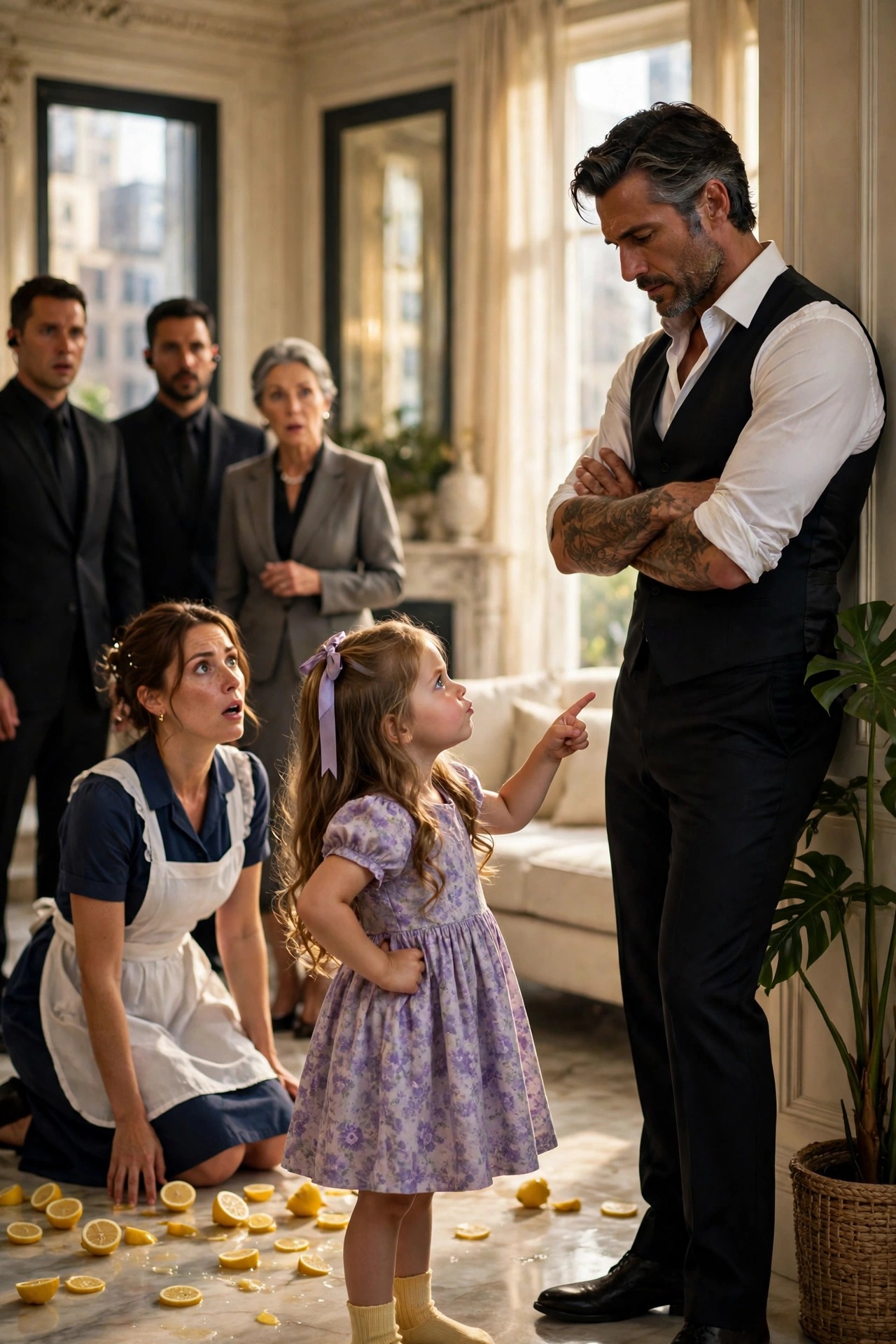
After the farmers' market, Lily stopped sleeping through the night.
She did not scream. That was the part that frightened me most. My daughter, who had opinions about toast crusts and firm rules about shoes on couches, would simply sit up in the dark, very quiet, holding her lavender ribbon in both fists like it was a rope that might keep her from falling.
"Mommy," she whispered the first night, "is the bad car still outside?"
"No, baby. Tomas checked twice. Nico checked with his serious face."
She nodded as if a report had been delivered in proper order, then crawled into my bed and pressed her cold feet against my legs. I lay awake long after her breathing slowed, counting footsteps in the hall that were only pipes, only wind, only my own fear learning new shapes.
Vincent noticed, of course. Vincent noticed everything.
"She had another night," he said on the third morning, not a question, when Lily fell asleep face-down in her oatmeal.
"She is four," I said. "A man grabbed at her in a crowd. She is allowed to be scared."
"I did not say she wasn't. I was about to ask what she needs."
There were shadows under his eyes that had not been there before the market. His coffee had gone cold untouched, which Lily would have called a broken rule.
"What she needs," I said more gently, "is for the grown-ups not to lie to her. And time. And probably new crayons. Hers are down to nubs."
That afternoon a wooden case appeared on the breakfast table — every shade of purple crayon known to mankind, in neat rows, no card. Lily woke, gasped, wrote a thank-you note in letters that leaned like tired soldiers, and Vincent folded it once, carefully, and put it in his breast pocket, where important men keep things they cannot afford to lose.
He kept his market promise, too — the total honesty he had sworn in exchange for our staying. Every evening he told me what there was to tell: a camera that glitched in the night, a followed car rented with a stolen card, dead ends. "Everett is angry about the dead ends," he said one night. "Everett is angry about a lot of things lately." Thunder rolled far off beyond the lake that night, and Lily, asleep with her ribbon tied around her wrist like a promise, did not wake. I remember being grateful for that small mercy.
I should have known the storm was only clearing its throat.
—
It came back three nights later and brought the whole sky with it.
Rain hammered the windows until the glass sang. At some hour past two, lightning split the grounds white, and I sat up with my heart already pounding — because the small warm weight that had crept in beside me at midnight was gone.
Lily's side of the bed was empty. Her ribbon was gone from the pillow. Her yellow socks lay on the rug where she had kicked them off, two small flags of a child who had gone somewhere barefoot and in a hurry.
"Lily?" I said. Then louder. "Lily!"
I checked the bathroom, the closet, under the bed, because fear makes you thorough and foolish at once. Her door stood open — and Lily never left a door open. Doors, in Lily's law, were closed softly, "so the house can sleep."
My daughter had gone up. Past the landing where the portraits stopped, up the narrow last flight to the restricted rooms Mrs. Bell had named on my first day in the same breath as Mr. Marquetti himself. Never enter. Never disturb. Seven years of silence lived at the top of those stairs.
I took them two at a time in my nightgown, calling her name in a whisper that grew less like one with every step.
I found her at the top.
She was asleep, curled on the carpet runner outside the last door at the end of the hall, her cheek on her folded hands, her ribbon clutched in one fist. With every breath she made a small, exhausted sound — a nightmare she had walked off in her sleep like her father walking into a burning building: toward the thing, not away from it.
"Oh, baby," I breathed, and gathered her up. "Oh, my brave, ridiculous girl."
She stirred but did not wake. "The music stopped," she murmured against my shoulder, in the pure logic of dreams. "I was finding it."
Behind me, the stairs creaked. I turned with Lily in my arms and Vincent stood on the landing in a black robe over his clothes, as if he had never gone to bed at all. The lightning came again and for one white instant I saw his face completely unguarded — and he was not looking at me. He was looking at the door.
"Mrs. Reyes," he said, very quietly. "Put her down."
"She's asleep. She's freezing. I am taking her back to bed—"
"Elena."
It was the first time he had ever used my name without the title, and it stopped me like a hand on my arm.
"Put her on the chaise in the alcove," he said. "Cover her. Then come back. Please."
There it was again, the word Lily had taught him. I did as he asked, laid Lily on the chaise in the alcove by the window and covered her, and her whole body relaxed at once, the way children's do when the dream lets go of them.
When I came back, Vincent stood before the forbidden door with a key in his hand — old, brass, longer than a modern key — and his hand, that steady hand, was shaking.
"In seven years," he said, "no one has opened this door. Not Bell. Not the cleaners." He stopped with the key at the lock and looked back at me. "You told me honesty was the condition."
"It was. It is."
"Then understand the price of it. Once you have seen it, I cannot make you a woman who hasn't."
"Open the door, Vincent."
He opened the door.
—
It was a music room, held in amber. A grand piano stood by tall windows, a cello on a stand in the corner, shelves of scores with a woman's handwriting marching across the spines. And against the far wall, beneath a mobile of small silver stars turning slowly in the draft, stood a crib — handmade, dark wood, empty, with a folded blanket inside it knitted in the softest yellow.
Yellow. Like Lily's lucky socks. I put my hand over my mouth.
"Her name was Isabel," Vincent said from the doorway, as if the room required introductions. "She played that piano badly and that cello like the angels were taking notes, and she laughed in this house the way Lily laughs in the kitchen, as if it were a right and not a permission." He stepped in at last, one step, the way a man enters cold water. "She was eight months pregnant in December, seven winters ago. A girl. We had decided on the name in this room. I will not say the name. It belongs to only three people, and two of them are dead. I hope you understand that."
"I do," I whispered. "Oh, Vincent, I do."
"There was ice on the lake road. She was driving to her sister's because I—" He stopped. When he began again his voice had been ironed flat, and it was worse than shouting. "Because there was a problem with a shipment, and I was working, and I had sent my driver home early that day. My driver. Who knew that road. She said she didn't mind. She said the baby liked the car. The police used the word accident, and I have hated the word for seven years, because accident means no one has to carry it, and someone should carry it. So I do."
"You carry it by locking a door?" I said, sharper than I meant, grief recognizing grief. "By making a whole house hold its breath for seven years?"
"Yes." He did not flinch. "I carry it by locking a door, and by working, and by making sure no one ever again mistakes me for a man who is somewhere else when it matters. Loyalty. Fear. Consequences. It built an empire, Elena. It also built this." His hand came down on the crib rail, and stayed. "The night of the funeral I sat in here until it was light. Then I locked the door and went downstairs and became — efficient. There is no music in this house. Have you noticed? No radio in the kitchen. Bell hums and catches herself. A house can be taught to be quiet. It learns who it belongs to."
"She heard it," I said. "Tonight, in her sleep: 'The music stopped. I was finding it.' Vincent — children walk toward the ache in a house the way they walk toward a nightlight."
He turned then and looked at me, and the dangerous man was simply not in the room. There was only a widower, forty-eight years old, with silver in his dark hair and tattoos down his forearms, standing in his dead wife's music room telling the truth at two in the morning because a four-year-old had made honesty a household rule.
"Sit with me," he said. "Not as staff. Sit with me the way people sit."
So we sat on the floor, backs against the piano, because neither of us could bear the furniture, and I told him about Daniel. The terrible pancakes, shaped like countries that did not exist. How Daniel used to get into bed in winter, find my feet like two blocks of ice, and slide his own warm ones against them without a word of complaint, every single night, as if warming my feet were a sacrament he had invented. The photograph on Lily's nightstand that she talked to before bed — reports, mostly. Teeth brushed. Rules kept. Daddy, the man at breakfast is learning.
"I talk to it, too," I admitted. "That is the thing I have never said out loud to a living person. When the bills came—" I laughed, and the laugh broke in the middle. "Mrs. Bell will have a stroke. The help is confessing in a locked room."
"You're not the help at two in the morning," Vincent said. "Daniel went back in. For a man who couldn't walk. He knew what that building was going to do, and he went anyway, because leaving was a sentence he couldn't pronounce. I understand that man, Elena. I have been him from the other side of the door." He turned his hand over on the carpet between us, palm up, an offering with nothing hidden in it. "I cannot fix the arithmetic of who gets taken. I have tried money. I have tried fear. The arithmetic does not care."
I put my hand in his. That was all. Two people holding on like passengers in rough weather, while the rain worked at the windows and a little girl dreamed down the hall. We stayed like that until the storm began, very slightly, to ease.
"We should take her down before she wakes in a strange place," I said at last.
"We should," he agreed, and neither of us moved for one more minute, and that minute, too, I have kept.
—
Lily woke in her own bed with no memory of the stairs, which I called grace. But three days later I went up — with permission, in daylight — and found that Lily had been there before me. Children always get there before you.
On the piano, weighted with a silver star from the mobile, was a fresh sheet of paper in purple crayon, in letters that leaned like tired soldiers:
SAD IS NOT BAD. TALK ABOUT IT.
Underneath, in smaller letters, clearly an amendment added after legal consultation with herself: EVEN BOSSES.
Vincent stood in the doorway reading it for a long time.
"She is amending my house rules in my wife's music room," he said.
"Would you like me to remove it?"
"No." He straightened the page by one careful degree, the way other men straighten a flag. "Leave it where she put it. It appears to be a formal document."
That evening he asked me to stay after the briefing, and Everett stayed too, and Vincent did something I understood, even then, would cost him more than money.
"I have been thinking about roots," he said. "A fight like this — Ricci pushing at the routes, men following a mother and child to a market — does not end when you win it. It ends when there is nothing left worth fighting over. So I am selling the routes. All of them. To Meridian National — a legitimate logistics company, audited, boring, with shareholders and a safety record. After the sale, I begin unwinding the rest of it into the light, piece by piece, whatever it costs me. Men do not retire from my chair, Everett. So I am not retiring. I am moving the chair."
"Sir," Everett said. He was smiling — I want to be fair to that smile, even now. It was warm, congratulatory, a lieutenant of eleven years hearing his chief lay down a burden. "That's the bravest thing I've heard in this house. Meridian will want it fast. Before Friday—"
"Before Friday," Vincent agreed. "It will be done before Friday."
I did not hear the call Everett made that night. I have had to build it since out of Tomas's evidence, a phone log and one recorded fragment, the way you rebuild a burned room from insurance photographs — and God forgive me, I wish I had heard it, because a woman who hears a thing in time can act on it. A woman who only reconstructs it afterward can only grieve in correct order.
At eleven that night, in his own office, with the house quiet above him, Everett Cole poured himself a drink from Vincent's cabinet and called Salvatore Ricci.
"Our friend has found religion," he is recorded as saying. "He sells the routes to Meridian, and it closes before Friday." A pause, ice in a glass. "Which means we move before Friday, Sal. After that, there's nothing left to take."