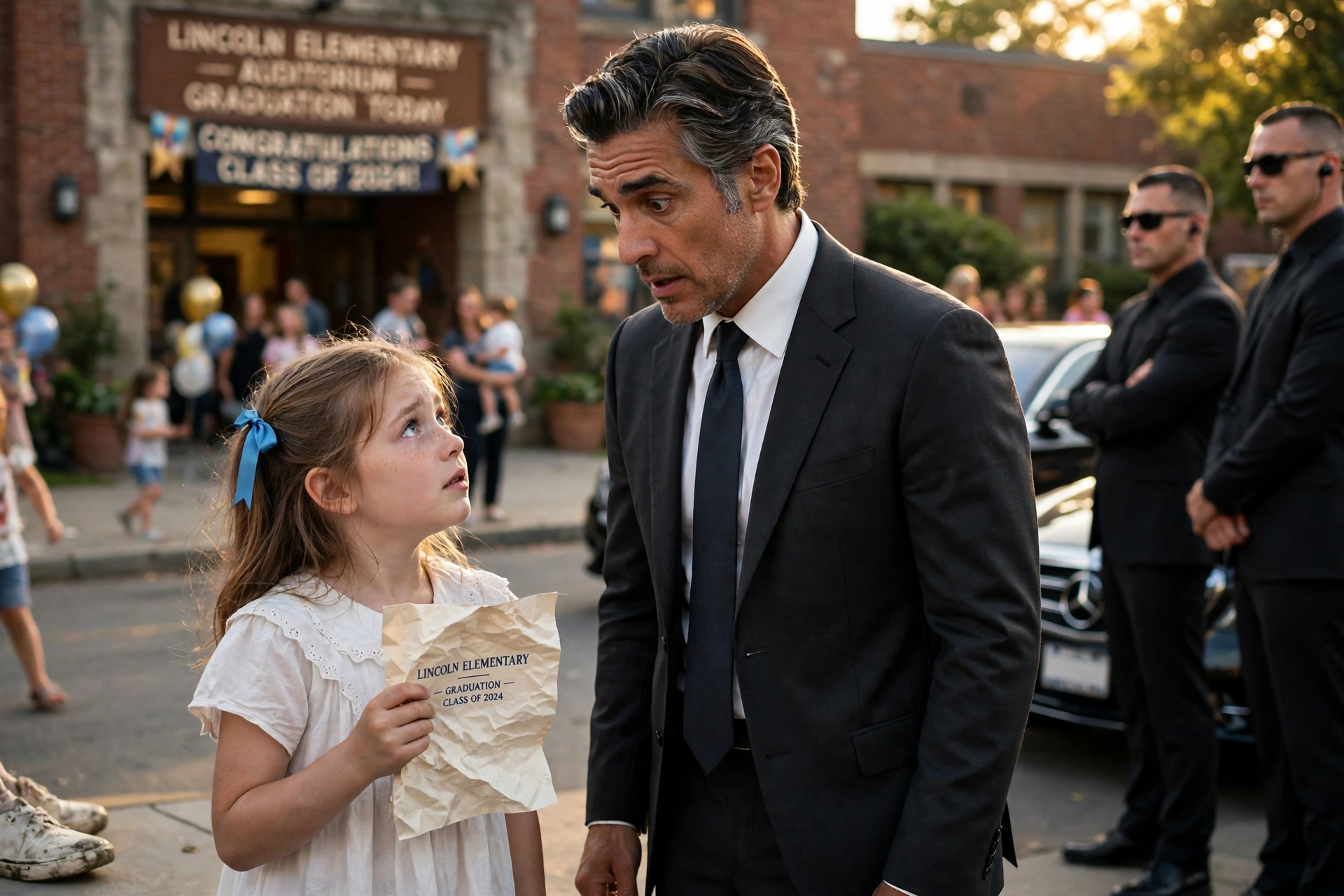
Luca Moretti had made powerful men wait in silence, had ended negotiations with a single look, and had built an empire on the New Jersey waterfront by never letting anyone see him hesitate, but he had never been stopped by a seven-year-old girl in a white dress with a blue ribbon in her hair, holding a crumpled program in hands that would not stop trembling, and asking him for the one thing no amount of money could buy: forty-five minutes in an empty chair, third row on the left, just until they called her name, because her mother was gone, her father had died before she was born, and she had already told her class that her dad would be there, and when he said no and walked away, he did not yet know that the chair he had refused would follow him all the way across town, that it would remind him of the boy he had been at seventeen staring at his own father's empty chair, or that sitting down at last would lead him to a little blue house where a grandmother was waiting with a cup of tea, a business card, and a secret about Harbor Point that could destroy everything he had built.
The afternoon light outside Lincoln Elementary smelled of cut grass and warm brick. Banners flapped above the auditorium doors, blue and gold, and parents hurried past with bouquets wrapped in cellophane and phones already raised to record something they did not want to forget. Luca Moretti did not hurry. He had learned, over twenty-nine years of building an empire, that hurrying made other people hurry, and that was usually useful. Today it was not. Today he was late for a meeting across town, and the late afternoon was doing what late afternoons in New Jersey often did: it was making him remember things he had paid a great deal of money to forget.
He was forty-six, and his suit had been tailored in a room where no one raised their voice. His shoes were polished. His watch was quiet and expensive. Behind him, two bodyguards waited beside a black Mercedes, the way they always waited, patient and unobtrusive, as if they were part of the car itself. Three men were waiting for him across town to discuss a multimillion-dollar freight agreement, and Dominic Vale, his most trusted executive, had already texted twice. Luca could feel the day narrowing to its usual shape: a room, a table, a decision, a consequence for someone who had refused him.
Then a small voice stopped him.
"Excuse me, sir. Could you be my dad just until they call my name?"
Luca stopped walking.
The little girl standing outside the auditorium could not have been more than seven. She wore a white dress that had been washed many times and ironed with care, scuffed white shoes, and a blue ribbon in her light brown hair. A crumpled graduation program trembled between her fingers. She did not look like a child who was used to asking strangers for things. She looked like a child who had rehearsed this sentence until it stopped sounding like begging and started sounding like a plan.
Behind her, the auditorium doors opened and closed, letting out bursts of music and applause. Other families moved around them, laughing, calling names, finding seats. The girl did not move. She looked straight into his eyes, and Luca, who had faced down port commissioners and rival shippers and men who smiled while they lied, found that he could not look away first.
"My name is Sophie Bell," she explained, as if introductions would make the rest of it ordinary. "You don't have to do anything special. Just sit in the family chair. When they call my name, you can clap."
Luca glanced toward the auditorium. He was aware, suddenly, of how large his hands looked, how loud his shoes sounded on the pavement, how completely out of place a man like him was in a place built for small chairs and smaller voices.
"Where's your family, Sophie?"
"My nana has a heart doctor appointment. Aunt May went with her."
"And your parents?"
Her fingers tightened around the program, creasing it further. For a moment her brave face wavered, and Luca saw the effort it cost her to keep smiling.
"My mommy died last winter. My daddy died before I was born."
She tried to smile again, and this time it was thinner, braver, and therefore harder to watch.
"Everybody else has someone coming. I told a girl in my class that my dad would be there."
Luca said nothing. He was not good at silence. Silence, in his world, was a tool. You let it sit until the other person filled it and gave you something you could use. This silence was different. It was not a tool. It was a weight.
"You only have to pretend for forty-five minutes," Sophie whispered. "Maybe fifty, because the second graders sing two songs."
One of his bodyguards checked his watch, discreetly, the way he had been trained to do. "Boss, we're late."
Across town, three men were waiting. Luca could picture the room already: the long table, the water glasses, the contract with its careful language about routes and rates and penalties. He could picture Dominic at the head of it, calm, explaining that Moretti Logistics did not lose freight agreements. He could picture himself walking in, late, and making lateness look like power.
"I have an important meeting," Luca finally said.
Sophie's smile disappeared. It did not fade. It simply left, as if someone had switched off a light in a small room.
"Oh. That's okay."
She folded her program carefully, along a crease that was already worn soft. "Thank you for listening."
Then she turned toward the auditorium.
But before disappearing inside, she looked back.
"If you change your mind, there's an empty chair in the third row. On the left."
She swallowed. Her voice was very steady for a seven-year-old, and that steadiness broke something in Luca that he had not known was still breakable.
"I saved it."
Luca watched her leave. The doors closed behind her, and the music became muffled, and the afternoon went on being bright and ordinary for everyone else. Something about those words brought back a memory he had not allowed himself to revisit in nearly thirty years.
He was seventeen again, sitting at his own school ceremony, staring at an empty chair.
His father had promised to come. Victor Moretti had said it the way he said everything important: briefly, as if the promise itself were a favor. Luca had worn a jacket that did not quite fit and had kept looking at the door. The ceremony had gone on. Names had been called. Other boys had stood to applause that belonged to whole families. When Luca's name was called, the applause had been polite and thin, and a driver in a dark suit had arrived afterward with a car and an envelope and an apology that was not really an apology.
Luca had spent his adult life making sure nobody could ever make him feel that powerless again. He had built an empire on the waterfront so that no door would ever close on him, no table would ever be too long, no promise would ever be something he had to wait for. He had learned to be feared, because fear was reliable in a way that love had not been.
Now a child had asked him for less than an hour.
And he had turned her down.
His phone rang. The sound was sharp in the warm air. Dominic Vale, his most trusted executive, wanted to discuss a contractor who had refused their terms.
"We spoke with his brother," Dominic said, his voice smooth and practical. "He's reconsidering."
Luca knew what that meant. He had known for years. For years, he had allowed intimidation to settle disagreements. He had told himself it was business, that the waterfront was a hard place, that softness was a luxury he could not afford. He had told himself that the men he dealt with understood the rules.
But suddenly, Sophie's disappointed face would not leave his mind. He saw it superimposed over the contract, over the table, over the whole careful empire he had built to protect a seventeen-year-old boy who was still sitting in an auditorium somewhere, staring at an empty chair.
"Leave the man's family alone," Luca ordered.
Dominic went silent. In all their years together, Luca had never heard Dominic quite that silent.
"Luca, that's not how we operate."
"Then we're changing how we operate."
He ended the call. The bodyguards looked at him, waiting for the next instruction, trained not to show surprise. Luca looked at the auditorium doors, at the banners, at the families still streaming in with flowers and cameras.
Then he turned to his bodyguard. "Cancel my meeting."
"Boss?"
"I'm going back."
Minutes later, Luca stood outside the auditorium again, and this time he did not feel powerful. He felt conspicuous, and nervous, and strangely awake. A teacher stopped him at the door, kind but firm, the way teachers are when they are protecting children.
"Sir, are you family?"
"No," he admitted. "But Sophie Bell asked me to come."
The teacher did not wave him through. She did what a good teacher does: she checked. She contacted Sophie's grandmother, June, who cautiously approved one supervised visit for the ceremony. Luca signed in, wrote his name in careful block letters, and bought six daisies from the school fundraiser, because six seemed right and because he did not know what else a man was supposed to bring to a child's ceremony when he had arrived with nothing but a car and a past.
He entered quietly. Third row. Left side. One empty chair.
He sat down.
The chair was small. His suit felt too dark for the room, his shoulders too broad. Around him, parents whispered and shifted and held programs. Onstage, second graders fidgeted in their white shirts and dresses. Luca held the daisies in his lap and tried to be still, tried to be the kind of man a child could point to without feeling embarrassed.
When Sophie spotted him, her eyes widened.
Then came a smile he would remember for the rest of his life. It was not polite. It was not brave. It was astonished and complete, the smile of a child who had saved a chair and had not really believed anyone would sit in it.
And when the principal called "Sophie Elizabeth Bell," Luca stood and applauded.
He applauded loudly, without caring who looked at him. He applauded until his hands stung. Sophie walked across the stage with her chin up, her blue ribbon bright under the lights, and for a moment Luca understood, in a way he had never understood before, what it meant to be proud of someone you had only just met. It had nothing to do with ownership. It had nothing to do with power. It had everything to do with showing up.
Afterward, Sophie ran toward him, her program still clutched in one hand, her dress swirling around her scuffed shoes.
"You really came back!"
"I did."
She looked at the flowers. "Are those for me?"
"Yes."
She smiled, and then, unexpectedly, she asked whether he would visit her grandmother's little blue house.
June invited him for tea, with Aunt May present. Luca said yes before he had time to make it complicated, and he followed Sophie's directions through streets that grew quieter and greener, to a small blue house with a porch and a garden that had been tended by hands that knew what they were doing. Inside, the house smelled of tea and lemon and old wood. Aunt May, a practical woman with kind eyes and a firm handshake, set out cups and watched him the way people watch a stranger who has suddenly become important to someone they love.
June was older, her grey hair pinned back, her hands steady despite the heart appointment Sophie had mentioned. She poured tea with care. She asked polite questions. She listened to Luca's answers the way people listen when they are trying to decide whether to trust a story or to wait for the part that does not fit.
Then Luca handed June his business card, because that was what men like him did, and because he wanted her to know his real name and not just the name Sophie had given him in her head.
June read the name twice.
"Moretti Logistics?"
"Yes, ma'am."
"The company that owned the Harbor Point warehouse?"
Luca felt the warmth leave the room.
"Yes."
June slowly placed his card on the table, as if it were suddenly heavier than paper. Then she looked directly into his eyes, and in that look Luca saw something he had not expected: not anger, not yet, but recognition, and grief, and a knowledge that went far deeper than a business card.
The tea went cold between them. Sophie, holding her daisies, looked from her grandmother to Luca and back again, sensing, as children do, that the grown-ups in the room had just stepped into a story that was much older and much darker than a school ceremony.
Aunt May set her cup down without drinking. The small sound seemed loud in the quiet house. Outside, a bird called from the garden, and a car passed slowly on the street, and none of it softened the change that had come over the room. Sophie moved a little closer to her grandmother, not because she was afraid of Luca, but because children know when the adults they trust need them near. She held the daisies against her white dress, and the white petals looked suddenly fragile against the blue walls of the house.
Luca did not reach for his card. He did not try to explain, because he did not yet know what needed explaining. He only knew that a name he had carried with pride for decades had just landed in this small kitchen like a stone in still water, and that the ripples were going to reach places he had not thought about in years. He thought of his father, of the waterfront, of the warehouse at Harbor Point that had always been a line on a balance sheet to him and was clearly something else entirely to June Bell.
And Luca understood, with a clarity that frightened him, that the empty chair he had filled that afternoon was not the only empty chair in this family's life. There were others. And one of them had his company's name on it.