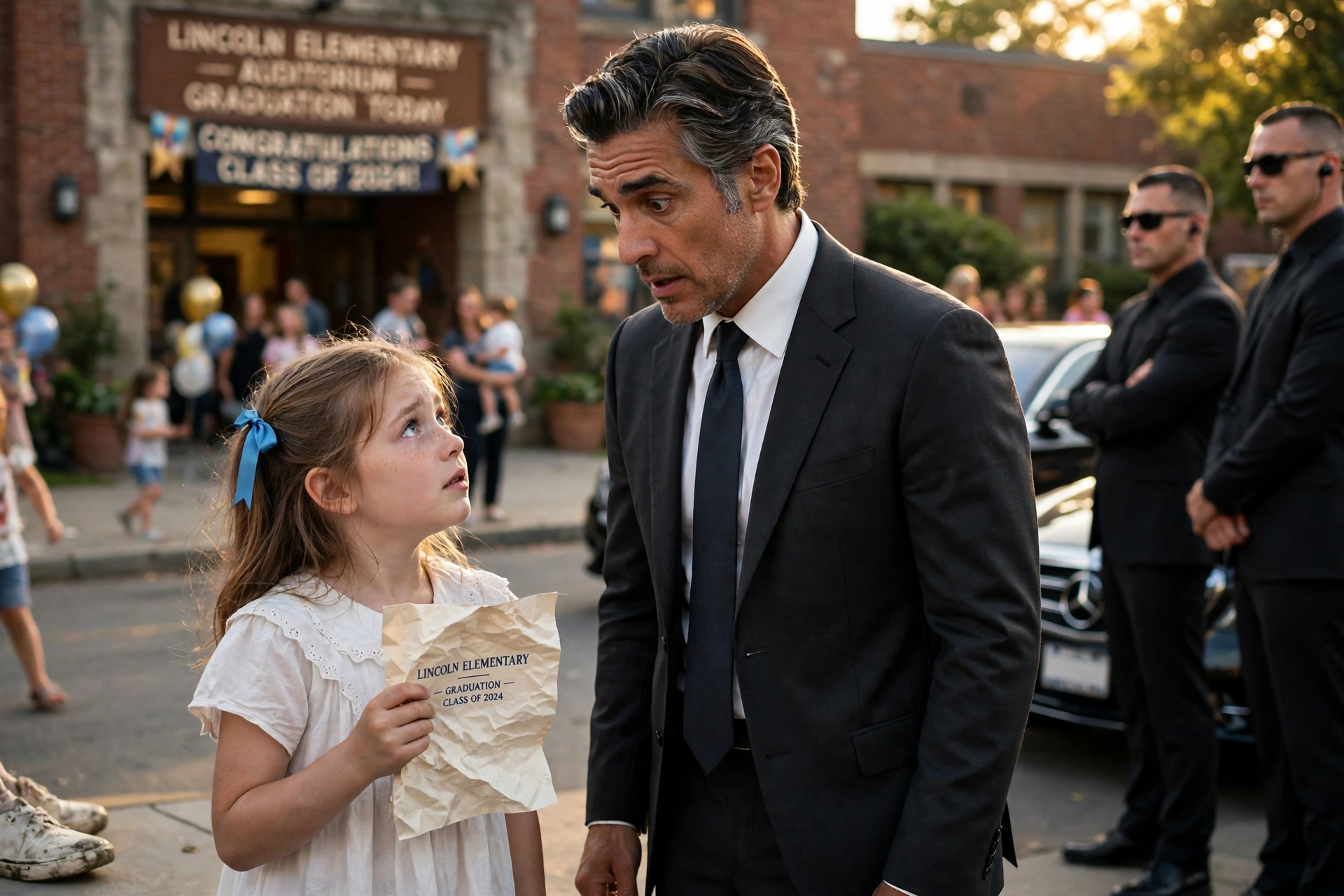
Luca did not sleep well that night. He lay in a bedroom that was too quiet and too large, listening to the city beyond his windows, and thinking about tea gone cold in a little blue house. He had sat in boardrooms where men tried to intimidate him with silence, and he had sat in courtrooms where lawyers tried to bury him in paper, and he had never felt as exposed as he had felt when June Bell placed his business card on her table and looked at him as if she were seeing two men at once: the man who had clapped for her granddaughter, and the man whose company name belonged to a place she could not say without her voice changing.
In the morning, his apartment looked the same. The coffee was the same. The suit he chose was the same dark charcoal. But the day did not feel the same, because for the first time in years, Luca was not sure what kind of man he was going to be when he walked into his office.
Dominic Vale was already there, calm and early, as always. Dominic had been with Luca since the early waterfront years, when Moretti Logistics was still a handful of trucks and a rented warehouse and a reputation that had to be earned one delivery at a time. He knew Luca's moods the way a sailor knows weather, and he knew, before Luca said a word, that something had shifted.
"The freight agreement," Dominic said, setting a folder on the desk. "Anton Reyes is pushing for the Harbor Point route. He wants the lease renewed on his terms, and he wants it this week. If we hesitate, he will go to the port authority and argue that we are not using the warehouse efficiently."
Luca opened the folder and did not really see it. Harbor Point. The name had been ordinary to him for so long that he had forgotten it could be a place where real people had lived and worked and died. To him, it was square footage, loading docks, insurance, and a line in a quarterly report. To June Bell, it was something else, and Luca needed to know what, before Anton Reyes or anyone else used it against him.
"Tell me about Harbor Point," Luca said. "Not the lease. The history."
Dominic frowned. "History is expensive, Luca. The warehouse was built in the nineties, after your father consolidated the waterfront properties. There were disputes, as there always are with old land. Your father settled them. That is what settlement means. It means the past stays settled."
"Settled for whom?" Luca asked.
Dominic did not answer at once, and that pause told Luca more than a denial would have. Dominic was not a man who paused unless he was choosing his words with unusual care.
"For us," Dominic said finally. "For the company. For everyone who depends on those jobs."
Luca closed the folder. He thought of Sophie in her white dress, holding a crumpled program, and of June pouring tea with steady hands. He thought of the way June had said "the company that owned the Harbor Point warehouse" as if ownership were not a legal fact but a moral one.
"I want the old files," Luca said. "Not the summary. The originals. Deeds, transfers, accident reports, everything from before I took over."
"Luca," Dominic said, and his voice was quieter now, the voice he used when he was trying to protect Luca from himself. "Some doors, once you open them, do not close again. And Anton is waiting for a door exactly like that."
"I know," Luca said. "Get the files anyway."
While Luca was asking for files, Sophie was back at school, and the world there was both smaller and larger than the world of freight agreements. Her teacher, Mrs. Alvarez, had praised her reading aloud that morning, and Sophie had glowed in a way that made her classmates look twice. At lunch, the girl who had once teased her about having no one coming to the ceremony asked, shyly, who the tall man in the dark suit had been. Sophie, who had learned early that truth needed careful handling, said simply, "He came because I saved him a chair." It was true, and it was enough, and it left the rest of the story where it belonged: at home, with her grandmother.
After school, Aunt May met her at the gate, because June had a follow-up with her heart doctor and Aunt May did not like Sophie walking home alone when June was tired. Aunt May was not a woman who wasted words. She worked at the library, she kept the blue house in order, and she had a way of asking a question that made it clear she already knew most of the answer.
"Your nana was quiet last night," Aunt May said as they walked. "Quieter than usual. And you were quiet too, after Mr. Moretti left."
Sophie kicked a small stone along the pavement. "Nana knows his company," she said. "She said the name like it was a bad word, but she also thanked him for coming. I don't understand that."
"Sometimes grown-ups can be grateful and angry at the same time," Aunt May said. "It does not mean they are lying about either feeling. It means the story is bigger than one afternoon."
"Is Mr. Luca a bad man?" Sophie asked, and Aunt May stopped walking, because this was the kind of question that deserved a full stop and a straight look.
"I don't know yet," Aunt May said honestly. "He came back when he could have stayed away. That matters. But coming back once does not erase a history, Sophie. It only gives a person a chance to show you who they are going to be next."
At the blue house, June was sitting by the window with a cup of tea she was not drinking. Her heart appointment had gone as well as such appointments go, which is to say the doctor had used careful words and had asked her to rest and to avoid stress, and June had nodded as if stress were something she could schedule around. When Sophie came in, June's face softened at once, the way it always did, and she pulled Sophie close for a moment that was longer than usual.
Later, after Sophie was doing homework at the kitchen table, June went to her bedroom and opened a drawer she did not open often. Inside, beneath folded scarves and old photographs, was a tin box. It was not locked. It did not need to be. June had kept it for years, not because she wanted to use it, but because she could not bear to throw it away. Inside were papers that smelled faintly of dust and time: a deed, copied and recopied, a letter in a young man's handwriting, and a photograph of a man in a dockworker's jacket standing in front of a warehouse that no longer looked the way it had in the picture.
June sat with the box on her lap for a long time. She thought of her son-in-law, Daniel Bell, Sophie's father, who had died before Sophie was born. Daniel had been a careful man, a man who kept records and asked questions and believed that paper could protect people when power would not. He had worked at Harbor Point, and he had found something in the warehouse files that had frightened him, and he had written it down, and then he had died in an accident at the warehouse that the company had called unavoidable.
June had never believed that word. Unavoidable. It was a word companies used when they did not want to say anything else.
She had also never used the papers. She had told herself she was protecting Sophie, that a seven-year-old did not need a war with a shipping empire, that a grandmother's job was to keep a house warm and a child safe, not to chase justice through courts she could not afford. But now the shipping empire had walked into her granddaughter's school ceremony and sat in a chair Sophie had saved, and June did not know whether that was coincidence or whether it was the beginning of something she had been dreading for years.
That evening, Luca called the blue house. He did not call to charm June or to argue. He called to ask, plainly, if he could come back for tea, with Aunt May present, and talk about Harbor Point. June was silent for a long time on the other end of the line, and Luca could hear Sophie in the background, practicing a song for school, her voice small and clear.
"Mr. Moretti," June said at last, "I need you to understand something. My granddaughter liked you today. She liked you because you came back. Do not make her regret that. If you come here, you come to listen. You do not come to manage me, or to buy my silence, or to make this story smaller than it is."
"I understand," Luca said. "I will listen."
When he hung up, Dominic was standing in his office doorway, holding the first box of old Harbor Point files. The box was dusty. The labels were faded. Dominic set it down as if it were heavier than paper.
"Are you sure?" Dominic asked.
Luca looked at the box, and then at the photograph on his desk, a photograph he rarely looked at: himself at seventeen, in a jacket that did not fit, standing alone after a ceremony.
"No," Luca said. "But I am going to open it anyway."
That night, Sophie dreamed of chairs. In her dream, there were many chairs in a long row, and most of them were empty, and she went from chair to chair, placing a daisy on each one, until she came to the last chair and found her grandmother sitting there, holding a tin box, and smiling at her as if to say that some chairs are not empty at all, they are just waiting for the right person to understand why they matter.
She woke up before dawn, went to June's room, and climbed carefully onto the edge of the bed, the way children do when they need to be close but do not want to wake someone fully. June opened one eye, smiled, and put an arm around her.
"Nana," Sophie whispered, "is Harbor Point a bad place?"
June held her a little tighter. "Harbor Point is a place where good people worked, and where some powerful people made choices they should not have made," she said. "And sometimes, Sophie, a place can be both. That is why grown-ups have to be careful with what they do next."
Sophie nodded, as if that made sense, and fell back asleep against her grandmother's shoulder, her blue ribbon loosened, her breathing slow and even. June stayed awake, watching the first light come through the curtains, thinking about deeds and letters and a young man who had believed paper could protect people, and about a shipping boss who had clapped for her granddaughter as if applause could be a kind of promise.
She did not know yet what Luca Moretti would do when he learned the whole story. She only knew that she could not keep the tin box closed forever, not now that he had sat in Sophie's chair and had looked at her granddaughter the way Daniel had once looked at the world: as if it were worth showing up for, even when showing up was hard.
In the morning, June made tea the way she always did, slowly and without hurry, and she placed the tin box back in its drawer for one more day. She was not ready to open it in front of Luca, and she was not ready to pretend it did not exist. She needed time to decide what kind of truth would help Sophie and what kind of truth would only frighten her. Outside, the garden was bright with early light, and the blue house looked, to anyone passing by, like an ordinary house where an ordinary grandmother was making breakfast for an ordinary little girl. June knew better. She knew that ordinary houses can hold extraordinary papers, and that ordinary afternoons can change the shape of an empire, if the person who holds those papers decides, at last, to speak.
Luca, for his part, learned that night that a promise made to a child is not a small promise at all. He wrote it down in his notebook, in plain words, so he would not forget it when the next freight agreement tried to make him forget: listen first, check the papers, do not use a family as leverage, and come back when you say you will. It was not a business plan, but it was, he realized, a better plan than any he had written in a boardroom, because it gave him a way to measure his days that had nothing to do with profit and everything to do with whether he had shown up honestly for the people who trusted him.