The days after the tin box were the longest Luca had known since he was seventeen and waiting for a father who did not come. He read files in the morning, met lawyers in the afternoon, and lay awake at night thinking about signatures that did not match and about a young clerk named Daniel Bell who had believed paper could protect people.
Dominic Vale did not like what he was seeing. Dominic had built his career on protecting Moretti Logistics, and protection, in Dominic's mind, meant containment. It meant finding the leak, sealing it, and moving on before the market noticed. He came to Luca's office with a plan that was, by Dominic's standards, generous: a private settlement for June Bell, generous enough to secure Sophie's education and June's medical care, in exchange for the deed, the letter, and a signed agreement never to speak of Harbor Point again.
"That is not justice, Dominic," Luca said. "That is a purchase."
"It is survival," Dominic said, and for the first time in their long partnership, his voice had an edge. "Luca, Anton Reyes is not bluffing. If this deed becomes public, the port authority will review every lease we hold at Harbor Point. Our lenders will ask questions. Our clients will ask questions. You could lose the waterfront, not because you forged anything, but because you inherited a company that did."
"Then perhaps I should lose the part that was never honestly mine," Luca said.
Dominic stared at him. "You are talking like a man who has never had to meet a payroll. There are hundreds of people who depend on those jobs, Luca. Dockworkers, drivers, office staff. Are you going to sacrifice them for a deed from the nineties?"
Luca thought about that, because it was a fair question, and because Dominic was not wrong about the jobs. He thought about the men and women who loaded ships in the rain, who had families and mortgages and school ceremonies of their own. He did not want to hurt them to help one family. But he also did not want to help one family by hurting the truth, because he had seen, in June's kitchen, what a buried truth did over seven years: it did not disappear. It waited in a tin box.
"I am not going to close the warehouse," Luca said. "I am going to find a way to make it right without destroying the people who work there. There has to be a way to return what was taken and keep the jobs. If there is not, I will find one anyway."
Dominic left the office without arguing further, but Luca could feel the distance growing between them, like a tide pulling back from a shore. Dominic had been loyal to Luca for decades, but his loyalty had always been to the company first, and Luca was beginning to understand that those two loyalties were no longer the same.
Luca hired an independent lawyer, a woman named Elena Marchetti, who had no ties to Moretti Logistics and no patience for corporate euphemisms. Elena read the deed, the letter, and the accident reports, and she told Luca, plainly, what he already suspected: the transfer signature was almost certainly forged, the accident investigation had been conducted by a firm hired by the company itself, and the settlement with Laura Bell had been designed to close questions, not to answer them.
"What Daniel found," Elena said, "was not just a forged deed. It was a pattern. The warehouse was overloaded to meet a deadline your father had promised a client. Shelves were stacked beyond their rated capacity. Daniel noted it in his notebook, and he noted that he had raised it with a supervisor, and that the supervisor had told him to keep the freight moving. The shelf that collapsed was not an act of God, Luca. It was an act of hurry."
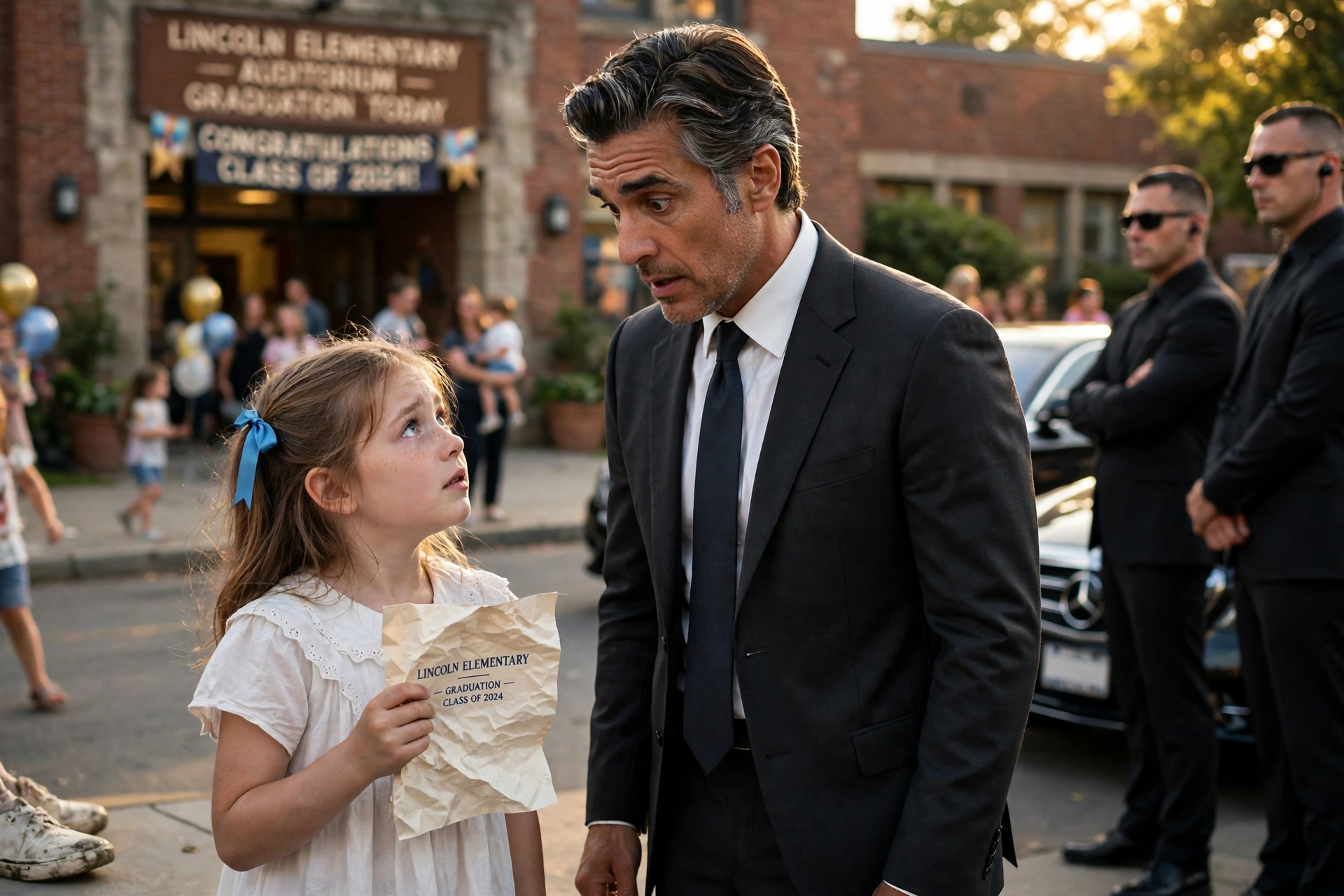
Luca felt sick. Hurry. He knew hurry. He had built a career on hurry, on deadlines, on making the freight move. He had told himself hurry was business. Now hurry had a name, and a face in a photograph, and a daughter who wore a blue ribbon to school.
"Was it murder?" Luca asked, because he needed to hear the answer in plain language.
"No," Elena said carefully. "Not on the evidence I have seen. It was negligence, and then it was a cover-up. The company did not plan for Daniel to die. It planned for no one to ask why he died. That distinction matters in court, Luca, but I am not sure it matters as much to a grandmother."
Luca nodded. He understood. To June, the distinction between murder and negligence would feel thin, because both had left her daughter a widow and her granddaughter fatherless.
While Luca was learning these things, Sophie was learning something else at school. A boy in her class, whose father worked for Anton Reyes, had heard his parents talking about Harbor Point and about a lawsuit, and he had repeated, in the cruel shorthand of children, that Sophie's new friend was a bad man who had stolen her family's land. Sophie had come home crying, not because she believed it fully, but because she did not know how to answer it.
June held her and said, "People will say many things about Mr. Luca now, Sophie, and some of them will be true and some will not. Your job is not to defend him or to condemn him. Your job is to be a child, to do your homework, to sing your songs, and to let the grown-ups sort out what they did wrong."
"But what if he is bad?" Sophie whispered.
"Then we will know," June said, "by what he does next, not by what other people say about what his father did before."
Aunt May, who had been listening from the doorway, added, "And if he does the right thing, Sophie, that does not mean we have to pretend the past did not happen. It means we can be grateful for the present without forgetting the past. Both can be true."
That evening, Luca did something he had never done before: he went to Sophie's school, not to the auditorium, but to the small office where Mrs. Alvarez kept her records, and he asked, with June's permission and Aunt May present, if he could make a donation to the school's music program, anonymously, in Daniel Bell's name. Mrs. Alvarez, who had seen many wealthy men try to buy goodwill, looked at him skeptically, until Luca said, "Not in my name. In his. He worked at the docks, and his daughter sings in your second grade. That is all the connection I want to claim."
Mrs. Alvarez accepted, on the condition that the donation be public only as a gift to the music program, with no plaque, no announcement, and no photograph. Luca agreed at once, and for the first time in days, he felt something like relief, not because he had solved anything, but because he had done one small thing that was not about his empire.
Elena also explained, in plain language that Luca appreciated, what his choices actually were. He could fight the deed in court, and he would probably lose, slowly and publicly, while Anton watched. He could settle privately with June, and he would probably succeed, but Sophie would grow up knowing that her family's story had been bought and filed away. Or he could return the parcel voluntarily, with a plan to keep the warehouse operating under a new, honest lease, and accept the financial loss and the public scrutiny that would follow. None of the choices were painless, Elena said, and none of them would make Daniel Bell alive again. The question was not which choice was painless. The question was which choice Luca could live with when he looked at himself in the mirror in ten years, and when Sophie, grown up, asked him what he had done when he learned the truth.
Luca spent the next day at Harbor Point itself, walking the docks without an entourage, talking to workers who had been there for decades. An older dockworker named Frank, who had known Daniel by sight, told Luca that Daniel had been a quiet young man who always double-checked the loads and who had once stopped a forklift driver from stacking a pallet too high, even though it had delayed a shipment. "He was not a troublemaker," Frank said. "He was a careful man in a place that rewarded speed over care. That is a dangerous combination, if you think about it." Luca thought about it for a long time after Frank had gone back to work, and he thought about how many times he himself had rewarded speed over care, and how many careful people he had overlooked because they did not shout.
June, meanwhile, had a difficult week of her own. Her heart doctor adjusted her medication and told her, firmly, to avoid stress, which made June smile in a tired way, because stress was not something she could simply decline, like a second helping of dessert. Aunt May took over more of the housework, and Sophie, sensing that her grandmother was tired, began doing small, thoughtful things without being asked: bringing June a glass of water, reading aloud from her school book in the evenings, leaving a daisy, now pressed flat, on June's bedside table. June kept that pressed daisy, because it reminded her of the afternoon when a feared shipping boss had sat in a school chair and clapped for her granddaughter, and because it reminded her that kindness and justice do not always arrive in the same package, but sometimes they arrive on the same day.
Later that week, Anton Reyes made his move. He did not threaten Luca directly. He threatened the port authority, in the form of a letter, suggesting that Moretti Logistics' title to Harbor Point was clouded and that a review would be in the public interest. He also, through intermediaries, suggested to a local newspaper that there was a human story behind the lease dispute, a story involving a widowed grandmother and a little girl. Luca knew what Anton was doing: he was turning June's pain into leverage, and he was counting on Luca to panic and sell the lease on Anton's terms to make the story go away.
Luca called June that night, and he told her what Anton was doing, because June deserved to hear it from him before she heard it from anyone else.
"Mr. Moretti," June said, after a long silence, "I have kept this box for seven years because I did not want Sophie to become a story in a newspaper. If Anton uses her, I will not forgive him, and I will not forgive you if you let him."
"I will not let him," Luca said. "I will not sell the lease to Anton to bury this. I would rather lose Harbor Point honestly than keep it by making a deal with a man who wants to use your granddaughter as a headline."
June was quiet, and then she said, very softly, "Then you are already different from your father, Mr. Moretti. Your father would have made the deal."
Luca hung up and sat in his office, looking at the files spread across his desk, at the deed and the letter and the accident reports Elena had summarized. He thought about Dominic, who wanted to buy silence, and Anton, who wanted to buy the lease, and June, who wanted neither, only the truth and a safe life for Sophie.
He realized that the investigation was no longer just about the past. It was about who would control the future of Harbor Point, and whether that future would be decided by men in boardrooms or by a grandmother in a blue house who had kept a tin box because she loved her family too much to throw it away.
And he realized, too, that he had not yet told Sophie the whole story, because Sophie was seven, and seven-year-olds should not have to carry deeds and accident reports. But he had promised her he would not look away, and a promise to a child, Luca was learning, is not a small thing. It is the largest thing, because children remember promises the way adults remember contracts, and they remember broken ones even longer.
That night, as Luca locked his office, he paused by the window and looked out at the waterfront lights, thinking about how many of those lights belonged to warehouses he had once seen only as assets. Now he saw them differently, as places where careful people worked, where families depended on honest safety rules, and where a single overloaded shelf could change a child's life forever. He did not feel proud of that new way of seeing, exactly, but he felt awake, and awake felt like a beginning, even if it also felt like a responsibility he could no longer set down.