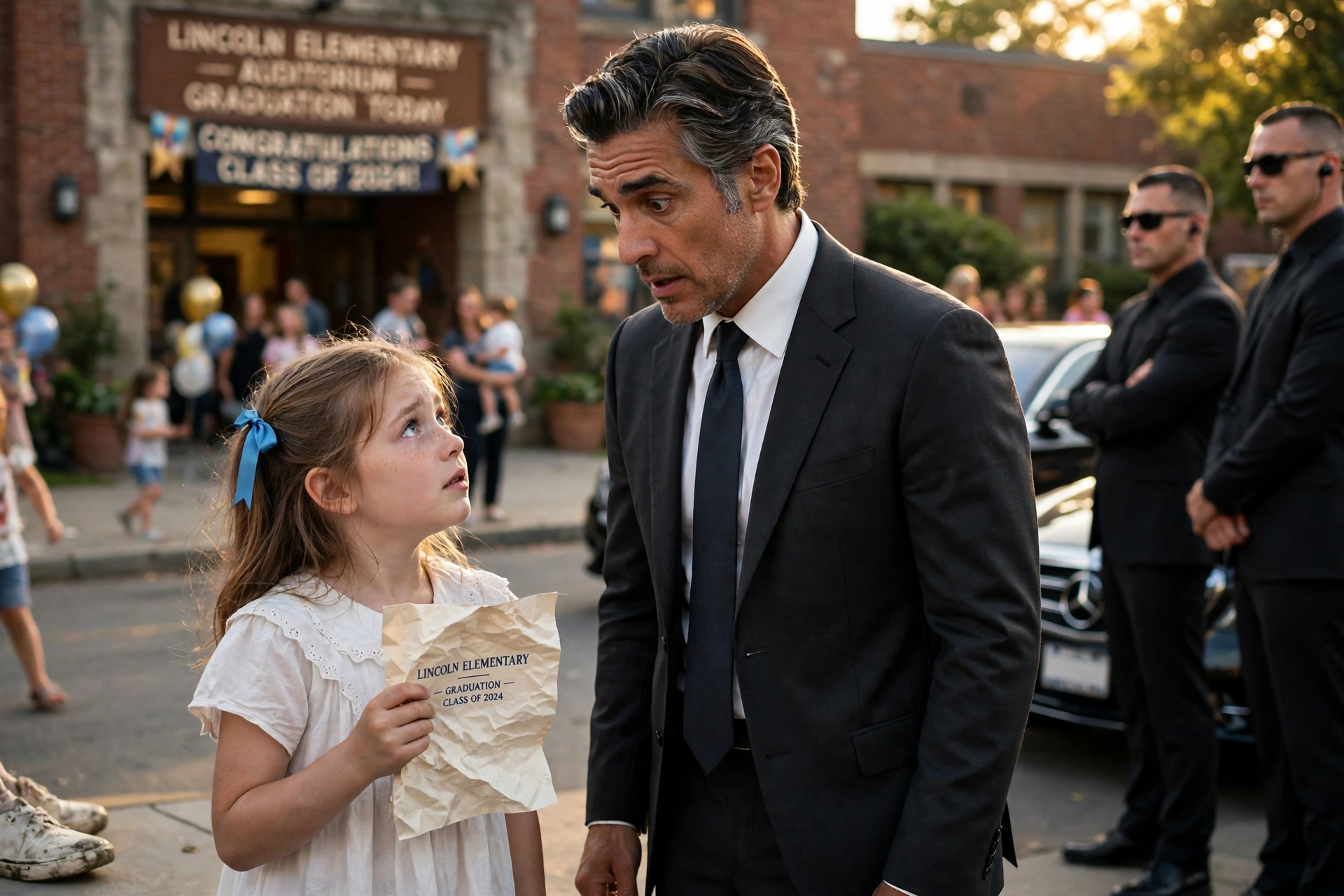
Luca arrived at the little blue house on a Saturday afternoon, and he arrived alone. No bodyguards stood on the porch. No black Mercedes idled at the curb. He had walked from the corner, carrying nothing but a notebook and a willingness to listen that felt, to him, both unfamiliar and necessary. Aunt May opened the door, looked him up and down, and let him in without ceremony.
"June is in the kitchen," Aunt May said. "Sophie is at the library with Mrs. Alvarez for a reading group. She will be home in an hour. That gives us an hour to talk like adults, Mr. Moretti, without a child in the room to soften what needs to be said."
Luca nodded. He had expected a confrontation. He had not expected to be grateful for it.
June was sitting at the kitchen table, and the tin box was on the table in front of her. It was not a dramatic object. It was dented at one corner, its paint worn, its latch loose. It looked like something that had held biscuits once, long ago, and had then been given a more serious job. June's hands rested on either side of it, steady, but Luca could see the effort steadiness cost her.
"Sit down," June said.
Luca sat. Aunt May poured tea and then sat too, not as a guest, but as a witness. That was important, Luca understood. June did not want this conversation to be private in a way that could later be denied. She wanted someone else in the room who would remember what was said.
"Before I open this," June said, "I want you to know why I kept it. I kept it because my daughter, Laura, asked me to keep it, and because my son-in-law, Daniel, believed it mattered. I did not keep it to hurt you, Mr. Moretti. I kept it because throwing it away would have felt like throwing away Daniel himself."
Luca nodded, and June opened the box.
Inside were three things. A deed, copied in faded ink, showing a parcel of waterfront land at Harbor Point in the name of Thomas Bell, June's late husband, and his brother. A letter, written in a young man's careful handwriting, dated a few weeks before Daniel Bell died. And a photograph of Daniel in a dockworker's jacket, standing in front of a warehouse, smiling as if he believed the future would be fair to him.
June laid the deed on the table first. "This land," she said, "was Bell land. My husband's family had worked the docks there for two generations. They did not own much, Mr. Moretti, but they owned that parcel, and they owned it honestly."
She laid the letter beside it. "Daniel worked as a clerk at Harbor Point. He was not a powerful man. He was a careful man. He noticed when numbers did not match, when a transfer was filed twice, when a signature looked too smooth to be real. He wrote this letter to Laura, my daughter, because he was afraid to write it to anyone else. He said the warehouse had been built on land that had been transferred with a forged signature, and that the man who benefited most was Victor Moretti, your father."
The room went very quiet. Luca could hear the clock on the wall, and the kettle cooling, and his own breathing, which suddenly seemed too loud.
"Daniel died before Sophie was born," June continued, her voice steady, but her eyes bright with a grief that had never fully left. "He died in an accident at that warehouse. A shelf collapsed. A load shifted. The company called it unavoidable. They paid a settlement, and they asked Laura to sign a paper saying she would not ask further questions. Laura was pregnant, and grieving, and afraid, and she signed. She died last winter, Mr. Moretti, of an illness that had nothing to do with Harbor Point, but she died still believing that Daniel's death had not been fully explained, and that the land that should have helped raise Sophie had been taken from her family by a signature that was not theirs."
Luca looked at the deed, at the letter, at the photograph of a young man who would never meet his daughter. He felt the floor shift under him, not dramatically, but completely, the way a building shifts when its foundation has been undermined for years and no one has noticed until the walls begin to crack.
"My father," Luca said slowly, "told me Harbor Point was settled. He told me the disputes were old and that settlement meant the past stayed settled. He never told me about a forged transfer. He never told me about Daniel Bell."
"Men like your father do not tell their sons those stories," June said, not unkindly. "They tell them about empires. They leave the rest in boxes."
Aunt May leaned forward. "June is not asking you to go to prison for your father's sins, Mr. Moretti. She is asking you to decide what kind of man you are now that you know. Because if you bury this again, you will not be your father. You will be worse. You will be a man who knew and chose to look away, after sitting in a child's chair and clapping for her as if you were family."
Luca stood up, too abruptly, and then sat down again, because standing felt like leaving and he did not want to leave. He thought of his father at seventeen, promising to come and sending a driver instead. He thought of himself at forty-six, promising to be on time for a freight agreement and cancelling it to sit in a school auditorium. He thought of Dominic, waiting with files, warning him that some doors do not close again.
"Did Daniel's death have anything to do with what he found?" Luca asked, and his voice was hoarse.
June looked at him for a long time. "I do not know," she said honestly. "I have never been able to prove that it did. I only know that he found something dangerous, and that he died soon after, and that the company that benefited from the forgery was also the company that investigated its own accident. That is not proof, Mr. Moretti. But it is enough to make a grandmother keep a tin box for seven years."
That honesty, Luca realized, was what made June dangerous to his empire, and also what made her trustworthy. She was not claiming more than she could prove. She was not threatening him with a story she had invented. She was offering him a story she had carried, quietly, because she had not known what else to do with it.
Before Luca could answer, the front door opened, and Sophie came home early from the reading group, her backpack bouncing, her blue ribbon slightly askew. She stopped in the doorway when she saw the papers on the table, and the photograph, and the serious faces of the adults.
"What's Harbor Point?" Sophie asked, and her voice was small but clear. "Is that where my daddy worked?"
June stood up at once, and Aunt May moved to Sophie's side, and Luca felt his heart contract, because this was the moment he had feared without knowing it: the moment when a child's simple question met an adult's complicated truth, and no one in the room could answer it without changing something forever.
"Yes, sweetheart," June said gently, kneeling so she was at Sophie's height. "Your daddy worked at Harbor Point. He was a good man, and he loved you before you were born, and he would have been very proud of you at your ceremony."
Sophie looked at the photograph, then at Luca, then back at June. "Did Mr. Luca's company hurt my daddy?" she asked, and the directness of the question was almost unbearable.
Luca did not look away. He did not try to soften it with a story. He said, "Sophie, I did not know your daddy, and I did not know about this land until today. But my family's company was involved in something that hurt your family, and I am going to find out the truth, even if the truth hurts my company. That is a promise, and I will not make it lightly, because I know what it feels like when a grown-up promises to come and does not."
Sophie studied him, the way children study adults when they are deciding whether to believe them. Then she nodded, slowly, and went to June, and June held her, and Aunt May poured more tea that no one drank.
Before he left the blue house, Luca stood on the porch for a moment, looking at the garden June had tended with such care. The garden was not large, but it was orderly in the way that comes from years of attention: roses along the fence, herbs by the kitchen door, a small bench where someone could sit and think. Luca thought about his own apartment, which had a view but no garden, and about his office, which had a conference table but no bench for thinking. He thought about how much of his life had been built for display and how little of it had been built for sitting quietly with a difficult truth.
On the drive back, he did not turn on the radio. He let the road noise fill the car, and he let himself remember his father more honestly than he usually allowed. Victor Moretti had not been a monster in Luca's memory. He had been a distant, demanding, impressive man who had taught Luca to shake hands firmly, to read a contract twice, and to never let a rival see him hesitate. He had also been a man who had missed ceremonies, who had sent drivers in his place, who had treated promises as flexible when business required it. Luca had spent his adult life copying the first half of his father and telling himself he had rejected the second half. Now he was not so sure. He had cancelled a meeting to sit in a child's chair, yes, but he had also spent years allowing intimidation to settle disagreements, and he had called that business. The line between his father and himself was thinner than he wanted to admit, and June's tin box had made that line visible for the first time.
When he reached his office, Dominic was waiting, and Dominic could tell from Luca's face that the meeting in the blue house had not gone the way Dominic had hoped. "You look like a man who has just been handed a problem he cannot buy his way out of," Dominic said. Luca nodded, because that was exactly right, and because Dominic, for all his loyalty to the company, still knew Luca better than almost anyone else alive.
That night, Luca went back to his office and opened the old Harbor Point files Dominic had brought him. He read until his eyes burned. He found transfer documents with signatures that did not quite match, and accident reports that were too brief, and settlement papers that were too eager to close questions. He found his father's name, again and again, in the confident handwriting of a man who believed that the waterfront belonged to whoever could hold it.
And then his phone rang, and it was not Dominic. It was Anton Reyes, the rival shipper who wanted the Harbor Point lease, and Anton's voice was smooth and delighted, as if he had been waiting for this call for a very long time.
"I hear you've been visiting a little blue house, Luca," Anton said. "I hear there's a grandmother with a box. Be careful. Boxes like that have a way of opening in courtrooms, and courtrooms have a way of ending empires. Unless, of course, you would like to discuss the lease on my terms, and we can make sure that box stays closed, together."
Luca understood, in that moment, that the secret June had kept for seven years was no longer just a family secret. It was a weapon, and Anton wanted to hold it, and Dominic would want to bury it, and June wanted, above all, for it not to hurt Sophie.
Luca ended the call without agreeing to anything. He sat in his dark office, surrounded by files that told a story he had not wanted to read, and he thought of Sophie's question, and June's tin box, and the empty chair he had filled and the other empty chairs he had not yet understood.
The climax of that day was not a shouting match or a threat. It was quieter and more dangerous than that. It was a man who had built his life on being feared realizing that fear would not protect him now, and that the only way forward was through a truth he could not control, for a child who had asked him for forty-five minutes and had ended up asking him for something much larger: to be the kind of man who does not look away.