June came home from the hospital on a Tuesday, and the blue house, which had felt empty without her, felt full again in a way that had nothing to do with noise. Aunt May had cleaned every room, had stocked the kitchen, had placed fresh flowers on the table, and had made a bed on the ground floor so June would not have to climb stairs while she recovered. Sophie had made a card, with a drawing of the blue house and a sun that was far too large and far too yellow, and she had written, in careful letters, "Welcome home, Nana. I saved you a chair, too."
June cried when she saw it, and then she laughed, and then she cried again, because recovery, she discovered, is not a straight line. It is a series of small, ordinary moments that feel extraordinary because you were afraid you might not have them again.
Luca did not visit every day. He visited when Aunt May said it was helpful, and he stayed away when Aunt May said June needed rest, and he learned, slowly, how to be present without being intrusive, which was a skill his previous life had never required of him. When he did visit, he brought groceries, not gifts, and he sat in the kitchen, with Aunt May present, and he listened to June talk about the learning center, about Daniel, about the garden, about the ordinary business of a house that had survived a great deal.
At Moretti Logistics, the fallout from Harbor Point was real, but it was not the catastrophe Dominic had feared, nor the triumph Anton had predicted. The board, after a long and difficult meeting, voted to accept the trust agreement, largely because Elena's lease-back plan preserved jobs and revenue, and largely because the alternative, a public lawsuit over a forged deed, would have been far more expensive in both money and reputation. Some shareholders grumbled. Some clients asked hard questions. A few contracts were lost, and a few new clients, drawn by the story of a company that had corrected its own past, came forward to ask about working with a shipper that took safety and honesty seriously.
Dominic, who had expected to lose his position, found himself in a different position instead: head of compliance and safety, a role that had not existed before, with authority to stop a shipment if it was overloaded, even if stopping it cost money. He took the role seriously, and he took it personally, because he had been part of the quiet for too long, and he wanted, in the second half of his career, to be part of something louder and cleaner.
Anton Reyes did not disappear. He filed a challenge with the port authority, arguing that the trust agreement was invalid, and he lost, because Elena's documents were thorough and because the Bell family's claim was documented in a way that Anton's lawyers could not easily dismiss. Anton did not apologize, and Luca did not expect him to. Anton simply moved on to another waterfront dispute, as men like Anton do, leaving Harbor Point to the people who actually worked there and to the family who had finally been heard.
Sophie, meanwhile, was dealing with a quieter kind of recovery. She had been frightened at the hospital, and frightened children do not always say they are frightened. They become quieter, or louder, or clingier, or more independent than they should be. Sophie became, for a while, very careful about June's health. She would check, several times a day, whether June was tired, whether June needed water, whether June's heart was all right, in the way children check things they do not fully understand but desperately want to control.
June noticed, and she handled it the way she handled most things: gently, and directly. She sat Sophie down, with Aunt May nearby, and she said, "Sweetheart, my heart is my job to take care of, with the doctor's help. Your job is to be seven, to go to school, to sing, to read, to play, and to tell me when you are scared, so I can help you carry the scared feeling instead of you carrying it alone."
Sophie nodded, and then she asked the question June had been waiting for, the question that had been underneath all the others since the tin box had been opened.
"Nana, if Mr. Luca gives back the land, does that mean my daddy is not dead anymore?"
June held her close, and Aunt May put a hand on Sophie's shoulder, and June said, very carefully, "No, sweetheart. Giving back land does not bring people back. Your daddy died, and that is a sad and true thing, and no deed or ceremony can change it. What giving back the land does is different. It means that the story about your daddy is now told honestly. It means that people will know he was a careful man who asked good questions. And it means that you will grow up knowing that your family was not forgotten, even when powerful people wanted to forget."
Sophie was quiet for a long time after that, and then she said, "I think my daddy would like that. I think he would like that people know he was careful."
"He would," June said. "He would like that very much."
In the weeks that followed, the learning center began to take shape, not as a grand building, but as a renovated room at Harbor Point, with bookshelves, with a reading corner, with a plaque that did not mention Moretti Logistics in large letters, but mentioned Daniel Bell in small, respectful ones. Luca funded it through the trust, not through his company, because he wanted the center to belong to the community, not to his reputation. Mrs. Alvarez helped choose books. Aunt May helped organize a small library of children's stories about asking questions and about showing up for other people.
Luca also changed how Moretti Logistics operated, in ways that were less dramatic than the Harbor Point ceremony but more lasting. He ended the practice of using family pressure in negotiations, a practice Dominic had once described as "speaking with his brother" and which Luca now understood for what it was: intimidation, dressed up as business. He instituted a rule that any employee could stop a shipment for safety reasons without fear of punishment, and he made sure the rule was not just a poster on a wall, but a practice that was actually used, and actually protected, when a young dockworker stopped an overloaded pallet in the first month and was thanked, publicly, instead of being quietly reassigned.
Some of Luca's old associates did not like the new Luca. They called him soft. They said he had lost his edge. Luca, who had once cared deeply about being feared, found that he cared less and less about that particular reputation, and more and more about a different one: the reputation of a man who could be trusted to keep a promise to a child, and to a grandmother, and to himself.
One evening, as autumn began to turn the leaves outside the blue house, Sophie asked Luca, during a supervised visit with Aunt May making tea in the next room, whether he would come to her next school event. It was not a graduation this time. It was a small autumn concert, where second graders would sing two songs, and where parents would sit in small chairs and applaud as if applause were the most important thing in the world.
Luca looked at June, who nodded, and at Aunt May, who nodded, and then he looked at Sophie, and he said, "Yes, Sophie. I will come, if your nana and Aunt May say it is all right, and if you save me a chair. But this time, I will not be pretending to be your dad. I will be there as myself, as a friend of your family, who is proud of you and who wants to hear you sing."
Sophie thought about that, and then she smiled, a smile that was not astonished this time, but settled, as if she had finally understood something important about how families can be made, not just born.
"Okay," she said. "But you still have to clap loud. That part does not change."
Luca laughed, a real laugh that surprised him with its ease, and June laughed too, and Aunt May, who rarely laughed out loud, smiled into her tea.
The learning center opened quietly, without reporters, on a Saturday morning when the light at Harbor Point was soft and golden. June cut a ribbon with hands that were still a little shaky, and Sophie read aloud from a book about a girl who asks a difficult question and does not stop asking until she gets an honest answer. The audience was small: dockworkers on their day off, teachers, Aunt May, Mrs. Alvarez, Dominic, Elena, and Luca, sitting in the back row, clapping as loudly as he had clapped at the school ceremony, because some habits, once learned properly, are worth keeping.
After the opening, an older woman who had worked at Harbor Point for thirty years approached June and told her that Daniel had once helped her carry a heavy box when no one else had offered, and that she had never forgotten it. June thanked her, and her eyes filled, because Daniel's story was no longer just a letter in a tin box. It was becoming a story other people told, in their own words, about a careful young man who had mattered to more people than his family had known.
Luca also visited his father's grave for the first time in years, not to forgive Victor Moretti in a single afternoon, and not to condemn him in a single afternoon, but to tell the truth out loud in a place where no one could argue with him. He stood among quiet stones and said, "You taught me to be strong, Father, but you did not teach me to be honest about where that strength came from. I am learning that now, from a grandmother and a little girl, and I wish you had learned it sooner, for all our sakes." He left no flowers, because flowers felt too easy, but he left with a clearer sense of who he was not going to be, and that, he discovered, can be a kind of peace.
Sophie, meanwhile, practiced her two songs for the autumn concert with a seriousness that made Mrs. Alvarez smile. She practiced in the garden, in the kitchen, and, once, in the car on the way to a doctor's appointment with June, until Aunt May said, laughing, that she would know those songs in her sleep. Sophie did not mind. She liked the feeling of being prepared, of knowing her part, of standing up in front of people and being heard. She had learned, without anyone teaching her directly, that applause is not just noise. It is a way of saying, "We see you, and we are glad you are here," and she wanted to earn that applause by singing well, not by asking anyone to pretend.
June's doctor, at her next check-up, said her heart was stable, that rest and medication and low stress were helping, and that she should continue to avoid large public ceremonies for a while, which June accepted with a wry smile, because she had already attended one very large public ceremony and had no desire to repeat the experience. She told the doctor, with a straight face, that she planned to spend the autumn in her garden and in her kitchen, and that if anyone tried to make her attend another warehouse ceremony, she would send Aunt May in her place, which made the doctor laugh and made Aunt May pretend to be offended, in the fond way families pretend when they are actually relieved.
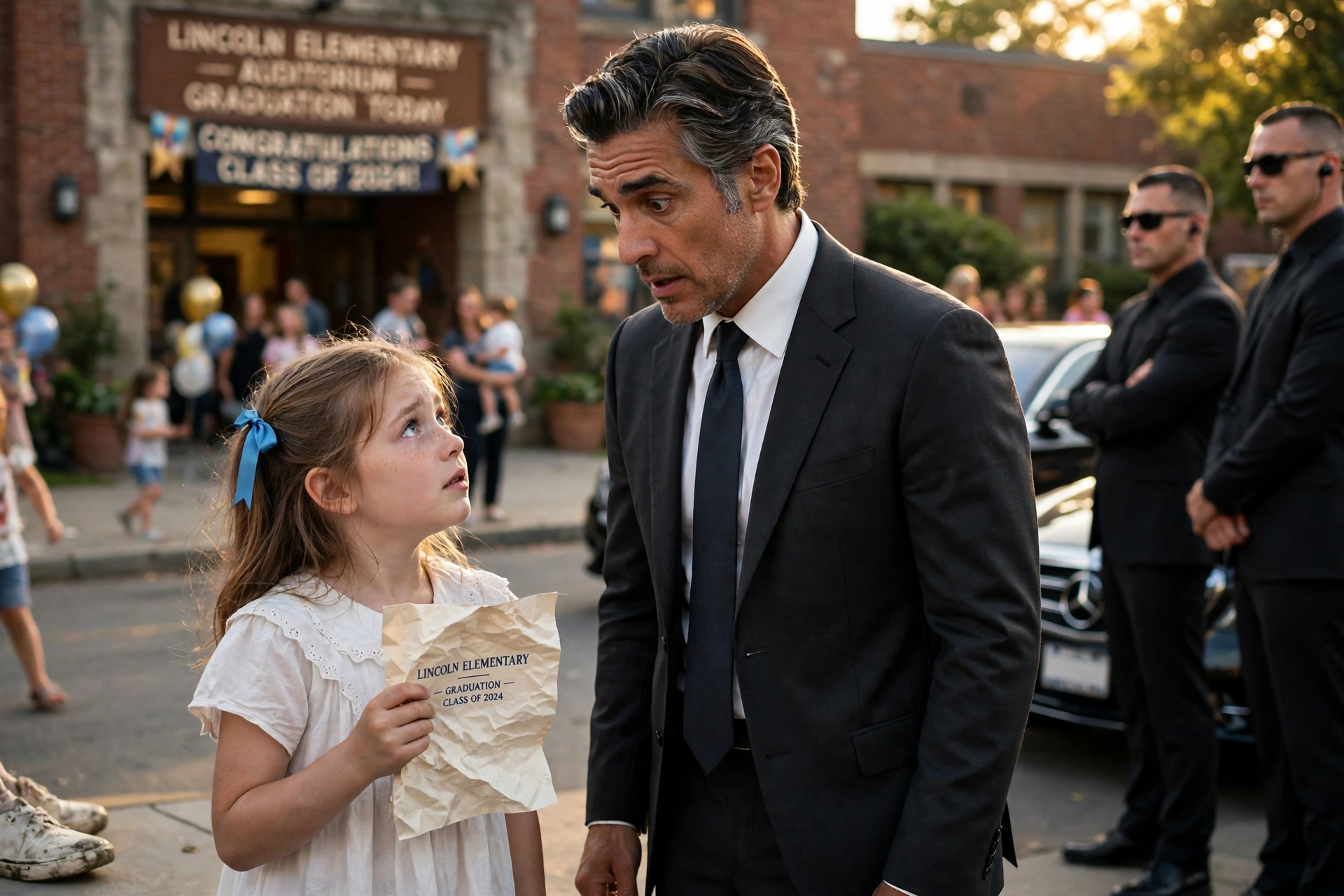
That night, Luca drove home through streets lit with early evening light, and he thought about how far he had come from the afternoon when a little girl had stopped him outside an auditorium and asked him for forty-five minutes. He had given her forty-five minutes, and she had given him, in return, something he had not known he was missing: a reason to be a better man, not for applause, but because applause, when it is honest, is a kind of promise, and promises, when they are kept, change the people who make them.
He did not know yet what the autumn concert would bring, or whether June's health would hold, or whether Harbor Point would remain peaceful. He only knew that the story was not finished, and that the next chapter, whatever it held, would be faced with people he had chosen to stand beside, rather than alone at a long table, trying to be feared enough that no one would ever leave him sitting in an empty chair again.