The Bullet in My Grandfather’s Drawer
The handle moved again.
Slowly.
Once.
Twice.
Someone was trying not to make noise.
Orson stepped in front of me.
It should have looked ridiculous.
He was a feared crime boss in a tailored black shirt standing in my grandfather's cramped workshop between a polishing wheel and a stack of old repair boxes.
Instead, he somehow made the room feel like his.
His left hand moved beneath his jacket.
I whispered, “You said everyone in your house was armed.”
His eyes stayed on the door.
“I wasn't talking about the house.”
Under different circumstances, I might have laughed.
Then the door opened.
One of Orson's men appeared.
“Clear.”
Orson didn't relax.
“What broke?”
“Back window. Whoever was inside left before we arrived.”
My stomach twisted.
“They were here.”
“Yes,” Orson said.
I turned toward the open safe.
My grandfather's letter was still in my hand.
“They were searching for this.”
“Probably.”
“Then why didn't they open the safe?”
“They tried.”
I looked closer.
Fresh scratches marked the lock plate.
Orson reached past me and touched them.
“They ran out of time.”
I looked at him.
“Because we came back.”
“Because someone warned them we were coming back.”
Kellen.
Neither of us said the name.
We didn't need to.
Orson took the letter from my hand.
“May I?”
“You already read it.”
“That isn't what I asked.”
I looked at him.
It was such an unexpectedly polite question that for a moment I forgot who he was.
Then I nodded.
He read the letter again.
Slowly.
His face gave away nothing.
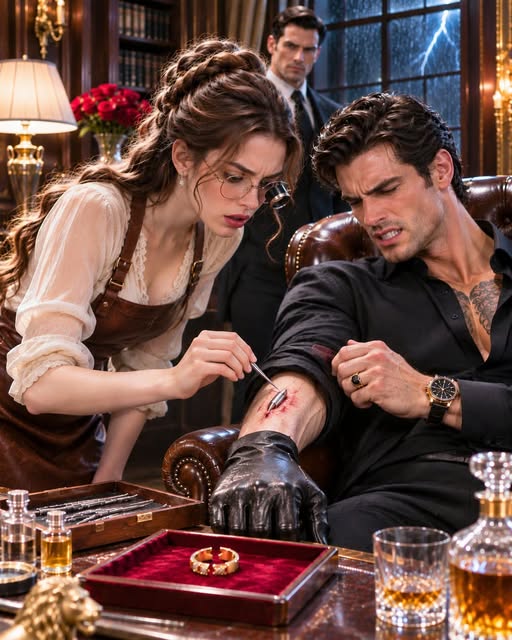
But I noticed his injured right hand curl slightly inside the glove.
Not enough to form a fist.
Enough to show pain.
“Your grandfather made an engraving punch,” he said.
“Apparently.”
“For Kellen.”
“We don't know that.”
His gaze rose.
“The letter names him.”
“It says not to trust him. It doesn't say Kellen commissioned the punch.”
Orson studied me.
“You're defending him?”
“No. I'm being precise.”
“Why?”
“Because precision matters.”
I lifted the casing.
“In my work, being almost right ruins expensive things.”
Something shifted in his expression.
Approval, maybe.
“Good,” he said. “Then let's be precise.”
We spent the next two hours going through my grandfather's records.
I had never realized how much he'd kept.
Every repair.
Every custom commission.
Every strange favor.
Everything was written by hand in ledgers that smelled like dust and old leather.
Orson sat opposite me at the workbench.
His men remained outside.
At some point, he took off his suit jacket and rolled his left sleeve.
The black glove stayed on.
I tried not to stare at it.
I failed.
“You can ask.”
I looked up.
“Ask what?”
“Whatever you've been trying not to ask for twenty minutes.”
I hesitated.
“Does it hurt?”
His eyes dropped to the glove.
“Sometimes.”
“How much movement do you have?”
“Almost none.”
“Can you feel your fingers?”
“Two of them.”
“Which two?”
“Thumb. Index.”
“Temperature?”
“Sometimes.”
I leaned closer without thinking.
“Has anyone done new imaging?”
“Several years ago.”
“And?”
“Too much scar tissue. Nerve damage. Bone fragments. Metal fragments.”
“You said six surgeons refused.”
“They didn't refuse.”
His voice became flatter.
“They told me surgery was more likely to make it worse.”
I looked at the glove.
“Because they didn't know exactly what was still inside.”
“Among other reasons.”
A thought occurred to me.
“If the fragment has an unusual alloy, identifying it could matter.”
“Are you a surgeon now?”
“No.”
“Good.”
“But I know metal.”
That almost-smile appeared again.
It made him look younger.
Less like the man newspapers described.
More like someone who hadn't always been feared.
I looked away first.
That bothered me.
I returned to the ledger.
Twenty minutes later, I found the entry.
November 14.
Nine years ago.
ARTHUR FENIMORE — PRIVATE TOOL FABRICATION.
No client name.
Only a payment number.
$8,000.
My grandfather would never have charged eight thousand dollars for a simple punch.
I showed Orson.
He leaned over the ledger.
His shoulder nearly touched mine.
“Cash?”
“Looks like it.”
“That's a lot of money for him?”
“Back then? Yes.”
The next page had been cut out.
Cleanly.
With a blade.
Orson's face hardened.
“Whoever searched the shop may have taken it.”
“No.”
I ran my thumb along the inner binding.
“The cut is old.”
“How can you tell?”
“Paper discoloration.”
I looked at him.
“Grandpa removed it himself.”
We searched the surrounding pages.
Nothing.
Then I noticed a tiny notation hidden beneath the spine.
AP-17.
I knew what it meant.
“Apothecary cabinet.”
“What?”
“My grandfather labeled storage in the most annoying way possible.”
I crossed the workshop to an old wooden cabinet with dozens of tiny drawers.
AP-17.
Inside were polishing stones.
Under them was a folded repair envelope.
I opened it.
A photograph slipped out.
Orson caught it before it hit the floor.
The picture was nine years old.
My grandfather stood beside a man wearing a dark coat.
The man's face was partially turned away.
But there was no mistaking him.
Kellen Price.
Younger.
Less gray at the temples.
Same eyes.
On the back, Grandpa had written:
K.P. collected custom punch. Said it was for brass collector's ammunition. Asked me not to record his name.
Three days later, another note:
Saw report about Dramore shooting.
Mark in photograph looked familiar.
Need to confirm.
And then:
Confirmed.
God forgive me.
My throat tightened.
“My grandfather thought he helped make the bullet.”
Orson stared at the photograph for a long time.
“He made the tool,” he said.
“That's enough to destroy a man with guilt.”
“Did he ever tell you?”
“No.”
“Why show you the casing?”
“I don't know.”
Then I remembered.
I had been sixteen.
Grandpa had placed it beneath the loupe.
“Never trust a mark just because someone tells you what it means,” he'd said.
“Metal remembers the hands that touched it.”
At the time, I thought he was teaching me about forgery.
Maybe he had been trying to prepare me for this.
Orson turned the casing beneath the light.
“How did your grandfather get it?”
I searched the envelope again.
Another slip of paper.
Found outside Halstead freight yard, three days after shooting.
Not police evidence.
Unused casing from same custom batch.
Someone discarded box.
I read the words aloud.
Orson's jaw tightened.
“Halstead.”
“You know it?”
“I owned three warehouses there.”
“Owned?”
“They burned two years after the shooting.”
I looked at him.
“Accident?”
“No.”
He said it without hesitation.
The story was growing larger.
I hated that.
I wanted one villain.
One explanation.
One neat chain of evidence.
Instead, every answer seemed to expose another hidden layer.
“What happened the night you were shot?”
Orson was silent.
Then he stood.
For a moment, I thought he wouldn't answer.
He walked toward the shop window.
Rain slid down the glass.
“My father had been dead six months,” he said. “I had taken control of the organization. Half the older men believed I was too young.”
“You were thirty-seven.”
“In my world, that was young.”
“What were you changing?”
His reflection stared back at me.
“Things that made people money.”
“That isn't an answer.”
“No.”
I crossed my arms.
He glanced over his shoulder.
“You don't give up easily.”
“Occupational hazard.”
His gaze returned to the rain.
“There were businesses my father tolerated that I wouldn't.”
“Drugs?”
He didn't answer immediately.
That was enough.
“Yes,” he said eventually. “Among other things.”
That surprised me.
“A Mafia boss with principles.”
“Don't romanticize me.”
“I wasn't.”
“Good.”
His voice was colder now.
“I've done things you would hate me for.”
I believed him.
Strangely, that honesty made me trust him more than if he'd tried to pretend otherwise.
He continued.
“Someone was moving narcotics through three freight routes using my name. I ordered it stopped. Money disappeared. Men lied. I scheduled a private meeting with four people I trusted.”
“Kellen?”
“One of them.”
“What happened?”
“The meeting location changed at the last minute.”
“Who knew?”
“Five people.”
“Then?”
“I arrived first.”
His left hand flexed.
“The shooter was across the yard. First round hit the car. Second missed. Third—”
He looked at his glove.
“I saw the muzzle flash.”
“You raised your hand.”
“I was reaching for the door.”
The story people told had been wrong.
He hadn't tried to catch a bullet.
He'd simply been caught in a fraction of a second where instinct and bad luck collided.
“The bullet shattered two bones,” he said. “Fragments tore through tendons. I returned fire.”
“Did you hit the shooter?”
“No.”
“Kellen?”
“Arrived ninety seconds later.”
My skin prickled.
“How convenient.”
“Yes.”
“Did you suspect him?”
“Not then.”
“Why not?”
“Because he carried me to the car.”
The room became very quiet.
“He saved your life.”
“I believed so.”
“And now you think he arranged the shooting.”
“I think both can be true.”
I understood.
If Orson died immediately, Kellen might become a suspect.
If he survived badly injured, Kellen became the loyal man who saved him.
A hero.
A trusted adviser.
The person closest to the throne.
I looked back at the photograph.
“That is terrifyingly smart.”
Orson's expression hardened.
“Kellen is terrifyingly smart.”
My phone rang.
I jumped.
Tessa.
I answered immediately.
“Hey.”
“Rosie, where are you?”
“At the shop.”
“With your mystery rich person?”
I looked at Orson.
“Yes.”
“You sound weird.”
“Long day.”
“Your landlord called me.”
My stomach dropped.
“Why?”
“He couldn't reach you. Said somebody paid your overdue rent.”
I stared at the wall.
“What?”
“Six months.”
I slowly looked at Orson.
His face changed.
He shook his head once.
Not him.
“Who paid it?”
“I don't know. He said a wire came through this afternoon.”
“From who?”
“Some company. Price Holdings.”
My blood went cold.
Orson heard.
He took the phone gently from my hand.
“Ms. Fenimore is safe,” he said.
Tessa went silent.
Then, very faintly:
“Who the hell is this?”
“Someone who needs you to forget this conversation.”
I snatched the phone back.
“You cannot threaten my friends.”
“I wasn't threatening her.”
“You sounded exactly like a man threatening her.”
Tessa whispered, “Rosie, are you being kidnapped?”
“No.”
Orson looked mildly offended.
“Technically,” I added, “I'm not sure.”
He almost smiled.
I told Tessa I would call later and hung up.
Then I faced him.
“Why would Kellen pay my rent?”
“To make it look like he bought your cooperation.”
The meaning hit me.
“If anyone finds out—”
“They'll think you're working for him.”
“Or that my grandfather was.”
Orson's expression turned grim.
Someone hadn't just searched my shop.
They were creating a story.
A version of events where Arthur Fenimore helped engineer the assassination.
And his granddaughter was still being paid.
I looked down at the casing.
“Orson.”
“Yes?”
“If Kellen knows we found this…”
“He'll move faster.”
“Against me?”
“Against both of us.”
A car door slammed outside.
One of Orson's men entered.
“Boss.”
Orson turned.
“What?”
“We have a problem.”
The man held out a tablet.
Security footage filled the screen.
Timestamped nine years earlier.
Halstead freight yard.
The image was grainy.
A dark figure crossed between two warehouses.
Then another figure stepped into view.
Kellen.
He handed something to the first man.
The video ended.
I looked at Orson.
“Where did that come from?”
His man hesitated.
“Anonymous email.”
Orson's face became stone.
Someone was feeding us evidence.
Which meant Kellen wasn't the only person who knew what had happened.
And whoever had waited nine years to speak had finally decided to stop hiding.
The tablet chimed.
A second message appeared.
One sentence.
IF ROSIE FENIMORE REMEMBERS THE CASING, ASK HER WHAT HER GRANDFATHER HID INSIDE THE RING.
I turned toward the red velvet box.
Toward Orson's mother's broken gold ring.
And suddenly, repairing it no longer felt like the reason I had been brought into his life.
It felt like the key to everything.
—