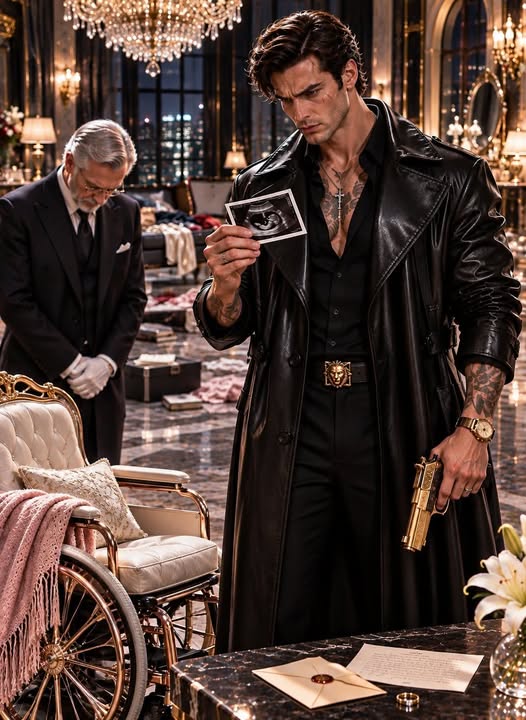
The hematoma shrank slowly, the way dangerous things retreat — grudgingly, on their own schedule. By the end of the second week the doctor used the word *resolving*, and scheduled me for a follow-up ultrasound at the clinic two blocks from Lena's building, close enough that I'd insisted on taking myself, chair and all, with the detail trailing at their professional distance like weather.
"You're a terrible protectee," Lena informed me, walking beside me anyway, because Lena's love language was refusing to leave. "Most women in hiding at least have the decency to be bored."
"I am bored. I'm bored out of my mind. If one more person tells me to rest, I'm going to—"
The arrangements, as Lena called them, arrived on a schedule so regular it could have been tide tables. Groceries I had not ordered, in brands I would have chosen, left at the clinic desk by a delivery service that did not exist in any directory. A doctor — Dr. Marsh, an obstetrician with a waiting list like a royal succession — who began, mysteriously, to hold a Thursday slot at the little clinic two blocks away, and who examined me with a respect for my privacy so total it could only have been purchased at a terrifying price. A new cushion for my chair, the exact model, in the exact firmness, appearing in Lena's storeroom with no card at all.
He never once came himself. That was the arrangement that undid me, slowly, the way water undoes stone. Adrian Vale, who could have parked an army in the clinic courtyard and called it Tuesday, had reduced himself to groceries and a good doctor and a cushion — to *care*, delivered at the exact distance I had demanded, with his name scrubbed off every box. I would sit in the courtyard with my tea and watch his men change shifts across the street, two shadows handing over to two shadows, and I would think: *he is showing me. This is what showing me looks like from a man who doesn't talk.*
It did not make me ready. But it made me honest, which in my experience is ready's older sister. On the morning of the follow-up ultrasound I did a thing I had not planned: I asked Marcus — who materialized at the courtyard gate with the air of a man who had merely been passing, every day, at tea time, for two weeks — whether his employer was sleeping.
"Ma'am," Marcus said, "the boss is sleeping the way Chicago is sleeping. Technically, and with one eye open. I'll tell him you asked."
"You'll tell him nothing," I said.
"Ma'am," said Marcus, with the ghost of something that on another man's face would have been a grin, "I already have."
The ultrasound tech printed four copies this time without being asked, because by now the whole clinic knew the shape of my story, if not its names. Seven weeks and six days. The flicker was a drumbeat now. I held the strip of photographs in the elevator going down and tried, experimentally, to think the words *our daughter* — the tech had said *girl, best guess, don't paint a room yet* — and the words fit, which frightened me more than the bleeding had.
The parking garage under the clinic was concrete, echoes, and one flickering tube of light. The detail's car was at the far ramp, engine on, exactly where professional weather stands. The man who stepped out from behind the pillar by the elevator bank was young, neat, and holding nothing at all, which was somehow the worst of it.
"Mrs. Vale." He said it pleasantly, like a valet. "There's a car waiting. Mr. Kade would like a conversation about your husband's shipping routes. It goes easier if—"
I don't remember deciding to shout. I remember the shout — Lena's name, the alarm word Adrian's world uses, anything — and then the garage became a place of terrible speed. The young man lunged for my chair's push handles, to wheel me like luggage; Lena, fifty-two years old and built entirely of conviction, went at him with her bag and her voice; the chair rocked hard against the curb stop and Marcus's hand arrived out of nowhere and clamped the frame, holding me upright by main strength, his other hand doing something I didn't see that made the young man's grip simply stop mattering.
And Adrian came out of the stairwell door at a dead run.
I had never seen him run. In six years of marriage I had seen him stride, advance, withdraw, and once — memorably — descend a staircase in a way that ended a negotiation, but I had never seen the most composed man in Chicago run flat-out with his coat flying, and I understood in that suspended second that I was watching what Adrian Vale looked like when the composure finally cost more than it bought.
The second man came from the far side of the pillar. I saw the gun the way you see things in dreams, in pieces: the hand, the metal, the angle — the angle that ended at me, because I was the leverage, I was the conversation Mr. Kade wanted to have. I heard myself say my baby's nonexistent name. I heard Lena scream.
Adrian didn't slow down. He crossed in front of my chair — deliberately, the way I'd crossed in front of a car six years ago on a wet pavement, with the same terrible clarity of decision — and the shot, when it came, took him high in the left side, spun him half around, and put him down on one knee with his hand pressed to the wound and his other hand reaching back, blind, until it found my chair's wheel and *held*.
"Gia." Blood was coming through his fingers with a steadiness I recognized from trauma bays and tried not to. "Gia, are you— look at me. Are you hit? Is the baby—"
"I am looking at you," I said, and my voice was doing something wild and broken, "you absolute idiot, I'm looking right at you—"
"Good," he said, with enormous satisfaction, as Marcus and the second guard finished the business of the garage in the efficient, awful way of men in their profession, and the young man with the pleasant valet voice discovered what the floor tasted like. "Good. Then we're even."
"*Even?*" Something in me went incandescent through the terror. "You think this is arithmetic? You think you just paid—"
"I think—" He was going gray at the edges, and still talking, the stubbornness of him like a structural feature. "I think I finally understand the pavement. Why you didn't hesitate. It isn't debt, woman. It isn't even choice. There just isn't a version where you're in front of me and I'm anywhere else."
"Check her first." It was the first order Adrian Vale gave from the concrete floor of that garage, with Marcus's jacket balled against his side and Marcus himself saying *sir* in the tone men use on the dying, and it was obeyed with the speed usually reserved for his angrier instructions. A paramedic — the first ambulance had come in hot behind the second guard's call — knelt by my chair and did the liturgy: pressure, pulse, the Doppler wand skating over my belly through the gel she'd warmed in her own fist, while the garage held its breath, and then — there, unmistakable, 158 and furious — the little drumbeat filled the concrete space and every armed man in it sagged by exactly one degree, like a field after wind. Adrian's eyes closed. His hand found my wheel again and held on with the last of the strength he was spending, and I heard him say, to no one, to the concrete, to God, whom he did not generally consult: "*There* she is."
Then the ambulance, and Lena's hand in mine all the way, and a trauma bay that received the most feared man in Chicago and processed him with the gorgeous indifference of medicine: *male, thirty-nine, GSW, left upper quadrant, through-and-through, missed everything that matters by a centimeter of mercy.* The bullet had gone in and out without kissing an organ. Surgery to clean it, a night of watching, and the surgeon — who had clearly been briefed by someone — said the words *he'll be fine* directly to me, and then, after a pause, *they both were extremely lucky,* and I knew she'd seen the ultrasound strip still crushed in my hand.
The hours between the garage and that waking had their own grim liturgy, most of which was performed on my behalf by people who refused to let me perform any of it. Detectives came and went with their careful questions; Marcus stood in every doorway like a change in the weather and the questions stayed careful. The young man with the valet voice, it emerged, had a phone, and the phone had a number, and the number had a cousin's name attached to it that made Marcus go quiet in a way I was learning to translate: *Rowan.* Celeste had sold the clinic's address out of the wreckage of her position, forty-eight hours before, for cash and spite. I received this news sitting in a family waiting room with a paper cup of water going warm in my hand, and I discovered that my feelings about Celeste Rowan had completed some final evolution: she had become, in my mind, simply a problem that had been solved by the wrong people in the wrong order — and the bill for the solving had come, as bills in that world always came, addressed to the person standing closest to me.
Lena, who had thrown her bag and her whole body into that garage, sat beside me with a butterfly bandage on her forehead and her arm around my shoulders and said, "When you write your memoirs, nurse, I want it noted that I fought a gunman with a handbag."
"A *gunman*, Lena. You fought a gunman with a handbag and a fifty-two-year-old's opinions."
"And I was winning," Lena said, "on points."
He woke at 3 a.m. in a private room with his side stitched and his empire standing in the corridor in the shape of Marcus, and I was there because there had never, at any point in that entire day, been an actual decision to make about where I would be.
"Tell me the baby's all right," were his first words.
"One hundred fifty-eight beats a minute," I said. "She's furious at the noise. Like her father."
"*She.*"
"Best guess," I said. "Don't paint a room yet." And then, because he was looking at me with six years in his face and a hole in his side that I had, in every way that mattered, put there by leaving — and because he had put himself in front of a bullet the way I once put myself in front of a car, without arithmetic, without hesitation — I took his hand off the blanket and held it with both of mine, and I said the truest thing I owned:
"When you get out of this bed, Adrian Vale, you and I are going to talk about the stillness. About Celeste in our house, and the audit, and what happens to her. About your doors being open and your sentences being finished in front of me from now on. About all of it. Slowly. Like adults. Like a marriage."
"A marriage," he repeated, hoarse.
"But the arithmetic is finished," I said. "There's no ledger. There was never a ledger. I didn't save a stranger's life so he'd owe me a wedding, and you didn't take that bullet so I'd owe you a return. We're just two people who keep stepping in front of things for each other. The only question left is whether we can learn to stand *next* to each other instead." I squeezed his hand. "That's the work. If you want it."
His eyes were wet. Adrian Vale, in a hospital bed, with half of Chicago's law enforcement quietly terrified to interview him in the morning, wept without bothering to hide it, and said: "Name the terms. Whatever they are. Name them and watch me sign."
"The first term is that you stop bleeding on my account."
"Done," he said instantly. "Marcus, tell the surgeons the terms are accepted."
And from the corridor came Marcus's voice, dry as a martini: "Sir, the surgeons have requested you stop giving orders through the wall."