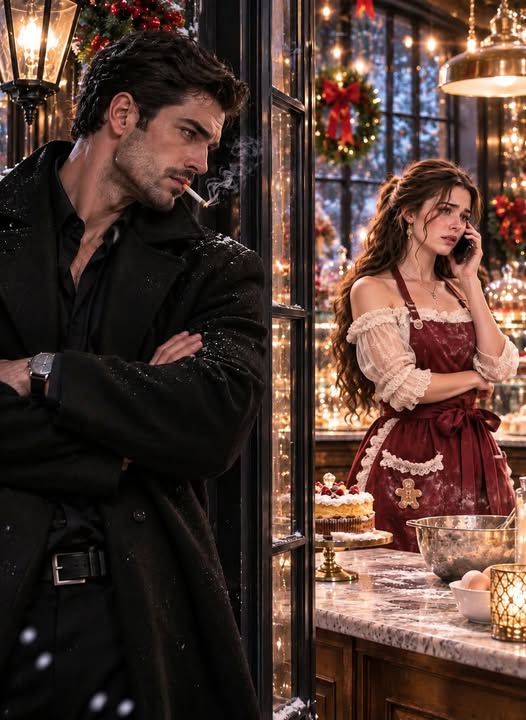
"The police are aware he is out," Nico said, in the voice he used for weather reports and executions. "He is a thief with a court date, Clara, not a ghost. Marco will drive you home. A man will be on your street tonight — you won't see him, and you don't need to. Go home. Sleep. Tomorrow the bakery serves Christmas breakfast to whoever knocks, the way it has for forty years. I would not have that tradition interrupted by Julian Cross."
I wanted to argue. But Ana's mother was waiting to take her home, and my mother was still sitting in the borrowed chair eating a second slice of her own tart with the expression of a woman solving an equation, and exhaustion had begun to hum in my bones like a struck bell.
So I went home. I slept, eventually, in the strange new quiet of a life that had changed shape in thirty hours.
I dreamed about the notebook. Three pages, tearing.
Christmas morning I was at the bakery by seven, and Maya by seven-fifteen, and by eight the windows were fogged and the line of regulars and strangers and one very apologetic Paige — who had shown up with Grant, both of them in aprons, demanding to be put to work — stretched to the corner. Grant Holloway washed dishes for three hours and was, I discovered, almost likable when stripped of his mother's lighting. Paige burned one tray of rolls and cried over it and then laughed, and it was the first time we'd laughed together since we were children.
But before the rush — in the blue, early quiet, with the first trays in the ovens and Maya still tying her shoes — I did something I had never done in three years. I went into the tasting room.
I told myself I was checking the radiators. The truth is that I wanted to see the place where he had sat, all those Fridays, six feet and one curtain away from my whole life. It was smaller than I'd imagined. One round table. Two chairs. A lamp with a green glass shade, like a banker's lamp in a film. On the sideboard, a single espresso cup on a saucer, washed and set upside down to dry — yesterday's, or the sixteenth Friday's; the staff knew better than to clear Mr. Vale's table. Brenda had made that a rule with real fear in it, and now I finally understood the fear and the rule both.
I stood in that little room and I tried to see my bakery the way he'd seen it: through the gap where the curtain didn't quite meet the wall. You could see the counter from there. You could see the window, and the ovens' glow when the doors opened. You could hear everything — the bell, the radio, Maya laughing, me singing, off-key, to songs about silver bells. Sixteen Fridays he'd sat in that chair and listened to a life he wasn't in, and chosen, week after week, to stay behind the curtain rather than risk darkening it.
The chair was pulled out slightly, the way you leave a chair when you mean to come back to it.
I left it exactly as it was. Some things you don't tidy. Some things are a message, and the message was: he had always intended to come back.
Then the ovens dinged, and Maya called my name, and Christmas morning began in earnest.
Nico arrived at ten with a box under his arm.
He waited until the rush thinned, until it was just the two of us and the smell of cinnamon, and then he set the box on the counter and opened it. Inside, on a bed of tissue, sat a plum pastry — small, burnished, perfect, identical to the one he ordered every Friday.
"You made this?" I said.
"God, no." He looked genuinely alarmed, and it startled a laugh out of me. "I have many skills, Clara. Pastry is a form of honesty I have never mastered. No — I had it made by a bakery in the North End that has tried for thirty years to get this right. I want you to tell me if they are close."
I tasted it. It was good. It was not the same.
"Close," I said. "Too much sugar. The plums should be sour first — the sweetness should arrive late, like it's apologizing." I stopped. "Why does this matter so much? Sixteen Fridays, Mr. Vale. Espresso and a plum pastry. A man like you could have a chef flown in."
He was quiet for a long moment, looking at the little pastry like it was a photograph of someone dead.
"My grandmother," he said at last, "came from a village you have never heard of, with nothing. She baked a plum pastry every Christmas of my childhood — sour plums, hard years, that taste. She died when I was nineteen, and the recipe died with her, because boys like me do not write things down." His mouth twisted. "I have eaten in the finest restaurants on four continents, looking for that taste without admitting I was looking. Three years ago, my work brought me to Boston. Sixteen weeks ago, I walked past this bakery and smelled the ovens." He looked up at me. "Yours was the closest. Not perfect. But close enough that I came back on Friday. And then — I kept coming back on Fridays."
"She sounds formidable," I said, because my throat had closed around anything larger.
"She fed eleven people at her first Christmas in this country, in a hall she borrowed from a church that didn't share her language, because a notice at the shelter said no one should eat alone on that day and she considered the notice addressed to her personally." Something moved in his face that might, in a less guarded man, have been a smile. "The foundation was her idea. The money became mine; the obligation stayed hers. Every Vale since has understood: the fortune is hers, held in trust, and Christmas is when the accounts are audited." He turned the little pastry a quarter-turn on its plate, precisely, the way he did everything. "You asked why you, yesterday. Why I stepped out. Clara — a man can sit behind a curtain for a pastry. He can sit there for the ghost of his grandmother. But I stepped out because a woman was being thrown into a storm by thieves, in my bakery, in front of my grandmother's portrait — metaphorically speaking — on the one week of the year my family is forbidden to look away." He paused. "Also because it was you. The order of those reasons is a matter I am still considering."
"The investigation," I said slowly. "The purchase. That came later, didn't it? You were coming here before you ever bought this place."
"I bought the bakery," Nico said, "because the chain's owners planned to sell the building to developers in January. The shop would have been gutted. Your ovens — scrapped. And then my auditors found the inventory discrepancies in the due diligence, and the investigation began, and I—" He paused, and this man who never paused searched for the honest sentence the way other men search for exits. "I found that the purchase had two purposes, and I had only admitted to one of them. A man in my position does not sit in a curtained room for sixteen Fridays for a pastry, Clara. He does it because at four o'clock on Fridays, a woman with flour on her cheek sings to the radio and gives the burnt loaves to a homeless man and writes 'staff meal' in the log so no one will make her stop."
The bakery was very quiet. Somewhere out front, Maya was explaining to a customer, with great authority, that we were absolutely a five-generation bakery now.
"You should have said something," I managed. "Sixteen weeks. You never said one word to me."
"What should I have said?" He spread his hands — those still, careful hands. "'Good evening, I am the man from behind the curtain, I have memorized your shifts?' In my world, Clara, attention from me is not a gift. It is a risk I place on a person's door. Men have tried to reach me through people I— through people near me." His jaw set. "So I watched the door instead. I made sure the delivery trucks came on time. I had Marco learn the names of the men who walk your route home. I told myself it was strategy." A breath. "It was not strategy."
My phone buzzed on the counter and shattered the moment like a dropped plate.
Unknown number. Four words.
You took everything. Christmas isn't over.
Under it, a photograph. My building. My street, my windows, taken from across the road — recently, because the snow on the sill was fresh.
Maya found me standing very still with the phone in my hand, and by the time she'd read it over my shoulder, Nico was already on his feet with his own phone at his ear, and his voice had gone somewhere arctic.
"Marco. The South Boston address. Now. And call the detective — Julian Cross has decided to make this simple for everyone." He ended the call and looked at me, and if I had ever doubted what the papers meant when they called him feared, I stopped doubting at the look on his face. "Clara. You will stay where my people can see you. That is not a request I will negotiate."
"My home," I said. "He's at my home, Nico. Mrs. Abernathy on the first floor is eighty-six, she feeds everyone's cats, if he goes into that building—"
"Marco is four minutes away and the police are three. Julian is a coward who sends photographs. He is not in your apartment, Clara; he is across the street in the cold, congratulating himself." Nico came around the counter and — deliberately, giving me every second to step back, which I did not do — took my cold hands in his warm ones. "Listen to me. This is the part of my life I kept behind the curtain. It is not a kind world, and it does not forgive debts. But you are not in it alone anymore. That is the entire sentence. You are not in it alone."
The police found Julian's rental car empty two streets from my building, engine warm. They did not find Julian.
Marco doubled the watch, the detective used words like "escalation" and "pattern," and Nico — over my loud objections, in front of two officers and my entire staff — cancelled nothing.
"The breakfast ends at noon," he said. "Then the bakery closes for two days, and Clara Bennett goes nowhere that is not lit, staffed, and known to me." He turned to me and, in front of everyone, gentled his voice by that fraction again. "You wished for one person who would notice if your chair was empty. I am establishing protocols, Clara. That is how I notice."
I should have been frightened that night, alone in my apartment with a guard in the street and a madman unaccounted for. And I was — but underneath the fear, like a pilot light, burned the strangest, steadiest warmth I had ever felt.
Somebody had noticed my chair.
I took a shower and stood in the steam until the water ran cold, washing other people's flour out of my hair, and when I came out my phone was lit with a message from Paige — a photograph, sent at midnight, of my mother's kitchen table back home. The tart I'd baked sat at its center, cut, with one slice gone, and beside it, folded with terrible care, was a pair of reindeer pajamas in my size. My little sister had driven them back from the house and laid them on the table where I would have sat, like a place setting for a ghost she refused to accept.
Under the photograph: *She ate a slice standing up in the kitchen, Clara. In her coat. I think she's in there feeling it. Don't give up on her.*
I didn't answer right away. I sat on the edge of my bed in my small, lamplit apartment, with a guard in the street below and a city hunting my ex-boyfriend on my behalf, and I looked at that empty chair my sister had set for me — and understood that noticing, once it starts, spreads.
Somebody had noticed my chair.
Somebody had been noticing it for sixteen Fridays.