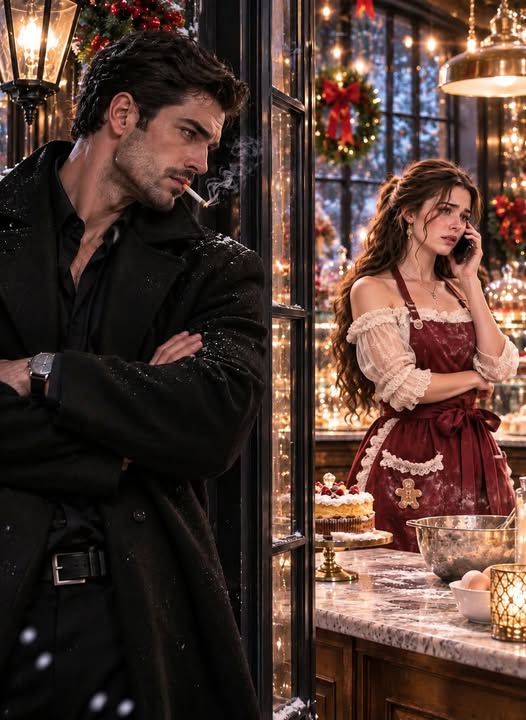
Julian Cross confessed to most of it before his lawyer arrived, which the detective described to me — visiting the hospital with terrible coffee and evident satisfaction — as "the smoke talking." Arson. Breaking and entering. Three years of theft, with Brenda Mercer as his partner and, it turned out, his predecessor — she'd been skimming Winter & Rye since long before Julian learned where the stockroom was, and she had already retained a lawyer of her own and a great deal of sudden, total recall about Julian. They would both plead. They would both serve time. The recovered money — the bakery's money, some of it — would come back through the courts like a slow river.
My $4,800 was in my account before New Year's. Nico's attorneys sent it with a note so dry it made me laugh in my hospital bed: Debt recovered in full. Plum pastry obligation: outstanding.
The bakery was another matter. Fire is a thorough editor. The kitchen was gutted; the shop floor survived under an inch of soot; the ovens — my ovens — were pronounced salvageable by a man Nico flew in from Chicago who spoke about cast iron the way priests speak about relics.
Insurance would take months. So Nico didn't wait for insurance.
On the twenty-seventh, against medical advice I pretended was a suggestion, Nico took me back to see it. He went with me the way you accompany someone to a grave — beside, not in front — and he held the ruined door for me and said nothing at all while I stood in my own shop and cried at the smell of it. Char and sugar. My village cake still in its case, gray as a photograph of itself. The tree black on one side and green on the other, like a year half-lived.
"Don't look at all of it," Nico said at last. "Look at one true thing."
So I looked at the ovens. They stood in the gutted kitchen like two old soldiers, soot-blackened, doors hanging — and when I put my good hand on the nearest one it was still, faintly, warm from the sun through the broken window, and I understood they were iron and iron survives, and so did I. Then Karl came out of the office carrying the metal cash box we'd kept under the counter since before I was born at that job, warped and smoke-stained — and inside it, untouched, was the reservation book. Three years of Fridays in Brenda's hand and mine. Vale. Vale. Vale. Sixteen entries, then a seventeenth I had never seen — written in a hand I knew by now, dated Christmas Eve, one word longer than all the others:
Vale — and guest.
"He made a reservation," I said, "for the night he fed two hundred people. He booked a table at a dinner he was hosting."
"He also paid for it," Marco said from the doorway, deadpan, carrying a crate of salvaged jars. "Full price. The foundation audited him. He argued about the oranges."
I laughed, standing in the ashes of my kitchen, with tears running through the soot on my face, and Nico took the reservation book from Karl and put it in my good hand like a deed.
"One true thing," he said. "Start there. We will rebuild the rest around it."
I was discharged on the twenty-eighth with a bandaged hand and strict instructions, and by the time Marco drove me past Winter & Rye that evening, there were already work lights in the windows and a crew I'd never seen working in the snow-dusted dark like it was noon. A hand-painted sign hung in the blackened window, in Maya's unmistakable lettering:
BURNT. NOT CLOSED. SEE YOU NEW YEAR'S DAY.
The staff came back before they were asked to. That is the part I tell people now, when they ask what kind of place Winter & Rye is. Luis arrived with his brother and two buckets. The dishwashers arrived. Old Mr. Abernathy arrived with a shop vacuum and his late wife's recipe box "for morale." Maya held a meeting on the sidewalk — in the snow, with a clipboard, because some part of Brenda's training had apparently been useful to someone — and assigned shifts for the cleanup like a general with glitter on her boots. Every one of them refused overtime pay for the rebuilding days, in writing, with signatures, which Nico accepted with a bow and then secretly doubled in their January checks, because the Vales and the Bennetts are apparently in an arms race of stubborn generosity and I am doomed to live between them forever.
I supervised from a stool with my bandaged hand in my lap, and handed out coffee with the other, and watched my people sweep my bakery out of its own ashes, and I understood something about the tart and the pajamas and the chair that I had never understood in Lorraine Bennett's dining room: a family is not the people who photograph you. It is the people who show up with buckets.
"You'll bankrupt yourself," I said to Nico, standing on the sidewalk with my coat over my shoulders and my heart somewhere in my throat. "Crews around the clock. In a blizzard. For a bakery."
"I have been bankrupt," Nico said, watching a man carry out a charred shelf, "in every way that matters, for about twenty years. Money was the one currency I had too much of." He turned to me. "Besides. It isn't a bakery, according to my grandmother's standard. It is a place where people are fed at Christmas whether or not they can pay. Those are load-bearing walls, Clara. I am simply maintaining the structure."
Paige came that night to my apartment with soup she'd made herself — badly; it was wonderful — and sat on my couch and cried in the un-elegant, mascara-running way she had never once allowed herself in front of Vivian Holloway.
"Grant confronted his mother," she said. "At the dinner. After you— after Mr. Vale— Grant stood up in front of everyone and told her that if the engagement announcement required my sister to be erased, she could announce his resignation from the family instead." She wiped her face with her sleeve, completely unphotogenic, and I loved her more in that moment than I had since we were nine. "The engagement's not off. It's— postponed, while Grant and his mother renegotiate what kind of family they are. He asked me to tell you he's sorry he ever let you be talked about that way in a room he was sitting in. And Clara— I let it happen for years. At every table. I was so afraid of being the one moved out of the photograph that I held the camera." She took my good hand. "Never again. If there's no chair for you, there's no chair for me. That's the whole negotiation."
My mother came on the thirtieth.
She stood in my little kitchen in her good coat with a tin in her hands — almond tart, her own making, from my grandmother's recipe. Lorraine Bennett had not baked, to my knowledge, since I was twelve years old. The tart was slightly lopsided. It was the most beautiful thing she had ever given me.
"I am not good at this," she said, in the doorway, not sitting down. "Your father used to say I could arrange a table for forty and not see a single person at it." She set the tin down like an offering. "I saw you, Clara, on Christmas Eve. In that room. With that man looking at the Holloway woman like— and the children, and the cake, and you said no to me. You said no, and the room stayed standing, and I understood—" She stopped. Her hands were twisting. I'd never seen my mother's hands do anything unplanned. "I understood that I had been making you smaller to keep my own chair comfortable. A mother should be the one who notices. I made myself the one who looked away." A long breath. "I am not asking you to forgive me tonight. I am asking whether I may come on New Year's Day. To the bakery. If there is a chair."
I should tell you I was gracious and wise. In fact I cried into my mother's shoulder like I was six years old, and she held me the way she must have before I got tall enough to measure, and the tart was dry on one side and perfect on the other.
"There's a chair," I told her. "There's been a chair the whole time, Mom. You just have to sit in the room I'm actually in."
Which left one negotiation, and it was waiting for me on New Year's Eve morning in the bakery office — new drywall, new desk, smell of paint and cinnamon — in a folder with my name on it, in Nico's handwriting.
"Partnership papers," he said. "Fifty-one percent of Winter & Rye, transferred to Clara Bennett, effective tomorrow. Before you argue—"
"No." I closed the folder. "No, Nico. I won't be given a bakery. That's just another kind of chair somebody can pull out. I'll buy in — from my salary, from the recovered money, over time, at a real price with real paperwork. I want it to be mine because I earned it in the open. That's the entire— that's everything. Don't you see?"
He looked at me for a long moment. Then the glacier did something it had never done in my presence: Nico Vale smiled, fully, like a man whose test has been passed by the only examiner he respects.
"My attorneys predicted you'd say that. Word for word, in Marco's case." He took a pen from his pocket and struck a clause with one line. "Then: manager's salary, doubled, backdated. A purchase plan at the independent valuation, payments from your share of profits, interest-free because I am not a bank and I dislike the comparison. Five years to full ownership of the fifty-one percent, Clara, and in the meantime a partner's vote from day one — that part is not for sale, because the shop already runs on your judgment and I am tired of pretending otherwise." He slid the folder back. "Sign, partner."
I signed with my good hand, the bandaged one resting on the desk between us like a witness.
"And now the other matter," Nico said, in a tone so carefully neutral that my heart immediately began to pound. "I am aware that I am your employer, your partner, your creditor in plum pastries, and — according to three newspapers — a figure of significant public concern. Courtship, in such circumstances, requires more transparency than is customary." He folded his hands. "So, transparently: when the partnership is settled and the shop is open and Julian Cross is a memory this city is done with, I would like to take you to dinner. Somewhere with no curtain. I would like to sit across a table from you in the light, and be looked at by you while I eat, and answer every question you have, including the ones about my other business. If the answer to any of them makes you leave, I will have Marco drive you home and I will never darken your Fridays again." His gray eyes held mine, steady as a held breath. "But I don't think you'll leave."
"No," I said, and my smile hurt my face. "I don't think I will either. Dinner, Nico. When the shop opens."
"Then we have two deadlines," he said, rising, and offering me his hand to shake like a partner, which I took, and which neither of us let go of for slightly longer than partnership required. "New Year's Day. And dinner."
Outside, Boston was doing its last day of the year under a sky like polished steel, and the work lights burned in my bakery windows, and Maya was painting a new sign in the glass with her tongue between her teeth in concentration.
SEE YOU TOMORROW, it said. EVERYONE.