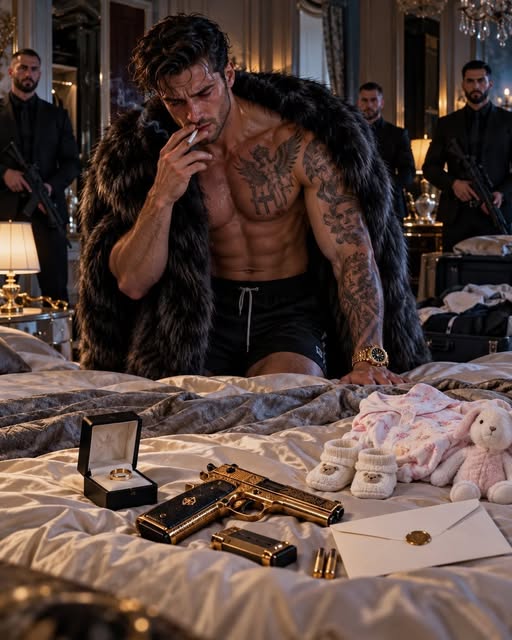
I stayed in Greyhook for eleven weeks, and it remains the only honest education I have ever had.
I took the inn's back room by the month. I learned the tides. I learned that Tomaszek's bakery opened at five and that Emily liked the end pieces of the rye, a fact about my wife of thirteen years that I learned in exile, from a baker, at the age of forty-three, and wrote down in my notebook with the reverence of a man copying scripture. I drove her to the midwife on Tuesdays and waited in the car until the Tuesday she came out, looked at me deciding something, and said, "You can come in. She wants to hear the heartbeat with you in the room, apparently. She kicks less when you're talking. The midwife has theories."
I heard my daughter's heart through a little speaker in a warm room, fast and stubborn as a drum in a parade, and I wept without ceremony in front of a midwife named Ruth who handed me a tissue and said, "They all do. The dangerous ones do it quietest."
I did not ask to move into the cottage. On the twenty-third day, Emily's back seized while she was reaching for a high shelf, and she stood gripping the counter with her face white, and I made soup — badly, a man's soup, too much salt — and she ate it sitting in the doorway of the spare room because the chair hurt less, and when she'd finished she said, "The spare room is for the baby's things, but the baby's things are currently one crib and a great many opinions. Sleep there if you want. For her sake. That's what I'll tell myself." I slept in my wife's spare room for nine weeks, on a camp bed, ten feet and fourteen months away from her, and I have slept in penthouses on four continents and never once rested the way I rested there, listening to her move around her own kitchen in the mornings, alive, unghosted, choosing hourly not to send me away.
We named the lost one. That was her doing, in the sixth week, on the shore path, at the turn of the point where the wind had first shown me the truth. She stopped and she said, "He needs his name said out loud by his father. Not in your notebook. Out loud, where the water can hear it." So I said it — Jonah, the name she had written in the margin of a nursery catalog eleven weeks into a pregnancy I never knew about — I said "Jonah Carter" to the Atlantic Ocean and the gulls and my wife, and I said what a man says, which was nothing organized, and she held my sleeve, not my hand, and that was the exact measure of where we were, and I was grateful for the sleeve as I have never been grateful for anything I owned.
Then, in the ninth week, the Blakes came to Greyhook.
Two men, in a car too clean for the town, asking at the diner after "the woman in the Halloran cottage" with the lazy confidence of men who have never been refused information by anyone they couldn't buy. Mrs. Abernathy telephoned the cottage before they'd finished their coffee — Greyhook had decided about Emily, and then, provisionally, about me — and I walked down Salt Lane and met them on the harbor road with Marcus, who had arrived in town three days earlier with two suitcases and the air of a man on holiday, and who had not, in fact, taken a single day off.
What I did with those men is the part of this story I most need told correctly, because the old Ethan Carter had a liturgy for such moments and every man on the East Coast knew its verses. I did not hurt them. I showed them a recording — Madison's own voice, from the penthouse, saying her father's name beside the word asset — and I told them to carry one sentence home to Victor Blake, verbatim, the way you carry a live coal: "The child is not a bargaining chip, she is not an alliance, she is not weather inside my house to be reported. She is a citizen of a town you cannot find twice. Come again and I will not send you home with a sentence. I will send the sentence to every family at your table, with your daughter's voice attached."
They left. Men like that are actuaries at heart; they had come to price a rumor and they left owning a liability. That night Emily stood in the cottage doorway watching the road a long time after it was empty, and she said, "You could have disappeared them. The harbor's deep. In the old days you'd have at least considered the harbor."
"In the old days I considered a great many things that cost me you."
"You let them go home to tell him."
"I let them go home to work for me. Fear that travels is cheaper than fear that stays, and it doesn't wake the baby." I said it lightly, and she looked at me then the way she had looked at me across our own table a decade before, in the good years, when a thing I said had pleased her against her expectations — and she laughed, out loud, one startled note, the first time I had heard it since before the fourteen months began. I would have burned another alliance for that sound. I believe she knew it. I believe that was why she laughed where I could hear.
In the eighth week, my lawyer came to Greyhook — a discreet man named Okafor who had papered over half my life and had never once asked me a personal question, which is why what happened at the inn's dining table rattled him so visibly. I was signing the Bayonne dock trusts into their new structure — the one with rules, and other men's names, and my signature demoted from a verdict to an opinion — and Emily was at the next table with her tea and her mending, not watching, the way you don't watch weather. Okafor slid the last page across and said, in the voice of a man checking a parachute, "You understand, Mr. Carter, that this is irrevocable. Once the trust is sealed, you cannot simply take the docks back on a bad night."
"I understand," I said, and signed.
"My father," Okafor said suddenly, surprising us both, "was in your line of work. Not your level. He never signed anything in his life that he couldn't unsign by morning. It's why we buried him with police at the gate." He gathered the pages with unusual gentleness. "I'll file them today."
When he'd gone, Emily said, to her mending, "You didn't look sick signing that. I expected you to look sick."
"I did look sick. For three months. In advance, in a kitchen in the city, over fourteen pages." I turned my cup in its saucer. "Signing's just the paperwork, Emily. You taught me that too. You said she just did the paperwork."
"I did say that." The needle went in and out. "I was very quotable, that whole letter. Grief makes poets of us all. Don't let it go to your head that you were worth fourteen pages, Ethan. Most of them were grocery lists for a life without you." But she said it with the ghost of the old dry humor, the one from the good years, and I took it like communion.
By the tenth week I had a shift at Tomaszek's bakery — unpaid, unadvertised, and understood by the entire town to be a penance with an apron. I could not bake. I could, it turned out, carry flour, mop, charm grandmothers, and stand at a counter at five in the morning being harmless in public, which in Greyhook was a sacrament in itself. Tomaszek watched me mislabel the rye three days running and said, "In Gdansk, my father had a saying: a man proves love by what he is willing to be bad at, in front of witnesses, for a long time." He corrected the labels. "You are proving very much love, Ethan. You are terrible at this."
It was in that same week that she asked me the question I had been dreading since the porch, on the shore path, at the turn, with the wind worrying her shawl. "When she's old enough," Emily said, "what do we tell her about Jonah?"
I had my answer ready, because I had rehearsed it the way I used to rehearse negotiations, and it was worthless in my mouth before it reached the air: something clean, something with edges, a version where the story had a shape a father could survive being the villain of. She listened to all of it with her head tilted, and when I had finished she said, "No. We tell her the truth in the order it happened, at the speed she can carry it. She had a brother. He died before he was born, the same night her father made the worst mistake of his life. Both of those are facts, Ethan, and she gets both of them or she gets neither of us." She took my sleeve against the wind. "Secrets are this family's original sin. You kept Madison in one pocket and me in the other and called it a life. I kept a living child behind a recording and called it protection. We're done. She grows up in a house where the worst thing in the world can be said at the table. That's the whole inheritance. The rest is just money, and she can earn her own."
"She'll think less of me," I said.
"She'll think accurately of you. It's a much better gift. I should know — I spent fourteen years thinking inaccurately of you, in both directions." And then, because she was Emily and mercy in her was always administered like medicine, precisely dosed: "She'll also know her father drove through a war and a winter to stand on this path and be told no by her mother for eleven weeks without once raising his voice. That's in the record too. I keep the whole record, Ethan. That's what the pages were. That's what the pages are for."
I wrote it down that night with my hand shaking for a reason that had nothing to do with fear. The whole record. In the old house we had kept two sets of books, like any criminal enterprise. In the cottage, in the spare room, on a camp bed, I was learning to keep one.
There was a storm in the tenth week that took the inn's roof from tired to theatrical, and at midnight, with the lane to Salt Lane running like a creek and my ceiling dripping into a saucepan in four-part harmony, Emily appeared in my doorway in her coat over her nightdress, holding a lantern, furious at the weather and at herself. "You'll catch your death and she'll ask where her father is and I'll have to say a roof. Get your coat. The cottage is dry and the spare room has walls, which is more than this place can currently say." I slept that night in her spare room listening to the storm spend itself on her roof, and at some hour near the old hour — 2:47, I checked, because I always check now; it is my rosary — I heard her moving in the kitchen, and I came out, and we drank tea in the dark while the rain walked on the roof, and she told me about the due date calculations, and the names she had tried and discarded for our daughter like dresses, and the one she kept returning to. "Hope is a lot to put on a person," she said. "It's either a blessing or a job description."
"Give her the job," I said. "She's had it since the womb. She's the only one of us who never once stopped."
Emily looked at me across the dark table for a long moment, and then she did something she had not done since the porch, since the kick: she reached across, deliberately, and covered my hand with hers, and left it there while the tea went cold. "There," she said, as if completing a repair. "That's practice too."
In the eleventh week there was a night of false labor — hours of it, Ruth's hands calm, the little clinic's lights humming — and I held Emily's hand through the whole counterfeit storm while she crushed my fingers with a strength that explained our daughter entirely, and said through her teeth, "If this is practice, Ethan, she's dramatic. She gets that from you." And when it passed and the room went quiet, she did not let go of my hand. Not that night. Not, as it turned out, on any night after, though it took her until the last page of this story to say why.