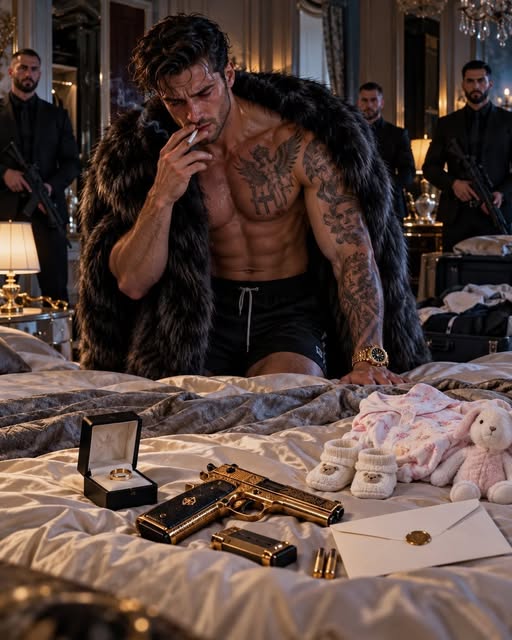
I waited one more day, and I will tell you why, because it matters to me that it be understood: I waited because Emily had written "Don't look for me," and I had spent three months learning — at the cost of a war, a fortune, and every illusion I owned — that her sentences were not obstacles to my will. They were the whole of the law. On the second evening I walked down Salt Lane at dusk, past the marigolds, and I knocked on the cottage door with nothing in my hands. No flowers. No men. No empire. It was the first time in twenty years I had knocked on a door I couldn't have had taken off its hinges.
She opened it wearing an apron over her dress, with flour on one wrist, and she looked at me for a long moment with an expression I had never seen on her in thirteen years of marriage — not fear, not fury. Assessment. The way you look at weather coming over water.
"You found me," she said.
"Simmons took a photograph. Three weeks before you left. I found the photograph, not you. You were never careless, Emily. He was."
"Marcus would have kept the drive secret to his grave."
"Marcus kept it until it was the only door left, and then he opened it because he loves you more than he fears me. He was right to. About both halves of that."
She stood aside. It was not forgiveness. It was not even welcome. It was the courtesy of a woman who had decided, sometime before I knocked, exactly what she would do if this moment came — and I understood, stepping past her into the warm lamplight of that little house, that Emily Carter had rehearsed this too. That I was the only person in the story who had ever once improvised.
The cottage was one room deep and full of her: books spine-out in a crate, a kettle, a narrow bed — and against the far wall, a crib. Secondhand, sanded and repainted a soft white, with a mobile of paper stars above it that turned slowly in the heat from the stove. I looked at that crib for a long time. I want it recorded that I did not reach for her, or fall, or speak. I looked at the crib my wife had rebuilt with her own hands in exile, for a child I had not known existed, and I did the hardest arithmetic of my life standing still.
"Sit down, Ethan," she said. "You look like the porch is holding you up."
She made tea. Her hands were steady — they had always been steadier than mine — and she set a cup in front of me and sat across the little table with her own, and her hand went, unconsciously or by long habit, to rest low against the swell of her, and she told me all of it. Not cruelly. That is the thing I cannot make people understand: there was no cruelty in her anywhere, and it was the cruelest hour of my life.
"They were twins," she said. "A boy and a girl. I found out at nine weeks, alone, in Dr. Patel's office, because you were in Chicago closing the Meridian deal — do you remember the Meridian deal, Ethan? You sent me a photograph of the skyline. I sat in that office with the ultrasound wand still cold on my skin and two heartbeats on a screen, and I composed fourteen different ways to tell you, and every single one of them started with you putting your phone down. That week you put Madison's name in your calendar under a client's. I know because I did your laundry. I decided to wait until I could tell you in person, in our kitchen, on a night you were actually in it. I was still waiting, three weeks later, when the bleeding started."
"The letter said—"
"The letter told you what you had earned knowing that night. The boy—" Her voice went, for the first time, and she stopped, and breathed, and took it back like a professional. "The boy's heart stopped sometime before the hospital. They think it may have been failing for days. The girl's didn't. Dr. Patel turned the screen toward me at three in the morning and said, 'Mrs. Carter, I need you to look. One of them is still fighting. Do you see that flicker? That is your daughter, and she is still fighting.' And I lay there with one child dead inside me and one child alive inside me, and I understood that I had exactly one job left in the world, and it wasn't being your wife."
"The Blakes," I said. "If they'd known — an heir, a pregnancy, in the middle of their alliance games—"
"Now you see it." For the first time, something like the old Emily crossed her face — the woman who had washed blood off a nineteen-year-old's hands and made him a king's education out of common sense. "Madison's father collects leverage the way other men collect art. A Carter heir, Ethan, born to a wife you'd already discarded in every way but law? He'd have had us both in a frame by Christmas. And you—" she said it without heat, which is how I knew it was the truest thing she'd said — "you laughed. That night at the beach house, Simmons was driving you, and your voice carried, and it got back to me the way everything in our house got back to me, eventually, through the walls. 'Emily knows her place. She'll never leave.' I was eleven weeks past losing our son and seven months from delivering our daughter, standing in my own kitchen in the dark, and I thought: he is right about one thing. The Emily who knew her place will never leave. So I had to stop being her."
The room was very quiet. The paper stars turned above the crib.
"Why didn't you tell me she lived?" I said. "In the recording. You said — 'there's something else you never knew about our baby.' You let me bury two children for three months, Emily."
"Yes," she said. "I did. I let you grieve the way I grieved — without anyone to call. It is the only cruel thing I have ever done to you on purpose, and I won't pretend it wasn't on purpose. You needed to choose us without knowing there was anything left to win. If you'd come looking for an heir, Ethan, you'd have found a cottage and a closed door. I had to know whether the man who came was coming for the baby or for me." Her eyes were wet and utterly unsparing. "So. Which man came?"
I have answered questions at gunpoint with more certainty and less truth. I put both my hands flat on her table, where she could see them, the way you show a frightened animal you are unarmed.
"The man who came," I said, "burned his peace and half his fortune before he knew there was a child to come for. Ask the Blakes. Ask anyone. I declared war on the second-richest table on the East Coast for a woman who'd left me a letter telling me not to look for her, because looking for her was the first order you'd ever given me that I intended to disobey — because it was the last one I ever will. Emily. I am not here for an heir. Empires I can replace. I have proof — I'm drowning in proof. I came for the woman who ironed a coat with another woman's receipt in the pocket. I'm here to spend however long it takes learning to be called back into your life, at whatever distance you set, on whatever terms. Hers—" my voice broke then, finally, in front of the crib — "hers too. If I'm permitted. When I'm permitted. If I'm ever permitted."
"Wait," she said. "If you're going to stay for tea, you stay for all of it. That's the rule of this house. Nobody gets the edited version here. You taught me what the edited version costs."
She went to the crate of books and took from between two of them a flat envelope, worn at the corners from being handled, and she put on the table in front of me a photograph — grainy, black and silver, the size of a playing card. An ultrasound image. I have negotiated with men while guns were being cleaned in the next room and my hands have never once betrayed me, but they betrayed me then, openly, and I had to lay the photograph flat and look at it through the trembling like weather.
Two shapes. Two small curved moons in the dark of her, side by side, and beside each, in the technician's neat printing, a flicker marked and measured. I could see — even I could see, who knew nothing, who had been told nothing — that there were two of everything in that picture. Two countries. Two citizens.
"That was nine weeks," Emily said. "Both hearts going like horses. I carried that picture in my coat for a year, Ethan. Through the hospital. Through the pharmacy — yes, I know about Simmons's photograph, Marcus told me what you'd found, and I'll tell you what you were looking at, since you never asked: the second box the pharmacist set down was vitamins. For her. I was smiling in that window because I'd just heard her heartbeat on a Tuesday morning in a town where nobody knew my name, and she was still there, still fighting, and for one minute the grief stepped back from the glass. That smile cost me everything I had left that day. I'm glad it's the one you found. It balances the bracelet."
"I don't know how to hold both of them," I said. "The one I lost and the one I didn't. Every time I reach for the joy it feels like a betrayal of him, and every time I sit with him it feels like I'm failing her before she's even—" I stopped. It was the most honest sentence I had produced in forty-three years and it had no ending.
"Yes," Emily said. "That's the job. That's the whole job, and nobody gets to be finished with it, and you don't get to hand your half to me. I carried your half for a year. My arms are tired, Ethan." She said it without self-pity, the way a person states the weather in a country they've survived. "So here are my terms, since you've come all this way to hear terms. No men of yours in this town — Marcus can stay, Marcus is family, the rest go home. No guns past the town line, not even yours, especially yours. Your telephone stays on and it stays answered, by you, on the first ring if it's me — I don't care if you're in a room with God. And you don't lie to me again, including the kind of lie where you decide what I can bear. Especially that kind. That kind is the whole fourteen months in one gesture."
"I accept."
"You accept too fast. Men like you accept terms the way they sign treaties — as a way of getting into the room." Her eyes held mine. "So I'll say it the way Dr. Patel said it to me. Look at the flicker, Ethan. That is your daughter, and she is still fighting. You don't get credit for intentions here. You get credit for Tuesdays."
She looked at me for a very long time. Then she stood, slowly, the way she did everything now, with the weight of our daughter rearranging her balance, and she crossed the little room, and she took my hand off the table — my hand, that has done things I will not write down — and she placed it, flat and careful, low against her stomach, over the shawl, over thirteen years and fourteen months and two heartbeats, one lost and one—
—one that kicked, hard, startled and strong, directly into my palm. Once. Twice. A whole furious Morse from the other side of the world.
"That," Emily said, "is your daughter saying she'll consider it."
And then she took her hand away, and put the kettle on again, and said the sentence I have tried to live up to every day since, the sentence that was not forgiveness and was not a door closing either, but the honest country in between where I would have to learn to live:
"One kick doesn't forgive fourteen months, Ethan. But you can stay for tea."