The twins were exactly where they were supposed to be, which where my children are concerned has always been something of a miracle: on the lounge sofa, shoes off, watching the monitor with plates of cake balanced on their knees.
On the screen, Alexander was raising his glass to his daughter.
"Mom?" Luna said. "Why does that man look like Leo when Leo does his serious face?"
Out of the mouths of nine-year-olds. I stood in the doorway of that lounge with ten years balanced on my shoulders like a tray of glasses, and I made the decision I had actually driven to Chicago to make — not in the corridor, not at the contract signing, but here, now, with my children's faces turned up to me in the monitor's light.
"Because he's your father," I said.
The room went very still, in the way only children can make a room still. Leo set his plate down with great care, the way he does when he is being extra grown-up. Luna looked from the screen to me and back, doing mathematics no child should have to do, arriving at the answer with her father's own speed.
"The question mark," Leo said quietly.
"Yes, baby."
"Is he a bad man?" Luna asked. "Is that why we don't live with him?"
"He was a careless man with the truth," I said, "and I was a proud woman with it. You're going to stand with me while I fix my half. You don't have to say a word. Just hold my hands and be exactly who you are." Leo stood up and straightened the tie he had packed for the important dinner, and took my left hand. Luna took my right, and wiped cake off her chin with the back of her wrist like a prizefighter, and said, "Okay. Rule One."
The ballroom doors were the tall kind, built for entrances. The ushers pulled them open for the toast's applause, expecting, I think, a cake, or a choir, or some late-arriving dignitary.
They got us.
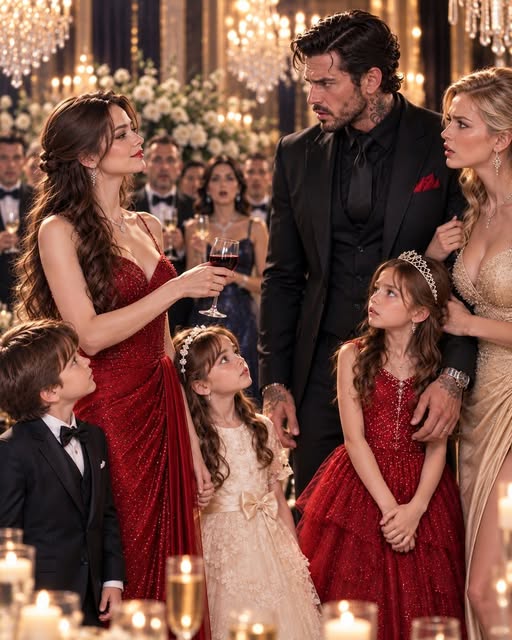
I have planned four hundred events. I know exactly what a room sounds like when its attention turns: it is not silence, it is the opposite of silence, a wave going out from the doors to the stage, table by table, glass by glass, as three hundred people understood one thing after another. A woman. In black, plain as a staff member and upright as a queen. A child on either hand. Walking — not hurrying, not trembling — down the long center aisle toward the stage, between the gold chairs, in the exact room where she had once walked out the other way, alone, with her head high and nobody stopping her.
Alexander Moretti saw me when I was halfway down the aisle.
I watched the color go out of his face in stages, like a city losing power. The glass in his hand stopped halfway down from the toast. Beside the stage, in the front row, Sophia rose half out of her chair and sat again, hard, as if her knees had made an executive decision, and her famous smile came off her face like a mask dropped on a floor.
"Claire?" Alexander said. My name, in a ballroom, through a microphone. Ten years and three hundred witnesses too late, and still it went through me like a struck bell. "Claire — what are you—"
"Alexander Moretti." My voice surprised me. It was the voice I use for vendors and weather emergencies: carrying, calm, impossible to talk over. "I think you just made a mistake."
He came down the stage steps slowly, leaving the microphone standing alone up there like an abandoned flag, and the room made a sound — three hundred people inhaling through their teeth — as he crossed the dance floor toward us. He stopped four feet away. He was looking at me the way a man looks at a road rising out of a flood. And then, not at me. Down. At the two children holding my hands, who were looking back at him with his mother's eyes and his own childhood face arranged in two new editions, and his voice — the voice that had silenced judges — cracked cleanly in half.
"Who are they?"
"Your son," I said. "Leo." I felt Leo's hand tighten on mine, and I squeezed back. "Your daughter. Luna. They are nine years old, Alexander. They were born the February after I left Chicago."
Nine. I watched him do the arithmetic every person in that room was doing, watched it arrive: the banquet, the ring on the marble, the signature on the papers — and underneath all of it, the whole time, a pregnancy nobody had told him about. Something moved across his face that I had never seen there in three years of marriage, not even in the dark, not even in the beginning.
Horror. Not at them. At himself.
In the front row, a small girl in a champagne-colored dress had risen to her feet.
Isabella. I knew her from the run sheet the way I knew every detail of that night — eight years old, Alexander's daughter, the heiress of the toast unfinished above us. A nanny was pulling gently at her sleeve, trying to sit her back down, but Isabella wasn't looking at the stage or at the crowd. She was looking at Leo with the frank, total stare of childhood, and then at her father, and her voice — a child's voice, pitched to carry the way children's voices do in formal rooms — went out across the silence like a bell.
"Papa," Isabella said, "why does that boy look like you in Nonna's pictures?"
Somebody in the crowd made a sound that was half laugh, half sob, and covered it too late. Alexander's head turned toward his daughter, and I saw the last of the arithmetic arrive in his face: not shame, not strategy — grief, plain and undisguised, for a whole second family standing in front of him that he had never been given the chance to fail on purpose.
"You said you only have one child," I told him, and my voice finally shook, one thread of it, like a wire in wind. "You just told three hundred people that everything you built belongs to your only daughter." I looked at my twins, and then back at the man who had once told me, in a kitchen, that I would not survive without him. "But that isn't true, is it?"
"No." The word came out of him like something pulled from deep water. "No, it isn't — Claire, I didn't know. I swear to you, I never knew—"
"She's lying!"
Sophia's voice cut across the dance floor like a thrown plate. She was on her feet now, cream suit blazing under the chandeliers, one hand outflung toward me, performing — and I use the word with respect for the craft of it — performing outraged innocence for three hundred witnesses and at least forty phones.
"Look at her! A dismissed employee with a grudge and a rented pair of children! She planned this — she's the producer, she put herself in this room to ambush this family in front of the entire city! Alexander, she took your money ten years ago and vanished, and now that it's spent she's come back with two coached children and a story—"
"The money," I said.
I didn't raise my voice. I didn't have to. Something about the two quiet words stopped her mid-sentence the way a hand stops a metronome.
"What money, Sophia?"
For the first time since I had known her — across three years of doorways and one conference table — I watched Sophia Reynolds hesitate. It lasted less than a second. A woman less practiced than me would have missed it entirely. But I had once sat in a kitchen while she described my comfort to me in the tone of a weather report, and I had had ten years to learn her face the way sailors learn a coastline.
"I — the settlement," she recovered, magnificently. "Everyone knows about the settlement. Five million dollars, and a house—"
"Then everyone knows more than I do," I said. "Because I never saw one dollar of it."
The whispering in the room changed key. Phones came up higher. I felt Leo step half a pace in front of me — my nine-year-old, running Rule One — and I put my hand on his shoulder and kept it there, gentle and absolute, because this was the moment I had crossed a decade carrying, and it was mine to carry, not his.
And here is the truth about that moment, the part I have never said aloud: I was watching Alexander. Not the room, not Sophia — him. Because I had stood in this room once before with my face burning, watching a man's arm hang still at his side while a woman slid hers through it, and some deep, unhealed chamber of my heart was waiting — actually waiting, breath held, fists at my sides like a girl's — to see whether he would do it again. Choose the room. Choose the peace. Choose the version of events that let Alexander Moretti go on being Alexander Moretti, undisturbed.
I saw the struggle happen on his face in real time. I saw his eyes go — once, quickly — to the tables of judges and senators and cameras. I saw the old machinery engage: the calculation, the cost, the scene.
My heart went down like a stone in a lake.
And then Francesca Moretti walked onto the dance floor.
She came without hurry, the way she did everything, with Marta at her elbow and three hundred people parting for her like water for a small, elderly ship of war. She stopped in front of Leo. She looked at him for a long moment, and then — gently, with a hand that trembled only slightly — she turned his head, just a fraction, toward the chandelier light.
"Look at him," she said, in a voice that reached the back wall without being raised. "All of you. Look, since you're all so fond of looking." Her fingers rested at my son's jaw with a tenderness that undid me where I stood. "I buried a husband with that crescent behind his ear. I raised a son with it. It has come down the Moretti line five generations, through men who were easier to kill than to fool." She took her hand away and lifted her chin at the whole glittering room. "The boy is a Moretti. So is his sister — she has my eyes and her father's temper, and she has been glaring at me for five minutes exactly the way Alexander glared at his tutors. Anyone who calls these children rented will answer to me."
Silence. The total kind. The quartet had stopped at some point; I could hear the candles.
Alexander moved then. He crossed the last four feet and stopped in front of me — close, too close for the room's comfort, exactly close enough for mine — and he looked down at Leo, and at Luna, and at me, and every piece of the old machinery was gone off his face, burned clean away, leaving the man I had married in a gray room with six witnesses and no flowers.
"Clear the room," he said, without turning around. "Everyone out. Now." Chairs began to scrape; the Moretti security materialized like weather. To his head of security, still without looking away from my face: "Dr. Abramowitz. Tonight — I want the family's doctor and a testing lab, and I want my lawyer, and I want the 2016 settlement file, all of it, on my desk within the hour." A pause, in which something enormous and cold finished assembling itself behind his eyes. "And Daniel — Mrs. Moretti is to stay in the family lounge. With two of your men. She is not to make calls. She is not to leave."
Across the dance floor, being guided gently and inexorably toward the lounge doors, Sophia Reynolds looked back at me once.
For the first time in thirteen years, she was the one whose face had gone white in a ballroom.
And I was not the one leaving.