"His name is Eddie Voss," I said.
The words came out of me like something pulled through a narrow space. In three years I had never said that name out loud to anyone — not to the police, who had closed the case as an unsolved hit-and-run; not to the insurance lawyers; not even to Leo, who had his own reasons for never saying it either.
"He's the man who was driving the car that hit my brother."
Roman didn't move. "You saw the driver?"
"For maybe four seconds." I could still see it with a clarity that three years had done nothing to soften: the rain, the intersection, Leo laughing at something on his phone as he crossed with the light — and the black SUV that didn't slow down. It struck him and threw him eleven feet. The driver braked. For one suspended moment, the man behind the wheel looked directly at my brother lying in the road, and the streetlight caught his face: the scar through the left eyebrow, the flat, pale eyes. Then he drove away.
"And at the hospital," I said. "Two days later. I came back from the cafeteria and he was standing outside Leo's room, looking through the glass in the door. He saw me see him. He walked away very fast, and he never came back. I told myself he was nobody. A ghoul. A stranger with a sick curiosity." My voice cracked. "I told myself a lot of things, Roman. I was very good at it. I was spending all my money on not dying of the truth."
Roman was quiet for a long time. Then he took the photograph and laid it gently back in the folder, and I understood that his gentleness was the most dangerous thing about him. Angry men make noise. Roman made decisions.
"Why," he asked, "would Eddie Voss be photographed with men who are watching you now?"
"I don't know."
"Why would anyone be watching you at all, Tessa? You are a secretary. You have no money, no territory, no—" He stopped. His eyes narrowed with the particular focus of a man re-reading a page. "Unless the watching isn't about you. Unless it's about what you might know. Or what Leo might know."
I said nothing. It was the wrong nothing. Roman had interrogated men for a living since before I was born into this city's ordinary dangers, and he read my silence the way I read his ledgers — every missing figure announced itself.
"There's something you're not telling me."
"There's something I'm not telling anyone," I said. "And before you threaten me, understand: it isn't disloyalty. It's the only coin I have left to keep my brother alive with. If I'm wrong about you — if this apology ends — that secret is the only thing standing between Leo and the people in those photographs."
He studied me. I held his stare and let my hands shake openly, because fear was the one thing in that room I didn't have to perform.
At last he nodded — once, like a man accepting terms he intended to renegotiate later. "Then I'll earn it," he said. "In the meantime, you will accept protection. That is not a request."
What Roman Caldwell called "protection" arrived within the hour, and it looked like this: a man named Dante Ricci — six feet of quiet in a gray coat, with the unnerving habit of appearing in doorways without having visibly crossed the room — was introduced to me as my "driver." A new wheelchair was delivered to our apartment that afternoon, a machine so advanced that Leo circled it twice before he'd sit in it, like it might be a trap set by kindness. Two unmarked cars took up residence on our street. And a locksmith changed our door lock while I was still deciding whether to be furious, and installed a second one I hadn't asked for and couldn't have afforded in a year of skipped lunches.
I was furious. I want that on the record. But that night, for the first time in months, I slept without my phone in my hand and a chair wedged under the door handle.
On the third day of protection, Roman came to the apartment himself.
He stood in our doorway holding two bags of groceries like a man defusing an explosive — prepared, expensive groceries, the kind with paper handles — and for a moment the most powerful man I knew looked exactly what he was: out of his element and determined not to show it.
"Dante's report said the boy's medication schedule changed," he said. "The pharmacy wouldn't release the new prescription to my man. I brought—" He stopped. Looked at the bags. "This is not the medication. This is food. I appear to have overcorrected."
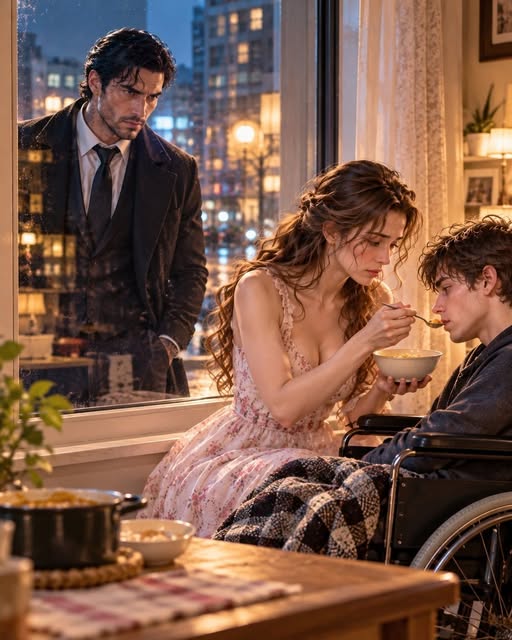
Leo, traitor, laughed from his new wheelchair — the first time I'd heard that sound in our apartment in a year. "Come in, Mr. Caldwell. She only bites on weekdays."
Roman stepped into our two rooms like a king entering a country he had accidentally invaded, which, to be fair, he had. He saw everything. I watched him see it: the radiator with its towel-wrapped pipe, the cabinet door I had re-hung with a belt, the corkboard where I pinned bills in order of menace. He did not perform pity. He did something worse. He memorized us.
"Leo," he said, "tell me about the accident."
The room went very still. Leo's hands tightened on the wheels of his chair. "Car came out of the rain. That's all anybody knows."
"That," Roman said gently, "is not all you know. But it is all you're saying, and I find I respect the shape of it." He set the bags on our counter. "When you're ready, son. Not before."
After he left, Leo was quiet for a long time. Then he said: "He knew I was lying."
"Everyone within a mile knows when you're lying, Leo."
"Yeah." Leo turned the new chair in a slow, wondering circle. "But he's the first one who didn't push."
Leo, meanwhile, was thriving in a way that felt indecent to watch, like laughing at a funeral. The rehabilitation program Roman had funded — the Halden Institute, all glass and light and therapists who treated Leo like an athlete instead of a tragedy — assessed him within the week. Dr. Amara Patel, a woman with a surgeon's calm and a coach's cruelty, told us Leo's injury had been undertreated for two years. "The spine is damaged," she said. "It is not finished. Neither is he. We start Monday."
Leo held my hand in the car on the way home, hard, the way he had when he was nine and frightened of thunder. "Tess," he said, "people don't just give you things like this. What does he want?"
"The truth, eventually," I said. "And he's going to get it. Just not yet."
At the office, the missing $20,000 sat between Roman and me like a third person at every meeting. I rebuilt the authorization trail line by line. The transfers had been coded with my credentials — my login, my approval sequence, time-stamped on evenings when I was verifiably at the hospital with Leo. Someone had cloned my access. Someone patient. Someone close enough to watch my habits and patient enough to wait for a pattern worth stealing.
I brought Roman the timeline on Thursday. He read it standing up, and when he finished, he said something I did not expect: "Carlo brought me your name within an hour of the discrepancy surfacing. In twenty years, I have never known Carlo to be an hour early to anything he wasn't steering."
"You think Carlo—"
"I think," Roman said, "that someone is building a story with you as the villain, and I almost shot the wrong character in it." He set the timeline down. "Say nothing. Work as if nothing has changed. If Carlo is innocent, I owe him an apology. If he isn't—" The sentence ended there, the way cliffs end.
Carlo stopped by my desk that week carrying two coffees, which was how I knew I was in more danger, not less. Carlo's kindness was a measuring instrument. He set one cup down beside my keyboard and gave me the soft, sorrowful smile of a man reading a eulogy he had commissioned.
"I owe you an apology, Tessa. The figures pointed where they pointed. I hope you understand — in my position, silence would have been a betrayal of the Don."
"Of course, Carlo." I smiled back with everything I had. "You were doing your job. I was doing mine. The money will turn up where it actually went. These things always do."
He studied me over the rim of his cup, and I watched him recalibrate: he'd expected a frightened girl, and I'd handed him a colleague. It was the first time I ever saw Carlo Marchetti look uncertain, and it lasted less than a second — then the smile rebuilt itself, perfect as paint.
"How is your brother?" he asked. "I hear he's been… settled into a program. Such good fortune. The family takes care of its own, yes?"
"The family," I agreed, "has been very generous."
What I did not say: I had never told Carlo about the program. I had told no one at the Caldwell organization except Roman. Dante might have filed a report — but reports in our office moved through exactly one pair of hands before they reached the Don's desk, and they were not Carlo's.
He knew about the program anyway. I carried that small, cold fact down the hall to Roman's office and laid it next to the timeline, where it sat ticking.
Late that afternoon, Dante asked for ten minutes with Roman and me, and produced a single sheet of paper: the black SUV in the photograph had been caught twice by traffic cameras, and its plates — false, but lazily false — traced back through two rental fronts to a holding company called Salto Ventures.
"Salto," Roman said. He didn't raise his voice. He almost lowered it. "Salvatore money."
Everyone in the Caldwell organization knew the name the way sailors know weather. The Salvatores had lost the Hudson terminals to Roman's father in the nineties and had spent thirty years being gracious about it in public and patient about it in private. If Salvatore men were photographing my brother, then Leo and I had somehow wandered onto a chessboard where families like theirs kept score in decades.
"The SUV visited her street four times this month," Dante said. "Always the evenings she works late."
"They think she knows something," Roman said. "Or he does." He looked at me. "Tessa. Whatever the boy is carrying — the price of it just went up. Men like Vincent Salvatore do not take photographs for scrapbooks."
"I can't give you what isn't safe to give," I said.
"Then I'll make it safe," he answered, with the absolute calm of a man discussing weather he intended to personally control. "That's the whole of my plan. Make it safe, and then ask again."
That evening, Dante drove me home in the rain. We were two blocks from the apartment when my phone rang. Leo. His voice came thin and fast, stripped of the slow care his injury had taught him.
"Tess. Don't get mad. And don't — just listen. At the clinic today, a man came in. He wasn't a patient. He asked the receptionist about me. By name. He wanted to know my therapy schedule — which days, what time, who brings me." A breath. "Tess, she told him. She didn't know. She just told him. And then he left."
Through the windshield, the wipers beat their steady, hopeless rhythm. Dante was already on his own phone, speaking in the low, flat Italian of men transmitting coordinates.
"Leo," I said, very calmly, the way you speak to someone standing on a ledge, "lock the door. Both locks. Don't open it for anyone who isn't me or Dante. I'm coming."
But underneath the calm, one thought was moving through me like cold water through a crack in ice: they weren't watching anymore.
They were scheduling.