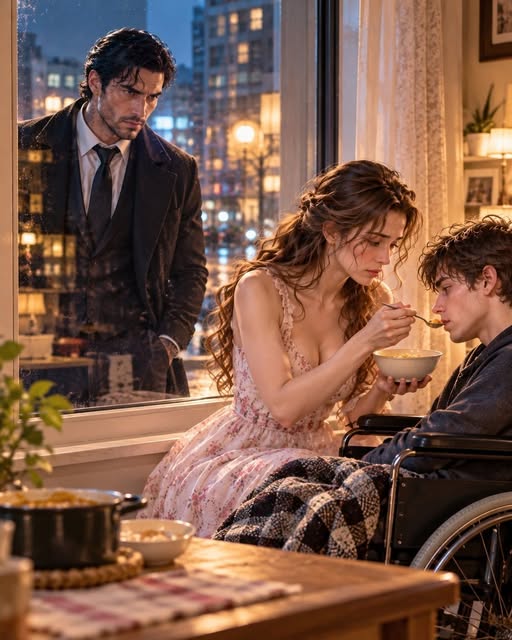
Roman didn't ask my permission. By the time Dante's car turned into our street, the decision had already traveled through the Caldwell organization the way weather travels through a valley — completely, and in one direction.
"We're moving you tonight," Dante said. "Both of you. The Don's house on Todt Hill. Bring what you can't replace."
Our street was wrong before I could say why. The unmarked Caldwell car that had watched the building for a week was there — but angled differently, its driver slumped in a posture no professional chooses. Dante's hand was already moving. "Down," he said, pleasantly, like a man suggesting rain, and pushed my head below the window line as he reversed us out of the street at a speed that tore the night open.
What I remember of the next four minutes comes in pieces, the way Leo says he remembers the accident: headlights where no headlights should be. A black SUV — the black SUV — coming out of the service road with its lights off and then, horribly, on. Dante's voice, level as a metronome, saying street names into his radio. The gun he drove with, held low against the wheel. My brother's name said by a stranger on an open channel: "They're not after the girl's car. They're vectoring on the second vehicle—" The second vehicle. The medical transport Roman's people had sent for Leo, because Leo couldn't ride in a sedan. It was three streets behind us.
I think I screamed instructions that made no sense. I know I called Leo's phone and heard it ring into a void that rebuilt, in real time, every nightmare I'd ever scheduled for 3 A.M.
Then Roman's voice came over Dante's radio, and I will hear it for the rest of my life, because it was the voice from the conference rooms and the contract signings, except stripped down to a single instrument: "Dante. The transport is mine. Nobody touches the boy. I don't care what it costs. Do you understand me — nobody."
They tried at the underpass where the expressway service road narrows to one lane. The SUV swung across to pin the transport van against the concrete. What the men inside it had not accounted for — what Carlo, feeding them our route, could not have known, because Roman had changed it twelve minutes before we moved — was that the "transport van" carried Leo, one terrified paramedic, and four armed Caldwell men who had been waiting all evening for exactly this invitation.
It was over in less than a minute. I know because Dante made me count my own pulse out loud while we drove, the whole way, so I wouldn't do something brave and fatal. Shots — not many, and none of them ours to fear, he said. Two Salvatore men down and living. One running, and not running far. And Leo: untouched. Leo, in the middle of it, had apparently told the gunman nearest him, with the majestic calm of the heavily medicated, "My sister is going to be so mad about this van."
They brought him to the Todt Hill house in a different vehicle, and I met him in a marble foyer bigger than our entire apartment, and I held his face in both hands and shook apart so violently that Roman had to steady me with one hand at my back — unobtrusive, unclaimed, gone the moment I could stand.
Dante appeared in the archway with his coat torn and a report he delivered like a weather summary. One of the two men taken at the underpass was awake and talking — not from courage. From arithmetic: he knew what Vincent Salvatore did to men who came home empty-handed, and he was purchasing a different ending.
"He says Voss has been watching the clinic and the building for a month, on Salvatore's orders. Not to kill." Dante glanced at Leo. "To listen. Salvatore believes the boy saw something on his last delivery three years ago — something written down. He's been waiting for Leo to recover enough to be… questioned. The therapy program changed their timetable. A boy who might walk again is a boy who might walk into a police station."
"Why now?" I asked. "Why not three years ago?"
"Three years ago, the boy couldn't speak properly and the sister suspected nothing," Dante said, not unkindly. "Salvatore could afford patience. Then the sister got a protector, and the boy got doctors, and patience started to look like a luxury."
Roman said nothing for a moment. Then: "Watch the house. Nobody in or out without my voice on the line." He looked down at Leo — at my brother, sitting pale and upright in his gleaming chair with his hands folded like a schoolboy outside the principal's office — and his voice changed in a way I had never heard it change for any captain or contract. "Leo. I think it's time. Don't you?"
Leo looked at me. I nodded, though my heart was slamming. And my brother took a breath like a man stepping off a ledge he had been standing on for three years.
It was in that house, an hour later, with Leo wrapped in a blanket in a room with a fire in it and his new chair gleaming beside him like a parked spacecraft, that my brother finally told the truth.
"I was running packages," he said.
Three years. Three years I had believed the story we told the police, the story I'd built my whole exhausted life on top of: a random car, a rainy night, a coward who fled. And underneath it, the whole time, this.
Two weeks before the accident, Leo had been working weekends at a garage in Hunts Point, saving for tools. A man started coming around — smooth, scarred, generous with tips. Eddie Voss. He offered Leo cash, real cash, to drive sealed packages across the river a few nights a week. No questions. Leo was twenty-two, we were behind on rent, and our mother was eight months in the ground. He said yes.
"I never opened one," Leo said. "I swear to God, Tess. Eleven runs, I never opened one. But the twelfth — the seal was already split when he handed it to me. It was raining. The box got wet in the trunk and the bottom gave out at a red light, and there was this… page. Like from a ledger. Names. Dates. Money next to the names. And some of the names—" He looked at Roman, standing silent by the fire. "Some of the names were your men, Mr. Caldwell. Men in your house. Money going the wrong way."
"What did you do with the page?" Roman asked.
"I put it back. I sealed the box with tape from the garage and I delivered it and I threw up in the parking lot after. But before I put it back—" Leo's voice broke. "I took a picture of it. With my phone. I don't even know why. Insurance. Proof I wasn't crazy. Two days later Eddie asked me to do a run at midnight, short notice, and I said no. I said I was done. And the next night—" He gestured at his own body, the blanket, the chair. "The next night the car came."
Silence, except for the fire.
"In the hospital," Leo whispered, "I woke up and I tried to tell Tess. She was right there. And then I saw him. In the doorway. Eddie. Just standing there looking at me through the glass, like he was checking his work. And I understood. If I talked, he'd finish it. And if she knew — if she ever acted like she knew — he'd start with her. So I forgot." He laughed, horribly. "I got real good at forgetting. Three years of physical therapy for my legs and I did all of it on a lie."
I couldn't speak. I kept seeing the doorway of that hospital room, three years burned into me, and myself in a cafeteria downstairs buying tea I never drank, while a man stood over my brother and taught him silence.
"I'm sorry," I said. It came out wrecked. "Roman — in your office, the photograph — I knew his face and I said nothing about the hospital, nothing about any of this, because—"
"Because a man stood in your brother's doorway and taught a twenty-two-year-old that silence was the price of both your lives." Roman's hand rested on the mantel; I watched his knuckles, the effort of gentleness in a man not built for it. "You didn't lie to me for three years, Tessa. You held a siege for three years. Alone, on a secretary's salary, with a broken wheelchair. There are made men in my organization who couldn't have done it for three weeks." He turned to Leo. "And you. You carried it in the dark so your sister could sleep. Whatever else happens tonight, boy — that goes in the ledger too. On the other side."
"The phone," Roman said, very quietly. "Leo. Where is the phone?"
Leo's face changed. "I hid it before the accident. The night I took the picture. I knew if they ever searched me—" He swallowed. "It's taped inside the frame of my old wheelchair. The hollow tube under the seat. The chair's in our closet. It's been in our closet the whole time."
The whole time. Three years of bills I'd paid on my knees, three years of soup and arithmetic — and the evidence that a crime family would kill for had been sitting in our closet behind the winter coats, inside the broken chair I pushed my brother around in, through rooms I cleaned while crying.
Roman was already on his feet, already on the phone. "Dante. The Hayes apartment. The old wheelchair, in the closet — go now, go quietly, bring me the chair and anything inside its frame." A pause. His face altered in a way I had never seen — not anger. Recognition. The look of a man watching a predicted card turn face up on the table.
"Dante," he said. "Say that again."
He listened. Then he lowered the phone and looked at me, and I knew before he spoke that the night had one more room in it, and the room was on fire.
"The apartment door is open," Roman said. "The closet is empty. They got there twenty minutes before we did."
"How could they know?" My voice went up and I didn't care. "Leo told no one. I told no one. This room is the first time that phone has existed outside my brother's head—"
"They didn't know," Roman said. "Understand me, Tessa. The moment we moved you, every watcher on that street knew the game had changed. They went in to strip the apartment for anything Leo might have hidden — papers, drives, anything. The wheelchair was the only thing in that home built to hide something in, so they took it." His jaw tightened. "They don't know they have it yet. They'll take that chair apart bolt by bolt by morning. And when they find a phone taped inside the frame—"
He didn't finish. He didn't have to.
Leo's photograph was gone. And whoever had it now knew — or would know by morning — exactly what it showed, and exactly whose names were on it.
Leo had gone the color of old paper. "Tess," he whispered. "I did this. The picture — I took it to protect us and it's the thing that's going to—"
"Stop." Roman's voice cut the room clean. He crouched — actually crouched, a king lowering himself to a wheelchair's height — until his eyes were level with my brother's. "Listen to me, Leo Hayes. For three years that photograph was a threat hanging over your family. Tonight it became something else: the one piece of paper on earth that Vincent Salvatore and I both need. And I—" something in his face that might, in another man, have been a smile — "I have never once lost a negotiation over a thing I need. Sleep. Both of you. Tomorrow, we go hunting in my own house."
He stood, and looked at me over Leo's head, and for the first time since a gun had followed me home in the rain, I believed him completely.
That was the moment everything became more dangerous. Because now I had something to lose on both sides of the war.