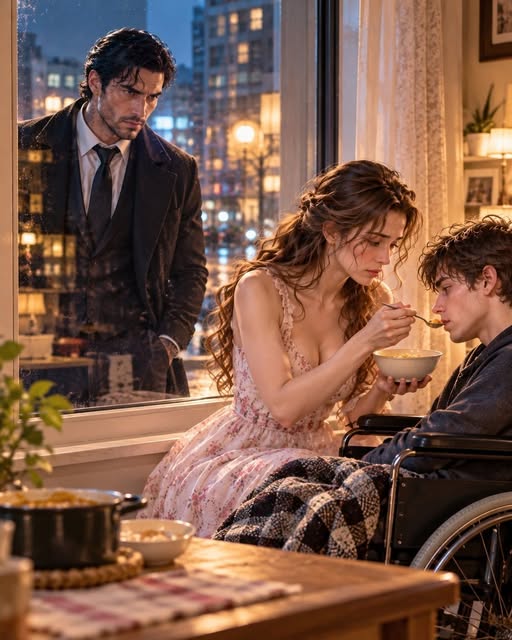
On Thursday at 2 P.M., my brother wheeled himself into the Halden Institute wearing his good shirt, and I watched him go on a bank of security monitors with my heart trying to exit my body through my throat.
I had dressed my brother that morning with hands that wouldn't stay steady, and he had watched me fail at his collar for the third time and said, "Tess. Look at me. Fourteen seconds yesterday. I'm not a package anymore. Packages don't get a vote — I got a vote, and I voted. Now fix my collar and stop shaking, you're making the bait nervous."
"You are the bait," I'd said. "I'm allowed to shake."
"The bait's brother—" He stopped. Grinned instead, and it nearly undid me. "The bait's sister is the scariest person in this war. Roman Caldwell is a close second and he knows it. He told Dante so. Dante told Marco. Marco charged me an extra set of reps for morale."
I'd laughed then — really laughed, standing in a borrowed bedroom of a mafia estate, dressing my brother to be kidnapped in. That's what courage looks like in our family. It isn't the absence of terror. It's terror, with jokes, on schedule.
Roman had rebuilt the building without moving a single wall. The receptionist who had once given away Leo's schedule to a stranger was on a sudden paid vacation; the woman at the desk now was Dante's cousin, who could field-strip a pistol and file insurance claims with equal fluency. Two of the "patients" in the waiting room were Caldwell men with newspapers and earpieces. The parking structure had a full team. The therapy gym had Marco, the therapist — who was, it turned out, an actual licensed therapist, because Roman believed a cover should be load-bearing — plus one orderly who was not an orderly.
"Every man, every gun, every second," Roman had promised me, and he had kept the promise like a contract written in his own hand. He stood beside me in the security office with his arms folded, watching the monitors, saying very little.
"You're not going down there," I said. It wasn't a question. We had agreed: the Don does not walk into traps; that's what makes him the Don.
"I'm not going down there," Roman agreed.
Leo's session began. On the grainy screen, small as a memory, my brother transferred to the parallel bars and stood — twelve seconds, Marco had written in the chart that morning; fourteen by the time the session ended — and even through the fear I felt that fierce, unreasonable pride. Fourteen seconds. A year ago the doctors had used the phrase "realistic expectations" at me like a locked door.
At 2:40, the transfer team arrived.
They were good. I say that with hatred, but they were good: three men in the right scrubs with the right lanyards and a clipboard bearing a transfer order for Leo Hayes — discharge to a long-term facility in Westchester, signed, stamped, and utterly false. Carlo had spent twenty years learning exactly what Caldwell-and-Halden paperwork looked like, because Carlo had invented half of it.
The trainee at the satellite desk — the one person in the building who was neither ours nor warned, because Roman had calculated that a perfect staff was itself a signal — accepted the order and buzzed them through to the therapy wing.
Thirty seconds. That was the size of the mistake. Thirty seconds in which three men walked a corridor that Dante's people were watching from the wrong end, because the plan had said they would come through the parking structure, and Carlo — who had helped design our habits for twenty years — had sent them through the front door like visitors.
On the monitor I watched a man in scrubs take the handles of my brother's chair in the doorway of the gym. I watched Marco step forward, frowning, with a chart in his hand like a shield. And I watched the man holding the chair lean down and say something to Leo, and my brother's face — small, gray, unmistakable — change.
Later Leo told me the words. The man had said: "Eddie sends his regards. Be quiet and nobody bleeds."
Eddie. Eddie Voss was in the building. Eddie Voss had his hands on my brother's chair.
I was out of the security office before I'd decided to move. I heard Roman behind me say my name in a voice that could have stopped traffic, and it did stop me — for exactly the length of the stairwell. Then I was running again, because there are orders you obey and there are sounds your brother makes when he's frightened, and only one of those things was in the building with me.
The parking structure. They'd reversed in ninety seconds — the front door had been the entrance, but the structure was always the exit, and Dante's team was already moving, suddenly, too late and not too late. I came out of the service stairwell into concrete and fluorescent light and the smell of hot engines, and the whole war was arranged in front of me like a photograph:
Leo's chair, stopped halfway down the ramp. The man from the gym doorway holding it — and an arm across my brother's chest now, and something small and dark in his free hand that I understood before I believed it. Eddie Voss stood two paces off with his scarred face turned toward the ramp entrance, where Dante and four men were coming down with their hands visible and their weapons down, because the geometry was obscene: every line of fire in that structure passed through my brother.
And Carlo Marchetti stood by the black SUV with the door open, one hand in his coat, watching it all with the mild, regretful expression of a man observing weather he'd arranged.
"Carlo," Roman said.
He had come down the ramp behind me — unhurried, alone, his coat open, his hands at his sides and visibly empty. The Don walking into the trap, after all. Dante made a sound I had never heard from him, half protest, half prayer.
"Don Caldwell." Carlo inclined his head. "You've lost weight. Stress, I expect. The boy comes with us, he answers Mr. Salvatore's questions in a civilized place, and if his answers are complete, he comes home. That is the whole transaction. Nobody bleeds. I designed it that way." His eyes flicked to me — and warmed with something like genuine fondness, which was the worst thing in that whole structure. "Tessa. You should have taken the money story and run, my dear. It was a kindness. It was me being kind."
"Take me instead," Roman said.
The structure went quiet in a way that gunfire never achieves.
"I know everything Salvatore wants to know. I am everything Salvatore wants to know. The boy is a secretary's brother with a three-year-old photograph. I am the Caldwell organization." He took one slow step forward, hands open. "Let the boy roll to his sister. Take me to Vincent. He'll trade a decade for me and you know it. Your page stays clean. That's a better transaction, Carlo. You designed this one badly."
It almost worked. I swear to God, it almost worked. Eddie Voss's eyes went to Carlo — a hired man checking whether the deal had changed — and in that half-second of doubt, Leo did the thing no plan had contained and no one who hadn't watched him between the parallel bars that morning could have predicted.
My brother stood up.
Fourteen seconds of standing, bought with two years of agony, and he spent them all at once: he rose out of the chair, lurched sideways with his whole weight against the man holding him, and knocked them both off-balance — not down, not far, just enough. Just enough to break the geometry.
Everything happened in the space of one breath. Dante's people moved. Eddie's gun swung — toward Leo first, then tracking, professional and fast, toward the largest decision in the room. Toward Roman.
Roman was already moving. Not away. Never away. He stepped into the line the way a man steps into a doorway, and the shot took him high in the side, under the ribs, and turned him half around.
I caught him. I don't know how I crossed the distance. I know his weight came into my arms, astonishing and wrong, and my hands were on the wound before I understood I'd moved, pressing down, and his blood was shockingly warm and his face was close to mine and entirely, infuriatingly calm.
"Nobody touches the boy," Roman said, to no one, to everyone, to the concrete. "That was the whole of the order."
"And nobody did," Dante said — from somewhere above the sounds of men being efficiently subdued. "Not a hair, Don. The boy stood up and saved himself. He gets it from his sister."
Eddie Voss was on the ground with Dante's knee in his back, bleeding from somewhere, alive — Roman's standing order, delivered that morning and repeated in the stairwell, had been absolute: everyone breathes, everyone talks. Carlo was against the SUV with his hands raised and four weapons considering him, and his face had finally lost its smile.
They dragged Eddie past us toward the second vehicle. He was laughing, which men do when pain and shock make them generous with the truth, and he looked at me — at my hands red on Roman's side, at Leo standing, standing, gripping his chair and shaking — and he called out, clear as a bell:
"Ask your traitor, secretary. Ask him who ordered the rain that night. Salvatore wanted the boy quiet. But the crash—" a cough, wet and ugly "—the crash was Carlo's idea. Your brother saw his name first. Ask him!"
The SUV door closed on him like a book.
I looked up. Carlo Marchetti was looking back at me over the guns, and slowly — like a man who has been carrying something heavy for three years and has just been permitted to set it down — he smiled.
—
The Caldwell family kept a private surgical wing the way other families keep a good lawyer: quietly, expensively, and in constant readiness. The surgeon — a woman who didn't ask questions in either sense — told me at 6 P.M. that the bullet had missed everything Roman couldn't spare and torn a great deal that he could. He would live. He would hurt. He would be insubordinate about bed rest by the weekend.
Leo slept in the family room with his head on my shoulder and his good shirt ruined, and Dante came and went with reports in his metronome voice. Both prisoners were alive. Both were secured. Eddie Voss had already begun, in the manner of drowning men, to trade the truth for air.
"Carlo ordered it," I said. Not a question. I had been turning Eddie's words over for two hours and they fitted everywhere, in every lock: the man who blamed me within the hour, who knew about the program he'd never been told of, who'd stood by a window in Roman's office three years ago and learned — because Roman told his underboss everything — that his Don's new secretary had a brother in a hospital bed who couldn't identify the driver who'd visited him. Carlo hadn't been protecting the payments. Carlo had been protecting Carlo, one silenced witness at a time.
"Yes," Dante said. "The Don will want a tribunal. The old way. Witnesses, the page, the whole architecture — he's been building it since Nadia found the keycard floor."
"When Carlo talks," I said, "I want to be in the room."
Dante looked at me for a moment, and something in his granite face moved, slightly, in the direction of respect. "The Don said you would ask that. He said it in the ambulance. His exact words were: 'She'll ask. Tell her yes before she has to.'" He paused. "He was losing blood at the time. He's been saying a number of things he's apparently been storing up."
I looked down at Leo, asleep against my shoulder, breathing the deep, even breath of a boy who had stood up in a parking structure full of guns and saved himself.
"Good," I said. "So have I."