The Salvatore technicians opened Leo's phone on the same night Carlo tried to sell my brother in a parking structure.
I know this because Vincent Salvatore told Roman so himself, in the telephone call that ended the war — a call Roman made sitting upright in a chair he had been forbidden to sit in, six days after taking a bullet for my family, with his shirt open at the side where the bandages were and his voice level enough to frighten the surgeon into leaving the room.
"Your man has read the page, Vincent," Roman said. "So you know what I know. It names your payments to a precinct captain the newspapers call a hero. It names dates my accountant has already matched to your money — matched, Vincent, from our side, without your phone. The boy's photograph is a souvenir now. The page exists in three reconstructions, in two safes, and in the memory of a twenty-five-year-old who stood up this week in a room full of your guns." A pause. "Your war is over. You just haven't decided what it costs yet. Let me help you. The Hayes family is finished business — permanently, publicly, in the record of both houses. Carlo Marchetti is mine; he was always mine; his treason is an internal wound and I will not have it dressed by strangers. Eddie Voss you will surrender to me, because he owes a debt in my territory and I intend to collect it. In exchange, Pier 9's lease comes to you at Christmas, the page never surfaces, and neither of us ever again mistakes the other's patience for weakness."
The silence on the line lasted eleven seconds. I counted. Counting is what I do.
"Your father," Vincent Salvatore said at last, "would have sent heads in a truck."
"My father," Roman said, "is why there's a page."
They agreed. Men like that don't shake hands; they simply stop aiming. Dante, listening, closed his notebook on three years of war like a man shutting a door in a house he intends to keep living in.
The night before the tribunal, I found Roman in the garage at Todt Hill, of all places, standing over a car I didn't recognize until he told me what it was: a 1979 sedan, kept running by Dante's mechanics for thirty years out of pure institutional stubbornness. The car his father had been shot in, in 1998, outside a social club in Bayonne. The car Carlo Marchetti had dragged him out of, burning, and driven to a hospital with his own hands blistering on the wheel.
"Carlo drove this car with second-degree burns," Roman said, "and refused treatment until my father was in surgery. I was eighteen. I stood in a corridor and watched a man decide my family was worth his hands." He rested his own hand on the roof of the car, lightly, the way you touch a coffin. "Tomorrow I sit in judgment on him with a clean conscience and a full file, and both of those things are true, and they do not cancel each other. That's the part no one warns you about this chair, Tessa. The traitor isn't a stranger in a mask. He's the man in your earliest photograph of safety. Sentence him anyway — that's the job. But I've stopped pretending the job is clean."
"Will it help," I asked, "that Leo and I are in the room? That he has to say it in front of the people he actually spent?"
"No," Roman said. "It won't help. It's simply owed." He looked up. "You understand that distinction better than anyone I know. It's why you're in the room too."
The tribunal met on Sunday, in the Todt Hill dining room, under the rules of a family that predates the country it operates in: the captains present, the evidence read into the record, the accused permitted to speak. Leo sat at the table in his chair — Roman's order, delivered through me with the subtlety of a parade: "He isn't a witness in a hallway. He's the injured party. He sits at the table."
Nadia read the money first. Two years of "harbor dues." The cloned credentials. The $20,000 planted on me like a flag on a hill Carlo intended to die on. Then Leo spoke — slowly, carefully, the whole architecture of it: the garage, the packages, the split seal, the page, the photograph, the rain, the doorway of a hospital room where a man had stood and looked at his work. He didn't falter. When he finished, the room was quiet in a way that made the fire in the grate sound loud.
Before the accused was brought in, Roman did something the captains would repeat to each other for years, because it had never been done for a secretary, or for anyone outside the blood and the oath.
He stood — slowly, against his surgeon's orders and his own stitches — and read my clearance into the record himself.
"Tessa Hayes," he said, "entered this family's service three years ago and has never once, in any particular, betrayed it. The charge of theft laid against her was manufactured by the man we try today, using her own diligence as the weapon — her credentials were cloned because they were beyond reproach, and they were beyond reproach because she is. Let the record show the debt is expunged, the suspicion is expunged, and the shame of it belongs where the money says it belongs." He looked around the table, captain by captain, making each of them hold it. "Any man who speaks of her as a suspect after today answers to me as if he'd spoken of my mother. That is the whole of the announcement."
Eleven men nodded. Old men, hard men, men who had decided fates over that table since before I was born — and I sat in my borrowed chair with my hands folded and let myself be publicly, ceremonially, permanently un-accused, and I understood that this, more than the program or the house or the gun he'd stepped in front of, was Roman Caldwell's true apology: he had unmade the lie in the same room, at the same volume, as the lie had been made.
Then Carlo spoke.
He did not deny anything. That is the detail I will remember longest: he stood in the wreckage of twenty years of brotherhood and declined, at the end, to insult the room with lies.
"Your father promised me this family would be mine to guard when he was gone," he said to Roman. "Not yours to inherit like a watch. Mine to guard. And then he died, and the guarding became… serving. I served a boy I'd diapered—" He stopped. Started again, and the honesty in it was obscene. "The money started as insurance. Then it became a salary. Then it became the only conversation in my life where I was the important one. Salvatore listened to me the way this family had stopped listening." His eyes moved to Leo. "The boy. The boy saw a page with my name rendered in a code any competent accountant could crack in a weekend — Nadia cracked it in two days from a dying boy's memory of it. The boy had to stop being a witness. I want the record to show I said broken. Not dead. A dead boy is a headline and an investigation. A broken boy—"
"Is a warning," Roman said quietly. "You made an example of a twenty-two-year-old who carried packages for grocery money. You stood in his hospital doorway and taught him to be silent, and then you came home and ate at my table for three years."
"Yes," Carlo said.
"You framed his sister. You watched her divide soup through a window of intelligence you fed to our enemies, and you let me — you let me, Carlo — load a gun and follow her home in the rain."
"That," Carlo said, "I did not arrange. That was yours, Roman. I merely supplied the story. You supplied the gun." He almost smiled. "We are both men who did what our natures told us. The difference is that mine lost."
The judgment of the Caldwell family, delivered by its Don with a bullet hole still healing in his side, was this: Carlo Marchetti would not die. I had asked for that — alone with Roman, the night before, in the only conversation of that whole season where I asked for anything for myself. "Leo stood up this week," I'd said. "His whole life from here is walking toward things. I won't have the first stone of it laid on a grave. Whatever else he is, Carlo is the man who ate at your table. Let the law have him. Let him grow old somewhere with his name in a file, knowing."
So: Carlo's name was struck from the family's record. His money — the Coral Gables house, the washed millions, every dollar of his insurance — was seized entire. And Nadia's file, the beautiful, airtight, translations-of-money file, went to a federal prosecutor with everything except the Caldwell family's own fingerprints, which is to say it went as the story of one corrupt underboss and one crime family's payments, told by an anonymous concerned party with excellent bookkeeping. Carlo Marchetti will spend the rest of his natural life in federal custody. Eddie Voss — delivered to Roman's door by Salvatore's people on Tuesday, in a car with a full tank, like a returned library book — got the same door into the same system: the hit-and-run file, reopened, with a witness. Leo's statement about Eddie took four hours and Leo insisted on giving it standing, braced between the parallel bars in the Todt Hill gym, because, he said, some paperwork you should do on your feet.
Before they took Eddie away, Leo asked for one minute. Dante wheeled him — no. Leo wheeled himself into the foyer where Eddie stood between two men, and my brother looked up at the man who had come out of the rain and rearranged his life, and he was not shaking.
"You took my legs to keep a secret," Leo said. "The secret's out. Everybody knows everything. So you didn't even get what you paid for." He turned his chair toward the gym, toward the bars, toward the whole rest of his life. "Watch the papers, Eddie. One day there's going to be a photograph of me walking my sister down an aisle. I want you to see it in whatever cell they give you. That's your sentence, as far as I'm concerned. The rest is the state's."
That night, when the house was quiet, Roman gave me back the folder.
The photographs of me. Of Leo. Our names, our address, three years of being watched by enemies and one night of being watched by him. He set it on the table between us in the library and said, "This should never have existed. I can't unmake the night I added to it. But I can give you the only ending it has."
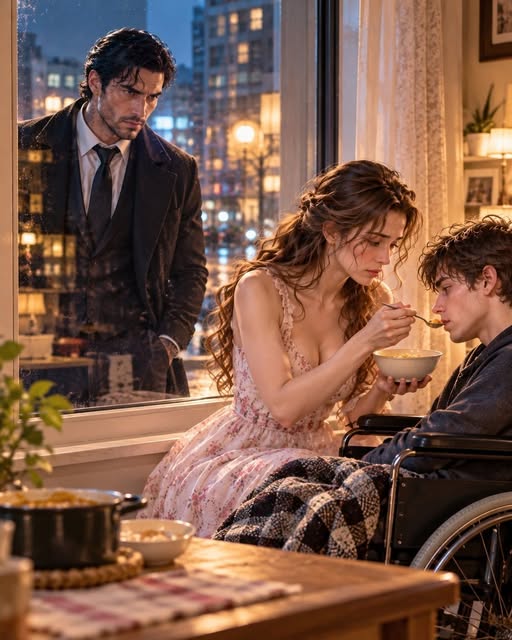
I fed it to the fire, page by page. The photographs curled and blackened — me, buying groceries; Leo, waiting by the window; the girl dividing soup, who felt, watching herself burn, like a stranger I had once been employed to be.
"I'm not your secretary anymore," I said. It wasn't a question, and it wasn't a wound. It was bookkeeping.
"No," Roman agreed. "You haven't been since the window. I was simply too much a coward to re-file the paperwork." He watched the last page catch. "Stay for dinner. Both of you. There's no soup."
"Is that a promise or a threat?"
"With my cooking," Roman Caldwell said, "it has been known to be both."
Leo was already asleep in the guest room with the fire door open and a Caldwell man dozing in an armchair outside it — a guard he'd charmed, by morning, into promising to lose to him at chess. I stood a while in the doorway watching my brother breathe, this boy who had been a target, a witness, a package, a secret, and was now, at last, only a patient with a chart that said improving in a doctor's good handwriting.
Fourteen seconds standing, the chart said. Improving.
"Let him sleep," Roman said behind me, very quietly. "Tomorrow we start the rest of it."
"The rest of what?"
"Whatever you two decide your lives are," he said. "I'm told it's called the future. I've recently become an investor."