Eight months after the tribunal, the Caldwell Foundation opened its doors in a converted warehouse in Long Island City, with my name on the glass and my brother's old wheelchair in the lobby.
The chair was Roman's idea, which surprised everyone who knew him and no one who knew the story. The Salvatores had returned it with the rest of the seized property during the settlement — dismantled, tagged, and emptied of its secret — and Dante's people had reassembled it out of something between respect and superstition. It stands now beside the reception desk with a small brass plaque that Leo wrote himself and the foundation's board approved unanimously:
THIS CHAIR CARRIED A WITNESS. IT IS RETIRED. SO IS HE.
The foundation's money is Carlo Marchetti's money — every seized dollar of it, the Coral Gables house, the "harbor dues," washed clean by lawyers instead of shells this time and pointed, permanently, at the thing Carlo spent three years trying to prevent: people getting well enough to talk. The Hayes Program funds rehabilitation for accident victims whose insurance has run out, which is a polite way of saying it funds people standing exactly where Leo stood, doing arithmetic in grocery aisles, choosing between medicine and dinner. In our first class there are forty-one of them. Dr. Amara Patel directs the medical board. Nadia audits us quarterly and terrifies our accountants, which is how I know the money is safe.
I am not a secretary anymore. I want to be careful about what I am, because labels were the first weapon used against me in this story, and I have developed opinions about labels. I run the foundation. I sign things. I have an office with a door I mostly keep open, a salary I don't have to apologize for, and a standing Thursday lunch with Roman Caldwell that everyone in both organizations refers to as "Thursday" in the tone people use for weather events.
In October, a woman named Rosa Delgado came into my office with a folder and a rehearsed speech. She was thirty-one. Her husband had been hurt on a construction site in March; his insurance had run out in July; their daughter was four. She had eaten, that week, exactly the way I used to eat, and she had the look I used to have — the bright, exhausted, over-prepared look of a woman who has done the arithmetic three times and is about to apologize for existing in a doorway.
She got four sentences into the speech before I stopped her.
"Rosa. Sit down." I came around the desk — my desk, with my name on the glass outside — and I sat in the visitor's chair next to hers, because some conversations should happen at the same height. "You don't have to sell me your husband's legs. That's not the application. The application is one page, and the answer is yes, and it was yes before you walked in, because a man named Carlo Marchetti paid for it in advance without ever knowing he was going to."
She cried. I gave her the box of tissues I keep on the desk for exactly this, and did not tell her that Roman had bought the tissues in bulk, personally, after the first month, and had them delivered with a note that said only: STOCK THE DESK. EVEN I KNOW WHAT THE DESK IS FOR.
Forty-one families in the first class. Forty-one front doors that no one will ever have to stand outside of in the rain, deciding. When people ask me what the foundation is for, I don't say rehabilitation. I say: it's a building full of people whose job is to stand between a family and the worst arithmetic of their lives. I know the job. I did it alone for three years, and I was very good at it, and nobody — nobody — should have to be that good at it alone.
Leo walks with a cane now.
I need to write that sentence plainly because it deserves plain writing: my brother walks with a cane now. Not far. Not fast. He describes his gait as "a hostage negotiation between me and gravity," and he is, objectively, the worst patient Dr. Patel has ever had and her favorite. He walks the length of the foundation's lobby every morning past his own retired chair, and the reception staff applaud, and he bows with his free hand over his heart like a matador, every single day, shamelessly. He is studying for his certification in adaptive vehicle modification — he intends to spend his life building machines for people whose bodies changed the rules — and in the evenings he is usually to be found at the Halden Institute, where a physical therapy resident named June Okafor has been losing to him at chess for four months with a dedication that fools absolutely no one.
Priya wrote to him, in the spring, when a newspaper ran a photograph of the foundation opening — Leo standing, cane and all, between Roman and me. It was a kind letter. It was also, like the first one, a door closing; this time Leo closed it himself, gently, with thanks, and then went back to losing at chess on purpose.
The week before the dinner, Dr. Patel discharged him.
Not from treatment — Leo will do maintenance work for the rest of his life, and he does it the way he does chess and June's heart, which is to say daily and with strategy — but from the program. From the siege. There was a final session at the Halden Institute, in the gym where a man in scrubs had once taken the handles of his chair, and Leo walked the parallel bars down and back without touching them at all, hands hovering an inch above the steel like a man blessing it, while Marco counted and Dr. Patel stood at the end with her arms folded and her eyes absolutely dry and furious with pride.
"Discharge summary," she said, signing the chart with a flourish. "Patient admitted unable to stand unaided. Patient discharged—" she looked up "—insufferable. Prognosis: he will walk his sister down an aisle within the year, and he will complain about the music."
"Doctor," Leo said, "that's the nicest thing anyone's ever put in my file."
"Get out of my gym, Mr. Hayes. You're taking up a slot some frightened person needs."
He went. On his own feet, with his cane, past the desk where a receptionist had once given his schedule to a stranger — the new receptionist is Dante's other cousin — and out into a bright cold afternoon where his sister was waiting with the car, exactly where she had always been waiting, except that now she was waiting in the open, in the light, with nothing in her hands but keys.
The dinner was in November, at Todt Hill, and I cooked.
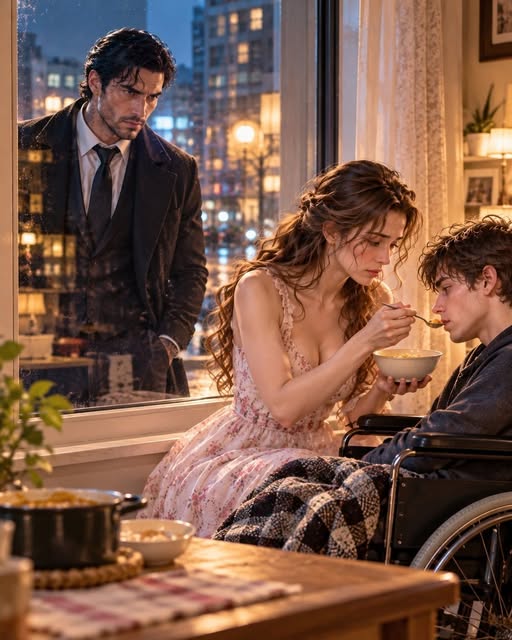
Not the staff. Me. I had insisted with a stubbornness that made Dante check, twice, whether I was issuing a threat. But there were things I needed to do in that kitchen, at that stove, with my own hands, in the house where my family's siege had ended. I made tomato soup. A stockpot of it, the size of a baptismal font, with real cream and roasted tomatoes and basil from Roman's greenhouse, and bread I had bullied the chef into teaching me, and a table set for eleven: Roman at the head, Leo at his right hand in a chair with arms, June beside him, Dr. Patel, Nadia, Marco, Dante and his wife Sofia, the surgeon who had saved Roman and never asked a question, and two captains who had nodded, once, at a secretary's clearance.
Roman served. Nobody objected, because nobody in that house had forgotten what serving meant in it now. He filled Leo's bowl. He filled the surgeon's bowl. And then he filled mine — the biggest bowl at the table, filled to the brim — and set it in front of me and said, for the room, because some apologies should have witnesses:
"No one in this house divides soup."
Leo lifted his spoon, and then he stopped, and looked at me across a table full of food and family and light, and asked the question that had once broken my heart in a two-room apartment in the Bronx:
"Tess… aren't you hungry?"
"Starving," I said. And I sat down, at the table, in the chair that was mine, and I ate my whole bowl. Both things. All of it. In front of everyone. It remains one of the bravest things I have ever done, and I have been shot at in a parking structure.
Later, when the table had dissolved into chess and arguments and the peculiar music of a house at peace, Roman found me in the kitchen, where I was doing what I always do after a meal I cooked: standing at the window over the sink, looking out at the dark, thinking.
He stood beside me a while without speaking. His side ached still, in cold weather; he would not admit it, and I had stopped asking and started simply keeping the good chairs near the fire for him, the way you maintain any long campaign of love — without announcements.
"I followed you home once," he said at last. "With a gun, and a story about you written by a liar. It's the worst thing I've done that I did with my own hands."
"Roman."
"I would like to do it again," he said, "every day, for the rest of my life. Properly. With permission. At a civilized hour, through a front door, into a home that is ours, where a man paints—" he caught himself, and I watched the most feared man in New York revise a sentence in real time, like a mortal. "Where your brother beats me at chess and complains about my cooking. I am not a man who kneels, Tessa. My surgeons have forbidden it. So I will ask you standing, in a kitchen, holding a dish towel, and you may put that in your ledger exactly as it happened."
I took the dish towel out of his hands. "Yes," I said. "On one condition, which is non-negotiable and goes in the record."
"Name it."
"You always eat what I serve you. All of it. In front of everyone."
Something happened to his face then that no camera had ever caught and no enemy had ever seen, and it is mine, and I am keeping it.
"Done," he said.
The ring, when it came that weekend, was his mother's — a plain gold band, worn thin as paper at the back, that had survived a burning car and thirty years in a drawer of things Roman Caldwell could neither wear nor discard. He didn't present it on a cushion or a knee. He put it in the ledger — the foundation's founding ledger, first page, under the list of seized assets converted to grants — and let me find it doing the quarterly books, which is the most romantic gesture available to a man raised by accountants of violence and a woman who reads fine print for love.
Under the ring, in his handwriting, which I had filed for three years and would know in the dark: ASSET, RECOVERED. VALUE: NOT FOR SALE.
We set the wedding for spring, in the foundation's warehouse, so that the plaque could attend. Leo has opinions about the aisle. He has measured it. He walks it in practice now, some mornings, when he thinks the lobby is empty — nineteen steps to the dining table was rehearsal. The aisle is twenty-four.
He intends to make every one of them.
It was an ordinary Tuesday in November when Leo walked — cane, June's hand nowhere near him because he had forbidden it for the length of the room — from the library door to the dining table, nineteen steps, while eleven people held their breath like a single held note. At step nineteen he took his seat at Roman Caldwell's right hand, folded his cane with a flourish, and said, "Write it down, Tess. Put it in one of your ledgers."
So I have. Here it is, in the good column, at the top, in ink:
Leo Hayes walked to dinner.
And the whole table — the don, the doctors, the accountants, the soldiers, the girl who once divided one can of soup into two bowls and lied about lunch — the whole table stood up and applauded, and nobody, not one person in that house, was hungry.