The families meet, when they must, in the back room of a social club on Mulberry Street that has no sign, no windows, and a kitchen that has fed sixty years of men deciding other men's fates over food none of them remembers eating. The rules of that room are older than I am: no phones, no recording devices, no weapons at the table, and no blood on the floor — a man who draws at a sit-down signs his own sentence before the smoke clears, and everyone in that room has buried someone who learned it.
We arrived the way men arrive at that room: early, quiet, and one at a time.
The club keeps a doorman named Enzo who has admitted three generations of us and forgotten, professionally, every face. He took my coat. He did not offer me his arm — I had made that correction in 2019, in front of witnesses, gently — and as Emma passed him he said, *Signora Romano*, with the grave pleasure of a man returning something lost to its shelf, and I heard her hand tighten on my arm in surprise that the world still had her name ready.
The room smelled of cigar smoke a hundred years deep, of lemon oil and strong coffee and the faint iron tang of the radiators. Dinner first — it is always dinner first; men who have already decided to kill each other have, in that room, finished their pasta like gentlemen, because the ritual is the leash that keeps the animal a negotiator. I listened to the seating arrange itself by footsteps and chair-legs: Castellano at the head, his breathing heavy with the asthma he hides from everyone but the dark; Benedetti on his right, wearing the same aftershave he had worn at my father's funeral; Greco, whose rings clicked against his glass every time he drank; Serra, young enough for his chair to fidget. And Dante at my right hand, close enough that the tick of his watch stitched itself into the meal — his watch, a thin gold thing our grandfather had left to *the sons of Aldo*, which Dante had worn, unchallenged, for six years, because I had let a great many small thefts pass as family.
Emma ate little. Under the table her knee touched mine and stayed, the way her foot used to under our kitchen table — the old signal, which I now understood had never been casual. When the plates went out and the door shut on the last waiter, Castellano folded his hands, and the room changed its pressure the way a room does when prayer ends and business begins.
They had called the summit because of the garage. Shots fired in a civilian borough, a wounded man, sirens — heat, in the old language, and heat is everyone's business. But there were two other questions under the table like dogs under a feast, and I could hear them breathing: the question of the Romano succession, and the question of whether a blind don dragging a runaway wife and a whisper of an heir behind him was still fit to hold his chair. Dante had fed both dogs for weeks, in other men's gardens, kindly. I knew. I had let him. A snake you watch is a snake you can catch — and a man should be allowed to finish building his own gallows before you show him the rope.
Emma came with me. That had been her condition, and mine, and for once we did not argue about the same thing in opposite directions. She sat at my left, in a chair Marco placed where the wall was at her back, and her hand rested on the table where I could find it. The room held Castellano, old as Rome and twice as hard; Benedetti, who had been my father's friend; Greco, who wanted my port contracts and made no secret of it; Serra, young for the chair and hungry in a way that made him honest. And Dante, at my right, where he had sat for six years, close enough that I could hear the tick of his watch.
Castellano opened it, the way a priest opens a mass. The garage. The wounded man. The police, bought and quiet, but for how long. I answered what was asked, with the truth, in order. When he sat back, it was Dante who sighed — theatrically, sorrowfully, a man carrying a burden the room should admire him for carrying.
"My cousin has been… under a strain," Dante said. "We are family here, so let it be said with love. His wife left him — no one knows why, she returns with no explanation the council has been given — there are stories of a child, a pregnancy no one has verified, nine weeks unaccounted for in a stranger's keeping. I have defended Luca in rooms like this one for six years. But a chair is not a charity. The Romano family must ask itself—"
"Ask," I said. "Ask everything, cousin. You've rehearsed it so beautifully. Don't stop at the overture."
The room shifted. Chairs. Breath.
"Very well." His voice hardened — the kind voice going into its case like a violin. "Is the child yours, Luca? Can you swear it in this room? Because a succession built on a—"
"Before I swear anything," I said, "the room will hear a recording. It's why I asked Gus Ferro to wait in the kitchen, and why Benedetti's man holds a drive that was couriered to my wife three days after she learned she was carrying my child." I turned my face, slowly, toward the table at large. "My wife received my voice, ordering her to end our child's life. *End the arrangement before it complicates the succession.* Play it, Emma."
She played it. My puppet voice, in that stone-walled room, out of her telephone: a dead thing walking. When it finished, nobody moved.
"I never said those words," I said. "Gus Ferro wired my father's office in 1987. He will tell you that every word was cut from a different room, a different year, and pinned in a row — and that the library it was cut from is my own archive, which three men on this earth can open." I let the silence work. Silence is my country; I am its king. "The archive keeps its own ledger. On the night three days before my wife fled her home, it was opened for two hours and nine minutes, and eleven years of my voice was copied out of it. The credentials, my friends, were Dante Romano's."
The sound a room makes when it turns — I wish I could give it to you exactly. It is not a gasp. It is the small, final settling of a dozen large men recalculating a decade. Dante's chair scraped.
"Credentials can be stolen—"
"They can," I agreed. "So I brought more than credentials. Marco."
Marco set it out the way he sets out everything, like a man dealing cards he has already counted. The gunman taken alive in the garage, his statement, recorded in a hospital with a lawyer of Benedetti's choosing present — I had made sure of that; my evidence would arrive in that room wearing other men's credibility like a good suit. The money trail: five thousand in cash, and a promise of twenty more, routed through a holding company called Vero Holdings, whose accounts were kept by a bookkeeper named Ferro — no relation to Gus, a symmetry that had grieved me — and whose sole signatory authority rested with a management firm Dante had owned, through straw, for four years. The attempt on my wife's building after the garage: the same car, the same cut-out. And last — because a man should always walk into that room carrying one thing he has never told a living soul — the matter of my father's death, and mine that failed.
"Six years ago a bomb took my father's life and my eyes," I said. "This spring I had the case read to me again, every page, because a number in it had begun to itch at me in the night. The timer was a model this family's enemies have never used. It was ours. I found the man who built it — he died in April, in a prison hospital, with the thing on his conscience like a stone in his shoe, and before he died he named the man who paid him to a priest and to the lawyer who holds his confession in escrow. I have heard it. Benedetti has heard it. The name he named, my friends, was Salvatore Romano."
"My father—" Dante's voice cracked, truly cracked, the polish gone. "My father has been dead five years, he cannot answer—"
"No," I said. "He can't. And God forgive me, cousin, I believe he acted from a grievance he thought was justice — his father's will, the chair that passed him by. I might have stood in this room and forgiven a dead man his war." I turned my head until I faced the sound of his breathing, and I let six years of darkness look at him. "But you finished it. You took his war out of its grave and you aimed it at a woman carrying a child, in a garden, kindly. You cut my voice out of my walls and told my wife to kill my heir with it. You paid strangers to make sure — I have the words from your own man's mouth, cousin — *the kid never gets born*."
"You were supposed to die in that car!"
He said it the way a dam says water — all at once, and forever unrecoverable. And then, because ruins make sounds, I heard what I had been waiting six years of nights to hear without knowing it: the scrape of his chair going over, and the small, unmistakable, mechanical click of a hammer being drawn back, in a room where no man draws.
A gun makes many sounds before it speaks. I have catalogued them all; it was my education, after the dark. I heard the click, and I heard the shift of his weight, and I knew the geometry of that room the way I know my own hands — he was two feet from Emma, and a man aiming at the future of my house does not aim at the don.
I moved. I do not remember deciding. The table's edge found my hip, a chair went over, and I put my body where the sound said the bullet would travel, and the gun spoke — deafening in that stone room, a white flower of pain opening in my shoulder — and then there were hands everywhere, and shouting, and the gun skittering across the floor, and Castellano's voice, old and iron, pronouncing the oldest sentence there is: "He drew at a sit-down. Take him. The council will decide before dawn."
Dante was still screaming when they took him out — about his father, about the chair, about a blind thief on a stolen throne — a voice coming apart at the seams, every room in it showing at once. I sat on the floor of the council chamber with my back against the wall and Emma's hands pressed over the hole in my shoulder, her voice in my ear saying my name like a rope she was hauling me up on, and I thought, with a clarity that pain sometimes lends a man: *it is finished; whatever the council decides, it is finished.*
"Luca." Her hands tightened. Her voice changed — a new note under the fear, low and wrong. "Luca, something's— I'm—" The wet warmth through my shoulder was mine. But her grip, suddenly, was not about my wound at all. "It hurts. Not — not like that. Lower. Luca, it's too early, it can't—"
Marco carried her to the car himself. I know because I heard his breathing the whole way, fast and controlled, and because Emma's hand never let go of mine — across the back seat, through the sirening streets, my blood and her terror mingling in the weave of her coat — until the hospital doors took her from me on a gurney with a doctor running alongside calling out words I will hear in my sleep until I die.
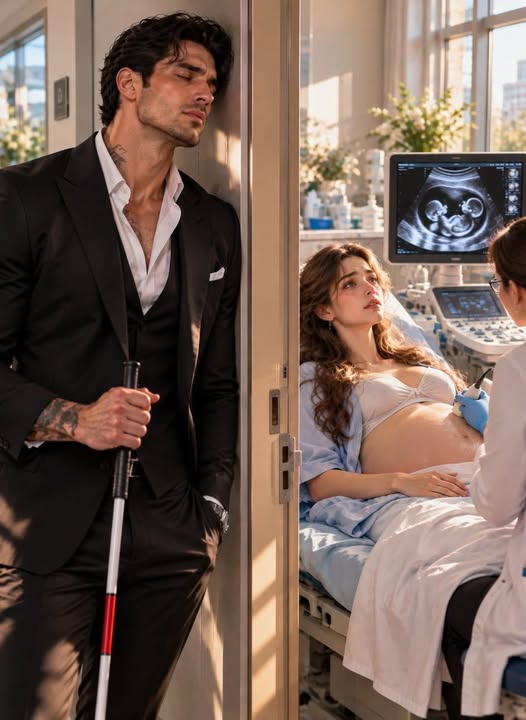
And then there was a corridor. Marble under my shoes. A cane somebody put back into my hand. And I stood outside a closed door, bleeding quietly into a bandage someone had slapped on me in the car, listening for a sound I could not make come faster — waiting, as I had waited nine weeks and one lifetime, for someone to tell me whether my family still existed on the other side of a door.