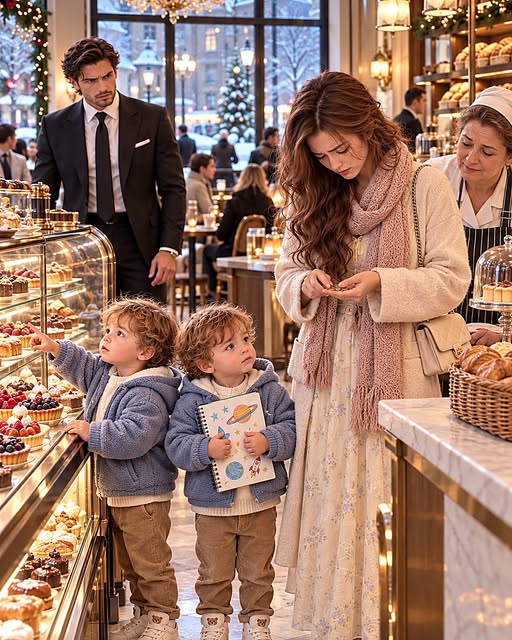
I was ninety minutes away from signing a six-hundred-million-dollar real estate deal when I saw my ex-wife counting coins to feed two little boys who looked exactly like me.
One of them — the smaller one, though only by a breath — tugged at her sleeve and whispered, "Mommy, just buy one sandwich. Eli and I can share."
My name is Preston Calloway. I am thirty-eight years old. I own more buildings than I can count without an accountant, I wear a watch worth more than most families earn in a year, and that Tuesday morning I was supposed to be finalizing the purchase of three luxury towers on Chicago's Gold Coast. I had the pen. I had the money. I had, by every measure the world respects, everything.
Then I walked into a small bakery on the South Side, and everything I had turned to ash in my mouth.
I had stopped there on a whim. My driver, Gerald, had taken a wrong turn after my morning meeting, and the smell of fresh bread drifted through the open window while we waited at a light. I told him to pull over. I cannot explain it even now. I only know that something in me — some part I had buried under five years of boardrooms and acquisitions — needed to stand in a place that smelled like my childhood for sixty seconds.
I was standing near the counter, half-reading an email on my phone, when a child's voice cut through the warmth and the quiet radio music.
"Mom, please. I'm not that hungry."
I looked up.
The boy could not have been older than four. His brown hair fell across his forehead in a way that made my chest tighten for reasons I didn't yet understand, and his enormous dark eyes were locked on the chocolate croissants glowing behind the glass case like treasure in a museum.
Beside him stood another boy.
Same face. Same eyes. Same hair.
Twins.
The second boy was hugging a battered spiral notebook to his chest, its cover crowded with lopsided drawings of planets and stars.
And between the two of them stood a woman I had not seen in five years.
Naomi.
My ex-wife.
For a moment, I genuinely forgot how to breathe.
The Naomi I remembered had worn bright dresses the color of marigolds and tangerines. She had laughed with her whole face, the kind of laugh that made strangers smile in elevators. She used to come home from the school where she taught science with chalk dust on her sleeves and stories about her students so ridiculous she could barely finish telling them before she started laughing again.
The woman in front of me wore a faded coat with a patched elbow. Her sneakers were worn down to a gray thinness. Her hair was dragged back into a messy ponytail, and there were shadows under her eyes that no amount of sleep seemed likely to fix.
She looked exhausted down to the bone.
But it wasn't her exhaustion that nearly brought me to my knees in that bakery.
It was her hands.
She was counting coins onto the counter. Dimes. Quarters. Nickels. A thin, careful stack of small money, arranged with trembling fingers like it was something precious. Like it was everything she had, because it was.
"Two chocolate croissants, please," she told the baker, in the same gentle, steady voice she had once used on frightened seventh-graders.
The old man behind the counter — his name tag read FRANK — glanced down at the coins. His face did something kind and complicated.
Naomi counted again. I watched her lips move. I watched her count a third time, slower, as if the numbers might change out of mercy.
She was short. Eighty cents short, I would learn later. Eighty cents between my sons and their breakfast.
"Mommy." The first twin tugged her sleeve again. "Just buy one sandwich. Eli and I can share. Really. We're not that hungry."
"Theo, sweetheart." Naomi knelt down in front of him, right there on the bakery floor, and smoothed his hair with a tenderness that made my throat close. "You don't have to share. Mommy has enough for both of you. I promise."
She didn't. I could see that she didn't. Frank could see it too.
The old baker looked at his register, then performed the most transparent act of grace I have ever witnessed. He widened his eyes and slapped the counter lightly, like a man who has just discovered a miracle.
"Well, would you look at that! Special promotion today. Two croissants for the price of one. Must be your lucky day, Miss Naomi."
Naomi's head came up. "Frank. You've already helped us so much. I can't—"
"And you can pay me back," Frank said, sliding two warm croissants into a paper bag, "by making sure these boys grow up loving science as much as their stubborn mother does. That's the deal. Non-negotiable."
The twins giggled. Eli clutched his planet notebook tighter, grinning, and Theo did a small, hopping dance of joy on the worn tiles.
Naomi smiled too. But as she stood and turned slightly away, I saw her press the back of her hand to her eyes, quickly, the way people do when they absolutely cannot afford to cry in public.
Something inside my chest cracked so loudly I was surprised no one turned around.
Five years earlier, I had stood in the marble foyer of our Lake Forest mansion — a house with eleven rooms we never used — and I had said to that woman: "If you can't learn your place at my side, you'd better disappear from my life."
I remember her face when I said it. That is the cruelest part. I have always remembered her face.
There was no anger in it. No hatred. Just heartbreak, pure and quiet, like watching something she loved sink slowly out of reach.
"Do you really mean that?" she had asked me.
And I — thirty-three years old, drunk on my mother's approval and my own rising empire — had said, "Yes."
My mother, Victoria Calloway, had spent the better part of a year poisoning me against my own wife, one tasteful, reasonable sentence at a time. "She's a schoolteacher, Preston. You're building an empire. You need a wife who understands your world." She said it over lunches. She said it over charity budgets. She said it in the car after galas, while Naomi sat in the back seat in a borrowed dress, silent, chalk still ghosting her sleeves because she had come straight from a science fair she refused to miss.
Eventually, I believed her. God forgive me, I believed her because it was easier than fighting her, and I dressed my cowardice up as ambition.
Naomi had refused to quit teaching. She didn't care about investor dinners or private jets or which fork mattered at a gala. She wanted a classroom full of children, a small garden, and a husband who came home for dinner.
I called that a lack of ambition.
I have never been more wrong about anything in my life.
In the bakery, Theo laughed at something Eli said — some private twin joke — and then he raised one eyebrow.
Just one. The left one, cocked high in amused skepticism.
My whole body went cold.
I knew that expression. I had seen it in my own mirror for thirty-eight years. My father used to laugh and point at me across the breakfast table: "There's the Calloway eyebrow. Means you're about to cause trouble."
And now this four-year-old boy, who shared a single croissant-bag breakfast with his brother because his mother was eighty cents short, was wearing my father's eyebrow on my face.
I looked at Eli. Same dark eyes. Same brown hair falling the same way. Same unmistakable, impossible expression.
My hands went completely numb.
Naomi gathered the paper bag, thanked Frank with a gratitude so sincere it hurt to hear, and guided the boys toward the door with a hand resting lightly between their shoulder blades.
I turned away. I turned my whole body away and stared at a rack of day-old muffins like they were the most fascinating objects in Illinois, because for the first time in my adult life, I was afraid to face another human being.
That evening, I sat alone in my office on Michigan Avenue, forty-one floors above the city, staring at the skyline while it lit up window by window. The six-hundred-million-dollar Gold Coast contract sat unsigned on my desk. Gerald had asked twice whether I wanted the car. I had sent him home.
I picked up the phone and called Martin Hayes, my attorney — a careful, decent man who had handled Calloway business for fifteen years.
"Martin. I need you to investigate someone."
A pause. "That's rarely a good opening, Preston. Who?"
"Naomi Vance."
The silence changed shape. "Your ex-wife?"
"Yes."
"You haven't said her name in five years."
"I need to know if she has children." I could hear my own voice shaking and did not care. "I need to know tonight."
Another silence, longer. "Why?"
I swallowed. "Because I think I saw my sons today."
Martin called back the next morning before eight.
"Preston. Are you sitting down?"
"Just tell me."
"Naomi has two sons. Twins. Theo and Eli Vance. They're four years old."
My heart was slamming so hard I had to press a hand flat against my desk to stay upright. "When were they born?"
"Prematurely." A rustle of paper. "Seven months after your divorce was finalized."
Seven months. I did the arithmetic like a man defusing something. Conception before the papers were signed. Before the foyer. Before my mother's year of whispers had finished its work, Naomi had been carrying my children while I told her to disappear.
"Who's listed as the father?"
Martin hesitated. "No father is recorded on either birth certificate."
I closed my eyes.
Four years. Four birthdays I hadn't known existed. First words spoken to an empty room. First steps across some worn apartment floor I had never seen. Four Christmas mornings. A woman I had promised to protect, raising my sons alone, counting dimes for croissants — while I bought buildings.
"Martin," I whispered. "Why didn't she tell me?"
"That's the second reason I'm calling." More paper, moving faster now. "I contacted the firm that handled your divorce — Whitmore and Gale, before they dissolved. Their archived file on your case has something strange in it."
"What kind of strange?"
"Naomi tried to contact you while she was pregnant, Preston. There is documentation. A formal correspondence, submitted through the firm, explaining the pregnancy and requesting direct communication with you."
"That's impossible." I was on my feet. My chair rolled back and struck the wall. "I never received anything. Nothing. Not a letter, not a call—"
"I know." Martin's voice was grim. "That's the point. The correspondence was logged as received, reviewed, and handled. Someone instructed the firm — in writing — not to forward it to you."
My blood turned to winter. "Who?"
"Preston, I think you need to see the authorization yourself."
"WHO SIGNED IT, MARTIN?"
His voice dropped to almost nothing.
"Your mother."
I stared at the phone in my hand.
My mother. Victoria Calloway, who lived in a multimillion-dollar estate in Lake Forest, who wore diamonds to breakfast, who chaired three charity boards and had her photograph in the society pages twice a month. The woman who had told me, over and over, that Naomi had walked away from our marriage because she cared more about her career than about having children.
The woman I had trusted more than my own wife.
I dialed her number with a hand that would not steady.
She answered on the second ring, bright as a bell. "Darling! How did the Gold Coast signing go? The Hoffmans are asking—"
"Did you know Naomi was pregnant?"
Silence.
"Mother."
"Preston, I don't think this is a conversation for—"
"DID YOU KNOW?"
Her voice hardened into something polished and cold. "I did what I had to do to protect our fortune."
I could not speak. I stood in my silent office with the phone crushing my ear and no words at all.
"You were building something extraordinary," she continued, reasonable as a surgeon. "That girl would have dragged you down. A schoolteacher, pregnant, clinging—"
"That girl gave birth to my sons."
"Lower your voice."
"FOUR YEARS!" I roared it so loudly that my assistant opened the door, took one look at my face, and closed it again. "I have two sons I never knew existed, and you decided that for me!"
"Everything I did was for this family."
I ended the call before I said something that could never be unsaid.
Then I called my assistant back in and said, "Cancel the acquisition."
She stared. "Sir? The six-hundred-million-dollar Gold Coast agreement? The investors are flying in at—"
"Cancel it."
"But—"
"I don't care."
Then I called Martin again, and I told him I wanted every document. Every letter, every log entry, every signature. I wanted to know exactly what my mother had done, in what order, with whose help.
His answer made my skin crawl.
"Preston… there's one more thing."
"What now?"
"We recovered a sealed letter. Naomi wrote it during her pregnancy. It was in the firm's archive, in the suppressed file. It was never delivered to you."
I pressed my hand against my forehead. "Read it to me."
"Are you sure?"
"Please."
I heard the faint rip of an old envelope. Then Martin stopped.
"Preston…"
"What? What does it say?"
His breathing had changed. When he finally spoke, his voice was barely a whisper.
"This letter isn't only about the twins."
My heart hammered. "Then what is it about?"
"There's something Naomi discovered before the divorce. Something involving your mother. And according to this letter… she was terrified you would never believe her."
I stared at the photograph on my desk — my parents, young and laughing, at the lake house the summer before my father died.
"Martin. What did she discover?"
He swallowed. "You need to hear the first sentence."
And as he cleared his throat to read, I understood that losing my wife, and missing four years of my sons' lives, might not be the worst thing my mother had ever done.