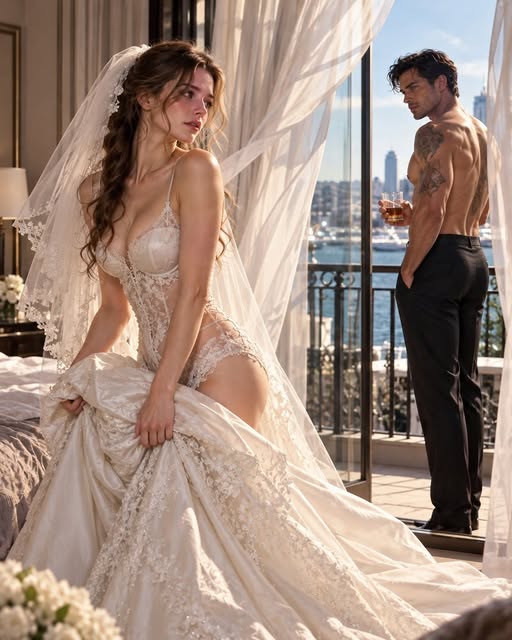
The bullet had done what bullets in shoulders do — enough damage to be respectable, not enough to be tragic. Through-and-through, the surgeon said, missing everything that mattered, as if even Graham's wounds were well-organized. He woke the next morning pale and furious at the hospital's coffee, and when I came in he looked at the scrub top I'd slept in and the cufflink still closed in my fist, and the first thing my husband said to me, hoarse and completely unsealed, was:
"You stayed."
"You got shot at a board meeting, Graham. Where exactly was I going to go — the gift shop?"
"That's not what I mean, and you know it." The machines ticked. Down the corridor, a cart rattled. He turned his hand over on the blanket, palm up, and left it there, open — an offering and a question. I put the cufflink in it, and then, after a moment, my hand. "I've been trying to understand the arithmetic of you since the Calder Museum. A woman who owes me nothing — who was told at 11:17 on her wedding night exactly what she was to me — spent four months in my study reading my brother's death until it confessed. Why?"
"Because someone forged my father's name," I said. "That's the simple answer."
"And the other one?"
I looked at our hands. "The other one is that I married a man who leaves notes on a schedule because he can't say things out loud, and somewhere between I'm trying not to overwhelm you and I have many hidden qualities, I stopped being able to leave him alone inside the worst story he owned." I met his eyes. "You want the truth, Graham? I found the crack in your file the night of the fundraiser. I could have taken it to the press from outside and burned this family down from a safe distance. I stayed in the house instead. I chose your kitchen at two in the morning. I have been choosing, on paper, in writing, every day since. Careful women keep records."
He was quiet for a long time. Then he said, "I married you for revenge and called it strategy for four months. I need that on the record too. Your father was the only man I could still punish for Miles. I told myself the arrangement was about the shares. It was — the shares were real. But I stood at that altar knowing exactly whose daughter you were, and I thought: let him know she's under my roof and means nothing here. Let the debt have interest." His voice went rough. "And then you laughed at my handwriting in my own kitchen, and answered Aldous Crane like a admiral, and read the footer of a form nobody else on earth would have read — and I understood I'd brought the one honest person in Massachusetts into my house as an act of cruelty, and she'd decided to save it anyway."
"Not save it," I said. "Audit it. There's a difference. Saving is sentiment. Auditing is a decision."
"Audrey." His hand tightened on mine. "When the eighteen months end—"
"The eighteen months ended the night your hands shook over a birthday card." I said it steadily, because I had rehearsed it beside an operating theater. "I'm not staying in this family as an arrangement, Graham. If I stay, I stay as a wife — chosen, not contracted. And I have terms."
A ghost of the old dry humor moved in his face. "Of course you do. Dictate them, Mrs. Vale."
"One: Everett faces real prosecution. No quiet family exile, no boat to a warm country. Men died — one man, and it was Miles, and it counts in a courtroom, not just in this family's bookkeeping. Two: my father's name is cleared publicly. Not whispered to the trustees. Publicly — the same papers that printed killer's daughter. Three: when you restructure the legitimate companies, the compliance directorship is mine. Every inspection, every subcontractor, every sign-off in this family runs through an office I build. Miles was going to make you legitimate. I'm going to finish his paperwork. Four—" I paused. "Four: you learn to say things out loud. Not everything. You're you. But the important things don't go on the schedule, Graham. They get said to my face."
He considered this with the gravity of a man signing a treaty. "Amendment," he said. "The notes stay. They're our first language. I'm not giving up the first language — I'm adding a second one."
"Amendment accepted," I said, and he pulled me, one-armed and careful of the tubes, down to the side of the hospital bed, and kissed me like a man amending a contract in the only clause that mattered.
Everett Vale was arrested at his foundation's offices, in front of his staff, with his coat folded over his arm like a man late for lunch. The DA reopened the Harborpoint collapse as a homicide investigation. Sorensen, with eleven seconds of his own voice playing in every interrogation room in Suffolk County, flipped within the week and gave the prosecutors a decade of errands. The family council stripped Everett of every Vale name he carried — companies, foundation, club memberships, the crypt where he'd expected to lie beside his brother. Charlotte went to see him once, in custody, before the transfer. She told me about it afterward without satisfaction, the way you report weather.
"He said, 'You always did read people better than paper.' I told him that was the difference between us. He read people as paper — as instruments, as entries. I read my daughter-in-law and knew the paperwork was lying." She folded her hands. "He asked if Graham would come. I said no. Some files stay closed."
The clearing of Daniel Lennox was done properly, which in Boston means it was done in print and at a podium. The trustee board issued a statement. At the press availability that followed — twenty minutes, a wall of cameras, a court of public opinion that had already convicted my father once on thinner evidence than a lunch menu — a reporter from the Herald got the question the whole city had been asking since the Calder Museum photographs.
"Mrs. Vale. Straight answer. Did you marry him for the money?"
The room inhaled. Beside me, Graham — one arm in a sling, present against medical advice and two trustees' pleading — did not move, but I felt the depth charge stillness come over him, and I put my hand flat on the podium to keep us both honest.
"I married him," I said, "because one hundred and seventeen families in South Boston were about to lose everything to a debt, and my signature was the price of their keeping it. That's not a romance. I've never sold it as one." I looked straight into the cameras, because paper is read in order and so, I'd learned, are press conferences. "What I didn't know, when I signed, was that my father's name was the collateral on a forgery. What Graham didn't know was that he'd married the only person in Massachusetts stubborn enough to read his brother's file to the last footnote. The money is in the public record, and so is the fraud, and I'd invite everyone in this room to read both files completely — in order — before writing another word about either of our families."
Graham spoke then, once, without notes, in the voice he used for harbor weather. "She's being modest, which the record will show is unlike her. She married a contract and audited it into a marriage. The Vale family owes Daniel Lennox its name back. It owes his daughter considerably more. We're paying both debts in full, in public, starting today." He turned and walked out on that, because Graham Vale has always known what every auditor knows: the last true line is where you stop.
The blog that had run KILLER'S DAUGHTER ran the retraction above the fold, with the examiner's affidavit summarized by a reporter who sounded embarrassed. My father read it at his kitchen table in the house that was no longer going to be seized, and then he read it again, and then he called me and said, "They spelled Lennox right this time," and hung up before I could hear him cry.
A week after the surgery, my husband had Marcus drive us to Harborpoint at dawn, over the surgeon's written objections and my spoken ones, because there was a document he needed to finish reading in the place it had been written.
The terminal was quiet — cranes asleep, water the color of slate, the new Platform C standing in the early light with its inspection tags doubled and bright, the way Lennox crews had always doubled them. Graham stood at the memorial plaque the family had set into the pier — MILES VALE, it said, and the dates, and nothing else, because for four years the family had not known what else was true — and he took from his coat the photocopied last page of Walt Briggs's diary, and read the entry aloud, to the harbor, in a voice that only shook once.
"7:10 a.m. M. Vale on site — walked Platform C himself. Asked about inspection tag. Told paperwork handled. 7:40 — crew up." He folded the page with his good hand. "He called me from the car park that morning. Did I ever tell you that? Four years, and I've never said it in a room. He was laughing. Miles laughing was a weather event. He said, 'Paperwork's handled, brother. Yours is the meeting, mine's the walking. Try not to sell the harbor before lunch.' And I said—" Graham stopped. The gulls went up off the pilings all at once, the way they do, for no reason men can see. "I said, 'Walk it twice, then. Once for you and once for the paperwork.' It was a joke. We had a hundred jokes. It was the last thing I ever said to my brother, Audrey — a joke about the paper that killed him."
"And now the paper acquits him," I said. "All of him. The walking, the questions he was already asking about the tags, the man he was going to be. That's in the file now too, Graham. In order. Forever. Your uncle built a file to bury two men, and it's the file that's going to be read at both their trials — his, in the courthouse, and yours—" I touched the plaque, where the dates were, where the truth now stood guard over them. "Yours is adjourned. You're allowed to stop attending it."
He put his forehead against the cold brass of his brother's name, and I held the railing and the moment and him, all three, until the sun came up over the harbor Miles Vale had intended to make honest.
Graham went to South Boston himself, when the sling allowed driving — which is to say, two weeks before the surgeon allowed it. I was not invited, and I understood: some apologies are a man's own paperwork. My father told me about it later, in his own spare style. Graham had stood in the ruined office above the quiet factory floor and said: I hated you for four years because hating you was easier than the arithmetic. Miles died because men I trusted forged paper, and I punished the only honest name in the file. I'm sorry. I can't give you the four years. I can give you the truth in print, your contract record restored, and a son-in-law who reads documents now.
My father said: "You took a bullet for my daughter in a corridor. You and I are never going to be easy. But we can be honest." And then — this is the part my father repeated twice, as if he couldn't quite believe his own mercy — he shook Graham's hand with both of his, like a man signing something in duplicate.
Graham came home that evening to find the household schedule on the kitchen counter, because some rituals survive revolutions. Friday's entry, in the staff's neat typing: Family dinner, Marigold Room. Car at 6:40. And below it, in a hard, slanted hand — slower than usual, the letters leaning on each other like tired soldiers, because he'd written it with the folder braced against his sling:
Clause regarding separate bedrooms: rescinded. Effective immediately.
I picked up a pen. I wrote, in my own hand, underneath:
Approved.