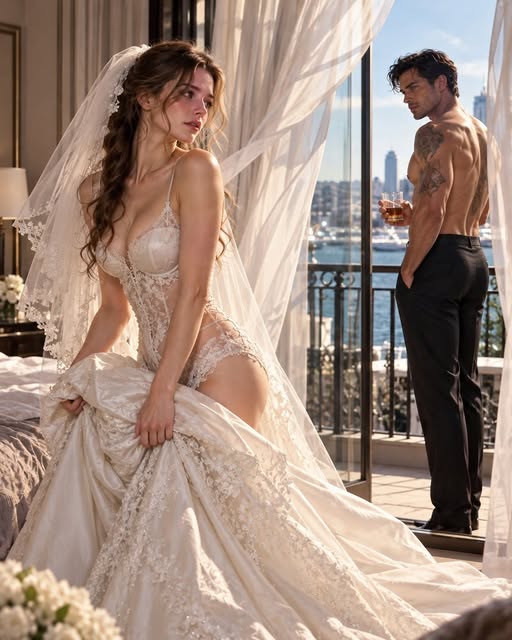
Eleven months after my wedding night, my husband renewed his vows to me in the Calder Museum, in front of forty people instead of three hundred — because this time we only invited the ones whose names belonged in the file.
By then, my office had teeth, and the whole waterfront knew whose they were.
The compliance directorship the trustees had voted me wasn't a title for the annual report. In my first quarter I audited every subcontractor chain in the family's legitimate businesses to the third tier — the tier nobody audits, the tier where Harrowgate had lived — and in the second quarter I disqualified Pruitt Haulage, a freight firm that had hauled for the Vales for nineteen years, run by a genial man who had godfathered two Vale cousins and fully expected the new Mrs. Vale's standard to bend at the border of friendship. His third-tier inspection documentation was a fiction of lapsed dates and photocopied signatures. Not fraud — worse, in my professional religion: habit. The habit of paper no one expects to be read.
Gerald Pruitt went over my head, as men of nineteen years' standing do, to the only head above it. Graham heard him out in the study — the same study, the same long table where we'd read a death to its confession — and then he called me in, and Gerald smiled the smile of a man about to watch a wife be managed.
"The Lennox Standard," Graham said, "applies to friends first. That is not a flaw in it, Gerald. That is the entire design. A platform stood certified in this family for four years because everyone involved was a friend of someone. My brother is in the ground and my uncle is in a cell and you are in my study asking me to make an exception for habit." He stood, and even healing, even one-handed with the cufflinks, he stood like a harbor wall. "Fix your paper. Reapply in a year. My wife's office will read it in order."
Afterward, alone, I said, "You didn't even look at his file."
"I read his file the way I read everything now," Graham said. "I asked myself what you'd say at two in the morning. Then I said it at two in the afternoon. It's called progress, and you're responsible for it, and I intend to put it in the schedule."
Everett Vale had been convicted in the spring — fraud, conspiracy, and manslaughter by a paperwork trail so complete that his own lawyers had advised him to plead to most of it. The jury needed four hours. Judge Reeve, retired and therefore free to attend weddings instead of sentencing people at them, sat in the second row beside Walt Briggs, who had worn a suit for the first time since Miles's funeral and kept tugging at the collar. My father walked me down the museum's glass hall — slowly, because Daniel Lennox does everything at the pace of a man who checks his work — and when we reached Graham, my father put my hand in my husband's and said, to him, in a voice the whole small room could hear: "Her signature's her own, son. Always was. I just lend her the name."
I wore the deep green dress. Not the six-thousand-dollar lace — that had gone, with Charlotte's blessing and a certain ceremony of its own, to a charity auction for the Harborpoint families — but the severe green silk from the fundraiser, the dress from the night Graham Vale first looked at me across a dinner table and recalibrated. It seemed honest. Our marriage had started at a closing and been saved at a fundraiser and bled for in a corridor; it was not a white-dress story, and we were done performing it as one.
Graham had written his vows on an index card. I knew the handwriting before I saw it — hard, slanted, careful. He unfolded it in front of forty witnesses, and the most feared man in Boston read his wedding vows off what was unmistakably a page torn from a household schedule.
"Item one," he said. "You mean everything to me, Audrey." The room made a sound — Charlotte, audibly, in the front row, like a woman paying off a long debt of breath. "Item two: the record is corrected, and stays corrected. Item three: nothing important goes unsaid in this marriage again. It gets said to your face, by me, out loud, even when—" he glanced up, and the dry humor surfaced, and every person there could see what it cost and bought him — "even when a note would be significantly easier."
My vows were shorter. I had drafted eleven versions, the way I draft everything. In the end I said: "I read paper for a living. You're the only document I've ever read that got more honest the longer I studied it. I choose the author. Every day. On the record."
Afterward, at the reception, Walt Briggs raised a glass and announced that he had news of his own: the Miles Vale Safety Foundation — funded by the settlement from Meridian's insurers and a Vale endowment — had certified its first class of platform inspectors that morning at Harborpoint Terminal, under the inspection protocol the industry papers were already calling the Lennox Standard. Briggs himself was the foundation's head of training. He had, he informed us, made every trainee memorize the footer of Form VSC-114 and the date of Revision 6, the way other men made their sons memorize scripture.
"Nothing stands on paper that a man hasn't stood on first," he said. "That's the whole catechism. The young Mr. Vale wrote it. We just finally read it."
Then Briggs did something none of us expected. He called forward the class's youngest graduate — a woman of twenty-three in a new inspector's jacket, with her certificate still in its folder and her whole face lit like a harbor at dawn — and introduced her to the room as Danielle Whitaker, first in her class on the written examination, perfect score on the practical.
"Whitaker," my father said, from his chair, in the voice of a man reading a beloved roster. "Sam Whitaker's granddaughter. Sam ran my number two press for thirty years."
"Still does, sir," the young woman said, "two days a week, since you reopened the floor. He says the presses missed him." She turned to me, and her composure wobbled at the edges, and I understood that she had rehearsed this. "Mrs. Vale. My grandfather's name was on a board in your father's factory, and it stayed on the board — he told me it stayed on the board on paper all through the bad years, even when the floor was shut, because your father said a man's name stays on the roster until the man takes it off himself." She held up her certificate. "I just wanted the family to know where the roster leads, is all. It leads here."
Charlotte Vale reached over, without a word, and took my father's hand where it lay on the table — the mother of the dead boy and the father of the audited bride, holding on to each other in front of forty witnesses like a treaty being signed in the only language left — and my father, after a moment, let her, and covered her hand with his, the tall-looped signature of a man countersigning mercy.
My father's factory floor was running again — not at the old scale, not yet, but the presses were running, and forty-one of the original hundred and seventeen were back on the floor, and a city contract, fairly won and honestly certified, hung framed in the office next to a four-year-old folder labeled HARBORPOINT — WITHDRAWAL, which Daniel Lennox declined to throw away. Careful men keep paper. Sometimes the paper is the only witness that never learns to lie.
The morning of the renewal, before the hair and the dress and the museum, Graham drove me himself — one-handed still, over objections now purely ceremonial — to the cemetery on the hill where the Vale family keeps its dead, and walked me between the stones to the one I had never visited, because it had never, until then, been mine to visit.
MILES ALEXANDER VALE. The dates. Loved is not carved there. It didn't need to be; the grass in front of the stone was worn by four years of a brother's standing.
"Miles," Graham said, with the formality of a man making an introduction at a table where protocol matters, "this is Audrey. My wife." A breath. The wind came off the harbor below and moved the trees like a hand through paper. "She's the consultant. The one who read the footer." He took from his coat a photocopy — the corrected certification record, the state's amended file, my father's name restored in the same clerical typeface that had once buried it — and weighted it under the stone's base with a sailor's care, where the weather would take it slowly and the record, elsewhere, would not weather at all. "The file's right now, little brother. All of it, in order. You can stand down from the platform. She's got the inspections."
I put my hand flat on the cold top of the stone, the way I had once put it on a shift board of a hundred and seventeen names. "I'll keep the tags doubled," I said. "That's the whole catechism. Paper expensive to fake, and someone awake at two in the morning who actually reads it. Rest now. We've got the walking."
That night, in the brownstone, I stood in the master bedroom — our bedroom, for months now — unpinning my hair, and my eyes went to the clock the way they had gone, once, in a silk slip with shaking hands.
11:17 P.M.
Graham saw me see it. He came and stood behind me in the mirror's frame, his arms around my waist, his chin at my shoulder — the shoulder that had healed into a silver seam he sometimes traced the way other men read Braille — and in the glass, our eyes met.
"At 11:17 on our wedding night," he said, "I told you you meant nothing to me."
"You did."
"I've been correcting the record ever since."
I leaned back against the whole solid fact of him — the man who tipped delivery drivers like apologies, who cooked at two in the morning, who had put his body between me and the last loose end of his brother's murder without consulting a single document. "Correction accepted," I said. "Filed. Stamped. Entered into evidence."
"Careful," he murmured. "You'll make a romantic of me yet."
"You were always one," I said. "You just kept it in a locked room on the third floor."
In the morning there was one more document in the house of Vale, and for once it was mine, and for once my handwriting — on the envelope I'd left on the household schedule in the kitchen, addressed to him in my neatest consultant's hand — was not entirely steady. Inside was a single sheet from Boston Medical, the kind with a letterhead and a result and a date circled twice.
I wasn't there when he opened it. I was standing in the doorway of the kitchen where I had once laughed at his handwriting and been frightened by my own laugh, watching my husband read the last page of the arrangement — the arrangement that had begun with a debt, a threat, and eighteen months of nothing — and go absolutely still, the way he had gone still over a birthday card in that same kitchen, a lifetime of paper ago.
He picked up a pen. Under next Friday's entry — Foundation gala, Harborpoint. Car at 6:40 — Graham Vale wrote, in his hard, slanted hand, the handwriting that had taught me who he was before he could say a word of it out loud:
Second bedroom: convert to nursery. Effective immediately.
And below it, before he had even turned around to find me watching, before the kiss and the laughing and the phone call to Charlotte that would make her pay off one final debt of breath — he added the item that had headed his vows, and would head, I already knew, every honest document in our house for the rest of our lives:
Item one: You mean everything.
I picked up the pen when he finally turned and held it out to me, and underneath his writing, in my own hand — the hand that had signed a marriage contract to save a hundred and seventeen families, and stayed to save one more — I wrote the word that had ended the worst night of my life and begun all the best ones.
Approved.