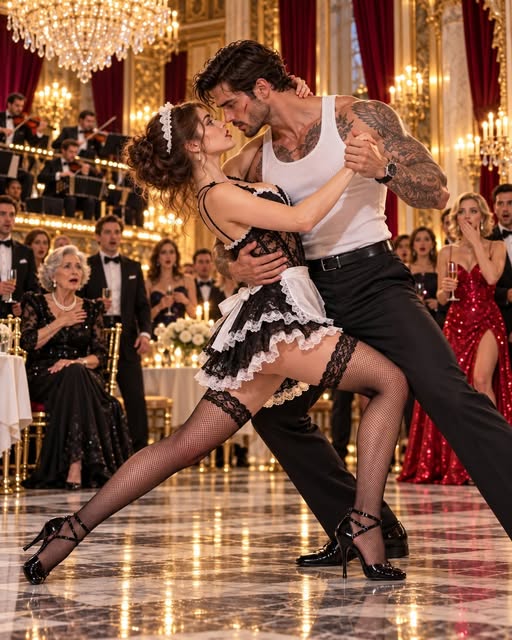
I had expected the war Conrad Hale promised. What arrived instead was slower, colder, and much more instructive: the true sound of an empire holding its breath.
The harbor commission voted nine days after the gala. Grant lost the terminal — two votes, exactly the two Conrad had boasted about — and I watched him take the news in his study with the stillness he'd been practicing, one hand flat on the desk, while Marcus read out the count and the cost: the terminal project, eighteen months of work, a fortune in projections, gone because a Whitmore had finally declined to purchase his future with somebody else's daughter.
"We knew the price," Grant said. "We paid the quoted price. That's new for this family. Write it in the ledger." He looked up at me, where I stood in the doorway with two coffees I had made myself, because some habits of mine were not choreography. "Your father lost his studio standing in a doorway telling Thomas Whitmore no for six years. I figure the family can survive losing a dock telling Conrad Hale no once."
Two of his captains defected to the Hales within the month, with their crews and their routes. One came back within two, poorer and quieter, having discovered that Conrad's generosity had a meter on it. Grant took him back without a word of triumph, which taught me more about the man than the gala had. Men did die that autumn, in the Hale docks dispute — two, both stevedores, neither of them soldiers, both of them somebody's Ethan and Noah — and Grant paid for both funerals and both families' rents for a year, in person, in cash, without photographers, and came home gray-faced and stood in the ballroom at midnight not dancing, just standing, in the place where the music stops.
"Teach me the accounts on this one," I said, and put my hand in the middle of his back, where the tension lived. "Not the money. The rest of it."
"There's no ledger for the rest of it," he said. "That's the problem with the rest of it."
"We'll start one," I said. "I'm good with books. Ask anyone. I learned columns from a man who kept a dance studio solvent on charm and arithmetic."
But the autumn wasn't only losses. In the first week of October, in a Whitmore Reserve boardroom with lawyers on both sides and Eleanor presiding like a small silver supreme court, the Ashland Avenue deed was signed over to the Brooks Family Trust — to me and Rachel jointly — together with a check drawn on thirty years of distillery ground-rent that made Rachel sit down hard in the corridor afterward, holding the boys' school forms, saying "Em, this is the rent. This is the rent forever. This is — Em, this is Dad's floor. We own Dad's floor."
Before the signing week was out, I asked for one more thing — not in the contracts, which is why I remember asking, and why I remember that it was granted without a single lawyer being consulted. I wanted to walk the distillery floor. The actual floor. Where the bottling line now stood in long humming rows over the ground where my father's studio had been.
The plant manager was a man named Okafor who had worked for Whitmore Reserve for thirty-one years, which meant he had arrived as a young man three years after the fire, into a building whose history nobody discussed. He walked me down the line with the wary courtesy of a man escorting a unexploded story, past the washers and the fillers and the labeling drums, the air sweet with oak and alcohol and steam.
"Here," he said at last, stopping where the oldest part of the plant met the new. "The surveyors' marks are still in the concrete, if you know where to look. The old building's foundation line." He pointed with his chin, not his hand, the way you point at something in a church. "The bottling line was laid along it in '96. Nobody told us why the floor plan bent there. Production floors don't bend, Miss Brooks. Somebody senior insisted." He glanced at me sidelong. "We used to get the story in pieces, us old ones. That there'd been a dance school. Music school. Something with children in it. On Sundays, before my time, they say the men on the first shifts could hear — " he stopped, embarrassed by his own sentence.
"Hear what?" I said.
"Nothing. Superstition." He folded his arms. "Pipes. The building settling. Men hear things on quiet shifts." But he said it the way people say things they have decided, privately and permanently, to believe the opposite of, and I understood that for thirty years, in the small hours, the men of Whitmore Reserve had worked their shifts inside the faint, pipe-borne rumor of my father's Saturday music, and had kept the rumor the way you keep anything fragile in a factory: carefully, and without ever once writing it down.
"When the studio opens," I said, "the first Saturday class is for the children of anyone who's ever worked this floor. Free. Forever. Your grandchildren are on the list whether they like it or not, Mr. Okafor."
He looked at the bent production line for a long moment. "I have four," he said. "Two of them dance already. Kitchen tiles, mostly." And then this thirty-one-year servant of the house of Whitmore did something no contract had required and no restitution schedule had itemized: he took off his hard hat, in the middle of his own plant, and held it against his chest like a man at a graveside or a christening — it is not always possible, I have learned, to tell those two apart, and on Ashland Avenue that autumn it mostly wasn't necessary.
We walked the site the following Sunday, the four of us — Rachel, me, and two small boys who had been promised, with auntly solemnity, that this parking lot was actually a palace in disguise. It wasn't much to look at: cracked asphalt, a chain-link fence, the distillery's brick wall on one side with a faded ghost sign high up that nobody had ever painted over, because Eleanor, I learned, had forbidden it for thirty years with no explanation anyone dared demand.
BROOKS, the ghost letters said. And below, smaller: DANCE STUDIO.
Ethan, seven years old and literal to his bones, read it aloud and then looked at me with enormous seriousness. "Aunt Em. It still says Grandpa's name. It never forgot."
"No," I said, crying into the October wind in a parking lot in front of my entire family. "It never did."
The bandoneon came home in November.
Eleanor summoned me to her sitting room with the air of a woman staging an ambush, and on the table beside her tea sat a case — old leather, brass corners, the initials D.B. worn almost smooth on the lid. "Thomas kept it," she said. "After the fire, the instruments that survived went to auction for the debts, and my son — who could have bought the building, the business, the man himself a lifeline, and chose the land instead — my son went quietly and bought his friend's bandoneon, and kept it in the music room safe for thirty years, and never played it, and never sold it, and never once had the courage to return it or the decency to throw it away. I have hated this object for three decades, Emily. It is the exact size and weight of a Whitmore apology." She pushed it an inch toward me. "It belongs to Daniel's daughter. It's yours. Play it badly at my funeral and think of us both."
I opened the case. The instrument inside was beautiful and ruinous and perfect, bellows like a paper lung, smelling of cedar and old storage and, faintly — or I imagined it, and I no longer care whether I imagined it — Saturday mornings.
I don't play. I never learned; dance was my language, and music was his. But Rachel's younger boy, Noah, five years old, solemn as a judge, reached out one finger and pressed a single button, and the old instrument drew a wheezing, golden, imperfect breath in Eleanor's sitting room, and the three of us — an eighty-three-year-old mafia matriarch, a housekeeper in a fiancée's dress, and a kindergartner — sat in the wreckage and glory of our families' whole tangled history and laughed until we cried, and then cried until we laughed.
Vanessa came to the studio site in December, alone, in a car she drove herself, which for Vanessa Hale was practically a disguise.
I was there with the architects — the reopening plans, the sprung floor, the mirrors, my father's Saturday light reconstructed by men with drawings — when her car pulled in, and she got out in a plain dark coat with no photographer, no friend, no audience, and stood looking up at the ghost sign for a long time.
"I never loved him," she said, by way of hello. "I want that on some record somewhere. I never loved Grant. I loved — " she searched, and for the first time since I'd met her, Vanessa Hale looked like a person doing arithmetic she hated " — I loved that there was a list of things I was owed, and he was the biggest item on it, and nobody was ever going to hand my item to the help." She turned to me. "You were never the scandal, Emily. You were the evidence that the list was fiction. I couldn't afford you."
"No," I said. "You couldn't. None of you could. That was never my price being high, Vanessa. It was your money being the wrong currency."
She laughed — actually laughed, a short surprised sound, the first honest thing I'd ever heard from her. "My father is sending me to Milan. 'Seasoning,' he calls it. A year, maybe two, until Chicago forgets which of us lost." She looked at the sign again. "Conrad Hale does not lose daughters gracefully. I suppose you'll hear things. Some of them will even be true." She got back into her car, and then — window down, engine running, one last moment of the girl with expensive jewelry — "For what it isn't worth: Paige confessed to the archdiocese, the police, and a podcast. In that order. Even my scandals have understudies."
She drove away. I have never seen her since, and I find, to my own surprise, that I hope Milan was kind to her. Cruelty was the only subject she was ever tutored in. It is possible to be glad to see the back of a person and still hope the world teaches them a gentler curriculum than the one they got.
Grant proposed properly on the first Saturday of spring, in the middle of the unfinished studio.
No ballroom. No cameras. Radiators ticking, sawdust on the new floor waiting for its final sanding, Rachel's boys' chalk drawings of dinosaurs still ghosting one wall because I had flatly refused to let the painters cover them until photographs were taken for the family archive. He had come, supposedly, to inspect the work — the Whitmore organization was funding the reconstruction as part of the restitution, though every contract in the building had my name and Rachel's on the first line, a detail he had insisted on with a ferocity that had startled his own lawyers.
He stood in the middle of the floor where my father had stood ten thousand times, in the light coming through the new windows the way it used to come through the old ones, and he got down on one knee in the sawdust in a suit that cost more than my first car.
"Grant — " I said, alarmed, delighted, terrified. "The suit — "
"The suit can be cleaned. I checked. Extensively. In advance." He took my hand. "Emily Brooks. The first time I asked you to marry me, it was a joke, in front of two hundred people, and it was the cruelest thing I did that year, and I have done the arithmetic on that too. The second time, it was a negotiation, in daylight, with terms. This is the third time, and there is no audience, and no ledger, and no word being kept — " his voice, for the first time in all the months I'd known him, went slightly unsteady " — there is just a man who gets up at six in the morning now even when there is no lesson, because the house is better on the days you're in it. Marry me because Tuesdays are better. Marry me because my grandmother is eighty-four and has started referring to you as her favorite grandchild and I'm losing in the rankings. Marry me because I intend to spend the rest of my life making sure you never lose your balance — and because you're the only person alive who knows what that promise actually costs."
I said yes in the sawdust, with the chalk dinosaurs as witnesses, and my father's name fading gently on the wall outside in the spring light, exactly where it had always been.