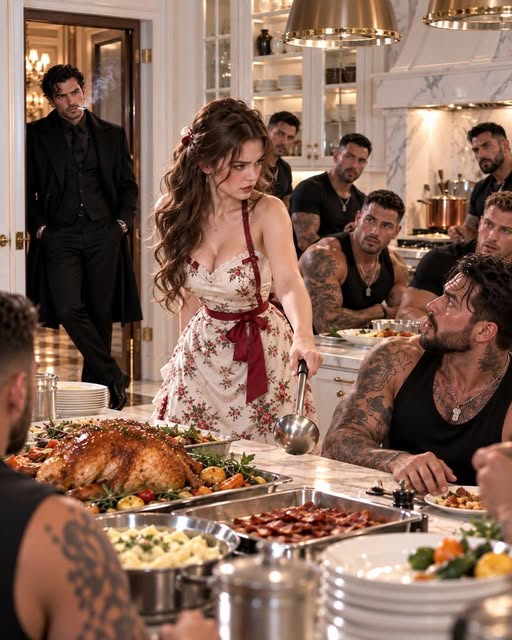
It started with a delivery that never arrived, and a storm I could smell coming off the river.
The forecast said ice by Thursday night. I'd run a plant kitchen long enough to know what ice does to country roads and delivery trucks, so on Wednesday morning I sat down with my green ledger and moved the big weekly supply run a day early — Thursday's order to Wednesday, every crate of it — and I walked the change down to the service office myself and pinned it on the board in my own handwriting.
Cole, the driver, read it over my shoulder. "Thursday's always been Thursday, Miss Maggie."
"Thursday's about to be under half an inch of ice, Cole. Wednesday will do."
He smiled his whole-face smile. "You're the boss of the kitchen."
I should have listened harder to something in that sentence. I didn't. That's on me, and I've turned it over enough nights since.
Because on Thursday night — the old night, the scheduled night — Anton Karras's men hit a Duca freight convoy on the river road, in the ice, with the kind of precision that isn't luck. They knew the route. They knew the timing. They knew the escort would be light because the estate's supply detail always ran the same road an hour behind the freight on a Thursday.
What they didn't know was that the supply detail had run on Wednesday. My ice storm had moved five men off that road. The convoy still got hit — two men hurt, one truck burned — but it wasn't the massacre it was drawn up to be, and by Friday morning Ravenwood was a kicked hive: engines, radios, men moving in pairs, and a silence at my breakfast table you could have cut with one of my own knives.
And I understood, with the eggs going cold on the pass, what nobody said out loud. Somebody inside the walls had sold the schedule.
By noon the suspicion had found its way downhill, the way suspicion does, and it pooled — naturally — around the newest person at Ravenwood.
"The cook changed the run," I heard through the pantry door, in a voice I knew. Cole's voice. Pleasant as ever. "Moved it a day early, all on her own. Ask yourself why the freight boys nearly got killed the one night her truck wasn't where it belonged."
My blood went up so fast the room tilted. Then it went cold, and clear, because a woman who has been poor and a woman who has been blamed learn the same lesson: panic is a luxury; paper is a weapon.
I took the green ledger off its shelf. I took the pencil-written shortage pages out of the back, where I'd hidden my own facts even from myself. And I walked into Roman's study at two o'clock without knocking, which nobody at Ravenwood did, and put the ledger on his desk between the gun and the telephone.
"Your driver says I moved the delivery to set up your convoy," I said. "He's right about one thing. I did move it. Here's the weather page I clipped, here's my note, here's the time I pinned it on the board — Wednesday, nine in the morning, in front of God and Mrs. Doyle." I turned pages with hands that shook only a little. "Now look at what they hit, Mr. Duca. They hit the Thursday schedule. The OLD schedule. If I'd sold your men, I'd have sold the new one — the one with your supply truck alone on that road and your convoy an hour ahead of it, unguarded. Whoever talked to Karras never saw my change. Which means your leak isn't new, and it isn't me. It's somebody who stopped reading the board a while ago — somebody working off an old printed timetable—" I put the shortage pages on top, last, like a trump card "— and somebody who's been stealing two bottles of Barolo and six pounds of coffee at a time out of my stores for months, a little at a time, the way a man does when he's being paid in drips and doesn't want a pattern. There it is. Dates and weights. I weighed the beef myself."
Roman read. Roman read the way he listened — completely, without moving. The room was so quiet I could hear the radiators tick.
"Who else sees the printed timetable?" he asked.
"The board copy goes to Cole for the supply run. There's one in your office. One in the garage." I swallowed. "That's what I know. It's your house. You'll know what it means."
"It means," he said, standing, "that I owe you an apology I don't intend to make with words." He looked at the shortage pages once more. "And Cole?"
"Cole smiles at me with his whole face," I said, "and in three weeks he's never once arrived to find me free to walk his crates in. I don't call that proof. I call it a smell. You decide what it's worth."
"How long have you known about the stores?" he asked.
"Since my third day," I said. "The beef told me before the bottles did. Six pounds doesn't walk out of a loin by itself."
"And you sat on it. For weeks. While a thief ate out of your kitchen."
"I sat on it the way you sit on a hen, Mr. Duca." I met his eyes and held them, which nobody did, but I had flour in my past and coal in my future and I was past minding. "A woman who's been homeless knows the price of an accusation that's only almost true. It costs the accuser everything and it costs the thief nothing. I wanted paper before I wanted justice. Paper doesn't flinch, and it doesn't get thrown out in the snow."
Something in his face changed then — not softness; respect is a different metal, and heavier. "You'd have made a formidable capo, Maggie Sullivan."
"I'd have made a formidable anything," I said. "I was busy surviving. It's not the same as having no talent, whatever the world thinks."
That afternoon I laid in the house for a siege the way you lay in a house for a storm, because in my experience they are the same discipline: fill everything that holds water, charge everything that holds a charge, count the candles and the cans, and put food where frightened people can reach it without thinking. I sent Angelo down to Walter's gatehouse with a crate — soup thermoses, bread, a ham, blankets, and the little radio Pete tuned for him — because whatever came at Ravenwood that night would reach the gatehouse first, and I would not have that old man cold and hungry at his post.
Walter received the crate like a quartermaster. "You take care of the whole line, Maggie," he said, settling the thermoses in a row. "That's what you do. You feed the whole line before the battle."
"Somebody has to."
"Your mother teach you that?"
"My mother," I said, "fed a picket line of four hundred men out of a parish kitchen in a strike winter, on donations and nerve. She used to say hunger is the first casualty and the easiest one to prevent." I straightened his collar without thinking, the way I'd have done for any soldier of mine. "You see anything tonight, Walter, you don't be a hero. You call it in and you get behind something thick. That's an order from your commanding officer."
"Yes, ma'am." He touched the keys in his breast pocket. "Cook's army. Best posting I ever had."
Roman found me at dusk, checking the kitchen shutters. He stood in my doorway with the storm smell on him and said, without preamble, "There's a decent chance Karras tests the walls tonight. I can have you in a hotel in the city in forty minutes. Vincent would take you himself. You'd be safe, and you'd be paid, and no man here would think less of it."
"Would you think less of it?"
"That's not the question I asked."
"It's the only one I'm answering." I latched the last shutter. "Mr. Duca, you don't evacuate the cook before a siege. That's precisely when a house needs her. Thirty men fight better fed, they heal better fed, and they hold a line better knowing there's a hot pot and a light on behind them. My mother held a kitchen through a strike, a blackout, and a fire. I am not going to a hotel."
He was quiet a moment. "And if they come through the kitchen?"
"Then they'll find out what every plant manager in Pittsburgh learned." I picked up my ladle off its hook and set it by the stove, where my hand would find it in the dark. "The kitchen holds."
"You're not staff, you know," he said, strangely. "Not anymore. Whatever happens tonight—"
"I'm the cook," I said. "It's the same thing, in a house that's worth anything. Go and do your work, Roman, and let me do mine."
That night the storm made good on its promise, and the men Karras sent to look at our walls came with it.
Walter saw them first — of course he did; it's why God and Roman Duca put him in that gatehouse. Two cars, lights off, rolling slow past the north fence where the cameras had a seam. Walter hit the gatehouse alarm and was on the radio to the house in a voice as calm as Sunday: "Company on the north road, and they ain't selling cookies."
The estate went dark and hard in under a minute. I'd never seen anything like it — thirty men becoming thirty soldiers without a raised voice, shutters, steel, the long table flipped for cover in the hall, Angelo turned from a duckling into something with a rifle and steady hands. And in the middle of it, Roman found me in the kitchen doorway with a flashlight in my fist and said, "Maggie. Listen to me. Whatever happens, this kitchen is the heart of the house tonight. The wounded come here. The men rotate through here. Nobody fights hungry and nobody bleeds alone. Can you do that?"
"I've been doing it all week," I said. "Get out of my doorway, Mr. Duca, you're blocking the light."
I ran that kitchen like a field station for six hours. Coffee in a rolling cycle so there was always a hot pot. Sandwiches built for one hand. Soup — God's own soup, made from the bones I'd been saving — because a man coming in out of the ice with numb fingers needs something he can hold in both hands and drink. Sal, still bandaged, sat by my stove against orders and ladled, pale as milk and pleased as a cat. Twice the doctor's man brought in hurt men — one with a gash from the fence wire, one with two broken fingers from a rifle bolt in the cold — and my steel table did its work again. Bruno came in at hour four with ice in his eyebrows and ate standing up, and said, "North side's quiet. They're gone. Testing us." And then, quieter, like it cost him: "House runs better with you in it, Ma—" He stopped. Bit it off. "—ggie. Maggie."
I pretended not to hear the slip. He pretended he'd made it on purpose. We both went back to work.
At midnight Roman came into the kitchen with snow on his shoulders and stood watching me portion soup into thermoses for the gate rotations, and I felt his question before he asked it.
"His name is Anton Karras," Roman said. "He wants my freight routes and my ports, and he's decided my house is the way to take them. Someone inside Ravenwood is his. Tonight you proved it wasn't you." He paused. "I need to know whether I can trust you with more than soup, Maggie."
I screwed the last thermos shut and handed it to him. "Then watch me," I said. "That's how trust gets built in a kitchen. Nobody hands it over. You watch the work."
He took the thermos. "For the gatehouse," I said. "Walter likes his with the pepper on top. And Mr. Duca—" He waited. "Whoever your leak is, he knew the old timetable by heart and he hasn't read my board since I came. That's not a careless man. That's a man who thinks the kitchen isn't worth watching." I wiped my hands on my apron. "Men have underestimated my kitchen before. It's the last mistake a few of them ever made."
For the first time since the bus shelter, Roman Duca laughed — a real one, short and surprised, standing in my kitchen with a thermos in his hand like a lunch pail.
"Goodnight, Maggie," he said.
"Goodnight, Mr. Duca. Mind the ice."