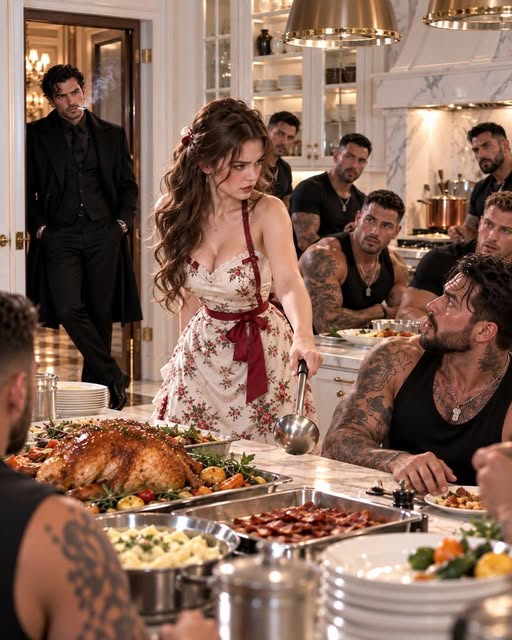
The strange thing about a fortress under siege is how quickly it becomes a home anyway.
Within a week of the lockdown, Ravenwood had settled into the shape of itself again — but a new shape, one with my kitchen at the center of it the way a stove is the center of a winter room. The men rotated through in their pairs and their shifts, and they ate at my table, and somewhere in those days, without a meeting or a vote, they started bringing me things. A chair Bruno had re-glued because he'd seen me favor my knee on the pantry step. A pair of proper kitchen shoes, my exact size, left by the door with no note — Angelo's doing, though he'd have died before admitting it. Pete began leaving the chessboard set up after dinner with the white pieces on my side, an invitation he never spoke aloud and I never declined.
Sal healed. On his first night back at the long table he was still moving like a man made of glass, and when I set his bowl down he looked up at me with his usual grin mostly reassembled and said, "Tell you the truth, I dreamed about this soup in that hospital bed. Told the nurse my ma used to make it."
"Your mother made split pea with a ham bone and a whole onion?"
"My mother," Sal said, "made reservations." The table roared. "You're the first ma I ever had, Ma."
He said it as a joke. The laugh that followed had something else under it, though — something that went around that table like a current — and I watched six of the roughest men alive glance at each other and not quite smile, the way men do when a true thing has been said in a room and nobody wants to be the first to honor it.
I went back to my stove with my ears burning.
It kept happening after that. Never to my face at first. Through the pantry door: Take it to Ma, she'll know. Ma says the north gate eats at six. Ask Ma. I heard it the way you hear weather coming. And I want to be honest about what it did to me, because I'd been nobody's anything for a long time. I'd managed eighty employees and been Ms. Sullivan. I'd been a daughter, once, and then an orphan in a red coat sleeping on a bench. I had not been anybody's Ma. I stood in my pantry among my labeled jars, with my ledger under my hand, and I cried for about ninety seconds, efficiently, the way I'd learned to do everything — and then I wiped my face and went out and asked Bruno why his gravy had a skin on it, and he said, "My fault, Ma," straight to my face, and didn't even notice he'd said it.
Mrs. Doyle noticed. She noticed everything; it was her religion.
"You'll want to be careful," she said, cornering me in the linen room with an armful of napkins and the air of a woman delivering a weather warning. "That word. In this house. These boys — most of them came from nothing, Miss Sullivan. Worse than nothing. The word means the house has decided you're permanent." She pressed the napkins into a stack with unnecessary precision. "Houses like this one eat people who get permanent carelessly. And there's the other thing." Her voice dropped. "Tomás — the manager before you. He didn't quit."
I went still. "The boss said—"
"The boss said what the house needed said." Mrs. Doyle's eyes were flint. "Tomás left in the night with two suitcases and a face like a man who's been told a date to be dead by. I cleaned his room myself. He'd been drawing two salaries — one from this house, and one I never saw the color of. And Cole—" She stopped. Chose her words like stones. "Cole drove him to the station. Cole has driven a great many things for this house, Miss Sullivan, and signed for a great many crates. I say nothing. I've said nothing for eleven years. But you're keeping a ledger, and I thought you should know your pencil isn't the first one to notice."
"The shortages started before me."
"They started," she said, "the day the routes changed and the money got big. You count what you count. I'll say I never spoke." She gathered her napkins and sailed out, spine like a plumb line, and I stood in the linen room understanding that I had just been handed the house's memory by its oldest keeper — and that she had handed it to me because the house had decided I was permanent.
In the days after the lockdown I started planning Christmas, and I did it the only way I know how to plan anything: I went man to man with a notebook and I asked the most dangerous question in my arsenal. What did Christmas taste like, when you were small and somebody loved you?
I got answers the way you get confessions — sideways, and at the sink, and mostly from men pretending to be doing something else. Bruno, up to his elbows in a sink he had no business being near, said his grandmother in the old country made lentils with a coin in the pot for luck, and then stood there dripping while I wrote it down like it was a state secret. Pete, without looking up from setting the chessboard, said his sister used to make a herring salad he had hated until the year she died, and he had not eaten it since, and he would not say whether he wanted it — so I wrote it down and underlined it twice. Sal asked for the stuffing his aunt made with chestnuts and then apologized for asking, as if wanting a thing were a weakness in a soldier. Angelo, who had no small-and-loved Christmas to report, said he'd take anything hot and plenty of it, and then, at the door, turned back and said, "Maybe the soup. The one from the lockdown. That tasted like—" He couldn't finish. He didn't have to.
Mrs. Doyle contributed her mother's shortbread recipe on a card written in a hand like copperplate, with the air of a woman handing over state papers, and a warning that if I altered one measurement she would know, and haunt me pre-emptively.
I built the menu the way I'd built the trap — carefully, and out of other people's truths: a Christmas table where thirty men who had come from nothing would each find one dish that said your life before this house is not forgotten here. It is the only sermon I know how to preach, and I preach it with butter.
Roman came upon me at the long table late one night with the notebook spread out like a campaign map, and stood reading over my shoulder — lentils (coin) — herring salad (Pete, handle gently) — chestnuts, shortbread (DO NOT ALTER, M.D. will know) — and said, "You're planning Christmas for men who haven't had one in a decade, and half of them would deny wanting one on a stack of Bibles."
"Half of them cried in my pantry asking," I said. "Men are simple, Mr. Duca. They'll walk through gunfire and call it Tuesday. Ask them what their grandmother cooked and they come apart like wet bread."
"And you?" he asked. "Who cooks your dish, Maggie? What's on this list for you?"
I looked at the notebook. There wasn't a line in it for me. There never was, in any kitchen I'd ever run; the cook eats standing, over the sink, last and least, and calls it the job. "Mine's the whole table," I said at last. "That's the cook's dish. Everybody else's, all at once."
He read my face the way he'd read the ledger — completely, without moving. "That," he said quietly, "is going to change too."
That night I did something I had not done since I arrived. I asked Roman Duca a question that wasn't about food.
He'd taken to appearing in my kitchen at the end of the day — telling himself, I think, that he was checking the house's heart, the way he'd named it — and he'd stand with his coffee going cold and watch the last of the work settle. That night I said, "At the bus shelter. You stopped. Men like you drive past bus shelters every night of their lives, Mr. Duca. I've been invisible on that bench to Bentleys and bishops. Why did you stop?"
For a while I thought he wouldn't answer. Then he set his cup down, and the carved door of his face opened on something I hadn't seen in it before.
"My mother ran a kitchen," he said. "Not like this one. A parish kitchen in the old neighborhood, six burners and a door that never locked. She fed strikers, drunks, priests, men fresh out of prison with the smell still on them. She had a rule: anybody who sat down got fed, and nobody's story was the price of the meal." He turned the cold cup in his hands. "She died when I was nineteen, in a winter like this one. The organization — all of this — I built it out of the world that killed her, and I told myself it was for her. Some of it even was." He looked up. "I fund three shelters in Philadelphia, Miss Sullivan. Anonymously. I was coming from one of them that night, from signing a check in a warm office, feeling very pleased with my own generosity — and I saw you cut your last sandwich in half for an old man, in the snow, with nothing in the world but twenty-three dollars and a broken suitcase. Do you know what I thought? I thought: there it is. That's the real thing. I just write checks at it."
"Roman—" It was the first time I'd used his name. It surprised us both.
"You asked." He stood, and gathered the moment away into his usual unreadable calm, but gentler. "I've spent twenty years learning that everyone around me wants something. You wanted a locked door and hot water for a dying old man — for him, not for you. A man in my position learns to collect the things money can't counterfeit. There aren't many."
He left me there with the radiators ticking and my heart making a fool of itself, and I thought about permanent houses, and stolen Barolo, and a man who funded shelters and carried a gun, and I did the most Maggie Sullivan thing imaginable.
I got out my green ledger, and I built a trap.
It took two days, and it took Roman and Vincent and nobody else. Here is how you catch a leak in a house: you give the water two different places to run, and you watch which one gets wet. The Christmas supply run — the biggest of the year, turkeys and hams and wine and enough of everything to feed thirty men like kings — was coming, and every soul at Ravenwood knew it would come the Thursday before Christmas, because it always had.
So I pinned a schedule on the kitchen board, in my handwriting, where anyone could read it: delivery Thursday, six in the morning, north service gate.
Then I took Cole aside by the garages, all warmth, and told him the truth — or what I let him believe was the truth. "Between you and me, Cole, the board's for show. The supplier can't do Thursday. You're picking up the Christmas run yourself, Wednesday night, from the depot — nine o'clock. Keep it under your hat; Mr. Duca doesn't want the house in a stir about changed plans."
And the true run — Wednesday at dawn, in the estate's own unmarked van, driven by Vincent, on a route only three people in the world knew — I wrote nowhere at all.
"Where did you learn to do this?" Vincent asked me, watching me letter the false board.
"A plant kitchen in a strike, Vincent. You'd be amazed what management teaches you about people." I capped my pen. "Now we wait and see which lie travels."
It traveled that same evening. Cole found me at the pantry door with two empty crates in his hands and his whole-face smile, and said, casual as weather, "Big week next week, Miss Maggie. Christmas run Thursday, same as always — house'll eat like kings."
I smiled back at him with my whole face, and felt something in me go cold and clear and sad.
"Same as always, Cole," I said. "Same as always."