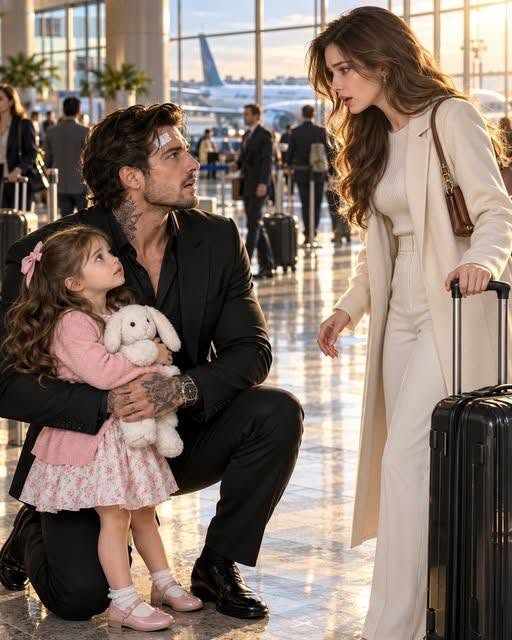
"How old is she?"
The question hung in the terminal air between us, and I did the only thing I had ever learned to do with Vincent Moretti's questions when the answer was a weapon: I refused to hand it to him.
"She's mine," I said. My voice came out steady, and I was proud of it, because my knees were not. "That's all she is to you. She's mine."
"Claire—"
"No." I gathered Lily up — all thirty-six wriggling pounds of her — and settled her on my hip, where she hid her face in my neck the way she did when strangers got loud. Over her hair, I looked at the man I had once promised forever to, and I kept my voice low and even and final. "You made your choice in a parked car five years ago. You don't get to unmake it in an airport because a little girl has your eyes."
Something moved across his face. In the old days I would have called it pain. I had spent five years practicing not calling it anything at all.
"At least tell me her name," he said.
"You heard it. In the terminal. That's all you get."
I turned and walked. Every instinct I owned screamed that he would follow — that the crowd would part, that a hand would close on my arm — because the Vincent I had married did not let things walk away from him. But the new silence at my back held all the way through the sliding doors, all the way down the taxi line, and it was only when Lily and I were inside a cab with the doors locked that I let myself look back through the glass.
He was still standing where I had left him, in the middle of the moving river of travelers, a tall man in a black suit standing perfectly still, watching the space where we had been.
"Mommy," Lily said, very seriously, from the car seat I wrestled out of my luggage, "that man has sad eyes."
"Yes, baby," I said. "He does."
The house in Evanston smelled of lemon polish and old books, exactly as it had when I was seven. My mother was home from the hospital already — discharged against the advice of half her doctors, because Margaret Bennett had never once in seventy-one years done what she was told — installed in her recliner with a blanket and a bell she rang like a duchess. She took one look at my face when I came through the door and said, "You've seen him."
It wasn't a question. Mothers know. She had been the only person besides Emma who knew about Lily — knew, and had kept my secret in her fierce old heart through five years of Sunday phone calls conducted in careful code.
"At the airport," I said. "He caught Lily when she tripped. Mom. He saw her face."
Her hand found mine, thinner than I remembered, the stroke still written in the slight lag of her left side. "Then it's begun," she said, with the calm of a woman reading weather. "Whatever it is, it's begun. You can't unring it now, Claire."
"He asked how old she is."
"And you told him nothing, and he'll find out anyway, because men like Vincent always find out." She squeezed my fingers. "The only question left is whether he finds it out from you or from the world. And you already know which one of those is safer for that little girl."
I did know. That was the unbearable part. I had built my daughter's whole life on a foundation of strategic silence, and I had done it well — but silence only works on men who have given up, and everything about the stillness of Vincent in that terminal told me he had never, for one single day, given up.
He came that night.
It was just past ten. Lily was asleep in my childhood bedroom, in the narrow bed under the glow-in-the-dark stars I had stuck to the ceiling at age eleven, most of which had long since fallen — three remained, stubborn as anything in that house. I was on the porch with a glass of wine I was using as a prop when a black car turned the corner at the end of the block, moving slowly, and stopped three houses down. Not at the curb. Not hiding. Just… present. The way weather is present.
He got out alone. No driver visible, no men. He walked up my mother's street in the dark in his black suit, and I understood with a clarity that hurt that this was a deliberate choice: Vincent Moretti, arriving at a woman's door with empty hands and no army, like an ordinary man. Like a supplicant.
He stopped at the bottom of the porch steps. The porch light caught the silver at his temples.
"You followed me," I said.
"My men followed your cab to Evanston. I had them stop at the city line." His voice was quiet. "I told myself I'd wait until morning. I told myself that for six hours, Claire. It's the longest I've lasted in five years, so you'll forgive me if I'm not proud of the margin."
"You don't get to make jokes."
"No," he agreed. "I don't get to make anything. I know that." His eyes went past me to the dark windows of the house, and something in them gentled and ached at once. "She's asleep?"
"Don't."
"Is she—" He stopped. I watched the most articulate manipulator I had ever known search for a sentence and fail. "Claire. Is she mine?"
There it was. The real question, the one under the one in the terminal.
"You have a gift," I said, "for asking questions you've already answered yourself. You looked at her face for three seconds and you knew. You knew in the terminal. So don't stand on my mother's porch and ask me to say it like it's news."
"Then say it like it's mine," he said, and his voice cracked on the last word, and I hated him for cracking it, because a crack was a door and I had spent five years bricking up doors. "Say it once. I haven't heard it from anyone. Five years of looking and I haven't heard one true thing. Say it, Claire."
"She's four years old," I said. "She was born eight months after I left Chicago. Her name is Lily. And she is the best thing I have ever done, and she has never — not one day, not one hour — been a part of your life, because you looked me in the eye and told me you loved someone else."
He took it the way he took everything in the old days — standing still, letting it land, not flinching for anyone's benefit. But his hands, I noticed, were shaking. Vincent Moretti's hands did not shake. I had watched those hands sign things and pour things and once, at a funeral, close his own brother's coffin, and they had never once shaken.
"Why did you search for me?" The question tore out of me before I could stop it — the question that had lived under my ribs for five years, the one I had never let myself ask Emma, ask my mother, ask the ceiling at 3 a.m. "You said you loved her. You chose her. Men who choose don't spend five years hunting the woman they threw away. So why, Vincent? Why did you search?"
For one suspended second, I saw the truth move across his face — whole, enormous, and ready. His mouth opened.
Then his phone rang in his pocket, and the face closed like a vault.
He answered without looking away from me. "Dom." A pause. The blood left his face so fast it frightened me. "Where?" Another pause. "Keep them away from this neighborhood. I mean it — nothing comes near this street tonight."
He ended the call. The man standing below my porch steps was gone, and in his place stood the other one — the one Chicago feared, all edges and cold arithmetic.
"There are people in this city who watch me," he said. "If they saw what I saw at that airport today, Claire, then Lily is already a rumor, and rumors in my world are just targets that haven't been priced yet. I need you to let me protect her."
"Protect her." I laughed, and it came out broken. "From your world? She's been safe for four years, Vincent. She got unsafe the day you caught her."
"I know." He said it simply, and it was the worst thing he could have chosen, because there was no defense in it to fight. "I know that too."
He reached into his jacket — slowly, showing me his hand the whole way, a courtesy for a woman who had flinched — and took out a plain white card. He set it on the second step between us rather than offering it to my hand. A phone number. Nothing else.
"When you're ready to hear it, I'll tell you everything," he said. "All of it. The parts I swore I'd take to my grave. Not a word less."
He walked back down the dark street to his car, and I stood on my mother's porch and watched the taillights go, holding a glass of wine that had gone warm, listening to my own heart misbehave.
Inside, in my childhood bedroom, my daughter slept under three fallen-star survivors on the ceiling, in a city that had just learned she existed.
I put Vincent's card in the kitchen drawer, under the takeout menus, where ordinary things go.
I told myself I would never call it.
The morning after the porch, Lily ate breakfast standing up, the way she did everything that mattered, and delivered her verdict on the situation with a jam spoon in her hand.
"The sad man was on our porch," she informed my mother. "He has white in his hair like Grandpa. He said my name in his eyes. Grown-ups can do that, Nana. Talk in their eyes."
"Out of the mouths," my mother said to me, over her tea, "comes the entire intelligence service of this family." She had heard everything from her recliner the night before, because Margaret Bennett's hearing had survived the stroke in considerably better shape than her left hand, and she had waited until Lily was deep in negotiations with the jam to fix me with the look she had been deploying since I was nine. "He stood on my porch and bled accurately, from the sound of it. You noticed that, even if you won't say it."
"What I noticed," I said, "is that he left when a phone rang, and the voice he used on that phone is the voice that used to come home at 4 a.m. smelling of other people's endings."
"And still you watched his taillights until they were gone. I heard the screen door, Claire. Screen doors in this house have been informing on you since 1998."
Before I could construct a defense, my phone lit up with Emma's name and a Los Angeles area code and the particular doom of a manager calling before nine.
"Tell me the airport video isn't you," she said, in lieu of hello. "There's a clip going around the group chats — shaky, far away, some tourist filming a kid tripping at O'Hare and a man catching her. It's nothing, it's fifteen seconds of nothing, except a stringer I know has started asking who the woman in the coat is, because the woman in the coat walks like a woman who used to have a stylist." Her voice dropped. "Claire. Is it you? Did he—"
"He caught Lily when she tripped," I said. "Three seconds. That's all it took, Emma. Three seconds and five years of architecture came down like a set wall."
The silence on the line had fifteen years in it. Then Emma — who had been present at every hinge of this story, who had held the test on the bathroom floor and the secret in her heart and had flown toward trouble her whole professional life — said the thing only she could say.
"Tell me what you need. Not what you'll accept. What you need."
"I need my daughter to be a secret for one more week while I figure out what kind of secret she can't be anymore," I said. "And I need you to kill that clip."
"Consider it killed. Stringers owe me favors in four time zones." A pause, softer. "And Claire — the other thing you need, the one you won't list? You're allowed to need it too. Whatever it turns out to be."
I hung up and stood in my mother's kitchen with the phone warm in my hand, listening to my daughter explain eye-talking to my mother in the next room, and I understood that the held breath had started — that from the moment Vincent Moretti's hands had closed around my daughter in that terminal, everything in our lives was now a countdown I couldn't read the numbers on.