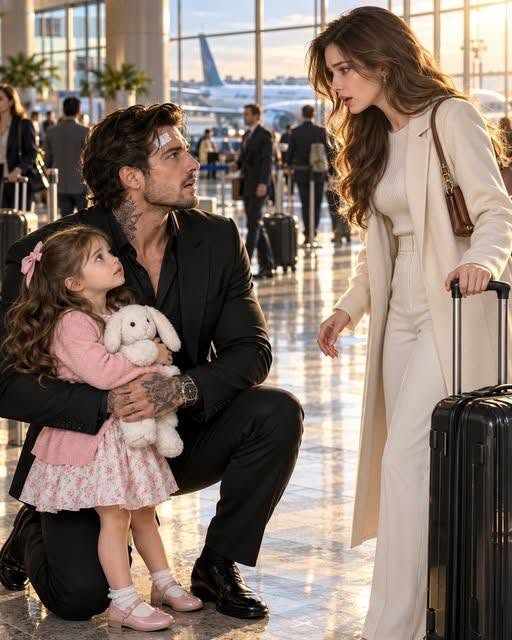
The hand I had been holding for four years slipped out of mine in the middle of Chicago O'Hare, and my whole life went with it.
"Mommy, look!"
Lily saw the snow globe first — a towering display in a gift shop window, a tiny Chicago skyline drowning in glitter — and four-year-olds do not ask permission from the universe. She was gone before my fingers finished closing on air, darting between rolling suitcases and tired travelers with the fearless speed of a child who has never once been given a reason to be afraid of the world.
"Lily, wait!"
I ran. My carry-on banged against my leg. A man in a Bears cap stepped back to let me pass and I heard myself apologizing to no one, the way mothers do, my eyes locked on the small red coat weaving through the terminal crowd. She rounded the corner by the coffee stand too fast — I saw her shoe skid on the polished floor, saw her little body tip toward a fall —
And a man in a black suit stepped out of the stream of travelers and caught her.
He caught her the way you catch something precious and breakable, one hand under her arm, the other steadying her back, setting her gently on her feet before she ever touched the ground.
"Careful, sweetheart," he said.
Then he looked down at her face.
And Vincent Moretti — the most feared man in Chicago, a man I had watched stare down police commissioners and rival kings without blinking — went completely, utterly still.
I knew those shoulders before I knew his face. I knew the cut of that suit, the silver threading the dark hair at his temples now, the exact angle of the jaw that had once rested against the top of my head in a kitchen in a mansion I had walked out of five years ago and never seen again.
My heart stopped the way hearts stop in the split second before a crash.
"Lily!"
Her name came out of me like a shot.
Vincent's head lifted slowly. His eyes found me across twenty feet of terminal — past the coffee stand, past the strangers, past five years of silence — and five years vanished in an instant, like they had never existed at all.
"Claire?"
My name in his mouth. Twelve years of my life lived in that voice, and it still had the power to stop my breath mid-chest.
Lily ran to me. "Mommy!" I caught her and pulled her behind me in one motion, instinct older than thought, and I watched Vincent notice it. I watched him notice everything. Her eyes — his eyes, dark and deep-set, the Moretti eyes his mother used to say could read a man's sins at thirty paces. Her nose. Her chin, stubborn as his. And my hand flat against her back, holding her behind me like a shield.
Shielding her. From him.
His gaze moved from Lily to me. From me to Lily. I saw the arithmetic begin behind his eyes, the way it must have for any man who could count: a marriage that ended five years ago. A little girl who was four.
For the first time in all the years I had known him — through police raids and funerals and the night his own brother was lowered into the ground — Vincent Moretti looked genuinely, helplessly afraid.
To understand what that moment cost us both, you have to understand what we were before we were a headline and a cautionary tale.
I met Vincent when I was twenty-three years old and he was twenty-eight, and neither of us had anything the world wanted. I was a drama student waiting tables in a Lakeview diner, rehearsing audition monologues into the steam of the dish pit. He was the quiet son of a family everyone in Chicago whispered about, running errands he never explained, with a secondhand suit and hands that were always scraped at the knuckles. He came in every Thursday for coffee he barely drank and stayed until my shift ended so he could walk me to the train.
We were young and broke and living on dreams, and I have never been happier in my life than I was in the years when we had nothing.
Vincent built his empire brick by brick while I chased mine across casting offices and summer stock theaters. He never once asked me to be smaller. When I booked my first real role, he sat in the third row with flowers he could not afford. When the family business turned darker and the whispering turned to fear, he built walls around our life and kept the ugliest parts outside them, and I — God forgive me — let myself believe the walls were the same as innocence.
Eventually I became an award-winning Hollywood star. My face went up on billboards over Sunset Boulevard. And fame never mattered to me as much as coming home to Vincent. I flew red-eyes across the country to sleep in our bed. I turned down a franchise — three films, a fortune — because the shooting schedule would have kept me in New Zealand for a year. My agent called it career suicide. I called it marriage.
The night before our wedding, in the little chapel his mother insisted on, Vincent had taken my hands and asked me if I was sure. Not about the family. About him. "My life will not always be clean, Claire," he said. "If it ever becomes too much — if you ever stop being happy — you have to promise me you'll go. Don't stay and rot beside me out of loyalty."
And I, twenty-five and drunk on love, had given him a promise of my own. "If you ever love someone else," I told him, "I won't fight her. I won't make a scene. I'll let you go. Just don't ever lie to me. That's the only thing I ask. Whatever it is — don't lie."
He had kissed my knuckles like they were holy. "There will never be anyone else. There never could be."
Twelve years, we had. Twelve years of morning coffee and red carpets and his head in my lap while I read scripts aloud doing all the voices. And then, so gradually that I blamed myself for imagining it, he changed.
His kisses became distracted — a mouth that arrived a half-second after his body did. His nights grew longer; his phone began to sleep face-down. His eyes stopped looking at me the way they once had, like I was the only lit window in a dark city. I told myself empires eat men alive. I told myself it was a season. Actresses are professional liars, and I lied to myself beautifully, in close-up, for months.
Then one gray afternoon, my manager called.
Emma had been with me since the diner days — the only person in Hollywood I trusted with my unmade face and my unguarded heart. Her voice on the phone that day was wrong, flattened out, the way people sound when they are carrying something breakable.
"Claire. I was downtown picking up the contracts from the lawyer's office. I saw Vincent."
"Emma—"
"He's with a waitress, Claire. At that little diner on Fulton. Rosa. He's there every day this week. I'm so sorry."
I drove there immediately. I remember nothing of the drive except my own hands on the wheel, white as bone.
The diner had a long front window, and through it I watched my husband — Vincent Moretti, who barely lifted a finger in his own house, who had men to pour his water — carrying dirty plates for another woman. He cleared her tables. He refilled coffee for her section. He stayed through the whole tail of her shift, patient as a saint, and when the woman laughed at something and touched his arm, he smiled at her with a tenderness I had not seen directed at me in over a year.
I waited outside for three hours. Stars are very good at waiting in cars. We learn it in holding areas and trailers. I sat in that car for three hours rehearsing dignity like lines.
When he finally emerged, the sky had gone the color of wet ash. He slid into the passenger seat of my car because his was parked around the corner, and for a long while we sat in silence, two people in a glass box, watching strangers live ordinary lives on the sidewalk.
Then he said, very quietly, "Do you remember what you promised me before we married?"
I did. Of course I did. I had been hearing it in my head since Emma's call, tolling like a bell.
"So you don't love me anymore?" I asked.
"No."
His answer came instantly. It did not hesitate. It did not search for mercy.
"I love someone else."
Twelve years disappeared in a single sentence.
I swallowed the pain — swallowed it whole, like a pill too big, and felt it tear all the way down.
"Then let's get divorced."
Vincent stared at me. "That's it?"
"What answer would change anything?"
He had none. He had prepared for a war, I think — for screaming, for thrown glass, for the Oscar-worthy collapse of a dramatic woman — and I gave him a weather report instead. He kept looking at me as if the script had failed him.
I kept what legally belonged to me, accepted the settlement he offered, and walked out of the Moretti mansion with two suitcases and twelve years in my throat, and I did not look back. I want that understood. I did not look back.
But weeks later, in a rented apartment in Los Angeles with my career already cooling in my hands, my life changed again.
I was pregnant.
I told no one except Emma. She sat on my bathroom floor with me at two in the morning, holding the test like it was a live wire, and she said, "Tell him," and I said, "He chose," and that was the whole argument, and she never raised it again. She helped me do what I did next. I left Hollywood — canceled my appearances, let my contracts lapse, paid the penalties out of the settlement without blinking. The tabloids invented a breakdown, a rehab, a secret illness. Let them. I disappeared from public life entirely and went to a small town in northern Michigan where nobody knew my face because my face had never been on their televisions in any way that mattered, and I quietly raised my daughter where Vincent Moretti could not find us.
Lily. Dark eyes. His eyes. Delicate features and a laugh that rearranged my whole chest. For five years I taught children's theater classes at a community center and told my daughter her father had been a man I loved very much who lived too far away to know us, and every word of it was true and none of it was the truth.
For five years, Vincent searched. I know that now the way I knew it then — in my bones, on the back of my neck, in the instinct that made me change towns twice and pay rent in cash. For five years, he searched.
And for five years, I stayed gone.
What brought me back to Chicago was not courage and it was not fate. It was a phone call from a hospital social worker on a Tuesday night: my mother, Margaret Bennett, seventy-one years old and stubborn as a fence post, had suffered a stroke in the kitchen of the Evanston house I grew up in. She was stable. She was asking for me. There are exactly two people on this earth I cannot refuse, and one of them was four years old and the other was in a hospital bed learning to say my name again.
So I packed two bags, took my daughter's hand, and flew home into the one city I had sworn she would never see.
Which is how, on a bright cold afternoon in Terminal 3, my daughter slipped my grip, chased a snow globe, tripped over her own small feet — and was caught, gently, by the most dangerous man in Chicago.
"Careful, sweetheart," he had said. And then he had seen her face.
Now he stood twenty feet away with five years in his eyes, and Lily was behind me, and my hand was on her back, and the whole terminal roared on around us — announcements, wheels, laughter — while the three of us stood in a silence older than my daughter.
Vincent took one step closer.
I stepped back.
Neither of us spoke. But I could see the question forming in his eyes — I had known that face for twelve years, and I could read it the way I used to read scripts, every line arriving before it was spoken.
Because after five years of silence, my ex-husband was finally standing face-to-face with the daughter he never knew existed.
His voice, when it finally came, was barely a voice at all.
"Claire." His gaze dropped to the small girl half-hidden behind my coat, and something in his face broke open. "How old is she?"