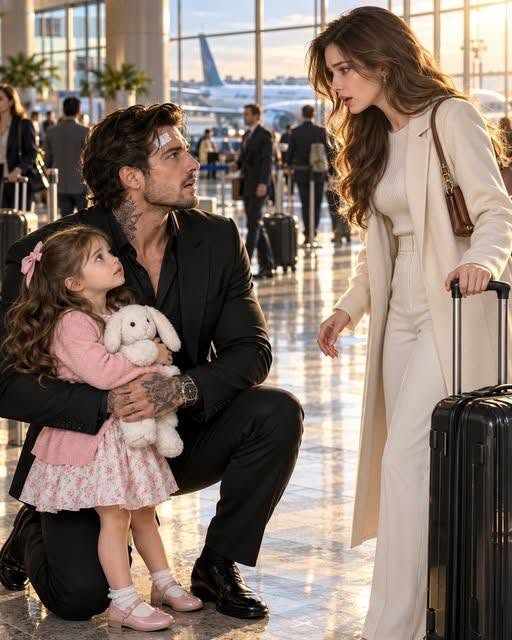
For three days, we lived in a held breath.
Vincent did not come back to the porch. But his protection arrived anyway, the way his world always arrived — quietly, wearing ordinary clothes. A man I had never seen began reading a newspaper on the bench across from my mother's house every morning, and he was still there, on a different bench, when Lily and I walked to the park. A woman with a stroller appeared at the grocery store at the same odd hours I shopped. When I finally lost my temper and marched up to the newspaper man on the third morning, he folded his paper with great dignity and said, "Ma'am, I'm just supposed to be furniture. Please don't make me be bad furniture."
I hated it. I hated that it was necessary more.
On the fourth day, I took Lily to the lakefront park because she had been cooped up with a sick grandmother and a mother made of wire, and a four-year-old cannot live on held breath. She went down the big slide eleven times. She fed a seagull half her crackers against my express orders. For one hour, in the pale spring sun, she was just a kid and I was just a mother watching her, and I let myself believe the lie that we could have that.
When we got back to my mother's car in the lot, there was an envelope under the windshield wiper.
I knew before I opened it. Some part of an animal brain that five years of hiding had grown in me knew. Inside was a photograph — grainy, telephoto, timestamped in the corner with yesterday's date and the exact hour Lily had been on that same slide, her red coat bright as a flag. Taped to the back of the photograph was a strip of paper with nine words typed on it:
THE MORETTI HEIR HAS A PRICE. ASK HER FATHER.
I drove to his office with the photograph shaking in my hand against the steering wheel.
Vincent kept an office above the restaurant his family had owned since before I was born — dark wood, no sign, a door you had to be expected to get through. I got through it because the man at the door had apparently been shown my photograph too, years of it, and he stepped aside from my face like it was a drawn weapon.
Vincent was at his desk with Dom Ricci and two others. He stood when he saw me — and then he saw the photograph in my hand, and the color left his face in a way I had never seen, not at funerals, not at the airport.
"Out," he said to the room, without looking at anyone. "Now."
The door closed. I threw the photograph onto his desk and watched it slide across the polished wood and stop against his hand.
"You did this," I said. "Your world found her because you couldn't stay away. Four years, Vincent. Four years she was safe, and you looked at her for three seconds in an airport and now strangers are photographing my daughter on a slide and pricing her like—" My voice broke and I hated it, hated all of it. "Like merchandise. Like a Moretti asset."
He picked up the photograph with the care of a man handling a live wire. "Where."
"My mother's car. Lakefront park, yesterday — the timestamp—"
"I know when. I had a man there." His jaw worked. "He saw nothing. Which means this was taken from the water side, long lens, by someone who knew the routes." He was already reaching for the phone. "Dom. Get in here."
What followed was ten minutes of the old world at full speed — calls in Italian and English, names I half-remembered from twelve years of dinners. When it was done, Vincent stood at the window with his back to me, and the answer lay in the room between us like a body.
"Dario Castellano," he said. "Victor Castellano's youngest son. He was nineteen when the war ended. We believed he fled to his mother's family in Sicily. He's been back in Chicago for at least a year, rebuilding his father's debts into a knife." He turned around. "Claire. This is my fault in more ways than the airport. I need to tell you what happened five years ago, and I need you to hear all of it before you decide what I am."
"Vincent—"
"The night of your premiere. The Glass Hour. Do you remember the lighting rig?"
I went cold. A rig had come down two feet from my mark during the after-party photo call — a scream of metal, a shower of sparks, a stagehand fired by morning. It had lived in my memory for five years as an anecdote I told at dinner parties. Careless crew. Lucky actress.
"It wasn't careless," Vincent said. "And the week after, your car's brake line — the car you didn't take that night because your stylist kept you late arguing about a hem. Claire, there was no brake failure. The line was scored. You lived because a woman in a fitting room couldn't decide between two dresses."
The room tilted. I sat down in the chair across from his desk without deciding to.
"The Castellanos were losing the war and they knew it," he said. "So they stopped aiming at me and started aiming at the only thing I couldn't armor. You. Famous. Public. Scheduled in magazines weeks in advance. They sent terms through a back channel — through a priest, if you want the whole rotten poetry of it. End the marriage. Publicly. Cruelly. Make it so no sane person alive believes Claire Bennett still matters to Vincent Moretti, and she becomes worthless to us. No leverage. No target. The war ends, she lives." His hands were flat on the desk, white-knuckled. "Dom built the performance. And I performed it."
"Rosa," I said. The waitress's name came out of some file Emma had kept. "The woman at the diner."
"Rosa Delgado." His voice changed — something almost gentle, entirely grief. "Her husband Enzo drove for me for nine years. He took two bullets meant for me in a parking garage in the first month of the war, and he died with my hands on his chest trying to keep him in the world. Rosa was seven months pregnant and working double shifts at that diner on Fulton because Enzo's death benefits existed on paper and nowhere else. I paid her landlord. I paid her hospital. And at the end of her shifts, when Castellano eyes were watching her too — because she was a thread to me, and they pulled threads — I sat in her section and I carried plates and I made sure the whole neighborhood saw Vincent Moretti at that diner every day, standing between that woman and the world."
He looked at me then, directly, without one layer of defense.
"When Dom needed a woman the whole city would believe I had thrown you away for, she was already there. Already tender. Already true in every particular except the one that mattered. I never touched her, Claire. I never wanted to. I washed dishes in a diner on Fulton Street and I said the words 'I love someone else' to the only woman I have ever loved, in a parked car, because eleven men in a room had done the arithmetic and the arithmetic said it was the only way you survived the year."
The silence afterward was enormous.
"You let me believe it," I said at last. "For five years. Every day of it. Do you know what I did with that, Vincent? I built her childhood on it. I told my daughter her father was a man who chose someone else. She has a story about you, and the story is a man who carried plates for another woman and couldn't be bothered to carry his own wife's heart across one parked car."
"I know."
"You didn't save me," I said, standing, and my voice was shaking so hard the words came out in pieces. "You erased me. There's a difference, and the difference is that the woman who gets saved gets asked. I never got asked. I got managed. By my own husband, in my own marriage, like one of your routes or your warehouses."
He did not defend himself. That was the unbearable discipline of the man — then, now, always: he stood in the wreckage of the thing he had done and he did not reach for one excuse, not even the true ones. "Everything" he had promised on the porch. This was everything, and it was exactly as ugly as the lie had been, in the opposite direction.
At the door, my hand on the brass handle that forty years of Moretti palms had polished, he spoke once more, quietly.
"Claire. The night you left. Did you know? About Lily?"
I stopped.
"I found out three weeks after the papers were signed," I said. "And I thanked God I hadn't known before. Because if I had known, I might have stayed. And I would have raised her inside a house where her father was already practicing lying to her mother — and calling it love."
I walked out of his office, past his silent men, into the gray Chicago afternoon, with a photograph of my daughter in my purse and the truth in my chest like a second, broken heart.
Behind me, I heard something in his office break against a wall — glass, wood, a man's whole composure — and I did not turn around.
I had practice at not turning around.
In the car, with my forehead against the cool glass of the passenger window and one of Vincent's silent men driving me home because my own hands had been judged — correctly — unfit for a steering wheel, my phone rang. Dom Ricci. Not Vincent. Dom, whose voice I had heard perhaps six times in twelve years of dinners, because Dom spoke the way other men breathed: only when it was necessary, and never for pleasure.
"Your detail is doubled as of an hour ago," he said. "Two cars on your mother's street, one at the rehab facility, and a woman named Pruitt who will be Lily's new swim instructor if anyone asks. No one will ask. Pruitt has killed a man with a pool noodle, metaphorically, in training. I wanted you to hear the arrangements from me, Mrs. Moretti, because I am the correct address for the blame in this matter, and I have learned late in life to deliver blame to its correct address in person."
"Bennett," I said automatically. "My name is Bennett."
"Your name," Dom said, with the patience of geology, "is whatever keeps you alive this month, and at the moment the name on the threat assessments is the other one, so you will forgive the filing system. I designed the performance five years ago. Vincent performed it — he will carry his portion to his grave, and he will insist on carrying mine too, because that is his disease. But the design was mine. I want it in your record from my mouth: he sat in my office the night before he said those words to you, and he put his fist through my desk — this desk, I kept it, the crack is under the blotter — and then he sat down and rehearsed sounding like a man who meant them, because he understood that if he flinched in that car, you would stay, and if you stayed, you would die in his driveway inside the year."
"Why are you telling me this?"
"Because he won't," Dom said. "He will take the whole weight, because in his religion your hating him correctly is a form of your safety. I am an old man correcting a ledger. That is all. Pruitt will bring Lily home from the park at four. Tell her the pool noodle story is classified."
He hung up. And I sat in the back of a dead man's empire's car, driving through the gray spring streets of my hometown, with a stranger's photograph in my purse and a crack in a desk I had never seen — under a blotter, kept for five years, by a man who never kept anything he didn't consider evidence — and I thought about the fact that the entire tragedy of my life might be measured in the things men in that world had preserved instead of said.
At home, Lily was at my mother's kitchen table with her crayons, drawing with the ferocious concentration of a general moving divisions. When she saw me she held it up, solemn as a gallery opening.
"It's the man who catched me," she said. "He has sad eyes so I gived him a sun."
The drawing showed a tall black figure with two enormous blue circles for eyes, holding the hand of a small red figure, and above them both a yellow sun the size of a house, taking up half the sky, as if a four-year-old had assessed the man's situation and prescribed, with total confidence, weather.
"That's very kind, baby," I said, and my voice held, mostly. "Why did you give him a sun?"
"Because nobody gived him one yet," Lily said, and went back to her crayons. "His eyes said."